The Radiant Face of Moses (Exodus 32:29-35)

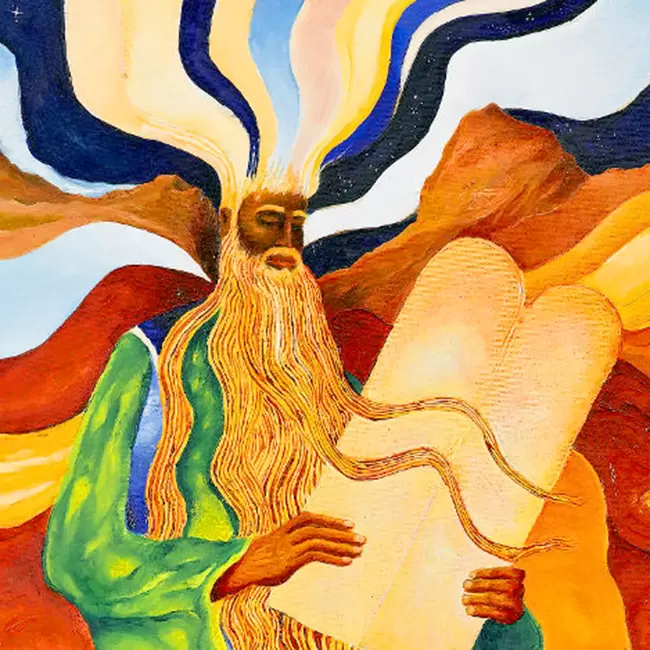
Moses and the Fire of Sinai, by Darius Gilmont

When Moses came down from Mount Sinai with the two tablets of the covenant law in his hands, he was not aware that his face was radiant because he had spoken with the Lord. When Aaron and all the Israelites saw Moses, his face was radiant, and they were afraid to come near him. But Moses called to them; so Aaron and all the leaders of the community came back to him, and he spoke to them. Afterward all the Israelites came near him, and he gave them all the commands the Lord had given him on Mount Sinai.

When Moses finished speaking to them, he put a veil over his face. But whenever he entered the Lord’s presence to speak with him, he removed the veil until he came out. And when he came out and told the Israelites what he had been commanded, they saw that his face was radiant. Then Moses would put the veil back over his face until he went in to speak with the Lord. (New International Version)

I’ve never seen anyone on Halloween dressed like Moses, complete with a shiny glowing face – even though the sight of Moses as he came down the mountain made the Israelites afraid to come near him. The face of Moses had been transformed in a way that made him appear haunted house scary to them.

Moses had actual face-to-face time with God on the mountain. And this seems to have changed his visage. Yet, Moses had stood before God previously without any change to his face. Moses had even interceded with God on other occasions with no special Halloween effect.

God made the new covenant and gave the new tablets because Moses smashed the old ones at the golden calf experience (see Exodus 32, especially verse 19). It could be that, with the radiant face of Moses, God was displaying before the people a tangible sign of God’s presence.

After all, the people had doubted God’s presence again and again during their time in the desert. So, when God’s seemingly ghostly presence was offered this time around, they were too afraid to be that closely connected to the divine.

Just as the loincloth that God made for the disobedient Adam and Eve in the Garden of Eden; and just as the sign of the rainbow God put in the sky after the world wide flood, so the Lord was making a new way for the people, a visible sign and demonstration of God’s presence – which was both reassuring and frightening.

It seems God wanted to show that Moses was still the leader, still God’s man, and that the people needed to not give him a hard time or rebel against God’s commands. At the same time, the Lord was assuring the Israelites that they were not abandoned, that Yahweh remains their God, full of mercy and grace, slow to anger, and abounding in steadfast love.

Transfiguration, by Lewis Bowman

In a similar way, the Transfiguration of Jesus in the New Testament Gospels does the same. The disciples were frightened on the mountain, seeing Jesus changed and probably much brighter than the face of Moses. And yet, they were also reassured that God was present with them in the person of Jesus Christ.

Just like the doubting people in Exodus, the disciples caught a glimpse of the great and awesome God, up close and personal. And like the people in the wilderness, the disciples did not understand everything that was going on. Both the ancient Israelites, and Christ’s disciples, did not fully comprehend what God was showing them. Each showed the fear of humanity, while God demonstrated God’s own character of love, faithfulness, and patience with frail humanity.

Certainly, when the face of Moses shone, it was an affirmation of the covenant’s renewal by God. The shiny face is also an indicator of the sort of relationship Moses had with God – and of his openness and vulnerability before God and before the community. It was a sign that Moses trusted God and that Israel, in turn, could trust God and Moses as their leader.

Whether veiled or unveiled, the face of Moses is a reminder of his unique relationship with God and with Israel. It’s a sign of God’s care and continual presence, and that God’s grace prevailed, even in the midst of Israel’s sin.

Another way of putting it, is that the radiant face of Moses represents a reversal of outcome concerning the golden calf idolatrous episode. It represents hope in the midst of a disaster in which all seemed hopeless.

In our own contemporary day and time of national upheavals and national disasters, it’s no wonder that many people would question whether there is any hope for our world, or not. Yet, no matter how dismal it may look; and no matter how unpromising the times we presently live in, today’s story about ancient Israel is a reminder to all of us to keep persevering and hold onto our confident hope that God is with us. There are better days ahead.

It might be Halloween, but the Advent of Christ is just around the corner.

Lord Jesus, Son of Man, Son of God, you encouraged us to come to you, all of us who labor and are heavy laden, and that you will give us rest. So, I now take your yoke upon myself, and learn from you because you are gentle and lowly in heart, and I know I will find rest for my soul. For your yoke is easy, and your burden is light. Help me to refocus from all that’s wrong in this old fallen world, and trust in you, through the enablement of the Holy Spirit. Amen.


Don’t Show Favoritism (James 2:8-13)

Yes indeed, it is good when you obey the royal law as found in the Scriptures: “Love your neighbor as yourself.” But if you favor some people over others, you are committing a sin. You are guilty of breaking the law.

For the person who keeps all of the laws except one is as guilty as a person who has broken all of God’s laws. For the same God who said, “You must not commit adultery,” also said, “You must not murder.” So if you murder someone but do not commit adultery, you have still broken the law.

So whatever you say or whatever you do, remember that you will be judged by the law that sets you free. There will be no mercy for those who have not shown mercy to others. But if you have been merciful, God will be merciful when he judges you. (New Living Translation)

Playing favorites is always a bad thing; you can do great harm in seemingly harmless ways.

Proverbs 28:21, MSG

One of my bedrock foundational unshakable beliefs is that God’s big world spins on the axis of grace. Without grace we would all be living in some nightmarish dystopian novel just trying to survive. Grace is the force which overwhelms and overcomes everything. 

When I was growing up, we had a dog named Sam. Sam loved being on the farm. More than once he tussled with a skunk. In those times, I could barely get close enough to clean him up because he stunk so badly.  Favoritism stinks, and God has a hard time getting close to us when we show partiality to others. God is going to clean us up when smelling the stench of discrimination on us.

Showing favoritism to some over others is evidence the dog is running away from the bath of grace. To develop relationships and interact with people the way God wants us to, we must be free from prejudice.

Favoring the rich over the poor stinks because God cares about those trapped in poverty. When Jesus began his ministry, he lifted-up the importance of poor folk by placing himself in the position of extending grace to them:

The Spirit of the Sovereign Lord is on me, because the Lord has anointed me to proclaim good news to the poor. (Isaiah 61:1; Luke 4:18, NIV)

In the Old Testament, there are seven different words for the “poor” because poverty was a pervasive reality (and still is!). The various reasons for poverty range from being born into poverty, being lazy, or being oppressed and/or in slavery.

The types of poor persons run the gamut from simple beggars to the pious and humble poor. These spiritual poor persons were called in biblical times the anawim” (Hebrew עֲנָוִ֣ים). The anawim are humble and gentle folk caught in grinding poverty with no other option but to put their trust in God.

The mistreatment, exploitation, and inattention to the needs of the poor are a chief reason why Holy Scripture is filled with references about how to treat them. The anawim are dear and near to the heart of God:

“Poor persons will never disappear from the earth. That’s why I’m giving you this command: you must open your hand generously to your fellow Israelites, to the needy among you, and to the poor who live with you in your land.” (Deuteronomy 15:11, CEB)

“If you hire poor people to work for you, don’t hold back their pay whether they are Israelites or foreigners who live in your town. Pay them their wages at the end of each day because they live in poverty and need the money to survive. If you do not pay them on time, they will complain about you to the Lord, and he will punish you.” (Deuteronomy 24:14-15, CEV)

Listen to this, you who rob the poor
    and trample down the needy!
You can’t wait for the Sabbath day to be over
    and the religious festivals to end
    so you can get back to cheating the helpless.
You measure out grain with dishonest measures
    and cheat the buyer with dishonest scales.
And you mix the grain you sell
    with chaff swept from the floor.
Then you enslave poor people
    for one piece of silver or a pair of sandals.

Now the Lord has sworn this oath
    by his own name, the Pride of Israel:
“I will never forget
    the wicked things you have done!” (Amos 8:4-7, NLT)

Nothing gets God’s hackles up more than unjust and unfair favoritism which is devoid of mercy and grace toward the poor. It all stinks to high heaven, and when God smells it, divine egalitarian power is not far behind.

It is the poor in spirit with no trust in physical resources who will enter the kingdom of heaven. The humble person gives grace to another, even though the person cannot offer something in return.

It’s easy to be merciful to people who have a deal with you about scratching each other’s backs. However, it is altogether a different thing to be gracious simply because it’s the right thing to do and pleases the heart of God. 

God cares about the condition of our souls and not the balance of our bank accounts. Inattention to the poor and needy only betrays a heart of unjust favoritism – a materialistic heart full of greed. Does money change you?

“Most people are convinced that gaining a lot of money … wouldn’t change who they are as people. Yet, a mounting body of research is showing, wealth can actually change how we think and behave—and not for the better. Rich people have a harder time connecting with others, showing less empathy to the extent of dehumanizing those who are different from them. They are less charitable and generous. They are less likely to help someone in trouble. And they are more likely to defend an unfair status quo. If you think you would behave differently in their place, meanwhile, you are probably wrong: These are not just inherited traits but developed ones. Money, in other words, changes who you are.”

Boston Globe, 2012

The University of Minnesota’s Carlson School of Management found in their research that even the mere suggestion of getting more money makes people less friendly, less sensitive to others, and more likely to view some groups of people as inferior to others. 

Another series of studies from the University of California at Berkley concluded that wealthier people tend to be less compassionate toward others in a bad situation than people from lower-class backgrounds. Their research concluded:

“If you win the lottery and you want to avoid becoming an insensitive jerk, there is a simple solution: Give at least half the money away.” 

Some poor people, as in the days of the Apostle James, are willing to put up with being treated unfairly so they might get a piece of the rich person’s pie. Favoritism ignores the sin in others to gain something from them. God says that is stinking thinking.

Favoritism is a violation of God’s law. The entire law is summed up in two commands: Love God and love neighbor. Favoritism violates our neighbor, and therefore, is sinful disobedience of God. Any needy human we encounter is our neighbor – no matter their social or economic status, their ethnicity, race, gender, or anything that identifies them as different. They are to be helped when we can do so.

We are to speak and act with mercy because we will eventually have to face the Judge. God is always watching us – every word and every action. Judge Jesus will respond to how we have treated each person we encountered and how we talked about other people when they were not around. We will all appear before Christ at the end of the age and must give an account of ourselves. (2 Corinthians 5:10)

Words are important, so they ought to be full of grace, seasoned with salt. Showing mercy instead of favoritism is the way love expresses itself.  Mercy is best given when we have first received it ourselves from God. A heart touched by the grace of the Lord Jesus is one which will stand in the judgment.

We rid ourselves of favoritism’s stench through the cleansing bath of God’s mercy in Jesus Christ. There is grace available if we receive it. God is the expert in transforming lives, renewing minds, and putting to death the pride of favoritism. The work is done with needed grace and compassionate mercy.

So, make it your goal to be a grace-giver, to have a willing heart that seeks to emulate the mercy of Christ. The bath of mercy and grace takes away the stank of prideful favoritism and leaves us with the sweet aroma of love, justice, peace, and joy in the Holy Spirit.

May it be so to the glory of God. Amen.

All Work Is Spiritual (Exodus 31:1-11)

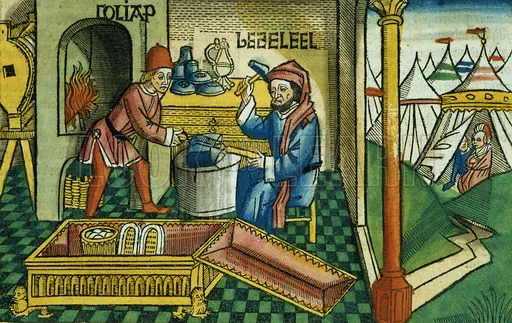
Bezalel and Oholiab build the ark of the covenant, a woodcut from the Cologne Bible, 1479

Then the Lord said to Moses, “Look, I have specifically chosen Bezalel son of Uri, grandson of Hur, of the tribe of Judah. I have filled him with the Spirit of God, giving him great wisdom, ability, and expertise in all kinds of crafts. He is a master craftsman, expert in working with gold, silver, and bronze. He is skilled in engraving and mounting gemstones and in carving wood. He is a master at every craft!

“And I have personally appointed Oholiab son of Ahisamach, of the tribe of Dan, to be his assistant. Moreover, I have given special skill to all the gifted craftsmen so they can make all the things I have commanded you to make:

the Tabernacle;
the Ark of the Covenant;
the Ark’s cover—the place of atonement;
all the furnishings of the Tabernacle;
the table and its utensils;
the pure gold lampstand with all its accessories;
the incense altar;
the altar of burnt offering with all its utensils;
the washbasin with its stand;
the beautifully stitched garments—the sacred garments for Aaron the priest, and the garments for his sons to wear as they minister as priests;
the anointing oil;
the fragrant incense for the Holy Place.

The craftsmen must make everything as I have commanded you.” (New Living Translation)

Methinks God cares about worship. After all, chapters 25-31 in Exodus are thoroughly dedicated to God communicating the specifics for the sacred spaces and symbols of worship for the Israelites.

Once the equipment for worship was described in detail, the one matter still needed was an artisan who could actually build and construct the objects. So, Yahweh also planned for the workers, as well. Bezalel was identified and designated as the person who would be divinely endowed for the task. He would be assisted by Oholiab, and together they carried out God’s instructions to the letter.

Although Bezalel and Oholiab were not priests and did not do “spiritual” work, nonetheless they were filled with the Spirit and set apart by God for their gifts to be used. In reality, all work is spiritual work, even the work of our hands. Everything we do is to be consecrated, set apart, and dedicated to the Lord for good and holy purposes.

The Spirit of God inspired and helped the two men in their very physical and mundane work. The Lord was present with them when they drew up the plans for making the objects, carved the wood, did the weaving and needlework of clothes, and the smithing of the gold. God cares about all work, not just the ethereal stuff.

A willing heart is one that follows in doing work for the Lord, and not following their own whims of how they think things ought to go. The craftsmen, Bezalel and Oholiab, were to do their work just as the Lord had commanded them to do it, just like the pattern shown to Moses on Mount Sinai. (Exodus 25:39)

God is concerned about everything, great and small alike.

When it came to the Lord’s will, the Israelites did not so much seek God’s guidance, as they waited for it. When in the desert, the pillar of cloud by day, and pillar of fire by night, determined when they moved and when they stayed put. The people simply observed, then responded. In other words, they were patient and waited for God to move, speak, command, and do whatever God was going to do.

So, when the Lord lays down some very specific instructions, those directives are meant to be followed down to the minutest detail. For the Christian, Jesus is our example. God’s will was made known to Jesus in the daily privilege and discipline of meeting with his heavenly Father and doing exactly what the Father wanted.

The Sovereign Lord has given me his words of wisdom,
    so that I know how to comfort the weary.
Morning by morning he wakens me
    and opens my understanding to his will.
The Sovereign Lord has spoken to me,
    and I have listened.
    I have not rebelled or turned away. (Isaiah 50:4-5, NLT)

All work is God’s work, and is to be done in the way God prescribes. Worship is to be directed to God, and as such, is to be done as God commands – and not any old way we think is good and needed.

No matter who we are, where we are, or what circumstances we find ourselves in, consistency in doing the will of God is imperative. Nobody has any ground for excusing themselves from their God-ordained work and worship. The ancient Israelites were in a desert without a permanent abode, yet they were still expected to follow God’s directives.

In order to embrace the will of God when it comes, and not make excuses, there are some practices we can do to help receive and do what the Lord wants:

  • Don’t fixate on past mistakes. Learn to be present and focus on what is happening in a given moment, and then you will be able to act in doing God’s will. As a result, you can stop making excuses and learn from past mistakes.
  • Take responsibility for your own words and actions. Take charge of what you have control over. If we don’t own this, then the excuses come out for why we failed to do what was needed.
  • Focus on your spiritual gifts and your strengths and skills. By actively doing what God has enables you to do, you can get the most out of each situation, without succumbing to excuses.
  • Don’t compare yourself to others. We are all unique individuals with unique journeys. That’s why it’s unhealthy to compare ourselves to others and make excuses of “not being good enough” or not measuring up to the skills of Bezalel or Oholiab or someone else. The only person you should compare yourself to is you!

By being attentive to your own walk with God, and being responsive to God’s will for your life, you will find your place in this world and discover the meaning and purpose meant for you in blessing others.

Blessed Holy Spirt of God, with God the Father and God the Son, I adore you as the Holy Trinity, the God whom I serve. I give you my heart, and offer my thanks to you for the grace given me in Jesus Christ. Continue to visit me with your grace, and enable me for work and worship in your church and your world. Amen.

God Is Good, Idols Are Bad (2 Kings 17:7-20)

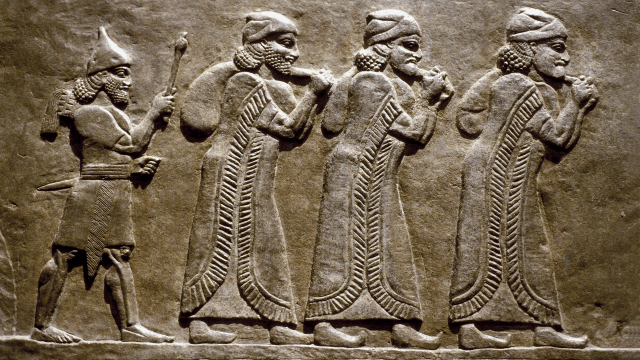
 An Assyrian solider deporting people from their land (From the Southwest Palace of Tiglath-Pileser III at Nimrud, ca. 730-727 B.C.E.; British Museum.)

The Israelites sinned against the Lord their God, who brought them out of Egypt and rescued them from the power of Pharaoh (the king of Egypt). They worshiped other gods and lived by the customs of the nations that the Lord had forced out of the Israelites’ way. They also did what their kings wanted them to do.The Israelites secretly did things against the Lord their God that weren’t right:

They built for themselves illegal places of worship in all of their cities, from the smallest watchtower to the largest fortified city.

They set up sacred stones and poles dedicated to the goddess Asherah on every high hill and under every large tree.

At all the illegal places of worship, they sacrificed in the same way as the nations that the Lord had removed from the land ahead of them.

They did evil things and made the Lord furious.

They served idols, although the Lord had said, “Never do this.”

The Lord had warned Israel and Judah through every kind of prophet and seer, “Turn from your evil ways, and obey my commands and decrees as I commanded your ancestors in all my teachings, the commands I sent to you through my servants the prophets.” But they refused to listen. They became as impossible to deal with as their ancestors who refused to trust the Lord their God. They rejected his decrees, the promise he made to their ancestors, and the warnings he had given them. They went after worthless idols and became as worthless as the idols. They behaved like the nations around them, although the Lord had commanded them not to do that. They abandoned all the commands of the Lord their God:

They made two calves out of cast metal.

They made a pole dedicated to the goddess Asherah.

They prayed to the entire army of heaven.

They worshiped Baal.

They sacrificed their sons and daughters by burning them alive.

They practiced black magic and cast evil spells.

They sold themselves by doing what the Lord considered evil, and they made him furious.

The Lord became so angry with Israel that he removed them from his sight. Only the tribe of Judah was left. Even Judah didn’t obey the commands of the Lord their God but lived according to Israel’s customs. So the Lord rejected all of Israel’s descendants, made them suffer, handed them over to those who looted their property, and finally turned away from Israel. (God’s Word Translation)

The Flight of the Prisoners, by James Tissot, 1898, depicting the Babylonian exile from Jerusalem

The prophets had warned the northern kingdom of Israel; but they did not listen, nor did they heed the prophetic utterance. Israel then stood as an example and a warning to the southern kingdom of Judah; yet they, too, refused to learn from their brother’s downfall.

And even before the kingdom was split between Israel in the north and Judah in the south, the ancient Israelites had a troubling tendency to buck the Lord’s instructions and find other more and creative ways of expressing themselves spiritually.

Every generation of people are responsible for their own spirituality and their own actions in life. We, in our contemporary time and place, need to learn the lessons of the past – for we also are not an exception in history, as if we can do whatever we want without attending to the common good of all persons and worshiping in any sort of way we want.

The trouble with the ancient worshipers of Yahweh is that they decided to pick and choose whatever commands they wanted to follow, or not. They went through continual times of idolatry and forgot about God and God’s Word to them.

To respect and revere the Lord is to obey God’s instructions. To worship Yahweh is to have an undivided allegiance to God and God’s commands. The failure to obey is really a failure of faith.

The prophets Amos, Hosea, Micah, and Isaiah specifically called out the sinful practices of the people and their negligence in upholding basic social and economic justice for everyone. They condemned violence and oppression of the poor; and expressed the divine displeasure with taking advantage of the disadvantaged.

How to treat people and live well were explicitly spelled out in the entirety of God’s Law. Yet, the leaders and the people, as a whole, decided to go another way. They kept introducing idolatrous and unhealthy forms of worship and living. And it led to their ruin.

The ancient people were continually offered grace if they would only accept it. They could return to the Lord and come back to the true worship and obedience of the God who had rescued them from trouble again and again. Turning from their unholy practices, and turning back to Yahweh, would reverse God’s impending judgment. Yet, tragically, the people did not listen.

Idolatry is a failure to trust God, and to rely instead on something else which is not able to sustain a life. Unfortunately, those who create a god according to their own liking end up becoming like the thing they worship, that is, worthless.

The tragedy of the Israelites is that they were to be God’s people, the Lord’s treasured possession, a kingdom of priests, and a holy nation which brings blessing to the earth. Instead, they traded their meaning and purpose in life to imitate everyone else around them.

Sadly, people have felt throughout history, and even we ourselves today, that there is something else, other than God, that we need in order to be happy – something more important to your heart than the Lord – whether it is human acceptance and approval, social reputation, political power and control, or financial advantage and privilege.

Idolatry creates an ignoring of the divine in our life. We might even have the chutzpah to think we can challenge God, like some small yippee pup who growls and takes on the big dog, who knows that with an effortless paw across the body, could toss the prideful pup away.

Like a mother bird who scours the land for food to sustain the babies, and brings it back to their gaping mouths, God longs to provide us with a good and beautiful life – if we will but only receive it.

Listen, my people, I’m warning you!
    If only you would listen to me, Israel.
There must be no foreign god among you.
    You must not bow down to any strange deity.
I am the Lord your God,
    who brought you up from Egypt’s land.
    Open your mouth wide—I will fill it up! (Psalm 81:8-10, CEB)

O Lord, as you gave us the greatest commandment, to love you with all our heart, soul, strength and mind, help us to love you above all else, putting you above the potential idols in our lives, including success, fame and wealth. May your benevolent kingdom come, and your moral and ethical will be done, here on this earth for this time, as it is always done in your heaven. Amen.