The Divine Teacher and Leader (Isaiah 48:17-21)

Thus says the Lord,
    your Redeemer, the Holy One of Israel:
I am the Lord your God,
    who teaches you how to succeed,
    who leads you in the way you should go.
O that you had paid attention to my commandments!
    Then your prosperity would have been like a river
    and your success like the waves of the sea;
your offspring would have been like the sand
    and your descendants like its grains;
their name would never be cut off
    or destroyed from before me.

Go out from Babylon; flee from Chaldea;
    declare this with a shout of joy; proclaim it;
send it forth to the end of the earth;
    say, “The Lord has redeemed his servant Jacob!”
They did not thirst when he led them through the deserts;
    he made water flow for them from the rock;
    he split open the rock, and the water gushed out. (New Revised Standard Version)

A presupposition is something that is assumed in advance or taken for granted. In my own life, I live with the following basic presupposition: Christianity works. It stands behind my faith and confidence, informing everything I do.

I believe in a good God, who genuinely wants people to succeed in life, and will do whatever it takes to help us, doing what is best for us, for our own good.

God is our divine teacher and leader. The Lord is the One who gave Israel the Ten Words (commandments) and the Law to live by. Yahweh is the One who mercifully delivered the ancient Israelites out of Egyptian slavery, protected them in the desert, and led them into the Promised Land.

Furthermore, for the Christian, God the Father is the One who sent God the Son, Jesus, to be with us and amongst us as Teacher and Lord, leading us and saving us. God the Father and God the Son together sent God the Holy Spirit to be with us always – continually teaching us all things, reminding us of Christ’s teaching, and providing needed leadership for our earthly spiritual journey.

Every provision has been given for us to live into a successful life. Yet, in the case of both the Jews who originally heard Isaiah’s prophecy, as well as for many of us as contemporary believers, we have paid scant attention to the divine commandments – nor have we submitted to the divine leadership.

God is teaching and God is leading. We, however, are having difficulty in heeding the instruction and the guidance.

“Hear, O my people, and I will speak,
    O Israel, I will testify against you.
    I am God, your God…

You give your mouth free rein for evil,
    and your tongue frames deceit.
You sit and speak against your kin;
    you slander your own mother’s child.” (Psalm 50:7, 19-20, NRSV)

And God has furthermore stated:

“Hear, O my people, while I admonish you;
    O Israel, if you would but listen to me!…

But my people did not listen to my voice;
    Israel would not submit to me…

O that my people would listen to me,
    that Israel would walk in my ways!” (Psalm 81:8, 11, 13, NRSV)

God desires the best for us and our welfare. The Lord wants us to experience happiness, prosperity, abundance, and blessing. Christianity works. Attention to the spiritual life brings success. Yet we keep working against ourselves through our ignorance of divine teaching and leading.

We could move freely and powerfully like a river – yet we continue to dam up the flow.

We could grow and gain strength like the waves of the ocean – yet we refuse to go out and set sail.

We could reproduce ourselves by making more disciples than the sand on the seashore – yet we are impotent.

We could endure by remembering the name of the Lord – yet there is no future without listening.

What must we do? Go out!

Just as the ancient Israelites went out of Egypt and left their bondage behind, so we are to go out and experience the redemption we have in Jesus Christ.

God is leading us to freedom. The Lord is teaching us how to live in this world as free people. But we must take the step of going out, of leaving, of walking the way of the pilgrim and sojourning into the successful life.

God has our backs. Just as the Israelites were taken care of in the desert with the sustenance of manna and with even water gushing out of a rock, so the Lord will care for you and me out in this scary world of ours.

God does what God does, not based upon what humanity does or doesn’t do, but because of God’s own decision and will. Since the Lord is always good, right, just, and loving, God acts in ways consistent with the divine nature.

Another way of putting the matter is that the spiritual life works, and Christianity works, because it is grounded in nature of God. When we reflect the image of God within us by using our words and our deeds toward mercy, grace, justice, and love, then we are synced with how the universe operates. And success in life is realized.

Even more than that, we are connected with the Creator – which makes all the difference as we try to continually navigate through this earthly life in ways that are right and redemptive.

O God, you made us in your own image and redeemed us through Jesus your Son: Look with compassion on the whole human family; take away the arrogance and hatred which infect our hearts; break down the walls that separate us; unite us in bonds of love; and work through our struggle and confusion to accomplish your purposes on earth; that, in your good time, all nations and races may serve you in harmony around your heavenly throne; through Jesus Christ our Lord. Amen.

Rituals Are Important (Exodus 13:1-10)

The Passover Meal (Last Supper) by Jess Santos

The Lord spoke to Moses, “Set apart every firstborn male for me. Every firstborn male offspring among the Israelites is mine, whether human or animal.”

Then Moses said to the people, “Remember this day—the day when you left Egypt, the land of slavery. The Lord used his mighty hand to bring you out of there. Don’t eat anything made with yeast. Today, in the month of Abib, you are leaving Egypt. The Lord swore to your ancestors that he would give you the land of the Canaanites, Hittites, Amorites, Hivites, and Jebusites. When he brings you into that land flowing with milk and honey, you must observe this ceremony in this month.

“For seven days you must eat unleavened bread. The seventh day will be a pilgrimage festival in the Lord’s honor. Only unleavened bread should be eaten during these seven days. No sourdough or yeast should be seen anywhere in your territory. On that day tell your children, ‘We do this because of what the Lord did for us when we left Egypt.’ This festival will be like a mark on your hand or a reminder on your forehead that the teachings of the Lord are always to be a part of your conversation. Because the Lord used his mighty hand to bring you out of Egypt, you must follow these rules every year at this time. (God’s Word Translation)

Rituals are an important part of being human. They help us to observe significant events, specials seasons, and daily routines. Ritual activities are meaningful re-telling of stories for us and others. In other words, rituals activate memory, enabling us to remember what is of value.

Religious traditions are typically filled with rituals, in order to remind the faithful of what is significant about their faith. Unfortunately, there are some Christian traditions which have a negative view of ritual, believing it to be “vain repetition.”

The problem, however, is not with rituals themselves; the issue is with the one performing the ritual. If it is done with a disconnect between head and heart, then the ritual does not accomplish it’s intended goal of helping the community to remember and giving meaning in the present time.

“Ritual is not simply an attitude or intention, just as love is not simply a feeling. At its most basic, ritual is something that you do. A man can’t plow a field just by thinking about it; he must go out to the field and get to work. If he is fully present to the work and acts with mindfulness and loving attention – if he brings his whole self along – then even as he turns over the rich soil beneath the plow, he turns it over in his mind and heart, as well. The act of tilling the soil becomes an act of tilling the soul.”

Alison Leigh Lilly

No matter whether folks are religious, or not, all people engage in rituals. For example, here are some rituals many people do in order to remember, celebrate, and renew an old story:

  • Birthdays (remembering and re-telling the birth story)
  • Graduations (remembering and re-telling the story of school)
  • Marriages & Anniversaries (remembering and re-telling the courtship story)
  • National Holidays (remembering and re-telling the patriotic story)
  • Dinner and/or Bedtime (remembering and re-telling stories from the day)
  • Morning (remembering and re-telling my story of purpose and meaning)
  • Earth (remembering and re-telling the seasons of Spring, Summer, Fall, and Winter)
  • Annual sojourns to special places such as vacations, sports stadiums, or reunions (remembering and re-telling the story of friendship and family).

The reasons people do such rituals are to

  • Re-enforce values
  • Have a sense of belonging
  • Mark time in a meaningful way
  • Form personal and healthy habits
  • Remind of us of who we are and what our purpose in this world is

Avoiding rituals can cause a lack of identity and purpose. Failing to observe rituals can also create loneliness, confusion, and emptiness.

“Rituals are those repeated actions done again and again in the interest of things like focus, grounding, tradition, cultural symbolism, predictable life rhythms, and feeling a part of something bigger than ourselves.”

Craig Kelley

The Lord gave divine instructions to the newly freed Israelites. And those commands involved instituting some ritual behavior, to be done year after year. God told them to observe a Passover ritual each year so that the story of Israel’s deliverance from Egyptian slavery would remain alive for the generations to come; and so that the event itself would have meaning for people in the present time.

Because Yahweh spared the firstborn of Israel’s children and livestock – and not the firstborn of Egypt – those same firstborn are to be given to God, in some sort of vicarious ransom. All the symbols of Passover are meant to be reminders of what the Lord had done for Israel.

The exodus event is to be actualized, made real for the generations today. By means of ritual, the relationship between God and the people is remembered and renewed for each new generation. Engaging in the ritual repeatedly helps press the story and it’s reality into both the mind and the heart.

And this is precisely what worship is supposed to do for the Christian. Ideally, a worship service is a re-enactment of Christ’s redemption for believers. Even more, it’s a dialogue between God and the people in which the Lord speaks and the worshipers respond.

One ritual which unites all Christians together is the Lord’s Table (communion, or the Lord’s Supper, or the Eucharist). Each Christian tradition has their particular views and theology surrounding it – yet it’s common to all. Observing the Table is a ritual which has been going on for two-thousand years; and which has it’s roots in the Passover and the original meal at the time of the exodus.

The Table is a time of remembrance, communion, and hope. We retell the story of Christ’s redemption and remember the Lord’s once for all sacrifice on the cross for the whole world. It is a unifying ritual, where believers commune together. And the Table expresses hope – that just as we eat and drink now, we will do so all together at the end of the age at the great supper of the Lamb.

Yes, rituals have meaning and it’s symbols are significant. They help us to express our shared humanity together.

May the love of Christ be active in your heart, be heard in your words, be seen in your actions and inform your choices today and every day. Amen.

Love and Obedience (Revelation 3:7-13)

“Write this letter to the angel of the church in Philadelphia.

This is the message from the one who is holy and true,
    the one who has the key of David.
What he opens, no one can close;
    and what he closes, no one can open:

“I know all the things you do, and I have opened a door for you that no one can close. You have little strength, yet you obeyed my word and did not deny me. Look, I will force those who belong to Satan’s synagogue—those liars who say they are Jews but are not—to come and bow down at your feet. They will acknowledge that you are the ones I love.

“Because you have obeyed my command to persevere, I will protect you from the great time of testing that will come upon the whole world to test those who belong to this world. I am coming soon. Hold on to what you have, so that no one will take away your crown. All who are victorious will become pillars in the Temple of my God, and they will never have to leave it. And I will write on them the name of my God, and they will be citizens in the city of my God—the new Jerusalem that comes down from heaven from my God. And I will also write on them my new name.

“Anyone with ears to hear must listen to the Spirit and understand what he is saying to the churches. (New Living Translation)

In 1983, Chuck Colson, a former White House Counsel and founder of Prison Fellowship, wrote a timely and influential book entitled Loving God. In it, he presented a simple yet biblical premise concerning the life of every believer in Jesus: The way to love God is to obey God. 

Every door that opens, hinges on our listening to God, and then obeying what the Lord says to do. This is how we show our love for God.

Jesus himself communicated to the church at Philadelphia (not Pennsylvania, but ancient Asia Minor, now present-day Turkey) affirming their faithful obedience of the message. Because of their steadfast observance of the gospel, the Philadelphian believers would be protected and loved by Jesus. 

The church at Philadelphia did much more than offer a confession of loving God – they affirmed their confession through a steadfast loving obedience to Jesus. 

In some Christian traditions, this is described as “living into our baptism.”  It’s one thing to experience the waters of baptism through being set apart by the Holy Spirit for a relationship with God in the person and finished work of Jesus; and it’s quite another thing to “live into” this reality by learning and listening to God’s Word, and then dutifully obeying it.

Humans are complex creatures in their psychology, sociology, and history. However, there is at least one simple straightforward biblical truth we all can live into: To love God is to obey God. 

Therefore, it is quite necessary for us to spend extended times reading and knowing our Bibles, so that we can adhere and hold fast to what it says. 

“It is not what we do that matters, but what a sovereign God chooses to do through us. God doesn’t want our success; He wants us. He doesn’t demand our achievements; He demands our obedience. The Kingdom of God is a kingdom of paradox, where through the ugly defeat of a cross, a holy God is utterly glorified. Victory comes through defeat; healing through brokenness; finding self through losing self.”

Charles Colson, Loving God

When we truly love someone, we want to do what they say, to fulfill their wishes – whatever those desires are. And then, when we do it, there is joy in accomplishing it. We don’t think about how much it costs, or all the work that goes into it. Instead, we say to ourselves, “This person is worth it. I’m glad to do it.”

This is why love is at the center of all true obedience to God. Those without love eventually give up, fall away, and fail to persevere through the difficulties of doing the will of God. But those enamored with love for God consider it a privilege to endure suffering for the sake of Jesus Christ.

Just yesterday I met with a dear woman in the hospital who had endured many hard things in her life. She relayed all of this to me with a sincere smile – because she is so thankful for God’s grace in her life. The woman’s face was bright with the love of God in her life; and she was profoundly grateful that the Lord saw fit to send me to see her.

My friends, how our world would be so much different and better, if we Christians would but bask in the love of God through Jesus Christ our Savior and Lord! We have quite enough Christians in this world who appear as if they were baptized – not in the gracious water of life – but in the sour vinegar of pickle juice. They tend to only obey out of duty, and do so with the grumpy frown which no one wants to be around.

This old fallen world needs us – our love for God and our love for one another – a love which informs and guides our every word and action. Hard things become easy with the presence of love, which the patriarch Jacob knew so well:

Jacob worked seven years for Laban, but the time seemed like only a few days, because he loved Rachel so much. (Genesis 29:20, CEV)

People of God, we can do hard things. We can do them because of love.

What does the Lord your God ask of you? Only this: to revere the Lord your God by walking in all his ways, by loving him, by serving the Lord your God with all your heart and being, and by keeping the Lord’s commandments and his regulations that I’m commanding you right now. It’s for your own good! (Deuteronomy 10:12-13, CEB)

May it be so, to the glory of God, and for the blessing of the world, as well as our own lives.

Gracious God, thank you for the message of good news that in Jesus Christ I have forgiveness of sins. Help me to hold onto this gospel through all the vicissitudes of life so that obedience springs from my heart in all things by the power of the Holy Spirit. Amen.

The Connection of Faith, Obedience, and Blessing (Genesis 22:15-18)

The angel of the Lord called to Abraham a second time from heaven and said, “By myself I have sworn, says the Lord: Because you have done this, and have not withheld your son, your only son, I will indeed bless you, and I will make your offspring as numerous as the stars of heaven and as the sand that is on the seashore. And your offspring shall possess the gate of their enemies, and by your offspring shall all the nations of the earth gain blessing for themselves, because you have obeyed my voice.” (New Revised Standard Version)

Faith

The biblical character of Abraham is synonymous with faith. And for good reason.

God had told Abraham that he would have a son with his wife Sarah. This was especially unusual because the couple were well advanced in age, and Sarah was incapable of having children. Infertility is not just a modern problem; it has always existed. 

Yet, despite all the contrary evidence of age and ability, Abraham believed God. Years later, and with a mix of patience and impatience from the would-be parents, the promise from God was realized.  Abraham and Sarah had a son, Isaac.

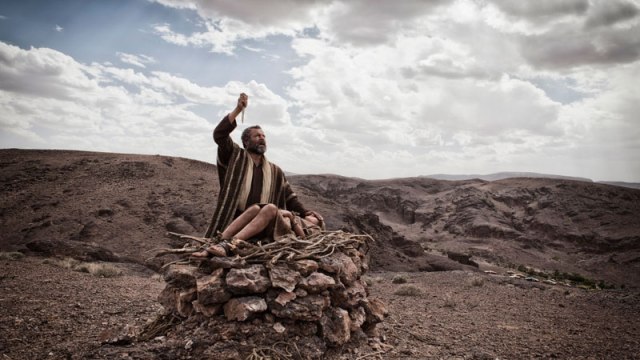
“The child of the promise.” This was Isaac’s moniker – which made the command from God so perplexing: “Take your son, your only son, whom you love—Isaac—and go to the region of Moriah. Sacrifice him there as a burnt offering on a mountain I will show you.” (Genesis 22:2) Huh?

I can easily imagine Abraham saying to himself, perhaps not out loud, “What the [insert favorite expletive]!”  But it only seems strange and super-weird to us. We get no reaction from Abraham, no questioning, no talk back. He just goes about the business of saddling up the donkey, chopping some wood for the sacrifice, and takes his only son with him on the journey to the mountain.

While you and I might try and figure out if we really heard God or not, Abraham had a history of talking with God. He knew God’s voice as well as he knew his own.

Abraham was well down the road of relationship with the God he served. We get an insight from the author of Hebrews into Abraham’s thought process, a line of thinking that is consistent with a person who has a regular habit of talking with God:

Abraham had been promised that Isaac, his only son, would continue his family. But when Abraham was tested, he had faith and was willing to sacrifice Isaac, because he was sure that God could raise people to life. This was just like getting Isaac back from death. (Hebrews 11:17-18, CEV)

Obedience

Abraham did not try and figure out God’s mind. He picked no fights and chose not to debate with God about the contradiction of ethics he was being asked to do.

Abraham simply obeyed. He reasoned that it did not matter if Isaac were killed, because God could raise him from death.

This, of course, is not what happened. It was all a test of faith. Abraham knew beyond a shadow of a doubt that God is the Lord who provides. After God stepped in and provided a ram for the sacrifice instead of Isaac, Abraham named that place “The Lord Will Provide.” (Genesis 22:14)

You and I most certainly do not always know why we are facing the circumstances we must endure. We are rarely privy to know what in the world God is thinking. Yet, like Abraham, if we have a spiritual history of walking with God and hearing God’s voice, there is no hesitation; we respond with obedience. We are convinced that God will provide. Obedience for the follower of Christ is not a burden; it is a privilege, even when we are being tested beyond our seeming emotional ability to do it.

Blessing

Blessings come through obedience. They are not willy-nilly thrown into a crowd like some cheap stadium trinket between innings of a baseball game. When the Israelites were about to enter the Promised Land, the connection between obedience and blessing was re-emphasized:

If you fully obey the Lord your God and carefully follow all his commands I give you today, the Lord your God will set you high above all the nations on earth. All these blessings will come on you and accompany you if you obey the Lord your God…. The Lord will establish you as his holy people, as he promised you on oath, if you keep the commands of the Lord your God and walk in obedience to him. (Deuteronomy 28:1-2, 9, NIV)

Here’s a simple observation about the blessing of Abraham: It took nearly five-hundred years before that blessing was realized. Furthermore, in the Christian tradition, it then took another fifteen-hundred years before the blessing was fulfilled in the person of Jesus.

And, I might add, all the promises of God to the people will be fully consummated at the end of the age when Christ returns. For a contemporary society which prides itself on timeliness, speed, and efficiency, taking the much broader scope of all history might seem unacceptable.

So, we come back around again to trust. Just as Abraham trusted God, even when it seemed like nonsense fraught with major moral implications, so we are to exhibit patient and persevering faith.

Although the scope of history is massively large, the only moment we have is the now. It is now, today, in which we put one foot in front of the other and toddle forward into the next moment – by faith.

We simply obey. Then, we obey again… and, again. It is in these continual small steps of faith and obedience that we discover the blessings of God in the middle of our path.

Sovereign Lord, your ways are sometimes strange. Yet, I know that everything you do is always right, just, and good. It is to your gracious and merciful character that I know you will guide and provide. My allegiance is to you as I anticipate divine blessings in my life through the Name of Jesus Christ, in the power of the Holy Spirit. Amen.