


People were also bringing babies to Jesus for him to place his hands on them. When the disciples saw this, they rebuked them. But Jesus called the children to him and said, “Let the little children come to me, and do not hinder them, for the kingdom of God belongs to such as these. Truly I tell you, anyone who will not receive the kingdom of God like a little child will never enter it.” (New International Version)
I happen to believe that kids are closer to the kingdom of God than most adults.
Us big people have developed a lot of baggage over the years. And all that stuff tends to obscure God’s kingdom and the light of Christ within us.
Kids, however, especially small children, still haven’t discerned any veil between the seen and unseen worlds. They freely move between them both without any problem.
So, of course, Jesus wanted to be around children. If he had any homesickness at all, I’m sure the presence of kids made him feel at home more than anywhere else on this earth.
Jesus is our Immanuel, God with us.
The kingdom of God is here within us.
The disciples of Jesus had some difficulty with Christ’s branding of the message because it was not exclusive enough for them. They wanted limits on the us part.
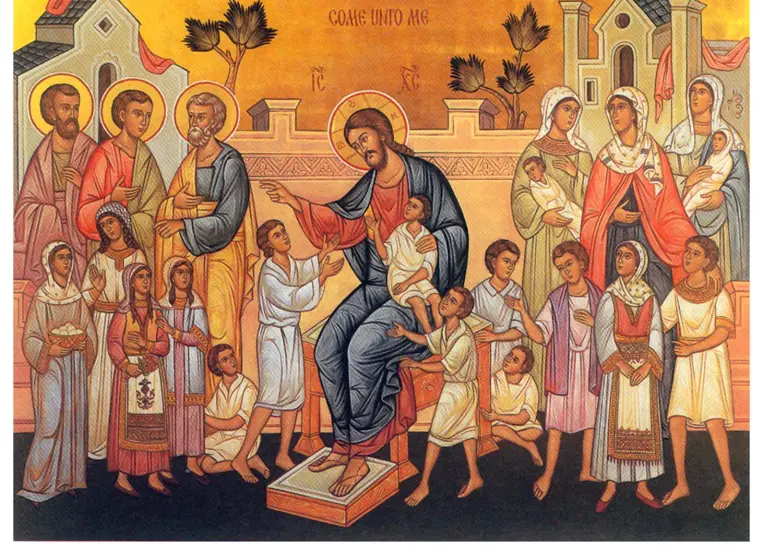
Kids are part of that mass of people that God is with. Children deserve as much or more attention than adults. More than simply saying that we care about kids, we need to be like Jesus. He let the children come to him and was intolerant of anyone preventing kids from doing so.
Since the disciples were, ironically, still living in a small world, they rebuked those who brought little children to Jesus.
We aren’t specifically told why the disciples rebuked the adults bringing children to Jesus. Maybe the children were making a lot of noise and were being a nuisance in the middle of Jesus’ teaching. Perhaps the disciples had Jesus on a tight time schedule and this bringing kids to Christ thing was causing a delay. It could be that the disciples simply saw children as an interruption to the “important” work of ministry.
I tend to think that the disciples simply failed to appreciate the children. The dominate view of kids in the ancient world was to see them as potential adults. Kids were pretty low on the ladder of society. The disciples likely saw no reason for children to be involved in what was happening.
The babies and toddlers and small children were brought so that Jesus might place his hands on them and pray for them. That still seems to me to be the best reason to bring kids to Jesus.
“This story teaches us that Christ does not receive only those who voluntarily come to Him of a holy desire and moved by faith, but also those who might not yet be old enough to realize how much they need His grace…. From this we gather that His grace reaches to this age of life also…. It would be cruel to exclude that age from the grace of redemption.”
John Calvin
“Jesus does not only save repentant adults; he also saves dependent children and all those whom we think are incompetent to respond to Jesus.”
Frederick Dale Bruner
Jesus flat out rebuked his disciples for hindering the little children from coming to him. He wanted just the opposite of what was taking place. Why? Because the kingdom of heaven belongs to such little people as these.
As mentioned, children were at the bottom of the societal pecking order in the ancient world. Their place in that society was to be respectful and quiet, to speak only when spoken to, and to never interrupt an adult.
Yet, Jesus took the time to touch them and pray for them. He invited this interruption to his schedule. Christ bluntly told his disciples that they were the ones being the hindrance, not the kids.
I baptize all sorts of people, including kids and babies. Why? Because in baptism, I recognize that the smallest ones among us can come to this holy sacrament. I understand that in baptism the Holy Spirit begins and initiates the process of salvation that will take that little one from infancy to adulthood and eventual death. I discern that, ideally, the child grows to live into their baptism by recognizing by faith that Jesus died and rose from the dead and grants grace and forgiveness to all who come to him.
In that process of salvation, of coming to know Jesus, we have the sacrament of the Lord’s Table to strengthen our faith and demonstrate to us that the saving work of Jesus that has been accomplished. It is a Table of grace for all the members of Christ’s Church.
In my Reformed Christian tradition, we believe that Jesus is not physically, but spiritually present at the Table. Because Jesus is present, we are able to receive the grace available to us as Christ’s members. So why, in light of this reality, and the words and practice of Jesus toward children, would we ever hinder and prevent the smallest members among us from participating at the Table?
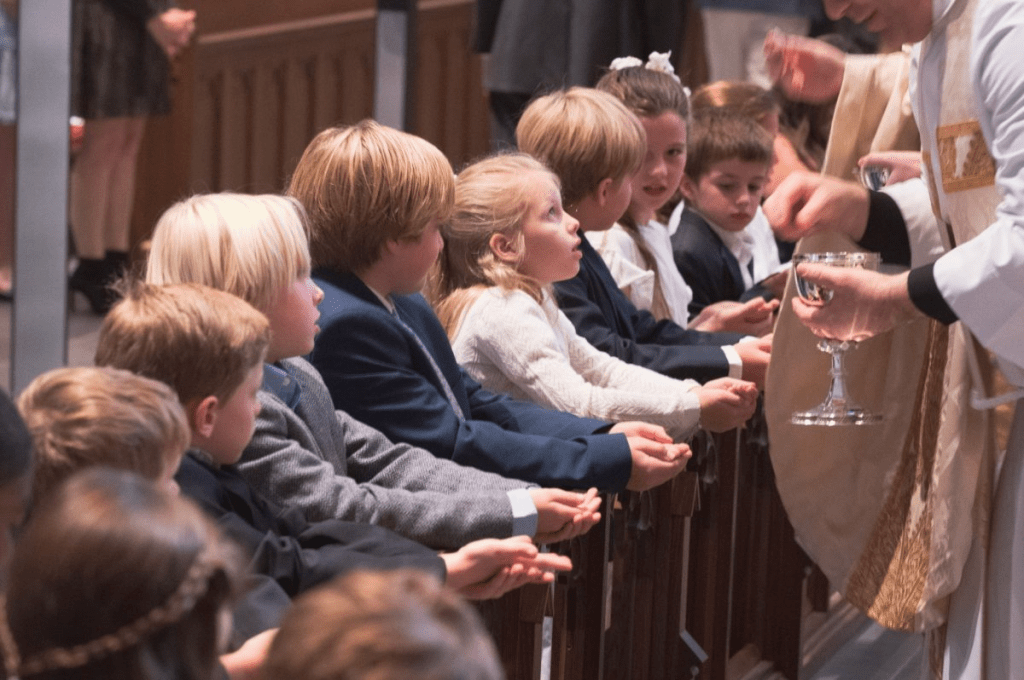
Here’s a thought: If Jesus himself were serving communion in a church, and a group of 2-year-old children came toddling up to the Table to see Jesus, would you stop them from doing so? Or much like the disciples, would you rebuke those bringing children to Jesus?
As for me, I’d rather not be rebuked by my Lord.
Jesus gave children the three gifts they most need: time, touch, and prayer. Parenting and teaching are holy vocations, and we have the wonderful privilege of bestowing these same gifts on our children, grandchildren, and students.
Time, touch, and prayer are ways we bless children. And, what’s more, as God’s children, we are all to approach Jesus and spend time with him, allow him to touch us, and interact with him through prayer.
May we all have the humility to bend down at eye level to the littlest among us so that we and others will know that the kingdom of God is among us.


 Rev. Tim Ehrhardt