
God Is Both Near and Far (Psalm 145:1-5, 17-21)

God giving life to Adam, by Michelangelo (1475-1564) on the ceiling of the Sistine Chapel, Rome

I will exalt you, my God the King;
    I will praise your name for ever and ever.
Every day I will praise you
    and extol your name for ever and ever.

Great is the Lord and most worthy of praise;
    his greatness no one can fathom.
One generation commends your works to another;
    they tell of your mighty acts.
They speak of the glorious splendor of your majesty—
    and I will meditate on your wonderful works….

The Lord is righteous in all his ways
    and faithful in all he does.
The Lord is near to all who call on him,
    to all who call on him in truth.
He fulfills the desires of those who fear him;
    he hears their cry and saves them.
The Lord watches over all who love him,
    but all the wicked he will destroy.

My mouth will speak in praise of the Lord.
    Let every creature praise his holy name
    for ever and ever. (New International Version)

The Lord is both near and far. The God of Holy Scripture is, at the same time, both:

  • approachable and aloof
  • close and distant
  • beside us and beyond us
  • available and elusive
  • revealing and remote
  • warm and cool
  • knowable and mysterious
  • readily at hand and at arm’s length
  • a good neighbor next door and a politician over in a city you’ve never been

The technical theological terms for describing God in such a way is that the Lord is both immanent and transcendent. And that is a good thing. We need the Lord to be both.

This psalm is a hymn of praise to God. The psalmist, David, celebrates the attributes and the actions of the Lord. David understood, better than most, that God is so far above humanity in divine majesty that miracles are always possible. Because God is God, the Lord’s arm is never too short to extend help and deliverance.

David knew that God’s powerful ability and God’s loving affection go hand-in-hand together; God’s mighty strength and God’s compassionate spirit work together harmoniously for our benefit.

They did not conquer the land with their swords;
    it was not their own strong arm that gave them victory.
It was your right hand and strong arm
    and the blinding light from your face that helped them,
    for you loved them. (Psalm 44:3, NLT)

God’s interventions, wonders, and miracles are never done dispassionately; the Lord’s arm is extended with deep concern and loving care for people.

The Lord acts as a close relative, like a parent, exhibiting qualities of both father and mother. God is close enough to not only hear our verbal prayers but to also hear our faint whispers. Indeed, the Lord is so close that we don’t even have to speak for the prayers of our heart to be heard.

The righteous call to the Lord, and he listens;
    he rescues them from all their troubles.
The Lord is near to those who are discouraged;
    he saves those who have lost all hope.

Good people suffer many troubles,
    but the Lord saves them from them all. (Psalm 34:17-19, GNT)

In the New Testament Gospels, Jesus gave us instruction on how to address God: “Our Father in heaven.” Not just “my” Father, but “our” Father. We are to pray with the mindful sense of our union with the Lord, as well as our connection with one another as believers.

The Lord sits in heaven as the Most High God, the transcendent Lord of me, you, and all people – watching over and protecting all whose hearts are in the right place, and effectively guarding us from a lofty divine vantage point.

My shield is God Most High, who saves the upright in heart. (Psalm 7:10, NIV)

Clap your hands, all you nations;
    shout to God with cries of joy.

For the Lord Most High is awesome,
    the great King over all the earth.
He subdued nations under us,
    peoples under our feet. (Psalm 47:1-3, NIV)

With our transcendent God always having a watchful eye over us, we need not fear anything or anyone. The Lord knows the score of how things are going in the world and in your life. And, what’s more, God knows the ropes in providing for us, protecting us, and powerfully handling any and all enemies to our souls.

Yet, at the same time, all the time, God is both our high holy King, and our close intimate Friend. Indeed, the Lord is graciously immanent as my Abba – the Father who is near and dear to our hearts.

Because you are [adopted] sons and daughters, God sent the Spirit of his Son into our hearts, crying, “Abba, Father!” Therefore, you are no longer a slave but a son or daughter, and if you are his child, then you are also an heir through God. (Galatians 4:6-7, CEB)

Christians everywhere in the world, and throughout the ages, gather together and repeat the Lord’s Prayer, every Sunday, as well as in weekly small groups, and daily individual prayers. We cry out, “Our Father in heaven” as the most used phrase over the course of our Christian lives.

And that sort of repetition is a good thing. It is important to verbalize that God is transcendent – far above all earthly powers as the sovereign Lord of the universe; and to vocalize that God is immanent – near to us as a father to a child.

Just because a phrase can become vain repetition doesn’t mean that repeating it is a bad thing. Using our words to reiterate both the far distance and the close relation of God is a worthy activity which fortifies our faith, and which passes truth to successive generations of the faithful.

The best way I know of cultivating a healthy sense of God’s transcendence and immanence (outside of reading scripture and praying) is through clouds and kids – both of which require mature adults to practice some much needed humility.

There is nothing quite like putting clocks and schedules aside, stretching out a blanket on a hill, laying back, and watching the clouds roll by. The perspective of massive highness reminds us that our problems are neither as daunting nor as important as we thought.

In contrast to the high clouds, there’s also nothing quite like forgetting your age and getting on the ground to be eye level with a kid. Fortunately, I have rambunctious and curious grandsons who continually remind me that, the lower I get, the better I understand what’s truly most important.

Neither my kids nor my grandkids care all that much about the what’s in my life – what I do – my work, my hobbies, my angst, my daily activities. But they do care a great deal about who I am and why I’m with them.

Intentionally developing a sense of God as both far and near, helps us remember who we are and why are here.

Ironically, the closer I get in touch with the reality that I’m mere dust, and will return back to the ground, the better I’m able to see the Most High God. And, conversely, the more I gaze into the sky, the greater awareness I have of the people around me. I learn to love God and neighbor, as I ought.

There’s no better time than now to get out there and take advantage of the clouds and the kids. It will likely help you to know God better; and it will probably bring a greater awareness, clarity, and connection to the truly significant which is always around us.

Father God, you formed us from the dust of the earth. Remind us of our place as your creatures at home in your creation. Forgive us when we forget our connection to the earth, and our dependence upon the goodness of your world. Lord have mercy.

Brother Jesus, you were born into this world, and made your earthly home in Nazareth. Help us to know and love the people and places where you have set us. Forgive us when we fail to care for our homes, our communities, and your creation. Christ, have mercy.

Blessed Holy Spirit, you desire to grow in us your fruit of love, joy, peace, patience, kindness, goodness, faithfulness, gentleness, and self-control. Forgive us when our roots are so shallow, and our hearts so restless, that our lives fail to bear fruit. Enable us to find our home in you, and in the places to which you call us. Lord have mercy.

Blessed Holy Trinity – Father, Son, and Spirit – the God who is both far and near: Forgive us our sins, settle us in a place of belonging, and enable us to bear fruit for your kingdom. Amen.

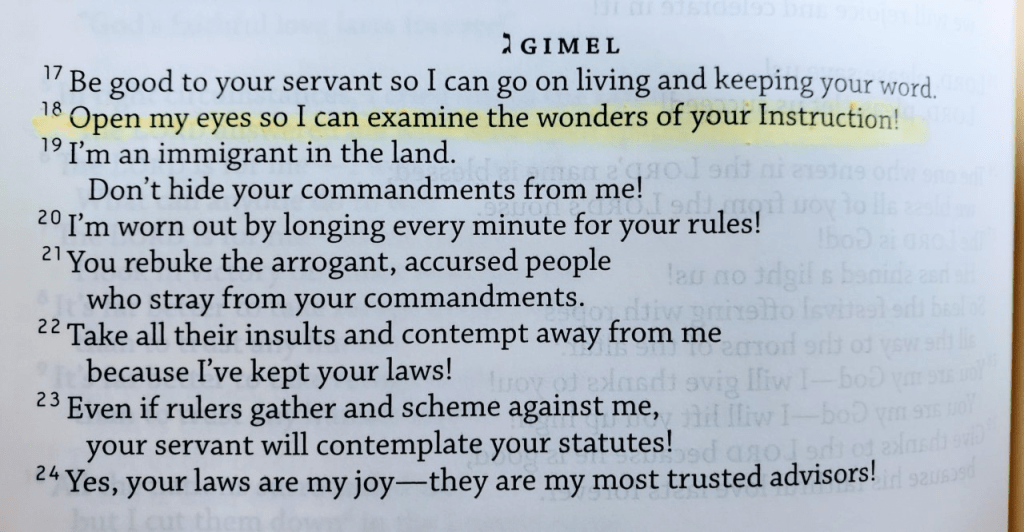
Psalm 119:17-32 – Examine the Wonders of God’s Instructions

Psalm 119:17-24, Common English Bible

ג Gimel

Be good to your servant while I live,
    that I may obey your word.
Open my eyes that I may see
    wonderful things in your law.
I am a stranger on earth;
    do not hide your commands from me.
My soul is consumed with longing
    for your laws at all times.
You rebuke the arrogant, who are accursed,
    those who stray from your commands.
Remove from me their scorn and contempt,
    for I keep your statutes.
Though rulers sit together and slander me,
    your servant will meditate on your decrees.
Your statutes are my delight;
    they are my counselors.

ד Daleth

I am laid low in the dust;
    preserve my life according to your word.
I gave an account of my ways and you answered me;
    teach me your decrees.
Cause me to understand the way of your precepts,
    that I may meditate on your wonderful deeds.
My soul is weary with sorrow;
    strengthen me according to your word.
Keep me from deceitful ways;
    be gracious to me and teach me your law.
I have chosen the way of faithfulness;
    I have set my heart on your laws.
I hold fast to your statutes, Lord;
    do not let me be put to shame.
I run in the path of your commands,
    for you have broadened my understanding. (New International Version)

The biblical psalms are one of my favorite places in the whole of Holy Scripture. I especially like Psalm 119 because it reminds me that I am not only saved from something, but I am also saved to something.

Genuine and real deliverance comes so that we can be free to love and serve God with our whole being. And Psalm 119 is there to help us know how to do just that.

Psalm 119 stretches for 176 verses as an acrostic to the Hebrew alphabet. Each Hebrew letter has its own 8 verse stanza, with each of those verses beginning with that letter. Unfortunately, of course, we lose this insight through translation.

One of the reasons the psalm was organized this way is because it was meant to be learned and memorized. In fact, the entire psalter was meant for public consumption – to be engrafted into the soul and hidden in the heart.

The wonders of Psalm 119 are, overall, a paeon of reverence and praise of God’s law. That’s because the Lord’s commands and instructions are an extension of the divine character. Laws of mercy and holiness are given to the people because God is merciful and holy.

Grace and law are not antithetical. They go together like a hand in a glove and rely upon each other. The hand of grace is what fills the glove of the law, and together, they extend divine help and direction to people in this fallen world of ours.

The heartfelt prayer of the psalmist is that the Lord would open his eyes so that he could see the wonders contained within God’s divine instructions for humanity.

“Open my eyes so I can truly see
the marvelous things in your law.”

Psalm 119:18, NET

This is a prayer for us, as well. Those who desire to please the Lord and walk in the way of God are continually seeking awareness of the divine all around them, insight into others, and understanding of self.

It is one thing to read the Bible, but it’s another thing altogether to understand it. The psalmist is asking for God to intervene on his behalf and remove anything and everything that would inhibit his ability to understand and discern God’s words and actions.

Insight, understanding, and application to life comes from dwelling in the Word. It is a process. A daily crumb will neither do to satiate our physical hunger nor our spiritual appetite.

Going days, even weeks, without ingesting God’s instructions will only lead to spiritual emaciation. It harms us and helps no one. Instead, we need to feed on Holy Scripture and savor every bite. Like the cow, we need to slowly chew and ruminate on Scripture so that it can be fully digested and become part of us.

I have memorized large chunks of the Bible over the years. The main reason my memory can call up so much Scripture is that I have read it, and continue to read it, over and over again. Even though I’ve read the Old Testament about one-hundred times and the New Testament in the neighborhood of three-hundred times, I still gain insight and understanding, seeing new and wondrous things.

I truly believe the Bible is an inexhaustible source of sage instruction and a continual fountain of wisdom. I’ll spend an eternity in heaven examining God’s Word and will never reach the height, depth, length, and breadth of it’s incredible, massive, and glorious precepts.

I am a strong advocate of straightforward readings of Scripture, over and over again. Although I encourage looking at devotionals, commentaries, and reflections (like this blog!) to help and encourage us, nothing can replace our constant and continual reading of the Bible.

The biblical Book of Psalms is the Church’s prayerbook. All 150 of them are meant to be used for every sort of life circumstance. Whether discouraged or anxious, joyful or confident, the psalms encompass the full range of the human condition – and Psalm 119 lets us know how central God’s instructions are to the life of God’s people.

So, read today’s psalm… several times. Let Scripture do it’s marvelous and wondrous work within you.

Blessed Lord, you caused all Holy Scriptures to be written for our learning. Help us so to wisely hear, read, mark, learn, and inwardly digest them so that by our patient reading of your holy Word, we may embrace and ever hold fast the blessed hope of everlasting life, which you have given us in our Savior Jesus Christ.

Psalm 67 – Make Your Face Shine Upon Us

May God be gracious to us and bless us
    and make his face to shine upon us,
that your way may be known upon earth,
    your saving power among all nations.
Let the peoples praise you, O God;
    let all the peoples praise you.

Let the nations be glad and sing for joy,
    for you judge the peoples with equity
    and guide the nations upon earth.
Let the peoples praise you, O God;
    let all the peoples praise you.

The earth has yielded its increase;
    God, our God, has blessed us.
May God continue to bless us;
    let all the ends of the earth revere him. (New Revised Standard Version)

One of the many reasons I like using the Revised Common Lectionary daily readings is that a psalm is read every day.

This is important because, slowly and over time, the reader moves to becoming a worshiper and a faithful person of prayer. What’s more, the psalms help us become familiar with the human range of emotion, various life situations, and sound theology. 

In an era when so many believers are “too busy” for basic Bible reading, daily prayer, and connection with God, this creates a dearth of sage spiritual direction from others. The “advice” which many well-meaning Christians give to each other is many times nothing more than microwaved leftovers of common foolishness in the guise of wisdom.

We’re devouring the innards of roadkill when we could be eating a choice meal of select and juicy psalms.

The psalms are the Church’s prayer book. We need the biblical psalter, just as much as we need the air we breathe. We also live in a time in which many people can access Holy Scripture (for free) via their smart phones, tablets, and computers. One can even add the voice function so that the believer can pray along with particular psalms.

An advantage to becoming conversant in the psalms is the ability to use them for all kinds of situations. Today’s psalm meets a particular need for prayer: How ought to politics and religion meet in our prayers to God?

In the USA, just say the word “politics” and many people get a visceral response before there is even a discussion about it. Feelings and opinions run high. Negativity is rampant. Mudslinging and name-calling are rife.

Psalm 67 offers a different path. It is the way of blessing the nations, the nation’s blessing God, and all of us together as a community of God’s people inviting God to work divine grace among us. 

The prayers to be offered are for the nations of this earth to know the Lord and bless God as Savior and Sovereign; for the Lord’s true identity and character to be revealed as Shepherd and Supreme to all; and for God’s people to be blessed so that the Lord will be revealed as the salvation of the nations.

Rather than become mucked in worry or despair over present circumstances and the unknown future, the psalmist orients our minds, hearts, and voices toward the sovereign God.

The psalms are meant to be used – repeatedly. One cannot overuse them. So, give this a try: Today set your phone, watch, or other device to alarm at two or three hour intervals. Whatever you are doing (if you are able) stop and pray Psalm 67. It will take less than a minute.

Let the positive approach to blessing others and seeing God’s control shape how you go about the rest of your day. Who knows? Maybe the psalter will eventually alter how you view the world, as well as yourself.

Lord, the light of your love is shining
In the midst of the darkness, shining
Jesus, Light of the world, shine upon us
Set us free by the truth you now bring us

Shine on me, shine on me

Shine, Jesus, shine
Fill this land with the Father’s glory
Blaze, Spirit, blaze
Set our hearts on fire
Flow, river, flow
Flood the nations with grace and mercy
Send forth your word
Lord, and let there be light

Lord, I come to your awesome presence
From the shadows into your radiance
By the blood I may enter your brightness
Search me, try me, consume all my darkness
Shine on me, shine on me

Shine, Jesus, shine
Fill this land with the Father’s glory
Blaze, Spirit, blaze
Set our hearts on fire
Flow, river, flow
Flood the nations with grace and mercy
Send forth your word
Lord, and let there be light

As we gaze on your kingly brightness
So our faces display your likeness
Ever changing from glory to glory
Mirrored here may our lives tell your story
Shine on me, shine on me

Shine, Jesus, shine
Fill this land with the Father’s glory
Blaze, Spirit, blaze
Set our hearts on fire
Flow, river, flow
Flood the nations with grace and mercy
Send forth your word
Lord, and let there be

Send forth
Send forth your word
Lord, and let there be
Send forth your word
Lord, and let there be light – Graham Kendrick

Leviticus 19:9-18 – Be a Good Neighbor

When you reap the harvest of your land, do not reap to the very edges of your field or gather the gleanings of your harvest. Do not go over your vineyard a second time or pick up the grapes that have fallen. Leave them for the poor and the foreigner. I am the Lord your God.

Do not steal.

Do not lie.

Do not deceive one another.

Do not swear falsely by my name and so profane the name of your God. I am the Lord.

Do not defraud or rob your neighbor.

Do not hold back the wages of a hired worker overnight.

Do not curse the deaf or put a stumbling block in front of the blind but fear your God. I am the Lord.

Do not pervert justice; do not show partiality to the poor or favoritism to the great but judge your neighbor fairly.

Do not go about spreading slander among your people.

Do not do anything that endangers your neighbor’s life. I am the Lord.

Do not hate a fellow Israelite in your heart. Rebuke your neighbor frankly so you will not share in their guilt.

Do not seek revenge or bear a grudge against anyone among your people but love your neighbor as yourself. I am the Lord. (New International Version)

All of these Old Testaments commands to the ancient Israelites are a development and expansion upon the basic core Ten Commands or Words given by God to Moses.

Those core commands are based in the character of God. That same character is to be the normal daily lived experience of God’s people.

The Levitical instructions are a fleshing-out of God’s basic commands for a specific people in their particular social, economic, and historical situation.

Although we need not, as modern folk, strictly observe the commands, as they are culturally constructed, we very much need to fulfill the ethics and morality which are behind the specific instructions.

Today’s Old Testament lesson has to do with being a good neighbor – a person who conscientiously lives in community with others and pays attention to the collective needs and wants of everyone. It is to live into God’s overarching ethic for the common good of all persons.

A commitment to community life needs good neighbors. They are characterized by the following virtues:

Sacrifice

Israel was chiefly an agrarian society. So, when the season of harvest came, the workers gleaning the fields were to only go over it once. That way, the poor and less fortunate could come behind and pick up what the workers missed or dropped.

Any landowner who instructed the workers to keep working until they got every scrap of grain or fruit was being cruel to the poor. Merciful and generous owners would, conversely, instruct the workers to leave a bit behind and not get everything.

Since God sacrifices on behalf of humanity, so we, too, are to make sacrifices which benefit the common good of all persons in the community.

Live a life filled with love, following the example of Christ. He loved us and offered himself as a sacrifice for us, a pleasing aroma to God. (Ephesians 5:2, NLT)

A sacrificial spirit, not a self-indulgent one, is what God is looking for in a good neighbor.

Honesty

Cheating, lying, stealing, and deceit have absolutely no place in the kingdom of God. Instead, honest dealings with others, always being above board in all matters, is of upmost importance to God.

Witnesses in court are expected to speak the truth without falsehood. Business dealings are to have accurate weights and measures. Integrity and trustworthiness are the building blocks of any good society.

Since God is truth, so we, too, are to live into truth through being honest in all we say and do.

Have nothing to do with a false charge and do not put an innocent or honest person to death, for I will not acquit the guilty. Do not accept a bribe, for a bribe blinds those who see and twists the words of the innocent. (Exodus 23:7-8, NIV)

An honest spirit, not a thieving one, is what God is looking for in a good neighbor.

Fairness

In the ancient world, and still in many parts of the world today, workers were paid at the end of the day for their day’s work. Bosses who withheld expected wages till the next day were quite literally depriving a family of their supper.

For those who are not able to do a solid day’s work, such as the blind and the handicapped, it’s bad enough to simply ignore them, because God is attentive to their plight. That situation is exacerbated exponentially, whenever someone or a group of people, decide to make such persons’ lives even harder than they already are.

Since God is fair in all dealings, so we, too, are to extend fairness to all without any prejudice or favoritism.

The Lord watches to see if we are fair or if we cheat others. (Proverbs 16:11, CEV)

A fair spirit, not an exploitive one, is what God is looking for in a good neighbor.

Justice

Unequal treatment is about as far from God as one can get. Being concerned only about those with similar political views, economic interests, or spiritual inclinations is a gross practice of injustice. It denies the ethic of the common good of all in favor of the common good of some.

Since God is just in all things, so we, too, are to uphold biblical justice for our fellow humanity, no matter who they are or where they come from.

Never deprive foreigners and orphans of justice. And never take widows’ clothes to guarantee a loan. (Deuteronomy 24:17, GW)

A spirit of justice, not injustice, is what God is looking for in a good neighbor.

Love

Hate is the inevitable result of holding onto anger through nursing a grudge and holding onto bitterness. It fails to speak up and speak out.

Love, however, assertively addresses anger and seeks to make things right in a calm and concerned way. Love attacks problems, not people.

Since God is love, so we, too are to love one another.

Dear friends, let us love one another, for love comes from God. (1 John 4:7, NIV)

Don’t let evil get the best of you; get the best of evil by doing good. (Romans 12:21, MSG)

A spirit of love, not a hateful vengeful one, is what God is looking for in a good neighbor.

A good neighbor is one who seeks the common good of all persons because God is good, all the time, and always does what is right, just, and fair.

Gracious God and Father, in a world of fear and suspicion, teach us that love is the only means to conquer fear.

Loving Lord Jesus, Son of God, in a world full of anger and frustration, teach to overturn the tables and tear down the fences which turn away the hungry and homeless; and to practice hospitality without prejudice.

Blessed Holy Spirit of God, in a world of indifference and ignorance, teach us wisdom, to be caring of one another, and to protect one another.

Blessed Holy Trinity, the God whom we serve, help us to know the peace that steals gently in through quiet acts of kindness, just as peace is always within you as one God, now and forever. Amen.