The Servant of the Lord (Isaiah 42:5-9)

This is what God the Lord says—
the Creator of the heavens, who stretches them out,
    who spreads out the earth with all that springs from it,
    who gives breath to its people,
    and life to those who walk on it:
“I, the Lord, have called you in righteousness;
    I will take hold of your hand.
I will keep you and will make you
    to be a covenant for the people
    and a light for the Gentiles,
to open eyes that are blind,
    to free captives from prison
    and to release from the dungeon those who sit in darkness.

“I am the Lord; that is my name!
    I will not yield my glory to another
    or my praise to idols.
See, the former things have taken place,
    and new things I declare;
before they spring into being
    I announce them to you.” (New International Version)

For those who serve the God of Scripture, there is work to be done.

According to Scripture, people are created in the image and likeness of God (Genesis 1:26-27). As the only creatures on earth with the divine stamp of God’s image, humanity’s purpose is to reflect and work toward that which characterizes God:

  • Be holy because God is holy. That is, set apart your life for good and right purposes, and not for ill. Devote yourself to being above board in everything, and work for the common good of all persons.
  • Love one another as God has loved you. Since the Lord demonstrated a sacrificial and unconditional love toward you, so do the same for others. Love God. Love your neighbor.
  • Do justice because God is just. God is concerned that everyone on planet earth has what they need – both physically and spiritually – to live and thrive in this world. Ensure that people’s needs are met, without any prejudice or favoritism.

The servant of God has a mandate to be a covenant and light for people. Since God makes and keeps promises to people; and since the Lord is light without any darkness, so God’s servant is to embrace and embody a steadfast commitment to continually doing good.

We are meant to be a blessing to people on this earth – and not a curse. (Galatians 3:8)

I don’t have much stomach for fellow believers who think they are responsible to let people know how sinful they really are. Such supposed messengers end up puking the “good news” on others, often leaving people in such a bad state that they want nothing to do with religion.

Any sort of forceful verbiage, or manipulative gaslighting of others, does not in any way reflect the God whom I serve; I view such underhanded methods as inconsistent with Scripture. Besides, the Lord certainly doesn’t need any of us, as if God is dependent on people’s gospel witness.

Instead, the Lord graciously cuts us in on the benevolent and gracious divine action that is being accomplished in the world. That God allows me to be a mouthpiece is a privilege and a responsibility. So, I will steward that trust well by using words that build up and encourage, without verbally accosting another in the name of serving God.

In the ancient world, the poor often found themselves in prison through the inability to pay off a debt. Part of the servant’s work is to cancel debt, thus providing freedom and a further means to work and support family. For the Christian, this is an elementary part of our prayers:

And forgive us our debts, as we also have forgiven our debtors. (Matthew 6:12, NIV)

Those words of Jesus are meant to uphold the ethical teachings of the Law:

At the end of every seven years you must cancel debts… There need be no poor people among you, for in the land the Lord your God is giving you to possess as your inheritance, he will richly bless you, if only you fully obey the Lord your God and are careful to follow all these commands I am giving you today. For the Lord your God will bless you as he has promised, and you will lend to many nations but will borrow from none. You will rule over many nations but none will rule over you.

If anyone is poor among your fellow Israelites in any of the towns of the land the Lord your God is giving you, do not be hardhearted or tightfisted toward them. Rather, be openhanded and freely lend them whatever they need. (Deuteronomy 15:1, 4-8, NIV)

Holiness, love, and justice are done by paying attention to the neediest of persons around us. The Lord’s servant can bring light because God is against the darkness. And the reason debts are cancelled (both real economic and spiritual forgiveness) is so that the monetary poor, and the poor in spirit, are liberated.

God is attentive to the vulnerable and needy; it is the Lord’s will that no one lives under the oppression of debilitating debt.

The work of the humble servant brings dignity, honor, and respect to human beings, thus honoring God and showing to the world what sort of God the Lord is – a gracious and merciful God who has a zeal for justice and for right relations in society. The Servant of the Lord, the ultimate Servant, is described in this way by the prophet:

Of the greatness of his government and peace there will be no end. He will reign on David’s throne and over his kingdom, establishing and upholding it with justice and righteousness from that time on and forever. The zeal of the Lord Almighty will accomplish this. (Isaiah 9:7, NIV)

Our Father in heaven,
hallowed be your name.
Your kingdom come,
your will be done,
    on earth as it is in heaven.
Give us this day our daily bread,
and forgive us our debts,
    as we also have forgiven our debtors.
And lead us not into temptation,
    but deliver us from evil. Amen.

A Call to Truth and Justice (Exodus 23:1-9)

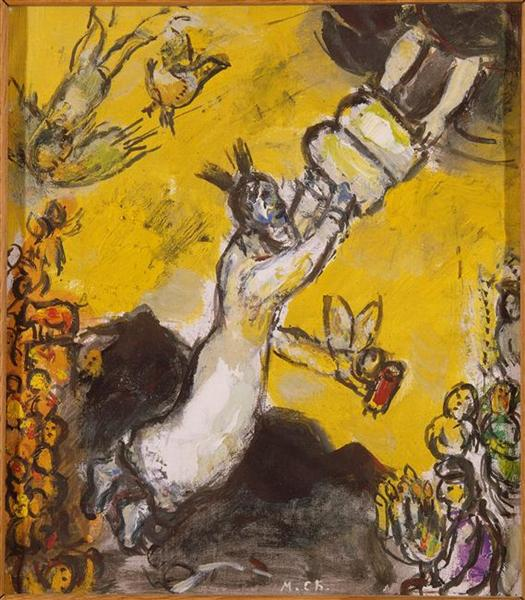
Moses Receives the Law, by Marc Chagall, 1963

“You must not pass along false rumors. You must not cooperate with evil people by lying on the witness stand.

“You must not follow the crowd in doing wrong. When you are called to testify in a dispute, do not be swayed by the crowd to twist justice. And do not slant your testimony in favor of a person just because that person is poor.

“If you come upon your enemy’s ox or donkey that has strayed away, take it back to its owner. If you see that the donkey of someone who hates you has collapsed under its load, do not walk by. Instead, stop and help.

“In a lawsuit, you must not deny justice to the poor.

“Be sure never to charge anyone falsely with evil. Never sentence an innocent or blameless person to death, for I never declare a guilty person to be innocent.

“Take no bribes, for a bribe makes you ignore something that you clearly see. A bribe makes even a righteous person twist the truth.

“You must not oppress foreigners. You know what it’s like to be a foreigner, for you yourselves were once foreigners in the land of Egypt. (New Living Translation)

On Mount Sinai, God gave Moses the Ten Commandments. These laws are basic ethical commands given to the people in their relationship to God and to one another. Following those Ten Words, the next several chapters of Exodus provide detailed instructions and commands for the Israelites in their own social, economic, and cultural context.

Today’s Old Testament lesson is part of this sequence of specific laws for the Israelites. These laws all have to do with being honest in legal matters. There is to be no perversion of justice through perjury, favoritism, bending to dishonest pressure, bribery, and false charges. What’s more, there must be no overlooking of the poor and powerless; and no disregard for the immigrant and foreigner.

All the sequences of commands – covering Exodus chapters 20-25 – are connected back to the basic Ten Commandments. The laws about justice and injustice are the fleshing-out of the ninth command to not testify falsely against your neighbor.

In other words, we are not to lie in public, especially when a person’s life or livelihood is at stake. We are to practice right relations with others; and do justice for all persons without prejudice or favoritism. We do this because God shows no favoritism and judges rightly with proper justice.

He will not judge by what he sees with his eyes,
    or decide by what he hears with his ears;
but with righteousness he will judge the needy,
    with justice he will give decisions for the poor of the earth. (Isaiah 11:3-4, NIV)

The Lord is a just God – it is inherent to the divine character. Therefore, our actions, as people created in the image of God, are to always be just, right, and truthful. There is a special place in God’s heart for the poor and powerless, and so, we ought also to consider their needs and treat them well and with respect – because true religion gives to those who we know cannot pay us back.

This, then, also is why immigrants and foreigners are mentioned. They need proper justice, and not negligence on our part to provide them with what they need. Throughout Holy Scripture we are admonished to not oppress the stranger from another place.

For through him [Christ] we both have access to the Father by one Spirit. Consequently, you are no longer foreigners and strangers, but fellow citizens with God’s people and also members of his household, built on the foundation of the apostles and prophets, with Christ Jesus himself as the chief cornerstone. (Ephesians 2:18-20, NIV)

The Lord watches over the foreigner
    and sustains the fatherless and the widow,
    but he frustrates the ways of the wicked. (Psalm 146:9, NIV)

Jesus picked up on the basic commands of God in his Sermon on the Mount – which, in many ways, is a restatement of the Ten Commandments by getting to the heart of them. Concerning the matter of giving false pledges, he said:

“Again you have heard that it was said to those who lived long ago: Don’t make a false solemn pledge, but you should follow through on what you have pledged to the Lord… Let your yes mean yes, and your no mean no. Anything more than this comes from the evil one. (Matthew 5:33, 37, CEB)

In court, we offer an oath, swearing that we will tell the truth and only the truth – and no lying. This is the only way that injustice can be avoided and justice can be established.

“I swear on a stack of Bibles I won’t…” “I will, if I get around to it….” These are a few of the caveats we give when making a promise or oath. Oaths communicate our truthful intentions of being above board with a high level of integrity.

It’s not okay when we bear false testimony concerning an event or incident that has taken place. There is no excuse for saying something is truthful when you know it isn’t quite true or all true. That makes us liars.

The Lord detests lying lips, but he delights in people who are trustworthy. (Proverbs 12:22, NIV)

Jesus wants us to clarify our values of right and wrong; make wise decisions; identify what we know is truth and error; and follow through on speaking the truth in love.

Any human society cannot stand unless it is committed to justice for all. People everywhere have a universal need for communities and nations which pursue truth, justice, benevolence, and integrity for everyone within their sphere of influence and responsibility.

Almighty God, who created us in your own image: Grant us grace to fearlessly contend against evil; and to make no peace with oppression, so that we may reverently use our freedom. Help us to employ that freedom in the maintenance of justice in our communities and among the nations, to the glory of your holy Name; through Jesus Christ our Lord, who lives and reigns with you and the Holy Spirit, one God, now and forever. Amen.

Freedom from Sin (Romans 6:12-23)

Therefore do not let sin reign in your mortal body so that you obey its evil desires. Do not offer any part of yourself to sin as an instrument of wickedness, but rather offer yourselves to God as those who have been brought from death to life; and offer every part of yourself to him as an instrument of righteousness. For sin shall no longer be your master because you are not under the law, but under grace.

What then? Shall we sin because we are not under the law but under grace? By no means! Don’t you know that when you offer yourselves to someone as obedient slaves, you are slaves of the one you obey—whether you are slaves to sin, which leads to death, or to obedience, which leads to righteousness? But thanks be to God that, though you used to be slaves to sin, you have come to obey from your heart the pattern of teaching that has now claimed your allegiance. You have been set free from sin and have become slaves to righteousness.

I am using an example from everyday life because of your human limitations. Just as you used to offer yourselves as slaves to impurity and to ever-increasing wickedness, so now offer yourselves as slaves to righteousness leading to holiness. When you were slaves to sin, you were free from the control of righteousness. What benefit did you reap at that time from the things you are now ashamed of? Those things result in death! But now that you have been set free from sin and have become slaves of God, the benefit you reap leads to holiness, and the result is eternal life. For the wages of sin is death, but the gift of God is eternal life in Christ Jesus our Lord. (New International Version)

The word “sin” is mentioned 10 times in these 12 verses of Scripture. It’s an important word, and so, we need to understand something of it. Discerning the concept of sin in the Bible is crucial to our spiritual growth and development as believers in Jesus. A better grasp of sin’s nature and power will help us to better understand and appreciate God’s grace and how to live the Christian life.

Sin Is Everywhere

We see the evidence of living in a broken world every day. Disaster, disease, and death are realities we all must deal with. The presence and power of sin is everywhere – in our hearts, our world, our institutions, and our families. It’s on television, the internet, social media, and moves in-and-out of smartphones. If it takes one to know one, we are all experts on being sinners.

Definitions of Sin

From the Bible’s vantage, sin is things we do (1 John 3:4) as well as things we leave undone (James 4:17). Sin is both actively breaking of God’s commands, and passively avoiding them. 

Christians throughout the ages have generally understood that the Ten Commandments (Exodus 20:1-17) and Christ’s law of love (Luke 10:27) constitute a brief summary of God’s holy and moral instruction for humanity.  These laws are based in the character of God as a holy and loving Being.

Sin, then, may be defined as anything in a person, group of people, an institution or a system, which does not express, or is contrary to, the basic character of God. In short, sin is a pervasive force which exists everywhere, defined in the following acrostics:

Sinful actionsSinful thoughtsSinful inaction
StressStupidSpiritual
InducedInwardInsidious
NarcissismNoodlingNarcolepsy

Sin Is Contrary to God’s Character      

All sin, whether active or passive, is self-centered and lacks self-awareness. Sin exists wherever a person, group, or organization thinks more about itself than of God and God’s love and justice. Sinful attitudes bring consequences such as:

  • Obsession with lust (1 John 8:34; Galatians 5:16) Lust is the stance of having to possess something, instead of appreciating it without ownership.
  • Broken relationships (Romans 3:23; Galatians 5:17) Wanting something without any concern for it’s cost leaves a trail of broken relationships with God and others.
  • Bondage to Satan (1 Timothy 3:6-7; 2 Timothy 2:26) Obtaining the object of our lust brings slavery, not freedom
  • Spiritual death (Romans 6:23; 8:6) Death is separation from God and estrangement from others
  • Hardening of the heart (Hebrews 3:13) A hard heart happens by stubbornly holding on to what we want, irrespective of what God wants
  • Deception (1 Corinthians 3:18; James 1:22, 26) To be deceived is to believe that other people, even God, are the problem whenever things go sideways

This may all sound like a total Debbie-Downer. Actually, it’s total depravity. Being depraved does not mean we are never capable of doing good; it means that sin has profoundly touched everything in our lives, without exception.

Sin Is Not the Last Word

Paradoxically, experiencing true joy and comfort comes through knowing how great our sin is. We live above sin by being set free from it by the grace of God in Jesus Christ. To be redeemed from sin, a provision is needed. In Christianity, sin has been dealt with once and for all through the person and work of Jesus. Christ is our representative, taking our place and delivering us from sin (Galatians 4:4-5; Ephesians 2:5-6; Colossians 2:9-15; Hebrews 2:17-18; 1 John 2:1).

Jesus Christ is our ultimate substitute (Romans 5:8)…

Which resulted in our redemption (Galatians 5:13)…

Leading to a satisfaction of all justice (Romans 3:25)…

Bringing reconciliation with God (Romans 5:10)… 

And putting sin to death, making us complete in Christ (Colossians 2:10).      

Although sin destroys everything it touches and leaves terrible consequences in its wake, sin does not have the last word: grace does.

Words for Sin

There are 33 different words for “sin” in the original Greek language of the New Testament. Only one of them is used in the verses from Romans: ἁμαρτία (“HA-mar-tee-ah”) literally means “to miss the mark,” or to “fall short.” (Romans 5:12-21; 1 John 1:8-10; 2 Corinthians 5:21)

The concept of missing the mark gets to the heart of why persons, groups, institutions, and systems fall short of God’s standard. We fail to see who we truly are and what God has truly done for us in Christ. And so, sin deceives us into believing that our needs can be met outside of God.

Metaphors for Sin

  • Obstacle. Sin obstructs a truly good and beautiful life. It’s like a blockade that prevents us from entering the kingdom of God; or like large hurdles we have to jump to move forward. Sin is like a bear on our back which slows us down to a crawl.

Let us rid ourselves of everything that gets in the way, and of the sin which holds on to us so tightly, and let us run with determination the race that lies before us. (Hebrews 12:1, GNT)

  • Addiction. The word “sin” is an attempt to meet a legitimate need in an illegitimate way. Sin is an energy which we become fixated on in order to meet our needs for love and acceptance. If unchecked, the sinful method for meeting the need becomes the need itself.

We are tempted by our own desires that drag us off and trap us. Our desires make us sin, and when sin is finished with us, it leaves us dead. (James 1:14-15, CEV)

“Seek what you are seeking – but don’t seek it where you are seeking it!”

St. Augustine
  • Marketing scam. Sin is misleading. It’s a scam or a branding which looks good but the product is all wrong. Sin is a deception, and it leads us to deceive others in order to make ourselves look better than we really are.

When you give to the poor, don’t blow a loud horn. That’s what show-offs do in the synagogues and on the street corners because they are always looking for praise. I can assure you that they already have their reward. (Matthew 6:2, CEV)

Overcoming Sin

Victory over sin and the dark force of this world comes through faith. Believe that you have been set free from sin.

For everyone born of God overcomes the world. This is the victory that has overcome the world, even our faith. Who is it that overcomes the world? Only the one who believes that Jesus is the Son of God. (1 John 5:4-5, NIV)

We need our ultimate faith to rest in God, and not in anyone or anything else. The Scripture says:

Trust in the Lord with all your heart,
    and do not rely on your own insight.
In all your ways acknowledge him,
    and he will make straight your paths. (Proverbs 3:5-6, NRSV)

Eternal God, in whom we live and move and have our being, whose face is hidden from us by our sins, and whose mercy we forget in the blindness of our hearts: cleanse us from all our offenses, and deliver us from proud thoughts and vain desires, that with reverent and humble hearts we may draw near to you, confessing our faults, confiding in your grace, and finding in you our refuge and strength; through Jesus Christ your Son. Amen.

Praise and Prayer (Psalm 86:11-17)

Teach me your way, Lord,
        so that I can walk in your truth.
    Make my heart focused
        only on honoring your name.
I give thanks to you, my Lord, my God,
    with all my heart,
    and I will glorify your name forever,
    because your faithful love toward me is awesome
    and because you’ve rescued my life
        from the lowest part of hell.

The arrogant rise up against me, God.
    A gang of violent people want me dead.
    They don’t give a thought for you.
But you, my Lord,
    are a God of compassion and mercy;
    you are very patient and full of faithful love.
Come back to me! Have mercy on me!
    Give your servant your strength;
    save this child of your servant!
Show me a sign of your goodness
    so that those who hate me will see it and be put to shame—
        show a sign that you, Lord,
        have helped me and comforted me. (Common English Bible)

Psalms are prayers. And today’s prayer is from David, a guy who knew what it was like to have evil men hate him and pursue taking his life, through no fault of his own. 

I don’t know about you, but, although I have never faced adversity to such a degree as David, I do know something about people who, to put it bluntly, just flat-out hate my guts. It is not a good feeling, and it can be terribly draining emotionally and even spiritually. 

Having disrespectful and rude people who talk behind your back (and sometimes even to your face) is in direct contrast to who God is.

Who is God? What is God’s character?

God is described by David as merciful and gracious, slow to anger and abounding in steadfast love and faithfulness. Whereas insolent people objectify others and do not seek their best interests, God always acts in accord with a basic divine character of love and grace. 

Based upon the nature of God, we can choose to cry out, just like David did, to show us a sign of God’s favor. We can pray for God to provide us with some tangible communication of divine love, given on our level, so that we can grasp and understand it.

For we all, at various points in our life, need help and comfort through hardship and adversity.

Be assured that God hears the cries of the godly. The Lord notices ungodliness and injustice, and will do something about it. 

At the same time we are receiving divine guidance and help, we can trust God to address the insolence that exists around us and toward us.

Why can we trust God? What is the basis of such faith?

Seven times in the psalm, David refers to Yahweh as my Lord. And three times David refers to himself as your servant. This is a relationship – Lord to servant, Creator to creature – and it means the servant can cry out to his Lord and can confidently expect a positive response to his cry.

It is the nature and character of God to be attentive and answer God’s people.

The Lord is merciful and gracious,
    slow to anger and abounding in steadfast love.

Psalm 103:8, NRSV

Because of the divine/human relationship, David can call boldly to God, confident of God’s will and of God’s power to help. The gang of violent people who had it out for David also have no regard for God. So, David is emboldened to pray for divine favor, while at the same time, praying against those that despise him.

Yahweh, the God of David, can deliver us from the lowest parts of hell itself, because God is the expert on deliverance from the worst places that humanity finds themselves in. And so, the Lord is the One who is worthy of praise. Eventually, this reality will ultimately be recognized by all nations.

“Great and amazing are your deeds,
    Lord God the Almighty!
Just and true are your ways,
    King of the nations!
Lord, who will not fear
    and glorify your name?
For you alone are holy.
    All nations will come
    and worship before you,
for your judgments have been revealed.” (Revelation 15:3-4, NRSV)

Praise and petition go together like a hand in a glove. David freely praises God with thanksgiving for the divine character and saving actions – while at the same time, he offers fervent prayer, based upon the understanding that God is good.

David’s impassioned petition is this: Teach me your way, Lord, so that I will walk in truth; and give me an undivided heart to keep on honoring and praising your name. David longed for a completely focused heart on God and God’s will for his life.

“Hear, O Israel: The Lord is our God, the Lord alone. You shall love the Lord your God with all your heart, and with all your soul, and with all your might.” (Deuteronomy 6:4-5, NRSV)

In those times when we feel as if we are between a rock and a hard place, wanting to remain positive, yet also acknowledging life’s crud, we can come to Psalm 86 and adopt it as our own prayer for the day…

Train me, God, to walk straight;
    then I’ll follow your true path.
Put me together, one heart and mind;
    then, undivided, I’ll worship in joyful fear.
From the bottom of my heart I thank you, dear Lord;
    I’ve never kept secret what you’re up to.
You’ve always been great toward me—what love!
    You snatched me from the brink of disaster!
God, these bullies have reared their heads!
    A gang of thugs is after me—
    and they don’t care a thing about you.
But you, O God, are both tender and kind,
    not easily angered, immense in love,
    and you never, never quit.
So look me in the eye and show kindness,
    give your servant the strength to go on,
    save your dear, dear child!
Make a show of how much you love me
    so the bullies who hate me will stand there slack-jawed,
As you, God, gently and powerfully
    put me back on my feet. (The Message)