The Sheep Need Boundaries (Jeremiah 23:1-8)

“What sorrow awaits the leaders of my people—the shepherds of my sheep—for they have destroyed and scattered the very ones they were expected to care for,” says the Lord.

Therefore, this is what the Lord, the God of Israel, says to these shepherds: “Instead of caring for my flock and leading them to safety, you have deserted them and driven them to destruction. Now I will pour out judgment on you for the evil you have done to them. But I will gather together the remnant of my flock from the countries where I have driven them. I will bring them back to their own sheepfold, and they will be fruitful and increase in number. Then I will appoint responsible shepherds who will care for them, and they will never be afraid again. Not a single one will be lost or missing. I, the Lord, have spoken!

“For the time is coming,”
    says the Lord,
“when I will raise up a righteous descendant
    from King David’s line.
He will be a King who rules with wisdom.
    He will do what is just and right throughout the land.
And this will be his name:
    ‘The Lord Is Our Righteousness.’
In that day Judah will be saved,
    and Israel will live in safety.

“In that day,” says the Lord, “when people are taking an oath, they will no longer say, ‘As surely as the Lord lives, who rescued the people of Israel from the land of Egypt.’ Instead, they will say, ‘As surely as the Lord lives, who brought the people of Israel back to their own land from the land of the north and from all the countries to which he had exiled them.’ Then they will live in their own land.” (New Living Translation)

All of the Old Testament prophets have something to say on the subject of caring for the flock, that is, on the religious leaders of the people and their sacred responsibility to spiritually meet the needs of others.

God cares for each and every sheep (person) and will do whatever it takes to ensure the flock has everything they need for life and godliness.

So, the Lord’s ire is raised whenever shepherd-leaders don’t do their proper job and fail to live into their vocation of responsibly caring for the flock by watching over it and providing for them.

One of the modern forms this takes is expecting worshipers to serve the institution, rather than the institution existing to serve the worshiper. The telltale signs of institutional centrality in the Church (instead of Christo-centric religion) is continually pursuing the priorities of attendance, money, and the church building.

To put it more crassly, some churches seem to only care about buildings, budgets, and butts in the pew. This makes the people the burden-bearers of supporting the system, rather than the system of leaders supporting the people.

“You get what you tolerate.”

Henry Cloud

Admittedly, I just painted a picture with a broad stroke; furthermore, there is nothing inherently wrong with institutional religion (after all, I’m part of the established religion scene). It’s just that shepherds need to be continually vigilant about focusing their pastoral goals and efforts in ways which spiritually care for the common good of all the flock.

A major reason why there is so much fear and anxiety amongst believers is twofold:

  1. Spiritual leaders have too much power and responsibility over too many things, and so, less time and effort is put into pastoral care and compassionately ministering to the flock of God
  2. Churches give spiritual leaders too much power and responsibility, having unreasonable expectations for pastors
  3. Believers aplenty have given up on church

You might conclude (wrongly) that institutional forms of religion, such as churches, just need to be avoided. However, none of us can completely avoid systemic sin because it resides everywhere. Instead, we need to clarify what we will tolerate and not tolerate.

Abusive situations occur when there are no fences to keep everyone safe, secure, and well-fed. It’s important to have boundaries in place for the life and health of everyone.

What are “boundaries?”

Boundaries define who we are. A boundary shows me where I end and someone else begins, leading me to a sense of ownership. Knowing what I am to take and not take responsibility for gives me freedom.

No is a complete sentence.”

Anne Lamott

Why is it important to set boundaries?

  • Boundaries help us keep the good in and the bad out. Setting boundaries involves taking responsibility for your choices. You are the one who makes them, and the one who must live with their consequences.
  • Boundaries help protect us from “gaslighting.” Gaslighting is a form of emotional abuse in which one person manipulates another into doubting their thoughts, feelings, judgments, perceptions, and/or memories. Gaslighting convinces someone to accept the gaslighter’s version of reality at the expense of their own.
  • Boundaries hold people accountable for their words and actions. Without boundaries, we can easily feel used and mistreated.

What are some ways to set healthy boundaries?

  1. Clarify your values. Is this about preserving personal space? Do you want to make sure your emotions are not dismissed or invalidated? Are you trying to take back control of your time, energy, or resources?
  2. Decide where the fence will go. Where is your boundary line? What behaviors can you tolerate?  At what point does someone cross the line with you?
  3. Identify specific, problematic behaviors. What specific behaviors constitute unwanted trespassing on your life?
  4. Identify how a boundary violation is handled. Will you remove yourself from the situation, or step away from an unfinished argument?
  5. Follow through on the consequences. This is essential. If you’ve stated clearly what your boundaries are and they are crossed, make sure to do what you said you will do.

God makes and keeps boundaries and puts up reasonable fences in order that God’s people will be safe and cared for. The Lord also enforces those boundaries and has clear consequences when they are crossed.

The sooner we respect those divine fences, the better off we will be.

Almighty and everlasting God, breathe your Holy Spirit into our hearts and inspire us with love for goodness and truth. May we respect and honor you, and have no fear to hinder us from doing your will. Help us to be compassionate leaders and followers, knowing your compassion, being mindful of your love, and serving you faithfully, through Jesus Christ our Lord. Amen.

God Will Take Care of You (Ezekiel 34:23-31)

I will give them a king like my servant David to be their one shepherd, and he will take care of them. I, the Lord, will be their God, and a king like my servant David will be their ruler. I have spoken. I will make a covenant with them that guarantees their security. I will get rid of all the dangerous animals in the land, so that my sheep can live safely in the fields and sleep in the forests.

“I will bless them and let them live around my sacred hill. There I will bless them with showers of rain when they need it. The trees will bear fruit, the fields will produce crops, and everyone will live in safety on his own land. When I break my people’s chains and set them free from those who made them slaves, then they will know that I am the Lord. The heathen nations will not plunder them anymore, and the wild animals will not kill and eat them. They will live in safety, and no one will terrify them. I will give them fertile fields and put an end to hunger in the land. The other nations will not sneer at them anymore. Everyone will know that I protect Israel and that they are my people. I, the Sovereign Lord, have spoken.

“You, my sheep, the flock that I feed, are my people, and I am your God,” says the Sovereign Lord. (Good News Translation)

We all need a safe place to live and our needs provided. When protection from harm and provision of needs are realized, we call this “peace.”

So many people long for peace, simply because they aren’t experiencing it. They feel unsafe – either physically, mentally, emotionally, or spiritually – and are separated from the sort of resources which would give them what they need to live well.

God is the expert on security and safety, peace and protection. The Lord has provided what we need.

His divine power has given us everything we need for a godly life through our knowledge of him who called us by his own glory and goodness. Through these he has given us his very great and precious promises, so that through them you may participate in the divine nature, having escaped the corruption in the world caused by evil desires. (2 Peter 1:3-4, NIV)

The Shepherd Ruler

God made a covenant with David that was to last forever. There was the anticipation of a leader, even the Messiah, who would come from the line of King David. Such a ruler will bring unity to the people. This leader shall be a servant of the people, a shepherd, characterized by humility. And, most of all, the hoped for ruler will usher in an unprecedented time of peace.

The flock of sheep – the people – will not have a care in the world. The new divine shepherd will not live off the sheep, but will instead live for the sheep. The shepherd shall be the ultimate non-anxious presence among the sheep, assuaging their fears and keeping them well-fed.

“I am the good shepherd; I know my sheep and my sheep know me—just as the Father knows me and I know the Father—and I lay down my life for the sheep.”

Jesus (John 10:14-15, NIV)

From the standpoint of Christianity, this great restoration project of the Lord finds its fulfillment in the person and work of Jesus. We needed a faithful shepherd, a merciful ruler, and we now have one.

The Settled Rest

Wholeness, integrity, thriving, flourishing, satisfaction, contentment, and a good life are all wrapped up in the biblical concept of peace and rest. And that is what the shepherd does for the sheep.

There is no peace when shepherds view the sheep as merely animals to be fleeced and used. But with a good shepherd, predators are kept away from the flock, plenty of pasture is provided to feed upon, and other shepherds in other fields attempting to steal sheep don’t stand a chance against the Good Shepherd.

A large chunk of humanity lives in a state of fear and anxiety because of violence, lack of basic necessities, disease, or natural disaster. Life can become so overwhelming that the future seems bleak and without hope. People long for peace – personal peace, family peace, world peace. They’re tired, and just want some rest.

“Come to me, all you who are weary and burdened, and I will give you rest.”

Jesus (Matthew 11:28, NIV)

Although the list of stressors may seem endless, divine blessings shall create the conditions in which humanity can live without fear and with hope in the world. No one will make them afraid, ever again.

“Peace I leave with you; my peace I give you. I do not give to you as the world gives. Do not let your hearts be troubled and do not be afraid.” (John 14:27, NIV)

The Sure Restoration

The divine/human relationship, so marred and messed up by the presence and power of sin, will be perfectly restored. The Lord is God; and God is with us. The divine energy is no longer against us, but is for us. And if God is for us, who can be against us?

Who shall separate us from the love of Christ? Shall trouble or hardship or persecution or famine or nakedness or danger or sword? As it is written:

“For your sake we face death all day long;
    we are considered as sheep to be slaughtered.”

No, in all these things we are more than conquerors through him who loved us. For I am convinced that neither death nor life, neither angels nor demons, neither the present nor the future, nor any powers, neither height nor depth, nor anything else in all creation, will be able to separate us from the love of God that is in Christ Jesus our Lord. (Romans 8:35-39, NIV)

God will care for you. Along with you, the Lord will care for your loved ones who need a faithful leader, a place of peace and rest, and a new life.

O God, the source of all holy desires, all good counsels, and all just works: Give to your servants the peace which the world cannot give, so that our hearts may obey your commandments, and that we, being defended from the fear of our enemies, may pass our time in rest and quietness, through the merits of Jesus Christ our Savior. Amen.

Care For the Flock (Ezekiel 34:1-16)

The Lord God said:

Ezekiel, son of man, Israel’s leaders are like shepherds taking care of my sheep, the people of Israel. But I want you to condemn these leaders and tell them:

I, the Lord God, say you shepherds of Israel are doomed! You take care of yourselves while ignoring my sheep. You drink their milk and use their wool to make your clothes. Then you butcher the best ones for food. But you don’t take care of the flock! You have never protected the weak ones or healed the sick ones or bandaged those that get hurt. You let them wander off and never look for those that get lost. You are cruel and mean to my sheep. They strayed in every direction, and because there was no shepherd to watch them, they were attacked and eaten by wild animals. So my sheep were scattered across the earth. They roamed on hills and mountains, without anyone even bothering to look for them.

Now listen to what I, the living Lord God, am saying to you shepherds. My sheep have been attacked and eaten by wild animals because you refused to watch them. You never went looking for the lost ones, and you fed yourselves without feeding my sheep. So I, the Lord, will punish you! I will rescue my sheep from you and never let you be their shepherd again or butcher them for food. I, the Lord, have spoken.

The Lord God then said:

I will look for my sheep and take care of them myself, just as a shepherd looks for lost sheep. My sheep have been lost since that dark and miserable day when they were scattered throughout the nations. But I will rescue them and bring them back from the foreign nations where they now live. I will be their shepherd and will let them graze on Israel’s mountains and in the valleys and fertile fields. They will be safe as they feed on grassy meadows and green hills. I promise to take care of them and keep them safe, to look for those that are lost and bring back the ones that wander off, to bandage those that are hurt and protect the ones that are weak. I will also slaughter those that are fat and strong because I always do right. (Contemporary English Version)

We have a pastoral duty to care for one another. Individuals need not have the title of “Pastor” in order to function as pastoral people who seek the welfare of the flock. A part of our responsibility (and privilege) is to know the flock well enough in discerning when there are some lost ones out there. Whenever that happens, we care about them enough to go after them.

If we either ignore the flock, fail to care for it, or seek to fleece them for our own benefit, we will have to contend with a God who has no tolerance for unnecessarily putting the sheep at risk. And we are to be attentive to the ones who have strayed and are lost.

Caring about the lost, enough to go after them, has always been, unfortunately, a scandalous activity for Christians who do it. In the Gospels, the religious leaders had a big problem with how Jesus was spending his time (Luke 15:1-3). From their perspective, Christ was guilty by association. Many of the people Jesus pursued and hung-out with were unsavory characters; there was really no doubt about their bad character. 

But we must come back to why Christ made the decisions he did: Jesus did not come to earth to make already righteous people feel good about being around him; he came to rescue sinners and restore them to God. 

Jesus never wavered from this fundamental mission. With everything he said and did, Jesus, the Good Shepherd, communicated that lost people matter to God – and that practice eventually got him killed.

Early in my Christian life, I adopted a practice, on most Friday nights, of going to a certain bar known for its less than virtuous clientele. I typically ordered a bowl of chili gumbo, and simply sat and talked with fellow students. I learned a lot about people – their hopes, fears, and spiritual inclinations. 

I learned even more about God. I saw the terrible brokenness of many people’s hearts, and saw that the heart of God was pained in longing to restore such persons to a place of spiritual abundance, peace, and joy.

One Friday night, in the middle of winter, as I was walking back from the bar with a friend at about midnight, we encountered a guy so drunk that he could not walk straight. He wasn’t wearing any pants, nor did he have a coat. In below freezing temperatures, he was in only a shirt and underwear. 

All the people who passed by him laughed and kept walking. But we stopped. It took several minutes to get some semblance of a story out of him about what happened, where he came from, and where he lived. The poor guy couldn’t remember losing his pants, which had his wallet and keys. 

He lived far enough away that there was no way he would have ever made it home. It’s quite probable that without someone helping him he would have passed out somewhere and died. We got him home, found a way to get into his place, and tucked him in his bed.

The next day I went and checked on him. Even though he had a bad hangover, we still had a good conversation about what happened and why I helped him. We ended up meeting several times together and talked a great deal about God, guilt, grace, Jesus, and salvation. 

Meanwhile, however, not everyone was happy about my practice. Some of the people in my church were not pleased with me spending time in a bar with “sinners.” They told me things like, “Bad company corrupts good character” and “it doesn’t look good.” I merely matter-of-factly responded, “I like the way I’m reaching out to lost people better than the way you’re not.”

We are in danger of becoming encrusted with so much insulation from lost people, and their very real hurts, that we do not know God’s heart for them. 

Jesus, better than any of us could ever imagine, knows how awful and horrific sin really is. That’s because he suffered by taking on the shameful baggage of every person who ever lived. Since Jesus understands how awful guilt and shame is, it’s God who goes uncorked with joy and celebration when just one lost sheep is restored to the flock.

Grace lies at the center of God’s heart – a scandalous grace that defies all earthly sense. God’s deepest desire, greatest yearning, and most passionate dream is that lost people return home. (Luke 15:11-32) 

In light of the reality that God’s heart burns for lost people, we as churches, faith communities, Christian ministries, and believers everywhere really need to: 

  • Put away all petty concerns and realize there are lost people, far from the flock, at risk and dying apart from God
  • Put all worries about the future in biblical perspective – because there are people with no hope and no God all around us
  • Put aside all pre-occupations with optics and marketing, numbers and money; and instead have a holy obsession with people knowing Jesus Christ, and him crucified, risen, and coming again 

We are to make it our aim in this life to pray for, long for, look for, run after, and pursue lost people and restore them to life.

For what does it profit a person to gain the world but lose their life because they was too pre-occupied with everything but caring for the flock? And what does it profit a church to have buildings, budgets, and butts in the pew, but never see a lost soul come to Jesus?

The Divine Helper (Psalm 121)

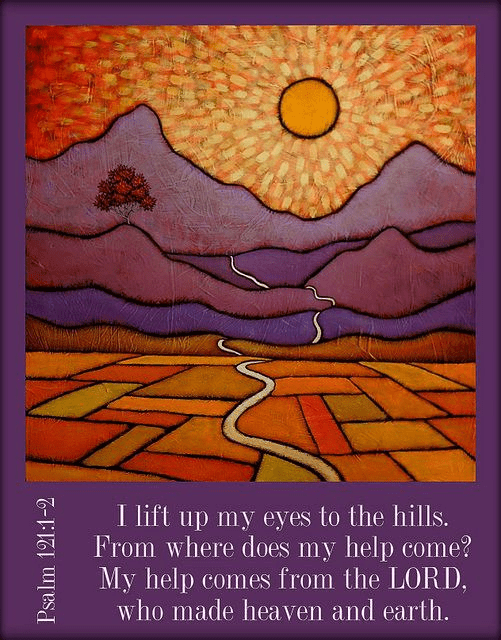
I lift up my eyes to the mountains—
    where does my help come from?
My help comes from the Lord,
    the Maker of heaven and earth.

He will not let your foot slip—
    he who watches over you will not slumber;
indeed, he who watches over Israel
    will neither slumber nor sleep.

The Lord watches over you—
    the Lord is your shade at your right hand;
the sun will not harm you by day,
    nor the moon by night.

The Lord will keep you from all harm—
    he will watch over your life;
the Lord will watch over your coming and going
    both now and forevermore. (New International Version)

Not a one of us gets off this planet without needing help – a lot of help! Even people who are in helping professions or who identify themselves primarily as helpers need help themselves.

There is no such thing as complete, total, and irrevocable independence. We humans are hard-wired by our Creator for community. That means we can only find our greatest fulfillment within interdependent relationships; and, furthermore, discover our highest happiness in a dependent relationship to God.

To need others, and especially to need God, is not a weakness; it’s a sign of strength. To have an awareness that help is needed allows us to make wise and confident choices. Only the fool goes it alone, believing they can pull themselves up by their bootstraps. “God helps those who help themselves,” was originally said by Benjamin Franklin, not Holy Scripture.

So, the question becomes: To whom and to where do we go for help? Who do we consult? With whom do we collaborate?

The most important step any of us can make is to realize that our own personal resources, although important and necessary, are inadequate. Therefore, we must admit, “I need help with this.” The next step is to go to the right source for that help.

The psalmist insists that the Lord is our helper, our keeper. Keeping is a large part of helping. God as our Divine Keeper means that the Lord watches over us, guards our lives, and seeks to preserve us from harm, wrongdoing, injustice, and oppression.

The very identity of God is wrapped up in being a Protector, Guard, and Watchkeeper. The Lord shields and shelters us, much like a mother hen over her chicks. God watches over us, just as a watchman keeps guard over a city at night when the residents are sleeping. And since the Lord is everywhere present, there is a continual divine presence in all of our life journeys. The dangers of both the day and the night are no match for the God who is our Keeper.

The promises of safety in today’s psalm are not meant to suggest that those who walk in the shelter of God will never endure harm or that nothing ill will ever befall them. The Psalter knows all too well that the wicked are everywhere and that they thrive unjustly.

Rather, these divine promises are general promises—they are blessings God does for those who rely on the Lord, call upon God’s name, and seek divine help. We are to have a continual awareness of God’s presence in this world. Although we are not inoculated from pain, God is always with us in our hurt and bewilderment.

It can be hard to ask for help. Our pride, stubbornness, and independence might cause us to experience harm rather than seek assistance. Be specific about the help needed. The following are some “helpful” ways of approaching God by answering some basic newsgathering type questions. The goal isn’t to convince the Lord to help us, but rather to enable us in connecting with what we truly need and being specific about God’s assistance for us or for others:

Who needs help?

Be clear and specific if the help is for yourself, another, or a group of people.

When Jesus had entered Capernaum, a centurion came to him, asking for help. “Lord,” he said, “my servant lies at home paralyzed, suffering terribly.”

Jesus said to him, “Shall I come and heal him?”

The centurion replied, “Lord, I do not deserve to have you come under my roof. But just say the word, and my servant will be healed. (Matthew 8:5-8, NIV)

How will God’s intervention help?

God is an expert listener. Tell the story of what you have tried already and where you fall short.

Jesus asked the boy’s father, “How long has he been like this?”

“From childhood,” he answered. “It has often thrown him into fire or water to kill him. But if you can do anything, take pity on us and help us.”

“‘If you can’?” said Jesus. “Everything is possible for one who believes.”

Immediately the boy’s father exclaimed, “I do believe; help me overcome my unbelief!” (Mark 9:21-24, NIV)

Why are you asking for God’s help?

Explain what’s going on and the reasons why you believe the Lord is the One to help. Mention the divine attributes and actions of God, as well as your own personal connection.

Then Asa called to the Lord his God and said, “Lord, there is no one like you to help the powerless against the mighty. Help us, Lord our God, for we rely on you, and in your name we have come against this vast army. Lord, you are our God; do not let mere mortals prevail against you.” (2 Chronicles 14:11, NIV)

Where is the help needed?

Is it a geographical location, a specific spot in the human body, or a place such as a building or home?

Jesus left the synagogue and went to the home of Simon. Now Simon’s mother-in-law was suffering from a high fever, and they asked Jesus to help her. So, he bent over her and rebuked the fever, and it left her. She got up at once and began to wait on them. (Luke 4:37-39, NIV)

When do you need help?

Immediately? Tomorrow? At a specific time?

O Lord, God of my salvation,

    when, at night, I cry out in your presence,

let my prayer come before you;

    incline your ear to my cry.

For my soul is full of troubles,

    and my life draws near to Sheol. (Psalm 88:1-3, NRSV)

What, exactly, is the need?

Spell out what you want in detail, holding nothing back. Don’t be concerned about the words or saying it right. Speak in your own plain language.

Help, O Lord, for the godly are fast disappearing!

    The faithful have vanished from the earth!

Neighbors lie to each other,

    speaking with flattering lips and deceitful hearts.

May the Lord cut off their flattering lips

    and silence their boastful tongues. (Psalm 12:1-3, NLT)

The help you and I need is in the name of the Lord who made heaven and earth. We only need to ask, and it will be given; seek, and we will find; knock, and the answer will open to us.

I Cannot Do This Alone

A Prayer by Dietrich Bonhoeffer

O God, early in the morning I cry to you.
Help me to pray and to concentrate my thoughts on you;
I cannot do this alone.
In me there is darkness, but with you there is light;
I am lonely, but you do not leave me; I am feeble in heart, but with you there is help;
I am restless, but with you there is peace. In me there is bitterness, but with you there is patience;
I do not understand your ways, but you know the way for me….
Restore me to liberty, and enable me to live now, that I may answer before you and before men.
Lord whatever this day may bring, Your name be praised. Amen.