Psalm 85:1-2, 8-13 – Giving the Good

Psalm 85 by American artist John August Swanson

Lord, you were favorable to your land;
    you restored the fortunes of Jacob.
You forgave the iniquity of your people;
    you pardoned all their sin….

Let me hear what God the Lord will speak,
    for he will speak peace to his people,
    to his faithful, to those who turn to him in their hearts.
Surely his salvation is at hand for those who fear him,
    that his glory may dwell in our land.

Steadfast love and faithfulness will meet;
    righteousness and peace will kiss each other.
Faithfulness will spring up from the ground,
    and righteousness will look down from the sky.
The Lord will give what is good,
    and our land will yield its increase.
Righteousness will go before him,
    and will make a path for his steps. (NRSV)

Steadfast love, faithfulness, righteousness, and peace are terms which all spiritual folks need to be familiar with as well as experience. Steadfast love and faithfulness have its ground in God’s chesed, the divine covenant loyalty and kindness which always holds on, even despite people’s fickle commitment. Righteousness and peace are primarily relational terms which communicate a harmonious way of being with others and all creation.

This psalm says God will give exactly what the people have prayed for. It is a blessing given by the Lord to those who long for wholeness, integrity, and unhindered connection with God and God’s creation. And it is in the metaphors surrounding the words which give us such a beautiful picture of the blessing realized.

This is neither a general nor generic blessing from God Almighty. It is personal. In the grand immensity of the universe, the Creator God bends and condescends not only to all humanity but also to the individual. God’s steadfast love and faithfulness will meet to bless you and me. The Lord will come alongside and conform a divine blessing to our life. God’s grace will stick to us like glue in the form of right relationships and unity.

All of God’s attributes and character shall work in a seamless whole to bring divine acceptance and assistance to our lives. The good news here is that our struggles to be right and live right amidst terrible conditions of pandemics and people’s petulance have a vindication of divine sanction and enablement.

So, take a big breath and exhale, allowing the worries and anxieties of adverse situations to be expelled from our weary spirits. The Lord will give what is good. Today’s psalm is a wonderful reminder that salvation is not limited to a coming life; it is also deliverance in this present world we inhabit, basking in the Lord’s love and shalom and enjoying the good gifts God wants to give us right now.

Gracious God speak peace to your people. Through your Son, the Lord Jesus, we turn to you in our hearts, knowing your steadfast love and faithfulness, your righteousness and peace goes before us, with us, and behind us. In Christ, our salvation is at hand. May we reflect your goodness, as we respond to you with heart, soul, mind, and strength. This we pray in the name of the One who is your peace, your salvation—Jesus Christ. Amen.

Psalm 133 – The Blessing of Unity and Harmony

Ascend to Jerusalem by Dan Livni
“Ascend to Jerusalem” by Dan Livni

Oh, how wonderful, how pleasing it is
when God’s people all come together as one!
It is like the sweet-smelling oil that is poured over the high priest’s head,
that runs down his beard flowing over his robes.
It is like a gentle rain from Mount Hermon falling on Mount Zion.
It is there that the Lord has promised his blessing of eternal life. (ERV)

Unity, solidarity, and harmony are a beautiful blessing. Disunity, division, and fragmentation are an ugly curse. Within all families and faith communities are a diverse bunch of people – which brings the potential of both wonderful fellowship and disagreeing fights.

Today’s reading is a psalm of ascent. It is one of a group of psalms the Israelites would say and sing together as they made their pilgrimage to Jerusalem and ascended the temple mount to worship the Lord. Their common purpose and shared experience led to a blessed unity among all the worshipers.

The metaphors the psalm uses are meant to convey the feeling and impact of a unified people’s blessing as one harmonious bunch. The reference to oil communicates abundance and extravagant blessing beyond expectation. The gentle rain or the dew pictures the giving of life to a parched landscape. The psalm is a celebration of life’s simple pleasures, enjoyed with friends and family.

People created in the image of God are hard-wired for community. Rather than existing in isolation, doing our own thing, and keeping to ourselves, the Lord’s intention for humans is to be close enough to one another to rejoice with those experiencing joy and to weep with those mourning a loss. True community requires unity and harmony.

To live in harmony with one another means we regard everyone the same way by not playing favorites, being condescending, or giving more weight to one group more than another. It is a willingness to interact, work, and play with all kinds of people – not just those whom we like or help us get ahead in life. We are designed by our Creator to live and work together in common purposes. In fact, it takes a great deal of effort.

Be completely humble and gentle; be patient, bearing with one another in love.  Make every effort to keep the unity of the Spirit through the bond of peace (Ephesians 4:2-3, NIV).

Think about what we have in Christ: the encouragement he has brought us, the comfort of his love, our sharing in his Spirit, and the mercy and kindness he has shown us. If you enjoy these blessings, then do what will make my joy complete: Agree with each other and show your love for each other. Be united in your goals and in the way you think. In whatever you do, do not let selfishness or pride be your guide. Be humble, and honor others more than yourselves. Do not be interested only in your own life, but care about the lives of others too (Philippians 2:1-4, ERV). 

If we desire the enjoyment of blessed relationships we will engage in genuine conversation, focused listening, and equal dialogue; simply stating opinions at each other will not do the trick.

Yes, we are to work at unity and harmony because we can have a nasty tendency to think better of ourselves than what is true, and of others what is not so good.  We might inflate our positive qualities and abilities, especially in comparison to other people.  Numerous research studies have revealed the propensity to overestimate ourselves.

For example, when one research study asked a million high school students how well they got along with their peers, none of the students rated themselves below average. As a matter of fact, 60% of students believed they were in the top 10%; and, 25% rated themselves in the top 1%.

College professors were just as biased about their abilities – 2% rated themselves below average; 10% were average and 63% were above average, while 25% rated themselves as truly exceptional. Of course, this is statistically impossible. One researcher summarized the data this way: “It’s the great contradiction: the average person believes he is a better person than the average person.”

Christian psychologist Mark McMinn contends that this study reveals our pride. He writes, “One of the clearest conclusions of social science research is that we are proud. We think better of ourselves than we really are, we see our faults in faint black and white rather than in vivid color, and we assume the worst in others while assuming the best in ourselves.”

Where sinful pride rules, disharmony runs amok within a community. The acid test of harmonious love is how we treat the lowly. One of the great preachers in church history, St. John Chrysostom (the fourth century Bishop of Constantinople) had this to say:

“If a poor man comes into your church behave like him and do not put on airs because of your riches.  In Christ there is no rich or poor.  Do not be ashamed of him because of his outward dress but receive him because of his inward faith.  If you see him in sorrow, do not hesitate to comfort him, and if he is prospering, do not feel shy about sharing in his pleasure.  If you think you are a great person, then think others are also.  If you think they are humble and lowly, then think the same of yourself.”

We cannot function apart from harmony. Consider a tuning fork. It delivers a true pitch by two tines vibrating together. Muffle either side, even a little, and the note disappears. Neither tine individually produces the pure note. Only when both tines vibrate is the correct pitch heard.  Harmony is not a matter of give and take and compromise to make each other happy or satisfied.  Harmony comes through a common mission and purpose which engages in shared experiences of loving and caring for others.

My Christian convictions and tradition tell me that the Word of God is applied by the Spirit of God through the people of God.  We are to embrace community.  We are to do life together.  We are to view everyone as my brother or sister. After all, we are our brother’s keeper.

So, let us ascend the hill of the Lord together. Let us worship God together with glad and sincere hearts. Let us be mindful of all our brothers and sisters, no matter who they are.


Psalm 105:1-6, 16-22, 45 – On Divine Providence

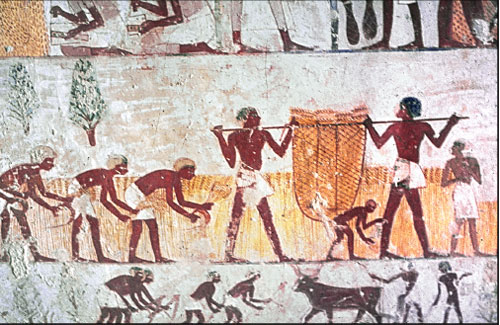
Egyptian workers harvesting grain c1420BCE
Egyptian workers harvesting grain. From the tomb of Mena in Thebes, c.1420 B.C.E.

Give thanks to the Lord and proclaim his greatness.
Let the whole world know what he has done.
Sing to him; yes, sing his praises.
Tell everyone about his wonderful deeds.
Exult in his holy name;
rejoice, you who worship the Lord.
Search for the Lord and for his strength;
continually seek him.
Remember the wonders he has performed,
his miracles, and the rulings he has given,
you children of his servant Abraham,
you descendants of Jacob, his chosen ones….

He called for a famine on the land of Canaan,
cutting off its food supply.
Then he sent someone to Egypt ahead of them—
Joseph, who was sold as a slave.
They bruised his feet with fetters
and placed his neck in an iron collar.
Until the time came to fulfill his dreams,
the Lord tested Joseph’s character.
Then Pharaoh sent for him and set him free;
the ruler of the nation opened his prison door.
Joseph was put in charge of all the king’s household;
he became ruler over all the king’s possessions.
He could instruct the king’s aides as he pleased
and teach the king’s advisers….

All this happened so they would follow his decrees
and obey his instructions.

Praise the Lord! (NLT)

Our spiritual and emotional vision can sometimes be myopic. It is precisely in those times when we have tunnel vision and neither look back to a past in which God acted with justice nor see ahead to a future with hope that we must remember God is supreme over everything, including time.

God’s providence and blessing is the animating force behind all events. The biblical character of Joseph is Exhibit A of God’s sovereign backstage orchestration of personal and world forces. Joseph’s story of brotherly betrayal, bondage, imprisonment, and rise to power include some lessons for us (Genesis 37-41):

  • Joseph is portrayed as a model of wisdom for us to follow.

Respect and obey the Lord! This is the beginning of knowledge. Only a fool rejects wisdom and good advice (Proverbs 1:7, CEV).  

Do not let mercy and truth leave you. Fasten them around your neck. Write them on the tablet of your heart. Then you will find favor and much success in the sight of God and humanity (Proverbs 3:3-4, GW).

  • Joseph did not know the end of the story while he was in the middle of it, languishing in prison. Little did he know that God was testing his character, training him to listen well, and preparing him for his eventual leadership in Egypt – all to save many lives from hunger and starvation.

Now faith is the assurance of things hoped for, the conviction of things not seen. (Hebrews 11:1, NRSV)

  • Joseph successfully negotiated and navigated a world which was vastly different from his own religion and ethics. He was determined not to give in to the seductions of women and power around him; and, he did not become bitter against his brothers, nor against the Egyptians.

Don’t love the world’s ways. Don’t love the world’s goods. Love of the world squeezes out love for the Father. Practically everything that goes on in the world—wanting your own way, wanting everything for yourself, wanting to appear important—has nothing to do with the Father. It just isolates you from him. The world and all its wanting, wanting, wanting is on the way out—but whoever does what God wants is set for eternity. (1 John 2:15-17, MSG)

Four-hundred years later, Moses also had to navigate the situation of being an Israelite in the world of Egypt, and walked in the footsteps of his forebear, Joseph:

By faith Moses, when he had grown up, refused to be known as the son of Pharaoh’s daughter.  He chose to be mistreated along with the people of God rather than to enjoy the pleasures of sin for a short time.  He regarded disgrace for the sake of Christ as of greater value than the treasures of Egypt because he was looking ahead to his reward. (Hebrews 11:24-26, NIV)

We understand, knowing the end of the story, that Joseph was in Egypt (in the world) to be a blessing and that God had him there for a purpose. This is no less true for the people of God. We do not exist merely for ourselves but to be a blessing to the world.  God, as he did for Joseph, shows us mercy while we are smack in the middle of hardship and not by taking us out of our worldly predicament.  Life must sometimes be lived at great risk amid the world and not apart from it.

Seen from a strictly worldly perspective, Joseph’s time in slavery and prison was an unnecessary injustice. However, from God’s vantage point, Joseph was learning to be mindful of God despite his circumstances. For the Lord is much more concerned about the process we undergo in spiritual formation, rather than simply producing a product at the end of the line. Most of life is lived in the mundane, and Joseph was faithful in all the workaday decisions and demands of life. This made him able to handle all the vicissitudes of others in their fickle and feckless ways and see God’s providential working.

Lord God, you hold both heaven and earth in a single peace. Let the design of your great love shine on the waste of our anger and sorrow, and give peace to your Church, peace among nations, peace in our homes, and peace in our hearts through Jesus Christ our Lord who with you and the Holy Spirit benevolently reign as one God, now and forever. Amen.

Genesis 27:30-46 – “Bless Me, Too!”

Isaac Blesses Jacob by Yoram Raanan

After Isaac finished blessing him, and Jacob had scarcely left his father’s presence, his brother Esau came in from hunting. He too prepared some tasty food and brought it to his father. Then he said to him, “My father, please sit up and eat some of my game, so that you may give me your blessing.”

His father Isaac asked him, “Who are you?”

“I am your son,” he answered, “your firstborn, Esau.”

Isaac trembled violently and said, “Who was it, then, that hunted game and brought it to me? I ate it just before you came, and I blessed him—and indeed he will be blessed!”

When Esau heard his father’s words, he burst out with a loud and bitter cry and said to his father, “Bless me—me too, my father!”

But he said, “Your brother came deceitfully and took your blessing.”

Esau said, “Isn’t he rightly named Jacob? This is the second time he has taken advantage of me: He took my birthright, and now he’s taken my blessing!” Then he asked, “Haven’t you reserved any blessing for me?”

Isaac answered Esau, “I have made him lord over you and have made all his relatives his servants, and I have sustained him with grain and new wine. So, what can I possibly do for you, my son?”

Esau said to his father, “Do you have only one blessing, my father? Bless me too, my father!” Then Esau wept aloud.

His father Isaac answered him,

“Your dwelling will be
away from the earth’s richness,
away from the dew of heaven above.
You will live by the sword
and you will serve your brother.
But when you grow restless,
you will throw his yoke
from off your neck.”

Esau held a grudge against Jacob because of the blessing his father had given him. He said to himself, “The days of mourning for my father are near; then I will kill my brother Jacob.”

When Rebekah was told what her older son Esau had said, she sent for her younger son Jacob and said to him, “Your brother Esau is planning to avenge himself by killing you. Now then, my son, do what I say: Flee at once to my brother Laban in Harran. Stay with him for a while until your brother’s fury subsides. When your brother is no longer angry with you and forgets what you did to him, I’ll send word for you to come back from there. Why should I lose both of you in one day?”

Then Rebekah said to Isaac, “I’m disgusted with living because of these Hittite women. If Jacob takes a wife from among the women of this land, from Hittite women like these, my life will not be worth living.” (NIV)

The twins Esau and Jacob are the very definition of sibling rivalry. Even at their birth, they jostled and positioned for their entry into the world. Although brothers, they were different from one another in every way. As their aged father, Isaac, was near the end of his days, he was looking to pass on a family blessing to Esau, the firstborn. And that’s where things got dicey.

Jacob, always the trickster, was still playing out the rivalry. When his brother Esau was out hunting and preparing to receive his father’s blessing, Jacob posed as his brother and deceitfully gained the blessing of Isaac. Both Isaac and Esau were shocked to discover what happened. Esau’s response was one of grief, disappointment, bitterness, with tears and weeping. Despite Esau not being known for his sensitivity to God or family before this event, we can certainly feel his cry: “Do you have only one blessing, my father? Bless me too, my father!”

Blessing with hands

The blessing. As a chaplain who works with behavioral health patients, I have heard many times over the lament of individuals without a blessing from their father. As people created in the image and likeness of God, we were meant to be blessed – to have a loving and enduring stamp of approval from both our heavenly Father and our earthly fathers. And when an earthly father, or father figure, either cannot or will not extend a vital blessing to children, it is a terrible wound – like an invisible open putrid abscess which continually leaves the person emotionally and spiritually sick.

Blessing is needed. Without blessing we flounder in the world, struggling to see hope, wondering if we are loved, and lacking confidence in our faith. To be blessed is to receive a beautiful gift. The term “blessing” in Scripture is a powerful communication of God’s presence and approval. So, when humans bless one another, we offer commitments of love and connection. We provide powerful words of encouragement and picture a special future for those we are close to.

None of this is optional. Blessing is God’s way of building up one another and fortifying each other for the rigors of this world. When blessing is withheld, and even worse, when it is replaced with cursing, then individuals are bereft of support to face stressful situations. Like a ship adrift without any power or wind, so the person trying to live in this world without blessing is dead in the water. Where there is no blessing, like Esau, revenge fills our hearts.

Jesus clearly understood the need and the power of blessing, and he was not deterred in deliberately offering it:

People were bringing little children to Jesus for him to place his hands on them, but the disciples rebuked them. When Jesus saw this, he was indignant. He said to them, “Let the little children come to me, and do not hinder them, for the kingdom of God belongs to such as these. Truly I tell you, anyone who will not receive the kingdom of God like a little child will never enter it.” And he took the children in his arms, placed his hands on them and blessed them. (Mark 10:13-16, NIV)

I wonder how this simple encounter affected the lives of those children on that day in which Jesus blessed them. I am curious in what ways they grew-up and how Christ’s blessing shaped their lives. Because that is what blessing does: it forms us into the kind of people we were meant to be.

Receive today this blessing from Holy Scripture:

The Lord bless you and keep you;
the Lord make his face to shine upon you, and be gracious to you;
the Lord lift up his countenance upon you, and give you peace. Amen. (Numbers 6:24-26, NRSV)