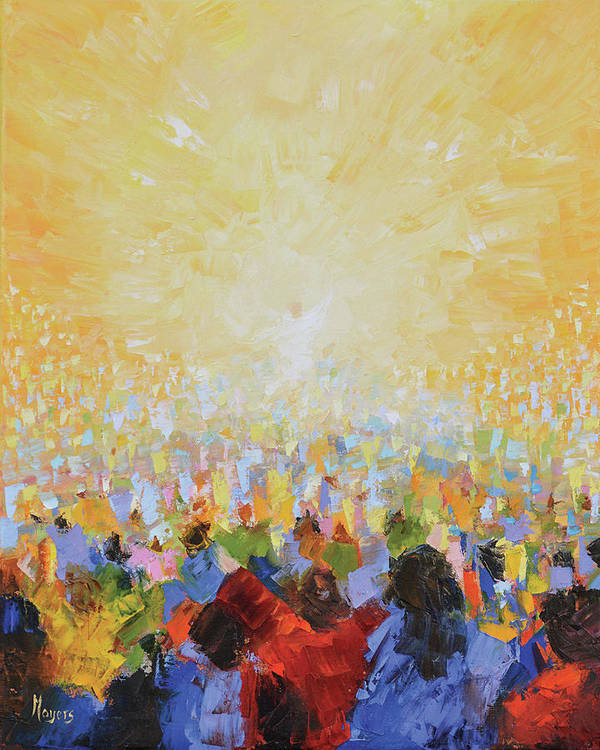
Psalm 67 – Make Your Face Shine Upon Us

May God be gracious to us and bless us
    and make his face to shine upon us,
that your way may be known upon earth,
    your saving power among all nations.
Let the peoples praise you, O God;
    let all the peoples praise you.

Let the nations be glad and sing for joy,
    for you judge the peoples with equity
    and guide the nations upon earth.
Let the peoples praise you, O God;
    let all the peoples praise you.

The earth has yielded its increase;
    God, our God, has blessed us.
May God continue to bless us;
    let all the ends of the earth revere him. (New Revised Standard Version)

One of the many reasons I like using the Revised Common Lectionary daily readings is that a psalm is read every day.

This is important because, slowly and over time, the reader moves to becoming a worshiper and a faithful person of prayer. What’s more, the psalms help us become familiar with the human range of emotion, various life situations, and sound theology. 

In an era when so many believers are “too busy” for basic Bible reading, daily prayer, and connection with God, this creates a dearth of sage spiritual direction from others. The “advice” which many well-meaning Christians give to each other is many times nothing more than microwaved leftovers of common foolishness in the guise of wisdom.

We’re devouring the innards of roadkill when we could be eating a choice meal of select and juicy psalms.

The psalms are the Church’s prayer book. We need the biblical psalter, just as much as we need the air we breathe. We also live in a time in which many people can access Holy Scripture (for free) via their smart phones, tablets, and computers. One can even add the voice function so that the believer can pray along with particular psalms.

An advantage to becoming conversant in the psalms is the ability to use them for all kinds of situations. Today’s psalm meets a particular need for prayer: How ought to politics and religion meet in our prayers to God?

In the USA, just say the word “politics” and many people get a visceral response before there is even a discussion about it. Feelings and opinions run high. Negativity is rampant. Mudslinging and name-calling are rife.

Psalm 67 offers a different path. It is the way of blessing the nations, the nation’s blessing God, and all of us together as a community of God’s people inviting God to work divine grace among us. 

The prayers to be offered are for the nations of this earth to know the Lord and bless God as Savior and Sovereign; for the Lord’s true identity and character to be revealed as Shepherd and Supreme to all; and for God’s people to be blessed so that the Lord will be revealed as the salvation of the nations.

Rather than become mucked in worry or despair over present circumstances and the unknown future, the psalmist orients our minds, hearts, and voices toward the sovereign God.

The psalms are meant to be used – repeatedly. One cannot overuse them. So, give this a try: Today set your phone, watch, or other device to alarm at two or three hour intervals. Whatever you are doing (if you are able) stop and pray Psalm 67. It will take less than a minute.

Let the positive approach to blessing others and seeing God’s control shape how you go about the rest of your day. Who knows? Maybe the psalter will eventually alter how you view the world, as well as yourself.

Lord, the light of your love is shining
In the midst of the darkness, shining
Jesus, Light of the world, shine upon us
Set us free by the truth you now bring us

Shine on me, shine on me

Shine, Jesus, shine
Fill this land with the Father’s glory
Blaze, Spirit, blaze
Set our hearts on fire
Flow, river, flow
Flood the nations with grace and mercy
Send forth your word
Lord, and let there be light

Lord, I come to your awesome presence
From the shadows into your radiance
By the blood I may enter your brightness
Search me, try me, consume all my darkness
Shine on me, shine on me

Shine, Jesus, shine
Fill this land with the Father’s glory
Blaze, Spirit, blaze
Set our hearts on fire
Flow, river, flow
Flood the nations with grace and mercy
Send forth your word
Lord, and let there be light

As we gaze on your kingly brightness
So our faces display your likeness
Ever changing from glory to glory
Mirrored here may our lives tell your story
Shine on me, shine on me

Shine, Jesus, shine
Fill this land with the Father’s glory
Blaze, Spirit, blaze
Set our hearts on fire
Flow, river, flow
Flood the nations with grace and mercy
Send forth your word
Lord, and let there be

Send forth
Send forth your word
Lord, and let there be
Send forth your word
Lord, and let there be light – Graham Kendrick

Luke 14:12-14 – Abundance and Inclusion For All

The Great Banquet by Hyatt Moore

Then Jesus said to his host, “When you give a luncheon or dinner, do not invite your friends, your brothers or sisters, your relatives, or your rich neighbors; if you do, they may invite you back and so you will be repaid. But when you give a banquet, invite the poor, the crippled, the lame, the blind, and you will be blessed. Although they cannot repay you, you will be repaid at the resurrection of the righteous.” (New International Version)

A lot of people live by the old adage, “You scratch my back and I’ll scratch yours.” It’s a phrase referring to reciprocity. In other words, if you give me something I want, I will then respond by giving you something you want.

That old adage works fine, that is, unless you have no ability to give or give back to another. If we only operate by the principle of reciprocity, a large chunk of people automatically get left out. And this situation is untenable and unacceptable to Jesus.

Christ observed that the religious insiders of his day were keeping entire groups of people on the outside through their practice of scratching one another’s backs.

We need to get ahold of the reality that God loves us, as well as everyone else – even the people we may not give the time of day to. God so loved the world that he sent his Son. Jesus has come to feed us. 

The kingdom of God is about food. The food given by Jesus is to feed the hungry by staging a banquet. It is a feast of God’s abundance. Yet, many seem to hoard the resources they have, only thinking about their friends, family, and people just like them. They act as if there is no need to invite outsiders, consumed as they are with their own daily lives.

We have an incredible abundant feast contained in Scripture – in fact, Jesus said that his food and drink was to do the Father’s will, that Scripture was his bread. (Matthew 4:4; John 4:34) 

It’s much too easy to take our blessings of food for granted. After all, when we are well-fed, it’s easy to assume that everyone else is, too. Feeling healthy, it’s easy to forget that others are hurting. Making money, it’s easy to think there are not many poor people around. Living in a community with plenty of churches and more bibles than people, it’s natural to assume that everyone knows the gospel of Jesus – but they don’t!

Then, whenever we get around to acknowledging there are people who need Jesus, we keep devising ways to reach them without having to change or accommodate our own lives to do it.

Christ’s call to faithful discipleship requires people to change from having a narrow focus on our small circle of friends, to including those who have no means to pay us back.

The gospel of Jesus Christ is open to outcasts and failures, to problem people and to unimpressive persons. People with needs and flaws are especially dear to Jesus. It’s the people who outwardly have it all together who are being replaced wholesale with those who admit their need. 

We must not be picky about who we invite to participate in the largess of abundance we possess. We are to avoid the spiritual snobbery of looking down our noses at the needy and less fortunate, who have nothing to offer us in return.

St. John Chrysostom (348-407, C.E.) was a Bishop of Constantinople and arguably one of the greatest preachers in the history of Christianity. John always thought of both the recipient and the giver in his sermons, insisting that both need God’s mercy.

With a concern for the giver’s soul, John insisted that givers provide for all – even the lazy, the fool, and the sinner. By opening our hearts in almsgiving, we open ourselves to Christ, who is present in the least of those among us. Refusing mercy to people deemed as unworthy, givers then actually shut themselves off from the very mercy God desires for them.

There is no reward from God when there is only reward from others.

“If we are going to examine lives, we will never have mercy upon any human being; rather, hindered by this inopportune meddlesomeness, we will remain fruitless and destitute of all help ourselves.”

St. John Chrysostom, On Repentance and Almsgiving

It’s not only the poor who suffer when the rich fail to give. In judging whether or not a particular person is worthy of love and aid, the wealthy person rejects the spiritual fruit that he would have received by giving with humility.

Giving to the poor, simply to relieve our own conscience, is not real charity; it doesn’t consider the other. We attend fully to the other by observing their spiritual and holistic needs for community, purpose, respect, and dignity. Dispassionate giving from a distance, without relationship, refuses to acknowledge the whole person. It exploits the poor for the mental comfort of the rich.

We need to be involved in people’s lives, and that takes a lot of blood, sweat, and tears. There are too many lost people who need Jesus, and too many Christians who are the walking wounded and need the healing touch of Jesus, for us to pay scant attention to the call of Jesus to invite the needy into our lives. 

Seeing people come into God’s great banquet, and into a joyous and vital relationship with Christ, probably takes about ten times more work than what you are thinking it does right now. Yet, this is the pathway of true blessing – to having God’s stamp of approval on our lives.

Merciful God, thank you for the abundance of life, relationships, health, comfort, and wealth you have provided to so many. Thank you that, even in times of need, despair, and brokenness, you are there. Please, put your arms around children and families in  poverty and disability so that they feel your comfort and hope. Meet their needs both physically and spiritually. And guide me so I can be your hands and feet pursuing justice for the poor and upholding the cause of the needy, in the way of Jesus Christ our Lord. Amen.

Ephesians 1:3-14 – We Are Blessed

Hallelujah by Mike Moyers

Praise be to the God and Father of our Lord Jesus Christ, who has blessed us in the heavenly realms with every spiritual blessing in Christ. For he chose us in him before the creation of the world to be holy and blameless in his sight. In love he predestined us for adoption to sonship through Jesus Christ, in accordance with his pleasure and will— to the praise of his glorious grace, which he has freely given us in the One he loves. In him we have redemption through his blood, the forgiveness of sins, in accordance with the riches of God’s grace that he lavished on us. With all wisdom and understanding, he made known to us the mystery of his will according to his good pleasure, which he purposed in Christ, to be put into effect when the times reach their fulfillment—to bring unity to all things in heaven and on earth under Christ.

In him we were also chosen, having been predestined according to the plan of him who works out everything in conformity with the purpose of his will, in order that we, who were the first to put our hope in Christ, might be for the praise of his glory. And you also were included in Christ when you heard the message of truth, the gospel of your salvation. When you believed, you were marked in him with a seal, the promised Holy Spirit, who is a deposit guaranteeing our inheritance until the redemption of those who are God’s possession—to the praise of his glory. (New International Version)

God has blessed us. The word “blessing” comes from the same word for “giving thanks.”  So, when, we consider the ways God has spiritually blessed us, it leads us to effusive gratitude and praise.  And this was exactly the case for the Apostle Paul.

In writing these words, Paul was so excited to share with the church at Ephesus about the blessings of God that he could not stop. In our English translations we have broken these verses up into several sentences and two paragraphs. But Paul originally penned this as one sentence!

More than anything, Paul wanted the church to know the wonderful blessings of God to them. Throughout the book of Ephesians, Paul’s constant theme to the church is reconciliation and restoration. In fact, that is the end game for God. God has cares about reconciling people to himself, and others. The Lord deeply cares about restoring the entire world to the lordship of Jesus Christ.

To accomplish this gigantic feat, God intervened into humanity by giving the church three main blessings: election, redemption, and inheritance.

Election 

The word “chose” and “chosen” in some English translations is the Greek word ἐκλεκτός (eklektos) or “election.” This is where it all begins for us. Even before the creation of the world, God had the end of the story in mind. Divine decisions were made about outcomes and results. 

This approach, by the way, is how we are to engage ministry in the church. That is, we begin with the end in mind of what we want to accomplish. Then, we gather the people and begin making the needed decisions to see that end purpose realized. Too often, churches begin with a group of people and wonder about what they should do – which is backwards from how God does it. 

In eternity past, in love, God predestined us to be adopted as his children. You and I are so loved by God that we were special to him before we were even ever born! Election means God has a purpose for us. On the human level, we elect candidates so that they may serve the common good and put their energies into accomplishing some noble cause. 

Likewise with God. We were not elected or chosen by God solely to go to heaven when we die.  Although that is true and shall happen, the reason we were chosen by God was for us to be holy and blameless, to be for the praise of God’s glory. We are not in some sort of holding pattern on earth, impatiently waiting for the afterlife. Rather, we are to be active in accomplishing God’s purposes for our election. And what is that purpose?

We are to participate with God in the grand scheme of reconciling and restoring all of creation back to the original design. Therefore, every act of forgiveness, grace, love, and kindness; every overture of faith and communication of the gospel to others; and all steps of obedience are small movements toward the great restoration story God is writing. 

For example, the book of Acts ends on a dramatic note with no resolution to it. That’s because the story is still being written. We are chosen to be a part of it.

Redemption 

To be redeemed means to be delivered by a payment of a price. In the ancient world, slavery was an entrenched part of the society. The picture of the slave market provided a means for Paul to communicate a spiritual blessing: We have been redeemed from the slave market of sin through the payment of Christ’s blood, and so now, we enjoy the freedom from and forgiveness of sin. 

This is not just redemption from something (sin, death, and hell); it is also redemption to reconciliation and restoration. God elected us to receive redemption so that the grand design of bringing all the earth under the lordship of Christ will happen. God has and is creating a new society, the community of the redeemed, that will realize the original design of unhindered connection with God and others. 

Inheritance

We are receiving an inheritance. It will be put into effect when God’s timing and purpose is accomplished – and Paul spells the purpose out: To bring all things in heaven and on earth together under one head, Jesus Christ. 

Here is how Paul envisions what is coming: The chosen and redeemed of God will one day die, then they will go to be with Christ. But that is not yet the end because the entire world still needs redemption. This is why the preacher of Hebrews could say about the great heroes of the faith:  

These were all commended for their faith, yet none of them received what had been promised.  God had planned something better for us so that only together with us would they be made perfect. (Hebrews 11:39-40, NIV)

There is not just life after death; there is life after life-after-death. All those people of faith, including our believing friends and relatives who have gone before us to be with Jesus, are waiting. They, along with us, have not yet received all the promised blessings of our inheritance. 

We are waiting for the reconciliation and restoration of all things, a new heaven and a new earth in which we will be together as sons and daughters in the kingdom of God with Jesus as King over us. The possession of the Holy Spirit is the guarantee that this is the case, and it will happen. 

Conclusion

Our blessings of election, redemption, and inheritance are all activated by faith. Belief is the switch that turns on the blessings to us in a real and actual way. The electricity is there in the person of the Holy Spirit. The light bulb is there, and it is us. 

So, the question for us today is: Are we turned on and shining brightly, or is the switch off?  We must access our blessings by belief in the Son of God who loved us and gave himself for us.

God is on a mission to reconcile and restore the world. Our salvation is part of God’s plan to make that happen. God is a missionary. The Lord has chosen us to be emissaries to a world that needs redemption and restoration. 

The church is like no other institution on earth – existing for the life of the world, and not for itself. Like a mighty army, we are to train ourselves for godliness so that we can engage an invisible enemy and see the kingdom of God come and the will of God done here on earth as it is always done in heaven. 

The camaraderie we enjoy as fellow soldiers is not the end purpose – restoring enemy territory back to its original government is. So, we care for our wounded and do everything we can for them. There are yet more spiritual battles to be won and hearts captured for King Jesus. 

May you and I, then, give thanks with grateful hearts for the great spiritual blessings of election, redemption, and inheritance so that God’s benevolent and merciful rule might spread everywhere to everyone.

God our Savior, you desire that none should perish, and you have taught us through your Son that there is great joy in heaven over every sinner who repents: Grant that our hearts may ache for a lost and broken world. May your Holy Spirit work through our words, deeds, and prayers, that the lost may be found and the dead made alive, and that all your redeemed may rejoice around your throne, through Jesus Christ our Lord. Amen.

Matthew 5:5 – Blessed Are the Meek

Blessed are the meek,
    for they will inherit the earth. (NIV)

To give us a flavor of Christ’s counter-cultural Beatitudes, when was the last time, or has anyone ever, described themselves to you as meek?

Whenever I have interviewed people for positions, both paid and voluntary, and asked them to tell me their strengths, I have never had anyone say to me, “I’m a meek person.”

Why would I want to be meek?

Far too often, we equate meek with weak. If someone is meek, we may wrongly reason they must be a washrag, or overly introverted, and maybe not taking proper initiative in life. Of all the character qualities we might aspire to, I doubt that meekness is on anyone’s top ten list of desired qualities.

Yet, of the few words in the Gospels which Jesus uses to describe himself, one of those words is meek. And even then, many English translations steer clear of the word. For example, the New International Version of the Bible says in translating the words of Jesus, “Come to me all you who are weary and burdened, and I will give you rest. Take my yoke upon you and learn from me, for I am gentle and humble in heart, and you will find rest for your souls. For my yoke is easy and my burden is light.” (Only the King James Version translates the word as “meek,” instead of “gentle.”)

What does it mean to be meek?

Meek and gentle are the same words. The original Greek word is πραεῖς (pronounced “prah-ace”). “Meek” is the word used in other ancient Greek literature for breaking a horse. It is to be changed from being a wild stallion who wants to go his own way, to a broken horse who is gentle before the Master and allows others on his back without bucking.

Consider, for example, the scene around Christ’s crucifixion. Jesus was naked, exposed, and vulnerable to the idle curiosity of the crowd and the vulgar frivolity of the soldiers who were having a party around his suffering. “If you are the king of the Jews,” they taunted, “save yourself.”

And yet the extraordinary thing is there was no spirit of revenge with our Lord. Jesus did not curse his tormentors. Instead, he prayed, “Father forgive them, for they don’t know what they’re doing.” (Luke 23:24)

It is important to notice the meekness that Jesus is speaking about in this Beatitude is not being a pushover. Meekness is not to be confused with being nice and easy-going. Meek and lowly as he was, Jesus could also take a whip to greedy money-changers in the Temple. We must not confuse meekness with weakness.

What characterizes a meek person?

Whereas poverty of spirit is more a humility before God, meekness is a humility toward other people. It is to be flat on our backs with only one way to look: up to God; and because we are in that position, there is no opportunity to look down on others. 

Meekness is a foundational Beatitude. Jesus considers it a necessary part of righteousness. I believe the word “meek” needs a renaissance. Even if we use the word “gentle” this will be a great advancement in how people interact with one another. So, what characterizes a meek person?

  • The meek have a desire to put other’s interests ahead of their own, because they know it is not all about them. They practice healthy rhythms of giving and receiving with others, without prejudice or favoritism.
  • The meek are more concerned with edifying and building up their brothers and sisters than justifying themselves. They don’t care who gets the credit. And they receive criticism well.
  • The meek are truly egalitarian and do all things with equity and inclusion. They make no distinctions between rich and poor, beautiful and ugly, intelligent and cognitive deficits, black and white, gay and straight, Democrat and Republican, or insider and outsider. In the meek person’s mind, every person is created in the image of God and therefore deserves respect, attention, and justice.

It is the meek who will inherit the earth – not aggressive people who believe in survival of the fittest, stepping on people to get where they want to go, or badgering others in order to get their way. 

Someone might protest, “But if I live this way, I’ll be pushed around.”  Meekness is not living without boundaries but is power under control. Maybe you will get stepped on – but you will inherit the earth.

How do I live as a meek person?

The three Beatitudes of being poor in spirit, mourning over sin, and meekness toward others are foundational to all that Jesus says and does. They are central to being Christ’s follower. Without them, there is only a contrived legalistic righteousness of our own without any real need of God. That is the way of pride, which is the straight and broad road to hell. 

Perhaps repentance is in order. It could be that too many people have made much more of themselves than what they truly are. Maybe we have adopted a soft attitude toward shame and shaming others, believing that some people need a bit of guilt from us to change their obnoxious ways. Perhaps we have paid scant attention to those who are in physical or spiritual poverty. And just maybe we have ignored and gossiped about others simply because we believe we are better than them.

A genuine follower of Christ lives a repentant lifestyle. The Apostle James said, “Confess your sins to one another, and pray for one another so that you may be healed” (James 5:16).  The way of Christ is the way of community. We are not to live ingenuine lives, hiding behind a mask of outward conformity. Now is the time for authenticity, living life as God intended it to be lived, as a disciple of Jesus in the way of spiritual poverty, mourning, and meekness – the narrow path that leads to salvation.

Non-retaliation happens when we realize our poverty of spirit and practice grief and lament. When we are flat on our backs before God, there is no place to look but up. And it means there is no ability to look down on others. It is to be broken and moldable before God. 

If you and I were part of the original crowd that listened to Jesus, there is hope. I have no ability to practice retaliation, even if I wanted to, because I have no earthly power. But that’s okay because, in this spirit of meekness, I take personal responsibility for my attitudes and my actions. I am neither worse nor better than any other person. I do not need to retaliate, even when egregiously wronged, because I can fully entrust myself to God alone who judges the living and the dead. 

Conclusion

It turns out that brokenness is the path to genuine righteousness. Jesus promised that the meek will inherit the earth. Christ didn’t just make that up. He was quoting Holy Scripture:

Do not fret because of those who are evil
    or be envious of those who do wrong;
for like the grass they will soon wither,
    like green plants they will soon die away.

Trust in the Lord and do good;
    dwell in the land and enjoy safe pasture.
Take delight in the Lord,
    and he will give you the desires of your heart.

Commit your way to the Lord;
    trust in him and he will do this:
He will make your righteous reward shine like the dawn,
    your vindication like the noonday sun.

Be still before the Lord
    and wait patiently for him;
do not fret when people succeed in their ways,
    when they carry out their wicked schemes.

Refrain from anger and turn from wrath;
    do not fret—it leads only to evil.
For those who are evil will be destroyed,
    but those who hope in the Lord will inherit the land.

A little while, and the wicked will be no more;
    though you look for them, they will not be found.
But the meek will inherit the land
    and enjoy peace and prosperity. (Psalm 37:1-11, NIV)

Jesus was saying that only the truly meek will learn contentment, joy, and satisfaction. Their ego is not so inflated that they insist they deserve more. Indeed, because as God’s people they are learning from him, the meek understand they are co-heirs with Christ in an inheritance of God’s kingdom.

May your meekness and gentleness be known to all.

*Above painting by Hyatt Moore