Christ’s Beatitudes (Matthew 5:1-12)

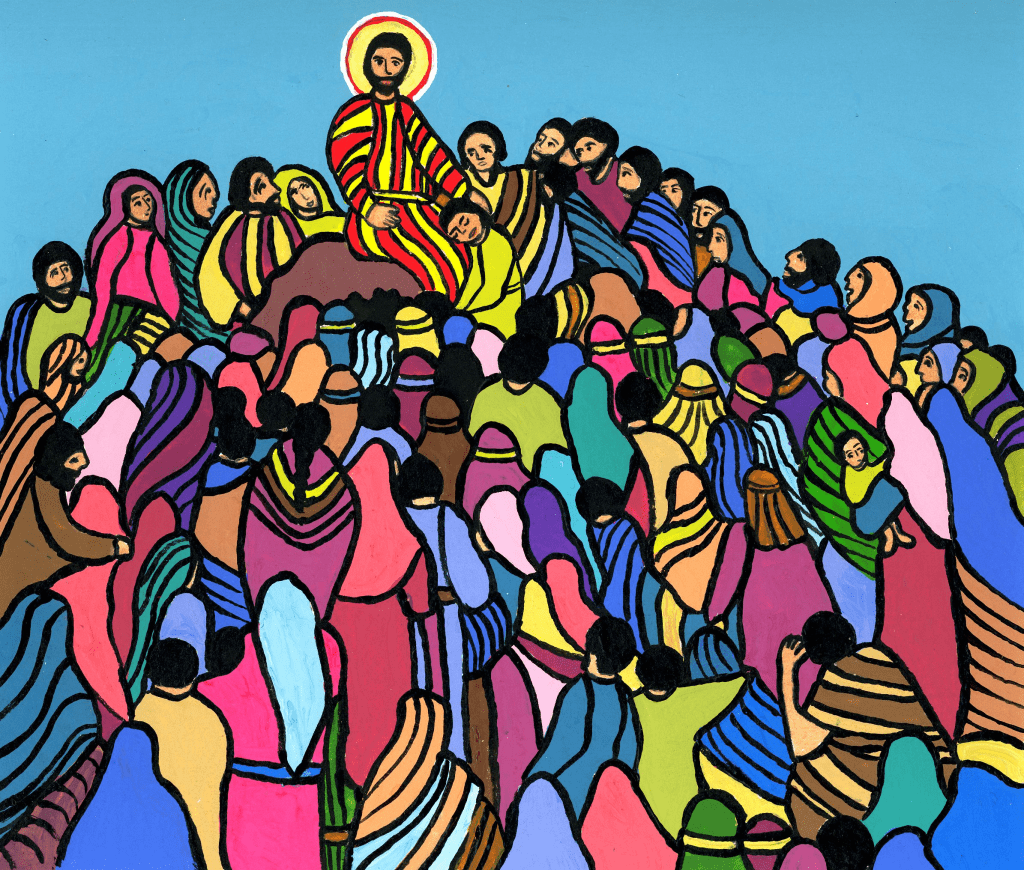
Sermon on the Mount by Gisele Bauche

When Jesus saw the crowds, he went up the mountain, and after he sat down, his disciples came to him. And he began to speak and taught them, saying:

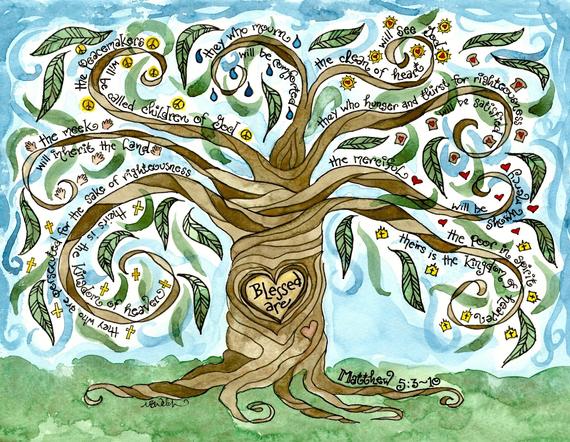
“Blessed are the poor in spirit, for theirs is the kingdom of heaven.

“Blessed are those who mourn, for they will be comforted.

“Blessed are the meek, for they will inherit the earth.

“Blessed are those who hunger and thirst for righteousness, for they will be filled.

“Blessed are the merciful, for they will receive mercy.

“Blessed are the pure in heart, for they will see God.

“Blessed are the peacemakers, for they will be called children of God.

“Blessed are those who are persecuted for the sake of righteousness, for theirs is the kingdom of heaven.

“Blessed are you when people revile you and persecute you and utter all kinds of evil against you falsely on my account. Rejoice and be glad, for your reward is great in heaven, for in the same way they persecuted the prophets who were before you. (New Revised Standard Version)

God’s Law (The Ten Commandments) was given on a mountain. That Law was restated and reframed on a mountain by Jesus in his Sermon on the Mount.

I believe that arguably one of the most important and impactful portions of Holy Scripture are the Beatitudes of Jesus, which serve as the foundation to all of Christ’s teaching.

Christ’s Beatitudes are not simply a random collection of pithy phrases from Jesus on what constitutes approval and blessing from God. They intentionally build upon each other and describe the nature of true righteousness.

The Poor in Spirit

Spiritual poverty, not wealth, is the spiritual base to the Christian life. Most of the original crowd listening to Jesus thought they were on the outside of the kingdom, on the margins of true religion. But Jesus told them they have a place in God’s reign as poor and pitiable people.

To be “poor in spirit” is to be a spiritual beggar who recognizes they have nothing to offer God. It is seeing oneself, one’s sin, and one’s life as spiritually bankrupt apart from God.

Beggars have neither the leverage nor the ability to strike deals with anybody; and so, they do one thing: beg continually.

The proud person would never be caught begging for anything. Yet, the humble spiritual beggar constantly prays because they need God. They discern that without God there is no hope. The kingdom of heaven belongs to the penitent and not to the proud.

The Mourners 

Mourning is the emotional response of acknowledging one’s spiritual poverty. 

Grief and lament have a central place in Christian theology and life. To avoid it, work around it, or short-circuit its process is to refuse Christ; there is no righteousness apart from mourning over sin. Crying, weeping, and even intense tears are important and necessary.

To experience personal grief over one’s sins and the sins of the church and the world is a Beatitude of Jesus. You neither need position, power, privilege, nor pedigree to be a mourner. All can mourn. This is the door by which we enter the kingdom of God.

The Meek

A meek and gentle spirit is the result of realizing poverty of spirit and practicing lament.

At the heart of what it means to be meek is a spirit of non-retaliation. Whenever we are flat on our backs before God, there is no place to look but up. Thus, there is no ability to look down on others.

To be meek is to be broken and moldable before God. A meek person takes personal responsibility for their attitudes and actions. The meek have no need to retaliate, even when egregiously wronged, because they fully entrust themselves to God alone who judges the living and the dead.

Ironically, brokenness is the path to righteous wholeness.

The Hungry and Thirsty

Only those who know their poverty of spirit, personally grieve over sin, and are gentle, end up longing for righteousness.

The desire for righteousness is a recognition that without God I will not make it. I cannot be righteous without Jesus. Simply put, righteousness is a right relationship with God and others.

Those who hunger and thirst for God’s righteousness know they cannot make things right by themselves; they need God’s help.

If we think we can live most days of our lives without God, we do not yet know true righteousness. People who understand their great need for Jesus are easy to spot. They crave and devour God’s Word as their daily food; and they cannot stop blabbering on about Jesus.
There are three practices of living that arise from being filled with God’s righteousness: mercy, purity, and peacemaking. These Beatitudes cannot be conjured up by our own will; instead, they organically grow within us and are freely expressed because of what God is doing in our lives.

You cannot force them any more than you can force a stalk of corn to grow on your terms. Rather, you work with the unforced rhythms of God’s grace and allow righteousness to take root in you.

Down below in the soil, spiritual poverty, mourning, and humility germinate. Then, when the plant breaks the soil and flowers, it produces mercy, purity, and peace-making.

The Merciful 

Mercy begins with a heart that seeks to be generous; it is a loving response to someone or a group of people in misery. We accept them and help them because we ourselves have been there.

The merciful person looks for ways to come alongside others and help, rather than pile expectations and burdens on others without mentoring them in the ways of God.

The Pure In Heart

Purity also results from true righteousness. A stalk of corn might look good, but if you shuck it and it’s filled with worms, it’s not worth much. Legalistic righteousness is concerned to look good; it’s obsessed with performance, perfection, and possessions.

Conversely, the righteousness of God fills our hungry hearts and makes us pure and holy, set apart for good use.

The Peacemakers 

Those who make peace intentionally put themselves in the middle of trouble because they want to live righteously with the mercy and purity that God has provided for them.

Peace is realized through peacemakers. It seems we all desire peace, and yet, peacemakers are hard to come by. It’s a tough gig. To achieve peace, one must first be at peace with God and self – which is why we need the cross of Jesus Christ.

The Persecuted 

Living righteously, as presented by Jesus, tends to bring persecution; and the persecuted consider it a small price to pay for realizing God’s justice in the world.

Folks who are offended by even slight criticisms are usually the ones who are privileged and in power. They have not yet learned the ways of Jesus. Pettiness is nothing more than a sign of unrighteousness.

Yoking up with Jesus, following him, and living into his words and ways has always been risky and dangerous. The Beatitudes of Jesus are not characteristics that lead to power, prestige, or possessions, but likely just the opposite.

“The Beatitudes, spoken with the community of Jesus’ disciples in view, are paradoxes – the standards of the world are turned upside down as soon as things are seen in their right perspective, which is to say, in terms of God’s values, so different from those of the world. It is precisely those who are poor in worldly terms, those thought of as lost souls, who are truly fortunate ones, the blessed, who have every reason to rejoice and exult in their suffering. The Beatitudes are promises resplendent with the new image of the world and humanity inaugurated by Jesus.”

Pope Benedict XVI

Truly righteous persons become living Beatitudes; they are walking, talking blessings to the world. They abide with Christ and are witnesses to a subversive, yet wonderful, way of life, where the last are first and the greatest are the least.

O Lamb of God, that takes away the sins of the world, have mercy upon me.

O Lamb of God, that takes away the sins of the world, have mercy upon me.

O Lamb of God, that takes away the sins of the world, grant me your peace.

Psalm 128 – Blessed

The Lord will bless you 
    if you respect him 
    and obey his laws. 
Your fields will produce, 
    and you will be happy 
    and all will go well. 
Your wife will be as fruitful 
    as a grapevine, 
and just as an olive tree 
    is rich with olives, 
    your home will be rich 
    with healthy children. 
That is how the Lord will bless 
    everyone who respects him. 

I pray that the Lord 
    will bless you from Zion 
    and let Jerusalem prosper 
    as long as you live. 
May you live long enough 
    to see your grandchildren. 
    Let’s pray for peace in Israel! (CEV) 

There is a consistent connection between obedience and blessing. That is, in observing God’s ways, one will typically enjoy divine favor and approval.  

Keep in mind, however, this is not a math equation. Like 2+2=4 there are folks who expect a neat linear connection between their obedience and their blessing. In math theology, when a woman is unable to have children, or a child goes astray from their heritage, the parent concludes that they themselves must have been unfaithful to God’s law or are being punished. Conversely, with children who grow to be good citizens and respectful persons, the parents might conclude it was because of their superior observance to the spiritual life. 

In both cases, parents take too much credit, either for a child’s wandering or success. As for kids going astray, even God had prodigal children, so cut ourselves some slack. As for children who maintain faithfulness, a lot of factors went into who they are. I suppose it is only natural to quickly assume we have far more control of than we really do. 

This all cuts to the heart of biblical interpretation. If all Scripture is read literally, then we will likely see the Bible as a math equation where doing and saying the right things gets a predictable result of blessing. Yet, this mistakenly views promise and proverb as the same thing, and divine work with one person or group will be precisely the same for another. The wisdom literature of Scripture, which includes the psalms, were never designed as prescriptive decree but rather as the sage approach for work, worship, and family. 

Today’s psalm communicates the path of happiness coming through love and respect for God. It neither promises lots of kids, ensures money, nor guarantees smooth sailing. Rather, when one lives each day being cognizant and observant to center everything around the divine, then blessing and happiness will tend to follow. 

Blessings and benedictions are given to sustain us in hope and confidence. The best things in life usually come through faith and family. So, when we choose to walk with God and travel down the ethical road, then life becomes full of peace and prosperity – perhaps not always in the manner we expect, yet blessing, nonetheless. 

Humanity is hard-wired for blessing, for a steady diet of encouragement, acceptance, and approval from God and others. When this is withheld from us, unhappiness, even despair begins to settle. Giving and receiving blessing is at the heart of being fully human and alive. Our work and family life will likely be miserable if blessing is absent. Yet, with blessing, we have a sustainable form of happiness and enjoyment. 

Eternal God, by whose power we are created and by whose love we are redeemed, guide, strengthen, and bless us through your Spirit so that we may give ourselves to your service and live today in love to one another and to you, through Jesus Christ our Lord. Amen. 

John 5:39-47 – Against Vainglory

Christ and Pharisee by Russian artist Ivan Filichev, 1993

“You have your heads in your Bibles constantly because you think you’ll find eternal life there. But you miss the forest for the trees. These Scriptures are all about me! And here I am, standing right before you, and you aren’t willing to receive from me the life you say you want.

“I’m not interested in crowd approval. And do you know why? Because I know you and your crowds. I know that love, especially God’s love, is not on your working agenda. I came with the authority of my Father, and you either dismiss me or avoid me. If another came, acting self-important, you would welcome him with open arms. How do you expect to get anywhere with God when you spend all your time jockeying for position with each other, ranking your rivals and ignoring God?

“But don’t think I’m going to accuse you before my Father. Moses, in whom you put so much stock, is your accuser. If you believed, really believed, what Moses said, you would believe me. He wrote of me. If you won’t take seriously what he wrote, how can I expect you to take seriously what I speak?” (MSG)

I like kids, even Junior High kids. They have not yet learned how to mask their honesty (like Senior High kids). Have a conversation with any early adolescent (other than your own kid) and you will likely get an unfiltered and unvarnished take on whatever topic you are discussing together. If the subject of celebrities comes up, they can quickly rattle off their favorites. There is a reason for that; they are very much in touch with wanting to be impressive, to stand out, even to be famous someday.

I have long contended that if you want to gauge a society’s true values, talk to a young adolescent. They just happen to have an emerging awareness of the world but not yet the sophistication to hide their true thoughts from others. Junior High age kids pretty much reflect what most adults are thinking but would never dare say out loud. After all, why lose prestige in the eyes of others who think I am wonderful? Better not to rock the boat, we reason.

“Vainglory” is an old out-of-style word which few people use anymore, yet perfectly captures exactly what Jesus was talking about when it came to people being unable to discern his divinity. Wherever and whenever you find an inordinate focus on wanting attention, seeking to impress others, and desiring celebrity status, there you will see vainglory digging its talons into a society.

Vainglory is just what it sounds like: an almost narcissistic self-absorption into one’s need for importance and attention so that the personal vanity blocks being able to see others right in front of them. In placing so much energy into becoming a celebrity among peers, the vainglorious person’s vanity fogs them from reality and the truth of another.

Conversely, we are to seek the glory which comes from God. Since so many are programmed to seek honor from others, it can be quite the undertaking to turn the hunt into finding our identity and fame as persons in the image of God. Our Gospel lesson today says our reorientation program begins with faith in Jesus Christ. It is the first step toward the unmasking of egomania and soliciting God’s favor.

The sixteenth-century Reformer, John Calvin, said that “a person is only prepared to obey the heavenly teaching when he is convinced that the chief thing to be sought in all of life is God’s approval.”

Thus, the appropriate response to vainglory is to fly like a bat of hell to the heavenly mercy of God. There is no shame in wanting honor; its just a matter of where we go looking for it. Faith is crippled when we keep trying to discern which way the wind is blowing. Both our identity and our sanity will eventually blow away. However, if we cease prioritizing worldly recognition and cancel our membership in the mutual admiration club, then our conscience clears enough to let divine grace fill our souls with the love of God in Christ.

Give me Jesus and that will be enough, thank you very much. As for recognition and attention, to be adored by the Savior is all I really need. Because at the end of the day, after the hurt of being ignored, overlooked, and forgotten, Jesus is standing at the door knocking, eager to come into the house and grace me with the gift of acceptance, approval, and admiration.

O Lord, in the name of Jesus Christ your Son our God, give me the love which never ceases, that will light my soul with divine grace so that I might be satisfied in you and lessen the darkness of the world. Lord Jesus, I seek your presence and glory. May I see you, desire you, look on you in love, and long after you, for your sake. Amen.