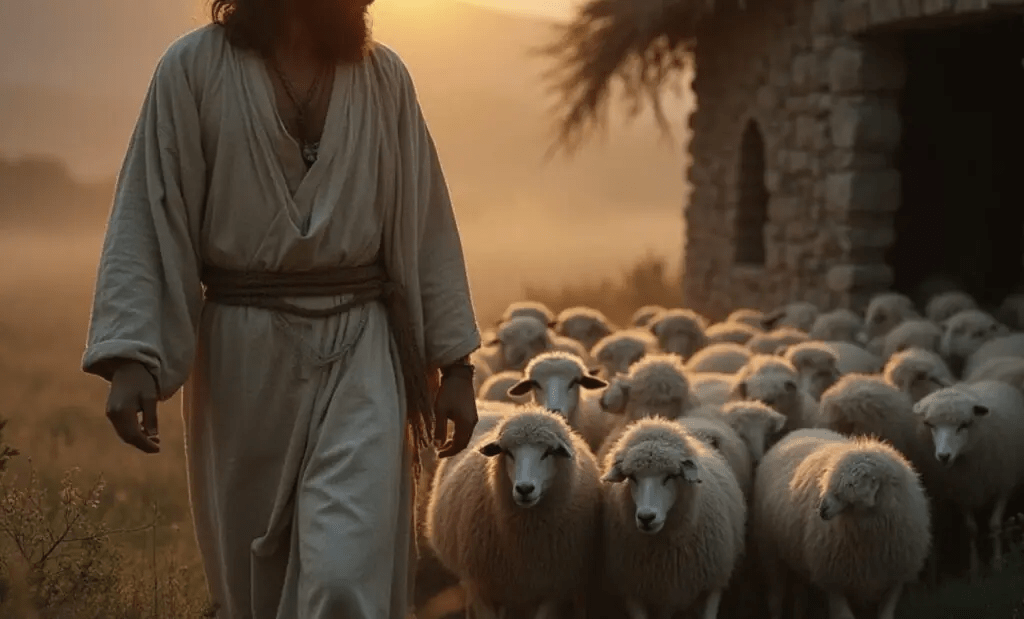
“Very truly, I tell you, anyone who does not enter the sheepfold by the gate but climbs in by another way is a thief and a bandit. The one who enters by the gate is the shepherd of the sheep. The gatekeeper opens the gate for him, and the sheep hear his voice. He calls his own sheep by name and leads them out. When he has brought out all his own, he goes ahead of them, and the sheep follow him because they know his voice. They will not follow a stranger, but they will run from him because they do not know the voice of strangers.” Jesus used this figure of speech with them, but they did not understand what he was saying to them.
So again Jesus said to them, “Very truly, I tell you, I am the gate for the sheep. All who came before me are thieves and bandits, but the sheep did not listen to them. I am the gate. Whoever enters by me will be saved and will come in and go out and find pasture. The thief comes only to steal and kill and destroy. I came that they may have life and have it abundantly. (New Revised Standard Version Updated Edition)
“A bee does not waste its energy trying to convince a fly that honey is better than s**t.” ancient Japanese saying
The voice of Jesus goes out into the world and calls persons by name. He spends no time twisting arms or putting the squeeze on people to get them into his sheep pen. Christ simply opens the gate, letting in people who come in response to his voice.
Jesus trusts that those who will come, will come. There’s no anxious hand-wringing on his part concerning whether anyone is going to show up, or not.
We certainly live in an anxious age – tending toward worrying incessantly about things out of our control. Many people spend an inordinate amount of time trying to influence things which belong to the realm of Jesus and the Spirit.
In addition, there is an over-abundance of putting unnecessary pressure upon ourselves to ensure we live some sort of perfect life. There is a hyper-developed sense of responsibility by some to never ever make any mistakes in this life.
I am speaking as much or more to myself. I have a nasty tendency of trying to be Atlas, picking up the world and carrying it on my shoulders. It’s all done in the erroneous notion that everything is up to me, that the earth spins on the Pastor Tim axis. After all, what will happen if I’m not there? I can’t be sidelined; people need me! O, what hubris there is in such notions.
In the Gospel text for today, Jesus makes no mention of our anxieties about entrance into the divine sheepfold. That’s because he has no expectations that we are to do his work. It isn’t our voices that are raised here; it is the voice of Jesus. We can trust that his voice and naming of persons is sufficient.
The responsibility and onus of salvation has always been on the side of God, not us. We redeem no one, including ourselves.
Sheep don’t shepherd the flock; the shepherd handles the flock of sheep. Another’s deliverance from sin, death, and hell comes neither from our hand nor our well-articulated words. No, it is the voice of Jesus that makes the difference. Hearing him is what creates response.
The voice of Christ is so powerful and effective that it doesn’t need to be heard audibly by the physical ear; it can more easily be heard with our spiritual ears and discerned by the soul.
Wisdom cries out in the street;
in the squares she raises her voice.
At the busiest corner she cries out;
at the entrance of the city gates she speaks:
“How long, O simple ones, will you love being simple?
How long will scoffers delight in their scoffing
and fools hate knowledge?
Give heed to my reproof;
I will pour out my thoughts to you;
I will make my words known to you. (Proverbs 1:20-23, NRSVUE)
It is our responsibility to listen and respond for ourselves, and not for anyone else. The gate will open for us.
We are to equally refuse listening to other competing voices of Trumpian-type charlatans. Such persons make grandiose promises which they never intend on keeping.
Those other voices only use the sheep by fleecing them of what little they have. However, if we enter the divine sheep pen, we need no longer be subject to the alternative voices which are full of foolish contradictory words that do nothing to help.
As the very gate by which the sheep enter, Jesus provides verdant green pastures; protects from bandits and predators; and gives life to the full. Christ calls folks together, guards, and sustains his flock. The shepherd can be trusted to take care of his own.
Open to me the gates of righteousness,
that I may enter through them
and give thanks to the Lord.
This is the gate of the Lord;
the righteous shall enter through it.
I thank you that you have answered me
and have become my salvation. (Psalm 118:19-21, NRSVUE)
Because Jesus gives abundant life, he can be contrasted with outlaws who come to create chaos among the sheep and ultimately destroy them.
Thieves do not come for the benefit of others; only themselves. They’re continually watching for how they can take advantage of situations, gaslight unsuspecting victims, and then dispense with them after having fleeced them of their resources, and even their very lives.
Whatever does not lead to life, leads to death and destruction. The hallmark of a contemporary charlatan-leader is that he creates division, disharmony, and disunity, rather than fostering loving connections and life-giving relationships.
If abundance is in the hands of a few, and not the many, then you can be sure that the outlaw is in charge of the flock. To have people languish, while others ignore them or even demonize them, is to have a charlatan thief calling the shots and trying to suffocate the voice of Jesus.
But the voice of Jesus will not be silenced. Christ’s voice will be heard. And it is being heard. Many are listening to the life that he offers. Jesus has the singular voice of deliverance.
Yet, many in this old world still seek political saviors. Only too late do these people realize that the would-be-savior makes a mockery of all that is good, just, and true.
In this current climate of Trumpism and a world which is attempting to resurrect authoritarianism in the name of Christianity, utopian dreams from twisted politicians will turn (and are turning) into nightmares.
Only Jesus is the gate; no one else can make the claim to providing an abundant life.
These current times are yet another temptation toward sinking into a debilitating anxiety. However, if we come back to listening to the singular voice of Jesus, then we can allow faith, hope, and love to take their rightful place in our lives. We can say along with the psalmist:
Even though I walk through the darkest valley,
I fear no evil,
for you are with me;
your rod and your staff,
they comfort me.
You prepare a table before me
in the presence of my enemies;
you anoint my head with oil;
my cup overflows.
Surely goodness and mercy shall follow me
all the days of my life,
and I shall dwell in the house of the Lord
my whole life long. (Psalm 23:4-6, NRSVUE)
Holy Shepherd, you know your sheep by name and lead us to safety through the valleys of death. Guide us by your voice, so that we may walk in certainty and security to the joyous feast prepared in your house, where we celebrate with you forever. Amen.