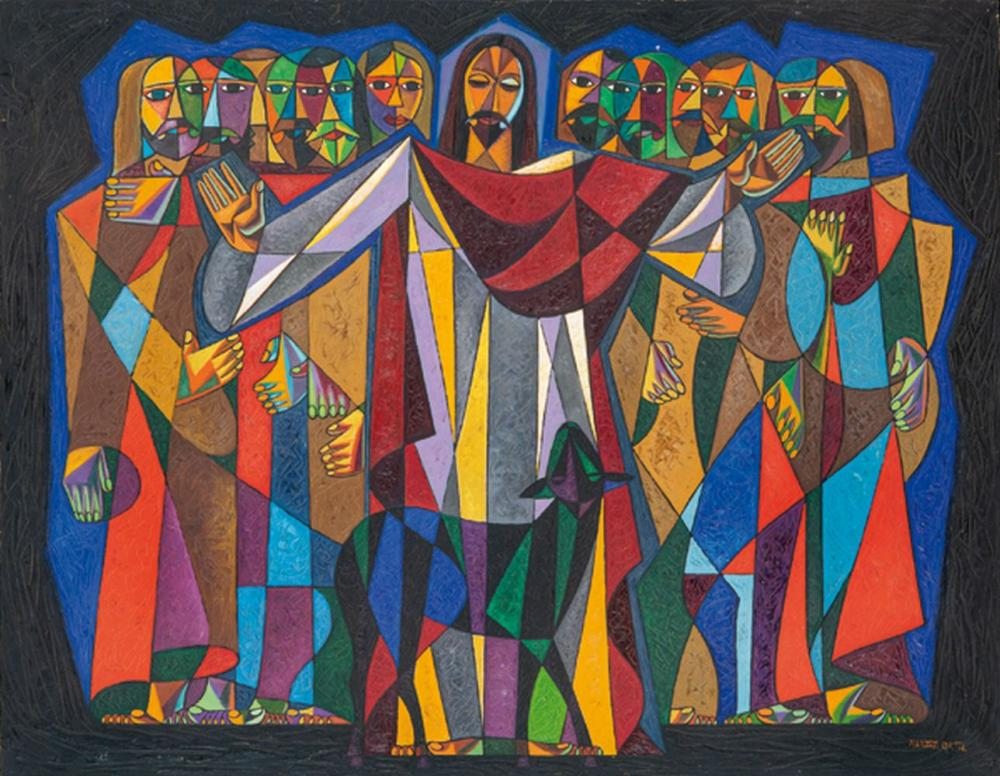
The Source of True Godliness (1 Timothy 3:14-16)

Jesus Christ and the Apostles, by Nicolás Martínez Ortiz (1907-1990)

Although I hope to come to you soon, I am writing you these instructions so that, if I am delayed, you will know how people ought to conduct themselves in God’s household, which is the church of the living God, the pillar and foundation of the truth. Beyond all question, the mystery from which true godliness springs is great:

He appeared in the flesh,
    was vindicated by the Spirit,
was seen by angels,
    was preached among the nations,
was believed on in the world,
    was taken up in glory. (New International Version)

Godliness is an important thing for those who seek to follow God.

So, the Apostle Paul wrote to his young protégé, Timothy, who was leading the church in Ephesus. Paul gave Timothy some sound practical instructions regarding how things ought to be conducted between pastor and people. Paul did this because he wasn’t quite sure how long it would be before he could show up in person, and he wanted to ensure that the ministry would go forward in a way that honored Christ.

Christian ministry is important because it doesn’t simply have to do with one’s private abilities and affairs. Rather, Christian leaders and pastors are entrusted with the household of God, the church. Believers are a holy sanctuary of the soul, the place where God dwells by means of the Spirit.

The Church is not a brick and mortar building, but the place of the living God, the pillar and foundation of the truth. Pastor and parishioners alike are to support the truth of the gospel, that is, the good news about the person and work of Jesus Christ.

Both believers and bishops who make up the Church support gospel truth by doing the following:

  1. Hear and heed the truth. “Whoever has ears to hear, let them hear… This is the meaning of the parable: The seed is the word of God. Those along the path are the ones who hear, and then the devil comes and takes away the word from their hearts, so that they may not believe and be saved. Those on the rocky ground are the ones who receive the word with joy when they hear it, but they have no root. They believe for a while, but in the time of testing they fall away. The seed that fell among thorns stands for those who hear, but as they go on their way they are choked by life’s worries, riches and pleasures, and they do not mature. But the seed on good soil stands for those with a noble and good heart, who hear the word, retain it, and by persevering produce a crop.” (Luke 8:8, 11-15, NIV)
  2. Handle the truth rightly. Make an effort to present yourself to God as a tried-and-true worker, who doesn’t need to be ashamed but is one who interprets the message of truth correctly. (2 Timothy 2:15, CEB)
  3. Hide the truth in your heart. I have hidden your word in my heart that I might not sin against you. (Psalm 119:11, NIV)
  4. Hold the truth as the Word of Life. Hold firmly to the word of life; then, on the day of Christ’s return, I will be proud that I did not run the race in vain and that my work was not useless. (Philippians 2:16, NLT)
  5. Ingest and digest the truth. Study, meditate, and devote yourself to God’s Word. Your words were found, and I ate them, and Your word was to me the joy and rejoicing of my heart. (Jeremiah 15:16, NKJV) You must not depend on bread alone to sustain you, but on everything that the Lord says. (Deuteronomy 8:3, GNT)
  6. Interest yourself in the truth, and defend it. “I have been put here for the defense of the gospel.” (Philippians 1:16, NRSV) I must write and ask you to defend the faith that God has once for all given to his people. (Jude 1:3, CEV)
  7. Impart the truth and disseminate it to others. The unfolding of your words gives light; it imparts understanding to the simple. (Psalm 119:130, NRSV) Teach these new disciples to obey all the commands I have given you. (Matthew 28:20, NLT)
  8. Indicate and demonstrate the power of the truth in the way you live your life. Let the message about Christ completely fill your lives, while you use all your wisdom to teach and instruct each other. With thankful hearts, sing psalms, hymns, and spiritual songs to God. Whatever you say or do should be done in the name of the Lord Jesus, as you give thanks to God the Father because of him. (Colossians 3:16-17, CEV)

The Church is a big deal because the head of the Church, Jesus Christ, is a big deal.

In many quarters of the world, the Church no longer has much influence or impact. For some, the Church is nothing more than an outdated antiquarian club that’s irrelevant to us today. For others, the Church is an abusive institution that looks to extend selfish power over others. And for many, the Church is simply not something they want to be a part of, having neither strong opinions one way nor the other.

Yet, the Apostle Paul, in his letters to all the churches, presents the Church as united to Christ and an extension of his person and work on this earth. Now, that’s a big deal!

Therefore, the Church is meant to confess Christ in its daily witness in all it says and does. In other words, the Church is to embody the words and ways of Jesus, and even Christ himself, by means of God’s Holy Spirit.

Everything about the Christian is to exude the very life of Christ.

How we can possess such a vital union and connection with Jesus is a mystery. Rather than trying to understand it, we embrace it and live it with all the energy the Spirit of God grants us.

We do, however, seek to know Jesus Christ ever more, every day. The more we know Christ, the better we will be able to know the height and depth of love, and to extend that love in all the places of this fallen planet that lack it. This is where true godliness and goodness spring from.

The Church everywhere and for all time confesses and proclaims that Jesus Christ descended to this earth, was visibly seen in a human body by both people and angels, proved right by the invisible Spirit, proclaimed among all kinds of peoples, believed in all over the world, and ascended into heavenly glory.

After two thousand years of church history, Christians are still unpacking the incredible richness and mystery of what all that means for us and for our salvation. And it is a spiritual journey worth taking for the rest of our lives.

May I walk this day, O Christ, in the realm of grace, walking with you, my feet firmly on your earth-path, my heart loving all as kindred, my words and deeds alive with justice. Amen.

Live Into Your Calling (2 Peter 1:1-11)

Simon Peter, a servant and apostle of Jesus Christ,

To those who through the righteousness of our God and Savior Jesus Christ have received a faith as precious as ours:

Grace and peace be yours in abundance through the knowledge of God and of Jesus our Lord.

His divine power has given us everything we need for a godly life through our knowledge of him who called us by his own glory and goodness. Through these he has given us his very great and precious promises, so that through them you may participate in the divine nature, having escaped the corruption in the world caused by evil desires.

For this very reason, make every effort to add to your faith goodness; and to goodness, knowledge; and to knowledge, self-control; and to self-control, perseverance; and to perseverance, godliness; and to godliness, mutual affection; and to mutual affection, love. For if you possess these qualities in increasing measure, they will keep you from being ineffective and unproductive in your knowledge of our Lord Jesus Christ. But whoever does not have them is nearsighted and blind, forgetting that they have been cleansed from their past sins.

Therefore, my brothers and sisters, make every effort to confirm your calling and election. For if you do these things, you will never stumble, and you will receive a rich welcome into the eternal kingdom of our Lord and Savior Jesus Christ. (New International Version)

The deepest yearning in every human soul is to become whole again, to return to their spiritual source, to experience belonging and union with the Beloved.

In the beginning, all of creation was a vessel filled with divine light. Then, it broke, and the shards of holiness were strewn across the earth. Those broken pieces are all around us. Sometimes, maybe oftentimes, we don’t see them because of our own darkness.

My friends, we have a simple but profound task: To bend down, find the broken shards, and pick them up.

This work of making a real and lasting contribution to humanity confirms our vocational calling and is made possible by divine power.

And yet, so many of us feel like a tiny Who on a speck of dust, with such a small insignificant voice, that nobody can hear us.

But somebody does hear us – and that somebody has very large elephant ears which are attuned to listen.

A person’s a person, no matter how small. A person has light, no matter how dim.

A great deception which befalls humanity is the lie that we aren’t enough – that somehow we lack voice and light in our core personhood.

This leads to another deceitful thought: God is holding out on me; I got the short end of things; I was never given the sort of voice which can be heard, or the kind of light which can burn bright.

Those deceiving vampires only suck the life out of us. What we need, instead, is to imbibe deeply of robust theology which empowers us to live faithfully in this world of corruption.

We have everything we need to grow in grace; God’s provision for us is total and complete.

By grace, we can discern between truth and error; endure hostility and hardship; persevere with patience as we await the new heaven and new earth; and confront anything in this present life with confidence and hope. We can do it because we’ve been equipped for it all.

Core to all this provision is the very life of Christ. Jesus is the source of the power; and his is the grace needed to live life to the full. The same resurrection power which raised Christ from the grave is available and provided to us.

God’s supply for us is sufficient. It is enough. We have everything we need to walk with boldness through any dark alley. The believer’s confidence is in carrying the cross – which keeps the deceiving vampires of guilt, shame, doubt, and distrust at bay.

Sheer cognitive belief, however, is insufficient. It’s only half the equation. The other half is to let our light shine, be the salt of the earth, and take up the gifts given us by God and use them.

Therefore, put significant energy into your faith development through knowing your call to bless the world and not curse it.

Confidently using faith, fully participate in God’s divine power through the qualities of:

  • Goodness. Cultivation of moral excellence is both helpful and needed in all our relationships. Goodness is like a seed planted. It proper amounts of water and sun, as well as continual tending to keep the weeds away.
  • Knowledge. There are two words in the ancient Greek for knowledge: one is a reference to acquiring information; and the other refers to actively using the information provided. The Apostle Peter uses the latter – an experiential knowledge which is wise, discerning, and discreet.
  • Self-Control. This is the ability to get a grip on yourself, to avoid controlling others and focus on all things within your own control. Ultimate control belongs to God; self-control belongs to you and me.
  • Perseverance. To see the big picture, to look ahead and keep your eye on the goal, is the lived practice of endurance. Everyone has patience. The real issue is whether we will tap into it, or not.
  • Godliness. The heart of godliness is a growing awareness of self, others, and God – rightly relating to them all with wholeness and integrity.
  • Mutual Affection. Basic human kindness is the basis of any healthy community and every relationship.
  • Love. This is the Christian’s consummate virtue. Whereas affection is to be mutual, love can always be done whether someone loves us back, or not. Genuine love can be directed at the unlovely, even enemies.

Effectiveness in living a virtuous life is not a matter of more but better.

It doesn’t happen on an industrial scale with a mass production of spiritual resources for the busy Christian consumer.

Rather, it occurs in the soil of God’s grace, mostly below the surface of the ground, slowly but surely germinating with faith, rising in hope, and producing a harvest of love that blesses both church and world.

A little bit of Jesus is enough to turn the world upside-down. You don’t need a big loaf of bread; a miniscule communion wafer will do.

A tiny mustard seed of faith can move a mountain.

A kernel of goodness can produce a harvest of righteousness.

A bit of knowledge and awareness can uproot the weeds of bigotry and hate.

A grain of self-control can grow into a field of peace.

A simple insight can create a cascade of transformation.

A single act of kindness can alter the course of another’s life forever.

A few seconds of attention can change the world.

A teensy amount of love can feed everyone on the earth.

We have everything we need to realize the new society Christ has made possible. We are in want of nothing. We are enough because Christ is enough. So, live into your calling with courage and confidence.

Heavenly Father, you are the One ever-present on this earth in your only Son and through your Spirit:
May your Name be shown forth as holy through us, your people.
May your gracious and benevolent reign come, establishing peace and justice, hope and life; and may your moral and ethical will be done, here on earth, as it is always done in heaven.
Give us what we need for today; and adjust our vision into a clear 20/20 awareness of others’ needs.

Forgive us of our great and many sins, for the immoral and unethical things we have said and done, and for the good words and good deeds we have failed to say and do; forgive us, just as we forgive those who have egregiously sinned against us.

Don’t let us amble down a dark path of temptation, of hardening our hearts and closing our minds; but instead, deliver us from the machinations of evil, and set our feet upon the lighted path of righteousness.

To You, everlasting God, belongs all sovereign decrees of  justice and truth;
To You, almighty God, belongs all powerful deeds of righteousness and goodness;
To You, holy God, belongs all glorious displays of love and compassion;

Through Jesus Christ, your Son, our Lord, who with You and the blessed Holy Spirit are one God, now and forevermore. Amen.

2 Samuel 1:4-27 – Express Your Grief

“What happened?” David asked. “Tell me.”

“The men fled from the battle,” he replied. “Many of them fell and died. And Saul and his son Jonathan are dead.”

Then David said to the young man who brought him the report, “How do you know that Saul and his son Jonathan are dead?”

“I happened to be on Mount Gilboa,” the young man said, “and there was Saul, leaning on his spear, with the chariots and their drivers in hot pursuit. When he turned around and saw me, he called out to me, and I said, ‘What can I do?’

“He asked me, ‘Who are you?’

“‘An Amalekite,’ I answered.

“Then he said to me, ‘Stand here by me and kill me! I’m in the throes of death, but I’m still alive.’

“So, I stood beside him and killed him, because I knew that after he had fallen he could not survive. And I took the crown that was on his head and the band on his arm and have brought them here to my lord.”

Then David and all the men with him took hold of their clothes and tore them. They mourned and wept and fasted till evening for Saul and his son Jonathan, and for the army of the Lord and for the nation of Israel, because they had fallen by the sword.

David said to the young man who brought him the report, “Where are you from?”

“I am the son of a foreigner, an Amalekite,” he answered.

David asked him, “Why weren’t you afraid to lift your hand to destroy the Lord’s anointed?”

Then David called one of his men and said, “Go, strike him down!” So, he struck him down, and he died. For David had said to him, “Your blood be on your own head. Your own mouth testified against you when you said, ‘I killed the Lord’s anointed.’”

David took up this lament concerning Saul and his son Jonathan, and he ordered that the people of Judah be taught this lament of the bow (it is written in the Book of Jashar):

“A gazelle lies slain on your heights, Israel.
    How the mighty have fallen!

“Tell it not in Gath,
    proclaim it not in the streets of Ashkelon,
lest the daughters of the Philistines be glad,
    lest the daughters of the uncircumcised rejoice.

“Mountains of Gilboa,
    may you have neither dew nor rain,
    may no showers fall on your terraced fields.
For there the shield of the mighty was despised,
    the shield of Saul—no longer rubbed with oil.

“From the blood of the slain,
    from the flesh of the mighty,
the bow of Jonathan did not turn back,
    the sword of Saul did not return unsatisfied.
Saul and Jonathan—
    in life they were loved and admired,
    and in death they were not parted.
They were swifter than eagles,
    they were stronger than lions.

“Daughters of Israel,
    weep for Saul,
who clothed you in scarlet and finery,
    who adorned your garments with ornaments of gold.

“How the mighty have fallen in battle!
    Jonathan lies slain on your heights.
I grieve for you, Jonathan my brother;
    you were very dear to me.
Your love for me was wonderful,
    more wonderful than that of women.

“How the mighty have fallen!
    The weapons of war have perished!” (New International Version)

Character is revealed by both attitude and action. It seems likely the Amalekite would have lived if he had any, at all.

But instead, the Amalekite tried to act as if he knew David. It became very apparent, he didn’t really know David, at all.

By claiming responsibility for King Saul’s death, the Amalekite sealed his own. David spent months outrunning and outwitting Saul, trying his best to stay alive, while at the same time, carefully avoiding killing Saul. In assuming Saul’s death would be good news to David, the Amalekite went full braggadocio, looking to impress, as well as get a reward.

He got a reward, alright.

David’s attitude could not be any more different than the Amalekite’s. Whereas the Amalekite had a small and selfish attitude, David had a magnanimous attitude. David had suffered much because of Saul, and yet held firm in his commitment to God and to the king.

Our attitudes and our actions truly reveal what is in our hearts.

Because David had an attitude which reflected that he knew God, he therefore genuinely grieved and lamented the deaths of both King Saul and Saul’s son, Jonathan.

Bereavement, grief, and lament are, unfortunately, scarce words in the English language. But those words were not strange or stingy with David. He shows us the good path to follow in facing significant loss and change.

David’s grief was not only personal but public. He crafted a lament and had everyone learn it and say it. Indeed, grief may be intensely personal, yet it most definitely needs a public outlet.

Tears, questions, sorrow, anger, anxiety, and sadness are all the normal and necessary expressions of working through the death of someone close to us. The only bad grief is unexpressed grief. It sits idle, deep inside one’s personhood. Over time, it becomes gangrene of the soul.

Many deaths are bittersweet. It may be an end of suffering for the deceased, but it is also the beginning of suffering for those left behind. Sometimes Christians forget that death is a result of humanity’s fall. There is nothing to rejoice over with death; it is something to mourn over.

We need to become comfortable with talking about death, bereavement, and all the emotions that come with it. Methinks this is a chief reason for so many improper attitudes, like that of the ancient Amalekite with David.

Unexpressed grief neither disappears nor goes away. It eventually comes out sideways, usually harming both ourselves and others.

To grieve and lament simply means that we tell our story – which requires someone to listen without criticism or invalidating our feelings.

David was able to respond the way he did because of his closeness to God. For even and especially God grieves over significant losses. It is the proper and right attitude.

My God, my God, why have you forsaken me?
    Why are you so far from helping me, from the words of my groaning?
O my God, I cry by day, but you do not answer;
    and by night but find no rest….

He did not despise or abhor
    the affliction of the afflicted;
he did not hide his face from me,
    but heard when I cried to him….

To him, indeed, shall all who sleep in the earth bow down;
    before him shall bow all who go down to the dust,
    and I shall live for him. Amen.
(Psalm 22:1-2, 24, 29, NRSV)

2 Peter 1:2-15 – We Have Everything We Need

May grace and peace be yours in abundance in the knowledge of God and of Jesus our Lord.

His divine power has given us everything needed for life and godliness, through the knowledge of him who called us by his own glory and goodness. Thus, he has given us, through these things, his precious and very great promises, so that through them you may escape from the corruption that is in the world because of lust and may become participants of the divine nature. For this very reason, you must make every effort to support your faith with goodness, and goodness with knowledge, and knowledge with self-control, and self-control with endurance, and endurance with godliness, and godliness with mutual affection, and mutual affection with love. For if these things are yours and are increasing among you, they keep you from being ineffective and unfruitful in the knowledge of our Lord Jesus Christ. For anyone who lacks these things is short-sighted and blind and is forgetful of the cleansing of past sins. Therefore, brothers and sisters, be all the more eager to confirm your call and election, for if you do this, you will never stumble. For in this way, entry into the eternal kingdom of our Lord and Savior Jesus Christ will be richly provided for you.

Therefore, I intend to keep on reminding you of these things, though you know them already and are established in the truth that has come to you. I think it right, as long as I am in this body, to refresh your memory, since I know that my death will come soon, as indeed our Lord Jesus Christ has made clear to me. And I will make every effort so that after my departure you may be able at any time to recall these things. (New Revised Standard Version)

One of the greatest deceptions which befall humanity is the lie that we aren’t enough – that somehow we lack something in our core personhood. Another great deception is that God is holding out on us – that we’ve gotten the short end of things.

It is my hope and prayer that today’s New Testament lesson puts a stake through the heart of those twin deceiving vampires. Erroneous beliefs only suck the life out of us. Instead, we must imbibe deeply of sound theology which enables us to live robustly in this old fallen world.

The Lord is my shepherd;
   I have all that I need.

Psalm 23:1, NLT

We have everything we need to grow in grace. God’s provision for us is total and complete. By grace, we can discern between truth and error; endure hostility, hardship, even persecution; live with patience as we await the new heaven and new earth; and face anything in this present life with confidence and hope because we’ve been equipped for it all.

Core to all this provision is the very life of Christ. Jesus is the source of the power and grace needed to live this incredible life. The same resurrection power which raised Christ from the grave is available and provided to us.

Believers are not in some weird holding pattern, like a plane circling the airport waiting to land, twiddling our thumbs until Christ returns. No! This present life is to be fully engaged with the tools given us of faith, hope, and love. And those spiritual implements are sufficient to walk with boldness through the valley of the shadow of death.

It continually must be borne in mind that we are to take up the gifts given us and use them in our present sojourn on this earth. Let us put significant energy into our faith development through knowing our call to holiness; and knowing Christ Jesus our Lord, his power and suffering.

Carefully and confidently using our faith, we are to fully participate in God’s divine power through the qualities of:

  • Goodness. Cultivation of moral excellence is both helpful and needed in all our relationships. Goodness is like a seed planted. We need to give it proper amounts of water and sun and keep the weeds away.
  • Knowledge. There are two words in the ancient Greek for knowledge: one is a reference to acquiring information; and the other refers to actively using the information provided. The Apostle Peter uses the latter – an experiential knowledge which is wise, discerning, and discreet.
  • Self-Control. This is the ability to get a grip on yourself, to avoid controlling others and focus on all things within your own control. Ultimate control belongs to God; and we are called to self-control.
  • Endurance. To see the big picture, to look ahead and keep your eye on the goal, is the lived practice of endurance or perseverance. Everyone has patience. It’s rather a matter of whether we will tap into it, or not.
  • Godliness. The heart of godliness is awareness of self, others, and God – rightly relating to them all with wholeness and integrity.
  • Mutual Affection. Basic human kindness is imperative between two people, especially with fellow believers.
  • Love. This is the Christian’s consummate virtue. Whereas affection is to be mutual, love can always be done whether someone loves us back, or not. Genuine love can be directed at the unlovely, even enemies.

We are to be effective and productive in adding divine virtues to our lives. It’s not a matter of more but better.

Even a smidge of faith can move a mountain.

A kernel of goodness can produce a harvest of righteousness.

A little bit of knowledge can be turned into love.

Small self-control can develop into immense self-control.

Keeping our head up for a few seconds can help us see the goal and endure to the end.

One insight can create a cascade of godliness.

A single act of kindness can change a life forever.

Love, no matter how big or small, can change the world.

We possess all these qualities and are in want of nothing. We are enough because Christ is enough.

Lord, make us instruments of your peace. Where there is hatred, let us sow love; where there is injury, pardon; where there is discord, union; where there is doubt, faith; where there is despair, hope; where there is darkness, light; where there is sadness, joy. Grant that we may not so much seek to be consoled as to console; to be understood as to understand; to be loved as to love. For it is in giving that we receive; it is in pardoning that we are pardoned; and it is in dying that we are born to eternal life. Amen. – A Prayer of St. Francis of Assisi