All Work Is Spiritual (Exodus 31:1-11)

Bezalel and Oholiab build the ark of the covenant, a woodcut from the Cologne Bible, 1479

Then the Lord said to Moses, “Look, I have specifically chosen Bezalel son of Uri, grandson of Hur, of the tribe of Judah. I have filled him with the Spirit of God, giving him great wisdom, ability, and expertise in all kinds of crafts. He is a master craftsman, expert in working with gold, silver, and bronze. He is skilled in engraving and mounting gemstones and in carving wood. He is a master at every craft!

“And I have personally appointed Oholiab son of Ahisamach, of the tribe of Dan, to be his assistant. Moreover, I have given special skill to all the gifted craftsmen so they can make all the things I have commanded you to make:

the Tabernacle;
the Ark of the Covenant;
the Ark’s cover—the place of atonement;
all the furnishings of the Tabernacle;
the table and its utensils;
the pure gold lampstand with all its accessories;
the incense altar;
the altar of burnt offering with all its utensils;
the washbasin with its stand;
the beautifully stitched garments—the sacred garments for Aaron the priest, and the garments for his sons to wear as they minister as priests;
the anointing oil;
the fragrant incense for the Holy Place.

The craftsmen must make everything as I have commanded you.” (New Living Translation)

Methinks God cares about worship. After all, chapters 25-31 in Exodus are thoroughly dedicated to God communicating the specifics for the sacred spaces and symbols of worship for the Israelites.

Once the equipment for worship was described in detail, the one matter still needed was an artisan who could actually build and construct the objects. So, Yahweh also planned for the workers, as well. Bezalel was identified and designated as the person who would be divinely endowed for the task. He would be assisted by Oholiab, and together they carried out God’s instructions to the letter.

Although Bezalel and Oholiab were not priests and did not do “spiritual” work, nonetheless they were filled with the Spirit and set apart by God for their gifts to be used. In reality, all work is spiritual work, even the work of our hands. Everything we do is to be consecrated, set apart, and dedicated to the Lord for good and holy purposes.

The Spirit of God inspired and helped the two men in their very physical and mundane work. The Lord was present with them when they drew up the plans for making the objects, carved the wood, did the weaving and needlework of clothes, and the smithing of the gold. God cares about all work, not just the ethereal stuff.

A willing heart is one that follows in doing work for the Lord, and not following their own whims of how they think things ought to go. The craftsmen, Bezalel and Oholiab, were to do their work just as the Lord had commanded them to do it, just like the pattern shown to Moses on Mount Sinai. (Exodus 25:39)

God is concerned about everything, great and small alike.

When it came to the Lord’s will, the Israelites did not so much seek God’s guidance, as they waited for it. When in the desert, the pillar of cloud by day, and pillar of fire by night, determined when they moved and when they stayed put. The people simply observed, then responded. In other words, they were patient and waited for God to move, speak, command, and do whatever God was going to do.

So, when the Lord lays down some very specific instructions, those directives are meant to be followed down to the minutest detail. For the Christian, Jesus is our example. God’s will was made known to Jesus in the daily privilege and discipline of meeting with his heavenly Father and doing exactly what the Father wanted.

The Sovereign Lord has given me his words of wisdom,
    so that I know how to comfort the weary.
Morning by morning he wakens me
    and opens my understanding to his will.
The Sovereign Lord has spoken to me,
    and I have listened.
    I have not rebelled or turned away. (Isaiah 50:4-5, NLT)

All work is God’s work, and is to be done in the way God prescribes. Worship is to be directed to God, and as such, is to be done as God commands – and not any old way we think is good and needed.

No matter who we are, where we are, or what circumstances we find ourselves in, consistency in doing the will of God is imperative. Nobody has any ground for excusing themselves from their God-ordained work and worship. The ancient Israelites were in a desert without a permanent abode, yet they were still expected to follow God’s directives.

In order to embrace the will of God when it comes, and not make excuses, there are some practices we can do to help receive and do what the Lord wants:

  • Don’t fixate on past mistakes. Learn to be present and focus on what is happening in a given moment, and then you will be able to act in doing God’s will. As a result, you can stop making excuses and learn from past mistakes.
  • Take responsibility for your own words and actions. Take charge of what you have control over. If we don’t own this, then the excuses come out for why we failed to do what was needed.
  • Focus on your spiritual gifts and your strengths and skills. By actively doing what God has enables you to do, you can get the most out of each situation, without succumbing to excuses.
  • Don’t compare yourself to others. We are all unique individuals with unique journeys. That’s why it’s unhealthy to compare ourselves to others and make excuses of “not being good enough” or not measuring up to the skills of Bezalel or Oholiab or someone else. The only person you should compare yourself to is you!

By being attentive to your own walk with God, and being responsive to God’s will for your life, you will find your place in this world and discover the meaning and purpose meant for you in blessing others.

Blessed Holy Spirt of God, with God the Father and God the Son, I adore you as the Holy Trinity, the God whom I serve. I give you my heart, and offer my thanks to you for the grace given me in Jesus Christ. Continue to visit me with your grace, and enable me for work and worship in your church and your world. Amen.

God, the Jilted Lover (James 4:4-10)

You’re cheating on God. If all you want is your own way, flirting with the world every chance you get, you end up enemies of God and his way. And do you suppose God doesn’t care? The proverb has it that “he’s a fiercely jealous lover.” And what he gives in love is far better than anything else you’ll find. It’s common knowledge that “God goes against the willful proud; God gives grace to the willing humble.”

So let God work his will in you. Yell a loud no to the Devil and watch him make himself scarce. Say a quiet yes to God and he’ll be there in no time. Quit dabbling in sin. Purify your inner life. Quit playing the field. Hit bottom, and cry your eyes out. The fun and games are over. Get serious, really serious. Get down on your knees before the Master; it’s the only way you’ll get on your feet. (The Message)

Quite apparent is the fact that the Apostle James was not trying to win friends in the world. However, he was trying to influence the people within the churches in his care. Specifically, he was confronting the proud and arrogant.

So, please understand, up front, that James was going after the haughty persons because it takes a hammer to break a hard heart. And so, his approach ought only to be emulated in the unique context of handling persons stuck in their own destructive hubris. Nevertheless, there is much instruction in these verses to help us all.

Throughout Holy Scripture, we find a marriage metaphor, likening the relationship of God to the people, much like a lover. God’s covenant relationship is at the heart of understanding the whole of Scripture. Whenever people stray from divine promises, God is offended and hurt. 

Yes, God feels pain. God is an emotional Being, which is why we have emotions as God’s image-bearers. One way to view the Bible is that it is a book about God, the jilted lover. The Lord set affection and love upon people, yet many people have spurned their Lover’s advance. And this situation pains God. 

When Adam and Eve, decided to find satisfaction outside of God, the Lord was hurt. After them, when people had children and raised them, they did so largely apart from the God who loved them:

The Lord saw that the human beings on the earth were very wicked and that everything they thought about was evil. He was sorry he had made human beings on the earth, and his heart was filled with pain. (Genesis 6:5-6, NCV)

Yet, God was gracious. The Lord took a group of Noah’s descendants, Abraham’s family, and set a covenant of affection on them. God hoped to restore the world to right relationship through the Israelites. However, they too, came to set their affections on others. So, nearly half of the Old Testament is devoted to communicating the Lord’s hurt and disappointment. 

Like a jilted lover, God longed for Israel to remain faithful. For example, the prophet Hosea had an unfaithful wife, Gomer, and their relationship mirrored the relationship between God and Israel. Just as Hosea did not give up on his wife, even though she was brazenly unfaithful, so God looked at Israel as a spouse and could not bear to give her up.

Israel spurned their lover’s grace and kindness and actively sought other lovers, causing God anger and agony. God recounted the history of unfaithfulness:

“At every crossroad you built your platform and degraded your beauty by spreading your legs to all comers. And so, you encouraged even more promiscuity. You prostituted yourself with the Egyptians, your neighbors with the large sexual organs, and as you added to your seductions, you provoked me to anger…. 

Still not satisfied, you prostituted yourself to the Assyrians, but they were not enough for you either. So, you prostituted yourself with the Babylonians, the land of traders, but again you were not satisfied. How sick was your heart that you could do all these things, the deeds of a hardened prostitute?…

You are like an adulterous wife: you take in strangers instead of your husband. Ordinary prostitutes are given gifts, but you gave your gifts to all your lovers. From every direction you even bribed them to come to you for your sexual favors. As a prostitute, you were more perverse than other women. No one approached you for sexual favors, but you yourself gave gifts instead of receiving them.” (Ezekiel 16:25-34, CEB)

Despite Israel’s unfaithfulness, God extended grace to the beloved spouse:

“I am taking you back!
I rejected you for a while,
but with love and tenderness
    I will embrace you again.
For a while, I turned away
    in furious anger.
Now I will have mercy
    and love you forever!
I, your protector and Lord,
    make this promise.” (Isaiah 54:6-8, CEV)

The Old Testament ends with God still longing for return:

The Lord proclaims: “I care passionately about Zion; I burn with passion for her.” (Zechariah 8:2, CEB)

All of this theological awareness was in the heart of the Apostle James when he wrote his letter to the hard-hearted. He knew they were flirting with the world. He wanted them to stop and return to the God who longed to show them grace, if only they would humble themselves.

God yearns, passionately, for us to find our needs met, and enjoyment found, in the loving divine embrace. Spiritual adultery hurts God deeply, like it would any jilted lover. God awaits with loving patience to show grace and compassion to wayward people. 

Only the stance and attitude of humility can receive grace. Sinful pride prevents people from receiving God’s good gift. So, James rattled-off ten quick staccato commands to remain connected in a love relationship with God. They are resolutions to live by. 

Submit to God

Humble folk willingly place themselves under God’s authority because they are convinced God has their best interests at mind. One temptation when facing adversity is to entertain the belief that no one is going to look out for you except yourself. So, to avoid getting hurt too badly, we might become cynical, arrogant, and callous – self-protective strategies designed to keep the hurt away. This only creates hardness of heart. The alternative is faithful submission to God – knowing that God’s Spirit will protect and living with the conviction that nothing can separate us from the love of God in Christ.

Resist the devil

Satan is a bully. The way to deal with bullies is to stand up to them. We face down the temptation by submitting to God and resisting the devil. Don’t be deceived into flipping it around by listening to Satan and avoiding submission to God.

Come near to God

Like a loving parent, the Lord longingly looks out the window waiting for prodigals to return. Coming to God is the first thing we ought to do. When my daughter was young her bike was stolen. So, we sat down together in the backyard and came to God in prayer. I barely finished praying when a police cruiser pulled up in the alley behind our house. The policeman rolled down his window and said, “Hey, are you missing a bike?”  We hopped in and he took us to where someone had ditched the bike. It was a tremendous lesson that when we come to God, God comes to us. I realize life does not always work that way, yet we can be assured that God listens, hears, and will respond.

Wash your hands

We cannot approach God with blood on our hands, but must come squarely facing our sin and disobedience.  We must deal with the wrong we have done without sweeping it under the rug. God wants us to admit our sin, receive grace, and deal with matters of restitution and reconciliation, without trying to save face when found out in a concern for “optics.”

Purify your heart

Whereas the previous resolution is mostly external, this one addresses the inner person, the heart. Not only do our actions need to be cleaned up through washing our hands, but our attitudes must also be purged of pollution. Our hearts cannot handle two masters; we are to be single-minded without mixed motives.

“The man who tries to walk two roads will split his pants.”

African proverb

The next four resolutions describe important emotional responses to sin:

“The Crying Giant,” Wilmington, Delaware

Grieve

Trying to move on without grieving and lamenting is called denial. Grief is not only an event; it is a process which takes time. Grieving is biblical. Sharing our stories with each other, giving testimony to God’s grace, and expressing ourselves is important. A loving God knows there cannot be healing apart from grief and lament.

Mourn

Blessed are those who mourn with an emotional response to the devastation of sin. Mourning sees sin in all its foulness and degradation. People who do not mourn become hard-hearted and need deep spiritual transformation. Jesus offers the remedy: By his wounds we are healed.

Wail

We are to more than cry – we need to wail.  Whereas mourning might be more personal, wailing has a much more public dimension to it. I believe the great tragedy in many modern churches is an inordinate focus on victory and triumphalism. The result: Far too many Christians cry alone. No one should ever have to cry by themselves. We must weep with those who weep. If there ever was an appropriate place for crying, it should be amongst fellow brothers and sisters in Christ.

Change

We cannot turn the clock back to some bygone idyllic era. We are to grasp the type of change which occurs in living for Jesus Christ and above sin – with no casual cavalier attitudes toward sin. I once had a conversation with a young woman about heaven and hell. When we began the discussion, she expressed a desire to be wherever the better party was going on. By the time we finished our conversation she was grieving and crying. I never knew what became of her. But once she got just a glimpse of the gravity of sin, it undid her.

Be humble

Humility sums up all these resolutions. The paradox is that through grieving, mourning, and wailing we become joyful and satisfied; through suffering there is glory; becoming last is to become first; entering the narrow gate leads to the broad open space of God’s eternal life.

Gracious God, our sins are too heavy to carry, too real to hide, and too deep to undo. Forgive what our lips tremble to name, what our hearts can no longer bear, and what has become for us a consuming fire of judgment. Set us free from a past that we cannot change; open to us a future in which we can be changed; and grant us grace to grow more and more in your likeness and image, through Jesus Christ, the light of the world. Amen

Follow God’s Word (Deuteronomy 6:10-25)

Priest Teaching Children The Catechism, by Jules-Alexis Meunier, 1898

Now once the Lord your God has brought you into the land that he swore to your ancestors, to Abraham, Isaac, and Jacob, to give to you—a land that will be full of large and wonderful towns that you didn’t build, houses stocked with all kinds of goods that you didn’t stock, cisterns that you didn’t make, vineyards and olive trees that you didn’t plant—and you eat and get stuffed, watch yourself! Don’t forget the Lord, who brought you out of Egypt, out of the house of slavery. 

Revere the Lord your God, serve him, and take your solemn pledges in his name! Don’t follow other gods, those gods of the people around you—because the Lord your God, who is with you and among you, is a passionate God. The Lord your God’s anger will burn against you, and he will wipe you off the fertile land. Don’t test the Lord your God the way you frustrated him at Massah. 

You must carefully follow the Lord your God’s commands along with the laws and regulations he has given you. Do what is right and good in the Lord’s sight so that things will go well for you and so you will enter and take possession of the wonderful land that the Lord swore to your ancestors, and so the Lord will drive out all your enemies from before you, just as he promised.

In the future, your children will ask you, “What is the meaning of the laws, the regulations, and the case laws that the Lord our God commanded you?” Tell them: We were Pharaoh’s slaves in Egypt. But the Lord brought us out of Egypt with a mighty hand. Before our own eyes, the Lord performed great and awesome deeds of power against Egypt, Pharaoh, and his entire dynasty. But the Lord brought us out from there so that he could bring us in, giving us the land that he swore to our ancestors. Then the Lord commanded us to perform all these regulations, revering the Lord our God, so that things go well for us always and so we continue to live, as we’re doing right now. What’s more, we will be considered righteous if we are careful to do all this commandment before the Lord our God, just as he commanded us. (Common English Bible)

The Catechism, by Edith Hartry, 1919

Christians often refer to the Bible as “God’s Word.” By that reference we mean that God has graciously revealed the divine nature to us through this Book, the Holy Scriptures. 

The ancient Hebrews referred to the first five books of the Old Testament as the Law of the Lord or the Torah. The Jewish people understood God as a great, high and holy Being who mercifully accommodated or communicated to us on our level by giving the Law. 

Just as a parent coos and babbles and speaks in a very different way to a baby in a crib, so God speaks to us in a way we can understand about the care, concern, and love the Lord has for us. Just as an infant is unable to understand an adult conversation taking place, so God is a lofty Being who is well above our comprehension. We have no ability to understand anything God says unless the Lord graciously and lovingly bends down to speak to us on our level.

God’s Law, the Torah, was the curriculum for Israel’s religious instruction. The Law of the Lord is meant to be a behavior pattern, to be embodied in the lives of God’s people through both teachers and parents who learn God’s Word and, in turn, pass it along to children and others – thereby providing guidance for how to live in God’s world. 

God’s law is an extension of God’s grace, and we are to gratefully accept the grace of God expressed in God’s Word. We are to ingest it, eat it, reflect on it, and dwell with it, in order to know God and be the people God wants us to be.

There are several other words that come from the root word for Law, Torah, in the Hebrew language. A teacher is a “moreh.” A parent is a “horeh.” Parents and teachers are to be living guides in the way of God’s Word. The Hebrew word for teaching is “yarah.” 

So, in other words, the moreh’s and the horeh’s are to yarah the Torah. Parents and teachers are to point and lead others into the ways of the Lord. The fifth book of the Law, Deuteronomy, makes it clear how parents, mentors, teachers, and influencers are to pass on God’s Word:

Israel, listen! Our God is the Lord! Only the Lord! Love the Lord your God with all your heart, all your being, and all your strength. These words that I am commanding you today must always be on your minds. Recite them to your children. Talk about them when you are sitting around your house and when you are out and about, when you are lying down and when you are getting up. Tie them on your hand as a sign. They should be on your forehead as a symbol. Write them on your house’s doorframes and on your city’s gates. (Deuteronomy 6:4-9, CEB)

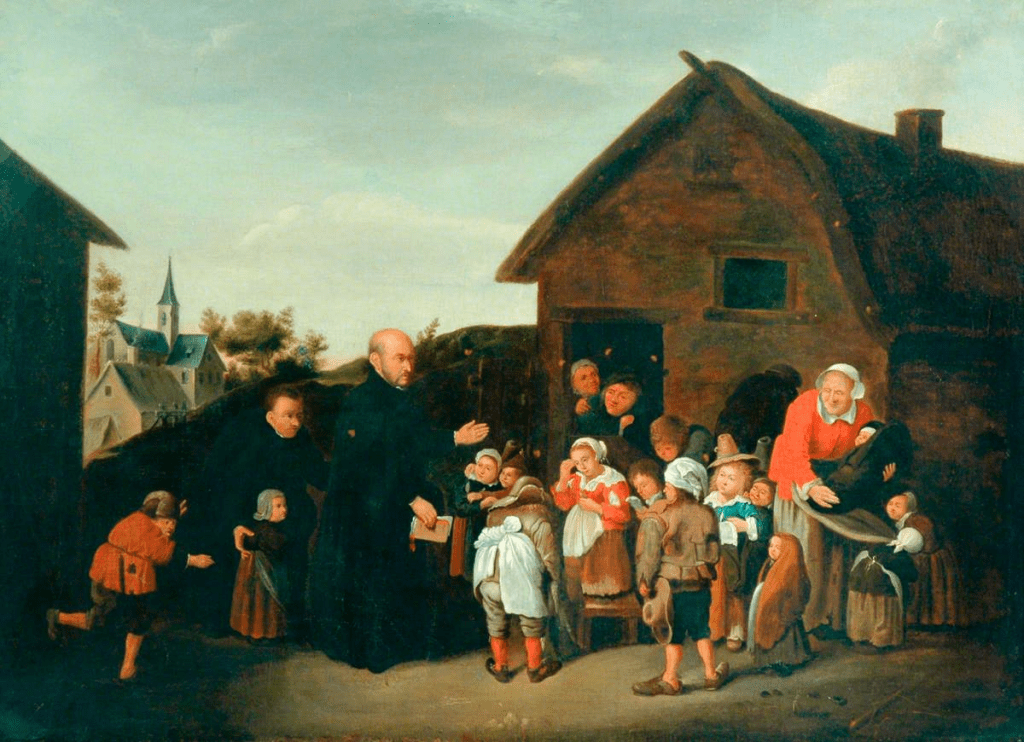
A Village Catechism, by David Rychaert III (1612-1661)

God’s Law, or God’s Word, is to be as familiar to us as our back door and it is to be in front of us all the time. When children ask us anything about God’s commands and regulations, we are to have a ready answer for them, in language and ways that they can understand.

We do this by carefully and systematically engrafting Holy Scripture into our minds and hearts. As we get God’s Word into ourselves, we are to also get it into our children and others. It happens by continually talking about Scripture – at home around the dinner table, as well as when we are working or playing together.

God’s Holy Word is to be continually in front of us, so that we do not forget it. We need to start each day and end each day with God’s Word. We can put the words of God on our refrigerator and our car’s dashboard. There is always an opportunity refer to God’s Word and incessantly chatter about it with others.

Someone may say, “That’s pretty radical – I don’t need to do all that!” Then I would say that you are missing out on living a blessed life because people are blessed when they walk according to God’s Word and keep God’s Law in front of them and seek God through God’s Word with all their heart. 

Let us not be so busy, pre-occupied, nor worried, that we end up pushing God’s Word to the margins of our lives as only a Sunday activity – or something for our discretionary time (which doesn’t actually exist). 

Let’s take the time to carefully look at God’s Word and let God speak to us through it.

Let us be intentional about connecting with the God who has so graciously given us a guide for grateful living. 

And let us lay solid plans to catechize people into the basics of faith and holy living in the church. Amen.

Psalm 2 – God

Why are the nations so angry?
    Why do they waste their time with futile plans?
The kings of the earth prepare for battle;
    the rulers plot together
against the Lord
    and against his anointed one.
“Let us break their chains,” they cry,
    “and free ourselves from slavery to God.”

But the one who rules in heaven laughs.
    The Lord scoffs at them.
Then in anger he rebukes them,
    terrifying them with his fierce fury.
For the Lord declares, “I have placed my chosen king on the throne
    in Jerusalem, on my holy mountain.”

The king proclaims the Lord’s decree:
“The Lord said to me, ‘You are my son.
    Today I have become your Father.
Only ask, and I will give you the nations as your inheritance,
    the whole earth as your possession.
You will break them with an iron rod
    and smash them like clay pots.’”

Now then, you kings, act wisely!
    Be warned, you rulers of the earth!
Serve the Lord with reverent fear,
    and rejoice with trembling.
Submit to God’s royal son, or he will become angry,
    and you will be destroyed in the midst of all your activities—
for his anger flares up in an instant.
    But what joy for all who take refuge in him! (New Living Translation)

Our view of God determines how we live. If our perception of God is a being who is small and ineffective or does not really see or care about everything that happens on earth, then the response of the nations in Psalm 2 is likely.

Demagogues and delegates meet for summit talks; God-deniers, the Messiah-defiers get together and say, “Let’s get free of God! Cast loose from Messiah!” (The Message)

However, if we discern that God is far larger than we can ever imagine and sees all, then we know that in heaven the Lord breaks out in laughter as he sits on the sovereign throne, as if amused by such insolence. 

People who think they can distance themselves from the God of the universe are, at best, delusional, and, at worst, in danger of being swept away like an ant hill.

In the past, God spoke through the prophets to our ancestors in many times and many ways. In these final days, though, he spoke to us through a Son. God made his Son the heir of everything and created the world through him. 

The Son is the light of God’s glory and the imprint of God’s being. He maintains everything with his powerful message. After he carried out the cleansing of people from their sins, he sat down at the right side of the highest majesty. And the Son became so much greater than the other messengers, such as angels, that he received a more important title than theirs.

After all, when did God ever say to any of the angels:

You are my Son.
        Today I have become your Father? (Hebrews 1:1-5, NIV)

The sovereign Lord blesses and protects all who seek what is right, fair, just, and true. So, we are to be smart and show respect. Because the fact of the matter is that God is bigger than anyone or anything. That’s good news for those who serve God and bad news for those who don’t. 

For the faithful, nothing can separate us from God’s steadfast love; and for the unfaithful, no nation has more power than God; and no organization, institution, or government can continue unabated in their unethical ways. 

So, when we face adversity, hardship, and difficulty we have a very large God who has our back. It may seem, in the short term, that evil is winning, and arrogant people are having their day, but ultimately God will deal with it. Jesus is king, and we are not.

The presence of God is everywhere. Whenever nations or institutions or governments or communities or individual people fail to discern this, then all hell breaks loose.

Sensing the Lord’s presence, knowing the love of God in Christ, is of upmost importance.

Parishioners must desire the presence of God in a church building more than the building itself. 

Christians must desire the presence of God in their liturgies, spiritual practices, and ministries, more than the programs themselves. 

Clergy must desire the presence of God with them at all times more than the presence of budgets, books, and butts in the pew. 

Spiritual parents and grandparents must desire the presence of God in their families more than the presence of kids, or order in the house, or wanting everything to be up to our standards.

God wants our hearts where they belong: desiring the divine love and presence of the Lord more than anything. Many religious folk in biblical times lost their true sense of purpose as God’s people. They neither perceived nor focused on God’s presence but cared more about the presence of animals and sacrifices, making money, and keeping their social positions secure. 

Failing to seek God’s presence, we are then likely not to see it, even when it stares us in the face. 

A few years ago, the Washington Post orchestrated an interesting experiment. They had arguably the best violinist in the world, Joshua Bell, play in the train station as a regular looking street musician complete with open violin case to catch monetary offerings. 

Not only did Bell play some of the most difficult pieces of music for the violin, but he also played them on a Stradivarius worth $3.5 million dollars. 

His earnings for a few hours of work were exactly $32.17, which is less than just one $100 ticket at a Boston concert hall he played three weeks before. No one noticed the extreme talent right in front of their faces, much like those who merely discern God as a pathetically ineffective deity, or those who only see Jesus as a regular guy.

“The Christian ideal has not been tried and found wanting. It has been found difficult; and left untried.”

G.K. Chesterton

Immense God, you are sovereign above all creation and everything in the earth. I choose this day to submit to the words and ways of Jesus, who is the true ruler of all. May all the nations come to see you for who you really are, the great and wondrous king. Amen.