Nativity of the Lord (Luke 2:1-20)

Nativity, by He Qi, 1998

In those days a decree went out from Caesar Augustus that all the world should be registered. This was the first registration and was taken while Quirinius was governor of Syria. 

All went to their own towns to be registered. Joseph also went from the town of Nazareth in Galilee to Judea, to the city of David called Bethlehem, because he was descended from the house and family of David. He went to be registered with Mary, to whom he was engaged and who was expecting a child. 

While they were there, the time came for her to deliver her child. And she gave birth to her firstborn son and wrapped him in bands of cloth and laid him in a manger, because there was no place in the guest room.

Now in that same region there were shepherds living in the fields, keeping watch over their flock by night. Then an angel of the Lord stood before them, and the glory of the Lord shone around them, and they were terrified. 

But the angel said to them, “Do not be afraid, for see, I am bringing you good news of great joy for all the people: to you is born this day in the city of David a Savior, who is the Messiah, the Lord. This will be a sign for you: you will find a child wrapped in bands of cloth and lying in a manger.” 

And suddenly there was with the angel a multitude of the heavenly host, praising God and saying,

“Glory to God in the highest heaven,
    and on earth peace among those whom he favors!”

When the angels had left them and gone into heaven, the shepherds said to one another, “Let us go now to Bethlehem and see this thing that has taken place, which the Lord has made known to us.” 

So they went with haste and found Mary and Joseph and the child lying in the manger. When they saw this, they made known what had been told them about this child, and all who heard it were amazed at what the shepherds told them, and Mary treasured all these words and pondered them in her heart. 

The shepherds returned, glorifying and praising God for all they had heard and seen, just as it had been told them. (New Revised Standard Version)
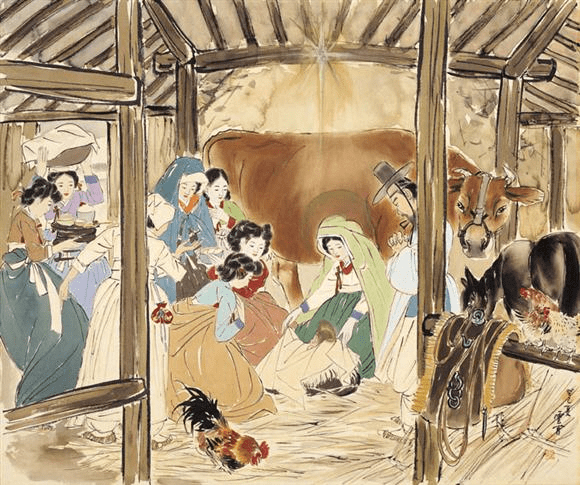
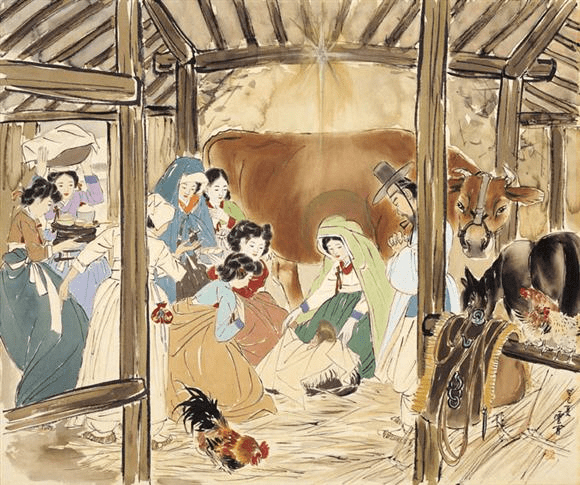
The Birth of Jesus Christ, by Woonbo Kim Ki-chang, 1953

Overwhelmed. That’s the word I imagine the characters in this story had, for various reasons.

To have spiritual or emotional overwhelm is to feel overpowered by several circumstances at once. It’s experiencing a lot of emotions all at the same time.

The sense of overwhelm can come from many different things, including complicated grief, relational distance, and too many responsibilities. Depending upon why we are overwhelmed, it will likely either leave us stuck and chronically tired, or free and forever rejoicing.

A good sense of overwhelm is awe and wonder. A bad sense of overwhelm is despondency and dejection.

Mary probably experienced the full range of overwhelm. An angel showed up and announced to her that she would give birth to a son and name him Jesus, meaning that God will save the people. He will fulfill the promise of being the Son of the ancient King David who has a permanent reign.

In other words, Mary would give birth to the Messiah. That sounds like the very definition of overwhelm, in both its good and bad sense.

Despite the temporal worldly power of the Roman Empire, Mary’s child would have a kingdom without end. And in spite of the Romans, God’s will and purpose would prevail.

And yet, Mary and Joseph were still subject to Roman authority. That meant they needed to be registered, along with everyone else in the Empire, so that the government knew about their tax base, and who was going to pay it.

The decree from Ceasar meant that, even though Mary was quite pregnant, she and Joseph would have to travel to Bethlehem, the family’s ancestral town, in order to be properly registered.

Jesus would not be born in the city of overwhelming power and control in Jerusalem. Rather, Bethlehem, a small non-descript town south of the city, is the place for an overwhelming birth experience to happen.

It’s appropriate that from the beginning, the life and ministry of Jesus would be more about the smaller and less powerful place and people.

And so, the new king, from the line of David, is born in the most humble of circumstances. It is fitting that the humblest of persons were the first to receive the birth news.

Shepherds were literally out on the margins of society. Their typical reputation was not good. They stink. They drink too much. They’re on the lower rung of cultural power.

Yet, a huge angelic delegation was sent from heaven to shepherds to announce the birth. It was an overwhelming experience, no matter how you view it.

Seeing Shepherds, by Daniel Bonnell

Angels showed up, and the shepherds were nearly paralyzed with fear. But their terror turned on a dime to awe, wonder, and joy.

What’s more, the good news shared with the lowliest of persons, is for everyone. All the overwhelm and awe is contained in a savior who has been born, Christ the Lord.

Overwhelming feelings were a regular experience of people in the Gospel of Luke who encountered angels – fear being the initial response. But it’s then followed by an assurance that God is extending grace to them, not judgment. No one need be afraid, because God is with them.

It’s not a new message; but it is a message that is newly focused in this savior of a baby. He is Immanuel, God with us. The presence of God is here, because the attention and love of God are here.

Out of my distress I called on the Lord;
    the Lord answered me and set me in a broad place.
With the Lord on my side I do not fear.
    What can mortals do to me?
The Lord is on my side to help me;
    I shall look in triumph on those who hate me. (Psalm 118:5-7, NRSV)

The real genuine authentic power of the universe is here – not found within political empires or governments, nor with the wealthy and influential – but discovered in the arrival of the actual savior, who holds all power and authority, and wields it according to proper justice and righteousness.

All along, God is the true deliverer who backs up the needy and oppressed. It is demonstrated in the angelic proclamations of good news about this Savior, the Christ, the One anointed and chosen by God, the son of David, the deliverer from ancient enemies.

The angel’s proclamation erupts with the sudden appearance of a multitude of God’s heavenly messengers praising God, declaring God’s glory, favor, and blessing of peace on the earth. The emphasis is upon God’s grace rather than human action.

In response to the announcement they received, the shepherds went to see if what they had heard was true, and indeed, it all was. When they saw the sign for themselves, they could not keep silent about all they had heard and seen.

The shepherds praised God, out of an overwhelming sense of amazement that the Lord had paid attention to them.

Praise is still the reaction in the life of the person touched by all that they have seen and heard.

Creator God, by your greatness you became small; by your power you became powerless; and by your limitlessness you became limited. Through the birth of your son, we can live in the divine light that shines on a world transformed by the limitless power of your love. Amen. Praise the Lord!

Second Sunday of Advent – Prepare the Way (Luke 3:1-6)

The Call from John the Baptist to Repent, by Renier de Huy, 12th century

In the fifteenth year of the reign of Tiberius Caesar, when Pontius Pilate was governor of Judea, and Herod was ruler of Galilee, and his brother Philip ruler of the region of Ituraea and Trachonitis, and Lysanias ruler of Abilene, during the high priesthood of Annas and Caiaphas, the word of God came to John son of Zechariah in the wilderness. He went into all the region around the Jordan, proclaiming a baptism of repentance for the forgiveness of sins, as it is written in the book of the words of the prophet Isaiah,

“The voice of one crying out in the wilderness:
‘Prepare the way of the Lord;
    make his paths straight.
Every valley shall be filled,
    and every mountain and hill shall be made low,
and the crooked shall be made straight,
    and the rough ways made smooth,
and all flesh shall see the salvation of God.’ ” (New Revised Standard Bible)

In this Christian season of Advent, we are reminded that God is not only high above us, transcendent, far away; God is also close to us, immanent, and with us.

We remember at this time of year that God does not remain distant, but entered our time and space at a particular moment in history, for a distinct purpose.

The Roman Empire was powerful, large, and very much in control of every place where it existed. The litany of imperial rulers and authorities which the Gospel writer Luke listed is meant to give us a feel of the Roman weight, and how much Roman might was ensconced in Judea.

The world at the turn of the common era was under the dominion of powerful people with lots of influence. But God did not come to any of them. Instead, God came to a loner – a man who spent his time out in the wilderness. His name was John, the son of Zechariah. We know him as John the Baptist.

With God coming to John at a precise point of time in a particular place, that made John a prophet with a singular message. John was born for this. (Luke 1:76)

It is fitting that a man hanging out on the fringes of society all by himself would be the one to prepare the way for Messiah.

After all, Messiah’s message would be one of bringing good news to the poor, proclaiming release to prisoners, and freeing those who are oppressed. (Luke 4:18-19; Isaiah 61:1-2)

God’s prophetic calling for John was one of preparation. John was to prepare the way of the Lord. He was to get the people ready to receive Messiah.

John went about his ministry of preparation by calling folks to repent, to change their minds and amend their ways, so that there might be forgiveness.

In a reference from the prophet Isaiah, Luke alluded to Jewish exiles returning from their Babylonian captivity. The actual physical road from Babylon to Jerusalem was a hard journey due to the distance and topography.

The “road” or the “way” in Holy Scripture is also a metaphor for the spiritual journey we take in this life. And that road has a lot of challenges to it. The very act of walking as a pilgrim over a long arduous journey changes a person.

It is rarely the destination that makes a person; it’s the journey itself which leads one to a changed life of thinking differently, and seeing things from a perspective we’ve never seen before.

The smoothing out of the road is a way of saying God is making it easier for people to return to the Lord, to get them ready for a new life with promises fulfilled and unexpected joy.

In other words, valleys raised and mountains flattened represent God’s efforts at helping us experience a complete transformation of life. The Lord will do everything possible to make renewal and restoration happen for us.

The Lord will set things right. In our contemporary world that is now largely controlled by powerful oligarchs and the super-rich, God will turn it upside-down. All of the world’s current powerful people will find themselves looking up, not down.

It would be nice and reassuring if I could give you certainty about the journey ahead. But I cannot do that. Yet, what I can do is assure us of what is at the end of the road. Look beyond the current days of self-centered leadership and popular ignorance, and understand that all flesh shall see the salvation of God.

Prepare the way of the Lord. We do that by how we go about walking the road. Each step we take every day is important and makes a difference. And when we stumble, there is plenty of grace to help get us back on our feet and moving forward.

We are all collectively journeying together to Bethlehem. And as we daily move and walk, at the end of our journey, Jesus is there.

But when the fullness of time had come, God sent his Son, born of a woman, born under the law, in order to redeem those who were under the law, so that we might receive adoption as children. (Galatians 4:4, NRSV)

And nothing can stop us or separate us from the love of God that is in Jesus Christ our Lord.

For I am convinced that neither death, nor life, nor angels, nor rulers, nor things present, nor things to come, nor powers, nor height, nor depth, nor anything else in all creation will be able to separate us from the love of God in Christ Jesus our Lord. (Romans 8:38-39, NRSV)

The journey may be arduous. You might feel like giving up. But Jesus is our Immanuel, God with us. In him, is our hope and our joy.

O Holy One of Israel, out of the embrace of mercy and righteousness, you have brought forth joy and dignity for your people. Remember now your ancient promise; make straight the paths that lead to you, and smooth the rough ways, so that in our day we might bring forth your compassion for all humanity. Amen.

Christ Is Born (Luke 2:1-20)

Nativity, by He Qi, 1998

In those days Caesar Augustus declared that everyone throughout the empire should be enrolled in the tax lists. This first enrollment occurred when Quirinius governed Syria. Everyone went to their own cities to be enrolled. Since Joseph belonged to David’s house and family line, he went up from the city of Nazareth in Galilee to David’s city, called Bethlehem, in Judea. He went to be enrolled together with Mary, who was promised to him in marriage and who was pregnant. While they were there, the time came for Mary to have her baby. She gave birth to her firstborn child, a son, wrapped him snugly, and laid him in a manger, because there was no place for them in the guestroom.

Nearby shepherds were living in the fields, guarding their sheep at night. The Lord’s angel stood before them, the Lord’s glory shone around them, and they were terrified.

The angel said, “Don’t be afraid! Look! I bring good news to you—wonderful, joyous news for all people. Your savior is born today in David’s city. He is Christ the Lord. This is a sign for you: you will find a newborn baby wrapped snugly and lying in a manger.” Suddenly a great assembly of the heavenly forces was with the angel praising God. They said, “Glory to God in heaven, and on earth peace among those whom he favors.”

When the angels returned to heaven, the shepherds said to each other, “Let’s go right now to Bethlehem and see what’s happened. Let’s confirm what the Lord has revealed to us.” They went quickly and found Mary and Joseph, and the baby lying in the manger. When they saw this, they reported what they had been told about this child. Everyone who heard it was amazed at what the shepherds told them. Mary committed these things to memory and considered them carefully. The shepherds returned home, glorifying and praising God for all they had heard and seen. Everything happened just as they had been told. (Common English Bible)

Nacimiento (Nativity), by Leoncio Saenz, 1983

It is of significance – and not by accident – that Jesus had a humble birth in a lowly setting. All around was the backdrop of a powerful Roman Empire. Whereas Christ could have been born as the mighty king that he actually is, he instead was born and then laid in a feeding trough for animals.

Caesar Augustus — whose name means revered or exalted one — ended a long period of war in the Roman Empire and was hailed as a prince of peace, the savior of the world. With his reign began the Pax Romana (Roman Peace). Under the rule of Augustus, the economy was booming; culture, religion, and infrastructure were developed and prospered. He was hailed by many with the title “Ceasar is Lord.”

Yet, as with many powerful rulers in history, Augustus ruthlessly suppressed his enemies and limited their human rights. It was peace by totalitarian rule – which is really no peace, at all.

It was in those days that Augustus proclaimed his decree for a census of the entire Roman world, so that taxes could be collected from all the conquered peoples of the empire. And so, despite being very pregnant, Mary and her fiancé Joseph made the arduous 90-mile trek from Nazareth in Galilee to Bethlehem, the city of David. That was the only way they could be properly registered, to return to the ancestral home.

It’s no surprise that Mary ended up giving birth to Jesus, far from their actual home, in less than ideal circumstances, for a delivery of a baby.

It appeared Ceasar Augustus was the absolute ruler, and much too powerful for anyone to challenge him. It also seemed that Jesus, a vulnerable little infant with even smaller resources, could do anything but just try and survive. But appearances can be, and are often, quite deceiving.

The Birth of Jesus Christ, by Woonbo Kim Ki-chang, 1952

In truth, Jesus is Lord, and Ceasar is not. Christ is the real Prince of Peace who brings God’s benevolent rule and reign to earth, as it is always done in heaven. And it will not be achieved through military power, but by the justice and mercy of God. Because, as it turns out, Love is a much greater force than any human authority or empire.

Considering God’s gracious kingdom – which turns all appearances on its head – it is quite appropriate that news of Christ’s royal birth comes first to a bunch of shepherds. They were among the lowliest of the emperor’s subjects.

Although we may tend to romanticize the shepherds keeping watch over their flocks by night, most people thought of shepherds as low class workers who nobody wanted to be around. They were poor, illiterate, and thought to be dishonorable drunks. Shepherds also had the reputation of being thieves because they grazed their flocks on other people’s property. In short, they were mostly the outcasts of society.

To this group of people the angel announces good news of great joy for all the people everywhere – and not just the powerful and the rich: To you is born this day in the city of David, a Savior, who is the Messiah, the Lord. The shepherds go to Bethlehem to find this baby, and become the first to share the good news of the Savior’s birth.

Today, we still live in a world dominated by people who desire power and privilege over others. We still live in a world enamored with wealth and resources, power and authority, military might and social control. In this world, much like the ancient world, the lowly still get trampled and the least among us get little if any attention.

Masters of both small and large worlds will eventually be toppled, not to mention our own personal petty empires we seek to build. All of our planning and scheming will never bring true peace and security. Jesus has arrived! Christ is born! All other empires are now on borrowed time.

Nativity, by Joseph Mulamba-Mandangi, 2001

The Savior is born for all the world, for us, even though we are separated from Christ’s birth by two millennia. Jesus still comes to bring peace on earth and goodwill to all humanity through the power of Love. He still casts out fear and relieves anxious hearts. And his reign will last forever and ever.

With Jesus Christ as Sovereign, outcasts are welcomed in; the hungry are fed; the poor are lifted up; captives are set free; enemies are reconciled. And wherever the good news is proclaimed, guilt and shame melts away, and lives are changed.

Today Christians all over the world celebrate the birth of Christ. And we also look forward to his coming again, when his reign of justice, mercy, and peace comes in all its fullness.

May God bless you this Christmas and always. May you be comforted by the Lord’s presence in your life, and always follow his guiding light. For Christ has come, the Immanuel, God with us. Amen.

One Thing (Psalm 27)

And We Shall Dwell in the House of the Lord, by Dale Terbush

The Lord is my light and my salvation—
    whom shall I fear?
The Lord is the stronghold of my life—
    of whom shall I be afraid?

When the wicked advance against me
    to devour me,
it is my enemies and my foes
    who will stumble and fall.
Though an army besiege me,
    my heart will not fear;
though war break out against me,
    even then I will be confident.

One thing I ask from the Lord,
    this only do I seek:
that I may dwell in the house of the Lord
    all the days of my life,
to gaze on the beauty of the Lord
    and to seek him in his temple.
For in the day of trouble
    he will keep me safe in his dwelling;
he will hide me in the shelter of his sacred tent
    and set me high upon a rock.

Then my head will be exalted
    above the enemies who surround me;
at his sacred tent I will sacrifice with shouts of joy;
    I will sing and make music to the Lord.

Hear my voice when I call, Lord;
    be merciful to me and answer me.
My heart says of you, “Seek his face!”
    Your face, Lord, I will seek.
Do not hide your face from me,
    do not turn your servant away in anger;
    you have been my helper.
Do not reject me or forsake me,
    God my Savior.
Though my father and mother forsake me,
    the Lord will receive me.
Teach me your way, Lord;
    lead me in a straight path
    because of my oppressors.
Do not turn me over to the desire of my foes,
    for false witnesses rise up against me,
    spouting malicious accusations.

I remain confident of this:
    I will see the goodness of the Lord
    in the land of the living.
Wait for the Lord;
    be strong and take heart
    and wait for the Lord. (New International Version)

Just recently, I was reflecting on my vocational life with a friend. I realized that, for the majority of my adult life, I have worked at least two jobs at once. On top of that, for several years, I was also going to school. Even now that I have gotten older and (finally) pared my work life down to just one job, I still work in two different places, complete with different offices and staff.

For us Americans, this is like a badge of honor – that we can demonstrate what hard workers we are. Yet, there is also something quite unhealthy about all this work that leaves room for little else in life. Typically, our relationships suffer. And the relationship which suffers the most is with God.

The psalmist had a singular desire – one thing – that he wanted above all else.

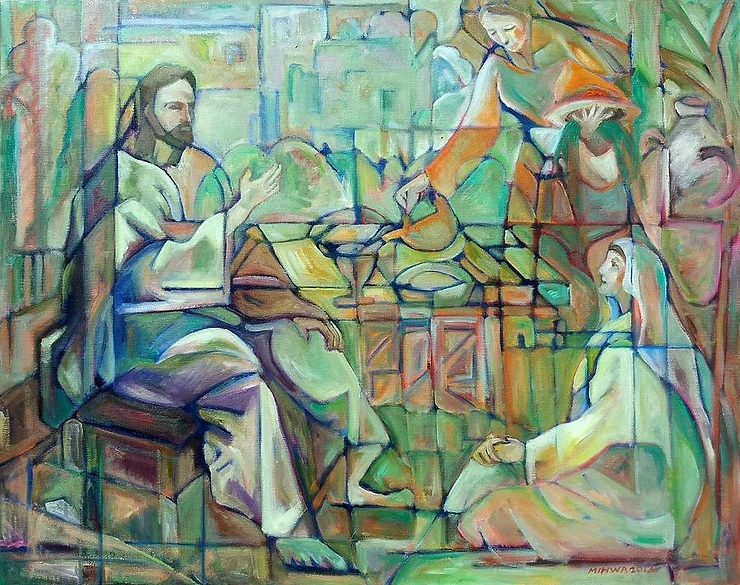
It’s the same thing that the Apostle Paul wanted more than anything else in the world (Philippians 31-14); and the one thing Jesus said to the rich young ruler that he lacked (Mark 10:17-31). It’s the thing that Mary pursued, and the thing Martha neglected (Luke 10:38-42). The blind man discovered the one thing in his healing encounter with Jesus (John 9:1-34).

Perhaps we, especially in the United States, need a miraculous healing, not only from our compulsions toward work, but also from our collective spiritual attention-deficit-disorder. We need to be able to focus on the one thing that is needed above all other things – without any sort of multitasking.

Rather than adding another thing to our calendar, and just trying to work harder, let’s step back and reconnect with what is most important to us. What is your highest priority in life? That question isn’t only for me as an American; it’s for all of us everywhere.

It’s instructive that the one thing the psalmist doesn’t ask for is revenge, or judgment, or, at the least, some comeuppance and protection. Instead, he simply asks this: To dwell in the house of the Lord. That is, the psalmist, David, wants more than anything else to live fully in God’s presence – because when that happens, everything else falls into place.

The inherent nature of God is goodness and beauty. So, to be with God is to be surrounding by what is lovely and good. To be in God’s presence is to relax and know real security.

In this state, we are then able to get our bearings and remember the good deeds of deliverance the Lord has done in the past; the mighty acts of power God will show in the future; and are blanketed in the present with the reality that the world doesn’t cease spinning on it’s axis because I have only one job, or take a break, or turn off my cellphone for a day. I can do it without fear or anxiety because God is with me.

With renewed focus, I can center my schedule, my calendar, my plans, and all my decisions around the surety that God is with me; and that I can enjoy the Lord forever. After all, this is what the Christian season of Advent teaches us – that Jesus, our Immanuel, is God with us, come in the flesh for us and for our salvation. That is the one thing we need to know today.

Ever-present and ever-loving God, we plant the seeds that one day will grow. We water seeds already planted, knowing that they hold future promise. We cannot do everything; and so help us have a sense of liberation in realizing this, so that we are enabled to do one thing very well; to take joy in being part of the process; to see that taking some steps, and then rest, is enough. We see in part, yet you, O Lord, see all things in their entirety. We are open to being, not just doing, no matter that circumstances, through Jesus Christ our Lord. Amen.