Baptism of the Lord (Mark 1:4-11)

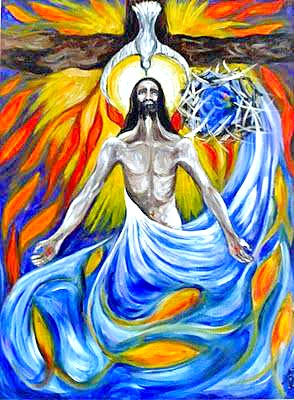
The Baptism of Jesus, by Rosalind Hore

So John the Baptist showed up in the desert and told everyone, “Turn back to God and be baptized! Then your sins will be forgiven.”

From all Judea and Jerusalem crowds of people went to John. They told how sorry they were for their sins, and he baptized them in the Jordan River.

John wore clothes made of camel’s hair. He had a leather strap around his waist and ate grasshoppers and wild honey.

John also told the people, “Someone more powerful is going to come. And I am not good enough even to stoop down and untie his sandals. I baptize you with water, but he will baptize you with the Holy Spirit!”

About that time Jesus came from Nazareth in Galilee, and John baptized him in the Jordan River. As soon as Jesus came out of the water, he saw the sky open and the Holy Spirit coming down to him like a dove. A voice from heaven said, “You are my own dear Son, and I am pleased with you.” (Contemporary English Version)

Why is the baptism of Jesus important?    

The baptism of the Lord is a regular staple each year on the Christian Calendar, because Christ’s baptism is a theologically profound event that announces the fact of his divinity in a dramatic way. The story of his baptism helps us understand Christ’s identity, as well as his mission.

Because God the Father acknowledged Jesus as God the Son, we are encountering God’s will for us through the words and actions of Christ. Jesus is the hinge upon which all history turns. The centrality of Jesus for everything we say and do is confirmed and expected through the event of his baptism.

Baptism is a ritual that signals new life. Jesus came to be baptized by John in the Jordan River – not because he personally needed to repent of sin – but so that he might identify with us as humans and signal for us the true way of life for people.

Jesus’ Baptism, by Laura James

With the Father’s affirmation of Christ, the Lord Jesus is our authority. All authority on heaven and earth has been given to him. He is the author and finisher of our faith. So we must pay careful attention to Jesus.

Here we are, two millennia removed from the earthly ministry of Christ. For some, the name of Jesus might be so familiar that they end up ignoring him. Or, others might become so disappointed with Jesus that, over time, they simply slip away from him. That’s why the author of the book of Hebrews exhorted: 

We must give our full attention to what we were told, so we won’t drift away. The message spoken by angels proved to be true, and all who disobeyed or rejected it were punished as they deserved. So if we refuse this great way of being saved, how can we hope to escape? The Lord himself was the first to tell about it, and people who heard the message proved to us that it was true. (Hebrews 2:1-3, CEV)

By remembering our own baptisms, and the authoritative claim Christ has upon us, we are able to keep what is most important in front of us at all times.

Why is the descent of the Holy Spirit significant?

If God the Father established the authority of Jesus over all things, then the Holy Spirit coming upon Jesus empowered him to exercise that authority over everything, especially the demonic realm. Jesus was given the Spirit so that he would confront evil in the world.

Our own baptisms are a participation in the baptism of Christ. We receive the same power. We are called to the same practice of self-denial in order to confront evil in our lives and in the world. The descent of the Spirit in Christ’s baptism opens to us a road of carrying our cross daily, and losing our lives in order to save them.

In Christ, we died to guilt and shame. We were baptized into Christ, and were therefore baptized into his death.  That means Jesus has opened the way for us to live a new life and no longer be slaves to sin. It furthermore means that we have been given the Spirit to deal with the continuing presence of sin in this life. 

Through Jesus Christ the Spirit of life set us free from sin and death. Therefore, we have been given the power to resist the devil and set our minds on what the Spirit desires. 

Baptism of Christ, by He Qi

So, we have an obligation, and it’s not to the sinful nature. Our responsibility is to put to death the misdeeds of the body. We can do this because we have not been given a spirit that makes us slaves to fear, but have received the spirit of sonship. (Romans 8:1-17)

Thus, God is not only Father of Jesus, but our Father, as well. We can cry “Abba and have all the help of heaven behind us in our quest to follow Jesus. This is all possible because of the descent of the Spirit in Christ’s baptism – a baptism that we participate in through our own baptisms.

How does heaven opening help me today?

Heaven was ripped and torn open, letting us know the striking reality that God does not remain far away, but has come near to us in the Son, the Lord Jesus.

Long ago in many ways and at many times God’s prophets spoke his message to our ancestors. But now at last, God sent his Son to bring his message to us. God created the universe by his Son, and everything will someday belong to the Son. God’s Son has all the brightness of God’s own glory and is like him in every way. By his own mighty word, he holds the universe together. After the Son had washed away our sins, he sat down at the right side of the glorious God in heaven. (Hebrews 1:1-3, CEV)

Heaven was again ripped open at the death of Christ. The curtain of the temple that separated the inner sanctuary from everything else was torn in two from top to bottom – signifying that once and for all, God is near, and has become close to us in the person of Jesus Christ.

So whenever we are in need, we should come bravely before the throne of our merciful God. There we will be treated with undeserved grace, and we will find help. (Hebrews 4:16, CEV)

What is our appropriate response to the baptism of the Lord?

Since Jesus is the rightful ruler of the universe; the authority over all things; a faithful high priest always living to intercede for us; the power to transform and give new life; the Deliverer from sin, death, and hell; then our proper response is confession, repentance, and the expectation of change.

The Lord’s baptism exposes all the things we rely upon other than Jesus, such as our own ability to set goals and accomplish them through sheer willpower; ideas and ingenuity; hard work and experience.

Yet we can rely on Jesus, and have the sort of change that he can bring. Rather than expecting everyone else, and every circumstance to change, God calls us to change through the empowering presence of the Holy Spirit – the same Spirit given to Jesus.

We have the opportunity and the invitation to trust Jesus. Just as it took humility for Jesus to be baptized by John in the Jordan River, so it takes humility for us to come to Christ and admit our need for help and inner transformation.

Almighty ever-living God,
who, when Christ had been baptized in the River Jordan,
and as the Holy Spirit descended upon him,
solemnly declared him your beloved Son,
grant that your children by adoption,
reborn of water and the Holy Spirit,
may always be well pleasing to you. Amen.

God Is Both Near and Far (Psalm 145:1-5, 17-21)

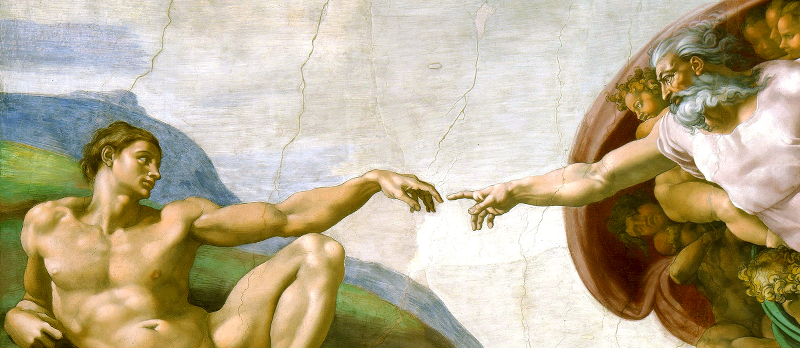
God giving life to Adam, by Michelangelo (1475-1564) on the ceiling of the Sistine Chapel, Rome

I will exalt you, my God the King;
    I will praise your name for ever and ever.
Every day I will praise you
    and extol your name for ever and ever.

Great is the Lord and most worthy of praise;
    his greatness no one can fathom.
One generation commends your works to another;
    they tell of your mighty acts.
They speak of the glorious splendor of your majesty—
    and I will meditate on your wonderful works….

The Lord is righteous in all his ways
    and faithful in all he does.
The Lord is near to all who call on him,
    to all who call on him in truth.
He fulfills the desires of those who fear him;
    he hears their cry and saves them.
The Lord watches over all who love him,
    but all the wicked he will destroy.

My mouth will speak in praise of the Lord.
    Let every creature praise his holy name
    for ever and ever. (New International Version)

The Lord is both near and far. The God of Holy Scripture is, at the same time, both:

  • approachable and aloof
  • close and distant
  • beside us and beyond us
  • available and elusive
  • revealing and remote
  • warm and cool
  • knowable and mysterious
  • readily at hand and at arm’s length
  • a good neighbor next door and a politician over in a city you’ve never been

The technical theological terms for describing God in such a way is that the Lord is both immanent and transcendent. And that is a good thing. We need the Lord to be both.

This psalm is a hymn of praise to God. The psalmist, David, celebrates the attributes and the actions of the Lord. David understood, better than most, that God is so far above humanity in divine majesty that miracles are always possible. Because God is God, the Lord’s arm is never too short to extend help and deliverance.

David knew that God’s powerful ability and God’s loving affection go hand-in-hand together; God’s mighty strength and God’s compassionate spirit work together harmoniously for our benefit.

They did not conquer the land with their swords;
    it was not their own strong arm that gave them victory.
It was your right hand and strong arm
    and the blinding light from your face that helped them,
    for you loved them. (Psalm 44:3, NLT)

God’s interventions, wonders, and miracles are never done dispassionately; the Lord’s arm is extended with deep concern and loving care for people.

The Lord acts as a close relative, like a parent, exhibiting qualities of both father and mother. God is close enough to not only hear our verbal prayers but to also hear our faint whispers. Indeed, the Lord is so close that we don’t even have to speak for the prayers of our heart to be heard.

The righteous call to the Lord, and he listens;
    he rescues them from all their troubles.
The Lord is near to those who are discouraged;
    he saves those who have lost all hope.

Good people suffer many troubles,
    but the Lord saves them from them all. (Psalm 34:17-19, GNT)

In the New Testament Gospels, Jesus gave us instruction on how to address God: “Our Father in heaven.” Not just “my” Father, but “our” Father. We are to pray with the mindful sense of our union with the Lord, as well as our connection with one another as believers.

The Lord sits in heaven as the Most High God, the transcendent Lord of me, you, and all people – watching over and protecting all whose hearts are in the right place, and effectively guarding us from a lofty divine vantage point.

My shield is God Most High, who saves the upright in heart. (Psalm 7:10, NIV)

Clap your hands, all you nations;
    shout to God with cries of joy.

For the Lord Most High is awesome,
    the great King over all the earth.
He subdued nations under us,
    peoples under our feet. (Psalm 47:1-3, NIV)

With our transcendent God always having a watchful eye over us, we need not fear anything or anyone. The Lord knows the score of how things are going in the world and in your life. And, what’s more, God knows the ropes in providing for us, protecting us, and powerfully handling any and all enemies to our souls.

Yet, at the same time, all the time, God is both our high holy King, and our close intimate Friend. Indeed, the Lord is graciously immanent as my Abba – the Father who is near and dear to our hearts.

Because you are [adopted] sons and daughters, God sent the Spirit of his Son into our hearts, crying, “Abba, Father!” Therefore, you are no longer a slave but a son or daughter, and if you are his child, then you are also an heir through God. (Galatians 4:6-7, CEB)

Christians everywhere in the world, and throughout the ages, gather together and repeat the Lord’s Prayer, every Sunday, as well as in weekly small groups, and daily individual prayers. We cry out, “Our Father in heaven” as the most used phrase over the course of our Christian lives.

And that sort of repetition is a good thing. It is important to verbalize that God is transcendent – far above all earthly powers as the sovereign Lord of the universe; and to vocalize that God is immanent – near to us as a father to a child.

Just because a phrase can become vain repetition doesn’t mean that repeating it is a bad thing. Using our words to reiterate both the far distance and the close relation of God is a worthy activity which fortifies our faith, and which passes truth to successive generations of the faithful.

The best way I know of cultivating a healthy sense of God’s transcendence and immanence (outside of reading scripture and praying) is through clouds and kids – both of which require mature adults to practice some much needed humility.

There is nothing quite like putting clocks and schedules aside, stretching out a blanket on a hill, laying back, and watching the clouds roll by. The perspective of massive highness reminds us that our problems are neither as daunting nor as important as we thought.

In contrast to the high clouds, there’s also nothing quite like forgetting your age and getting on the ground to be eye level with a kid. Fortunately, I have rambunctious and curious grandsons who continually remind me that, the lower I get, the better I understand what’s truly most important.

Neither my kids nor my grandkids care all that much about the what’s in my life – what I do – my work, my hobbies, my angst, my daily activities. But they do care a great deal about who I am and why I’m with them.

Intentionally developing a sense of God as both far and near, helps us remember who we are and why are here.

Ironically, the closer I get in touch with the reality that I’m mere dust, and will return back to the ground, the better I’m able to see the Most High God. And, conversely, the more I gaze into the sky, the greater awareness I have of the people around me. I learn to love God and neighbor, as I ought.

There’s no better time than now to get out there and take advantage of the clouds and the kids. It will likely help you to know God better; and it will probably bring a greater awareness, clarity, and connection to the truly significant which is always around us.

Father God, you formed us from the dust of the earth. Remind us of our place as your creatures at home in your creation. Forgive us when we forget our connection to the earth, and our dependence upon the goodness of your world. Lord have mercy.

Brother Jesus, you were born into this world, and made your earthly home in Nazareth. Help us to know and love the people and places where you have set us. Forgive us when we fail to care for our homes, our communities, and your creation. Christ, have mercy.

Blessed Holy Spirit, you desire to grow in us your fruit of love, joy, peace, patience, kindness, goodness, faithfulness, gentleness, and self-control. Forgive us when our roots are so shallow, and our hearts so restless, that our lives fail to bear fruit. Enable us to find our home in you, and in the places to which you call us. Lord have mercy.

Blessed Holy Trinity – Father, Son, and Spirit – the God who is both far and near: Forgive us our sins, settle us in a place of belonging, and enable us to bear fruit for your kingdom. Amen.

Ephesians 5:15-20 – Speak to One Another with Psalms, Hymns, and Spiritual Songs

Be very careful, then, how you live—not as unwise but as wise, making the most of every opportunity, because the days are evil. Therefore, do not be foolish, but understand what the Lord’s will is. Do not get drunk on wine, which leads to debauchery. Instead, be filled with the Spirit, speaking to one another with psalms, hymns, and songs from the Spirit. Sing and make music from your heart to the Lord, always giving thanks to God the Father for everything, in the name of our Lord Jesus Christ. (New International Version)

As you likely well know, an inebriated person tends to say and do things that they do not typically say or do when they’re sober. The Apostle Paul’s point about being filled with the Spirit is that, instead of doing and saying stupid things, we are so filled with God that we do things and say things that we would not typically do and say if we were not filled with God – that is, good things. 

Apart from being full of God’s Spirit, we tend toward mumbling, not singing; worry, not making music in our hearts; and complaining and arguing, not giving thanks. Half-filled Christians practice a half-hearted Christianity. They’re only half-baked in their service and devotion to Christ.

Why sing? 

Because singing is part of being filled with the Spirit of God. Singing happens when we experience God’s overflowing grace in our lives through the blessings of being chosen, adopted, and redeemed into God’s new community. (Ephesians 1:3-11)

Music is powerful. It’s not only a means of expressing praise and commitment to Christ and each other, it is also a powerful means of being impressed. For example, when we first teach kids the alphabet, we teach it in a song. Trying to teach letters in a rote fashion typically doesn’t work well for pre-school kids. Words set to music is why we still remember words from old TV shows, because those words were set to a catchy tune.  Music is why an Alzheimer’s patient cannot remember her daughter’s name but can flawlessly sing all four verses of Amazing Grace.

Singing is an offering and a sacrifice of praise to God (Hebrews 13:15). And singing is also a vehicle whereby we are taught, encouraged, and built up in the community of believers. We sing to God, one another, and even ourselves.

Church music, then, is to be both a means of praising God and a practice of encouraging each other. We do it through psalms, hymns, and spiritual songs.

Psalms

The word “psalm” helps us rightly think of the biblical book of Psalms. Singing the psalms is an ancient practice, going all the way back to the Israelites singing psalms in the temple and synagogue. The early church maintained this practice, especially as a means of being faithful to praying without ceasing. 

However, over time, medieval congregations began neglecting the practice. In fact, the congregations eventually gave up most singing altogether. Almost all the singing was done by church choirs and professional musicians employed by the state (no separation of church and state) to write, compose, and perform in worship services. 

Five-hundred years ago, with the Reformation, Martin Luther reinstituted congregational singing. He gave music back to the people. One of the results of this change was putting the book of psalms to song – the Psalter.  For many Protestant denominations, the Psalter became the primary means of singing. The Psalter chiefly set prayers to song. It was both a means of expressing prayer to God and learning Scripture.


Hymns

There have always been hymns in the church. Yet, it was not until the Reformation that hymns began to be written and sung by congregations. For the Reformers, hymns were used to teach sound doctrine and theology, as well as a means of confessing the faith together

Spiritual Songs

Spiritual songs are the present day equivalent of praise and worship choruses, or what some refer to as contemporary songs. These are songs purposefully designed to be emotional expressions of praise to God and to give powerful testimony for what God has done or is doing.

So, what?

Quick review:

  • Psalms are used to pray and learn Scripture.
  • Hymns are used to teach us sound doctrine and confess the faith together.  
  • Spiritual songs are an important way of expressing praise to God and being encouraged in the faith. 

Therefore, church music is to serve as both a revelation from God, and as a response from God’s people.

There are two important deductions from this verse:

  1. A variety of songs is inferred and expected.
  2. Paul commanded their use.

The reason worship style is such a hot topic in a lot of churches is because we all have our personal preferences.  And yet, if we are to be faithful to today’s New Testament lesson, we will not just lock in on what I want. 

Truth be told, we are selfish people when it comes to music. We want what we want, and we don’t care what somebody else wants. And we will persist in that self-absorbed spirit until somebody calls us on it. That somebody is the Apostle Paul. The Word of God calls us to encompass psalms, hymns, and spiritual songs – all three of them – in our worship.

I have a good friend who is an accomplished church musician and worship pastor. I once asked him how I can lead a worship service among such a variety of preferences concerning music. He answered my question with a question: “How highly do people, including and especially your musicians, value the unity of the church?  Do they love each other so much that they can allow for a wider range of style, and do so without vocally complaining about it?”

My friend went on to say, “When I arrived at one church as their pastor, some people were in a rather bad habit of saying very openly, ‘Oh I hate that song,’ or, ‘If I hear this song one more time I’m walking out.’ What I tried to do was teach people that this is not the most loving or mature approach and does little to build up the rest of the Body of Christ.”

If a group of people are being faithful to Scripture, and doing their best musically, then – if the music seems lifeless, dull, or strange to us – the real issue isn’t style but our hearts.       

Is that heart filled with the Spirit of God? If it is, then we will speak to one another using the Psalter, using time-honored hymns, and utilizing fresh contemporary praise songs. And the result will be the Body of Christ, the Church, built up in the faith.

Gracious God, give us grace to take to heart the great dangers we are in by our unhappy divisions about music.  Take away all hatred and prejudice, and whatever else may hinder us from godly union and concord; that, as there is but one body and one Spirit, one hope of our calling, one Lord, one faith, one baptism, one God and Father of us all, so we may from this time forward be all of one heart and of one soul, united in one holy bond of peace, and may with one mind and one mouth glorify you, through Jesus Christ our Lord. Amen.

John 3:31-36 – Believe the Son

The Trinity by Alex Rapoport, 1994

God’s Son comes from heaven and is above all others. Everyone who comes from the earth belongs to the earth and speaks about earthly things. The one who comes from heaven is above all others. He speaks about what he has seen and heard, and yet no one believes him. But everyone who does believe him has shown that God is truthful. The Son was sent to speak God’s message, and he has been given the full power of God’s Spirit.

The Father loves the Son and has given him everything. Everyone who has faith in the Son has eternal life. But no one who rejects him will ever share in that life, and God will be angry with them forever. (Contemporary English Version)

When Jesus ascended to heaven, he left instructions to his disciples to pray and to witness (Acts 1:1-11). Jesus asks of us what he himself does or has already done. The life and ministry of Christ on this earth was marked continually with prayer and bearing witness. Just as Jesus bore witness to what he saw and heard as the Divine Word, so his followers are to do likewise. The evidence and the veracity of Christ’s witness is the giving of God’s Spirit – the One whom confirms this testimony to us.

I, personally, have found Jesus to be precisely whom he claims to be. I have come to accept his testimony as gracious, truthful, and life-giving. I have wholeheartedly embraced the New Testament Gospel accounts of his birth, life, teaching, death, resurrection, and ascension. This belief came neither quickly nor easily for me – it resulted from an honest straightforward reading of the Bible, along with the gracious wooing of the Holy Spirit.

It really isn’t my job to convince you of Jesus Christ’s authenticity and trustworthiness. That is the work of the Holy Spirit. Instead, it is my task to bear witness of the things I have seen and heard concerning Jesus. 

My life has been thoroughly turned upside-down because of Jesus. With Jesus, I have been invited into the life of God. By the wounds of Jesus, I have experienced healing of damaged emotions and recovery from spiritual hurts inflicted by others. Through union with Christ, I have grace and forgiveness of things I have done and left undone. With Brother Jesus as my friend and companion, I enjoy loving attention and am never dismissed by him.

The Trinity by Jyoti Sahi

For those who have not read the Gospel accounts and refuse Christ, then, for honesty’s sake, please have the integrity to give Jesus a hearing before you dismiss him with a slight of hand. It is one thing to genuinely no little about Jesus, and it is quite another thing to ignore him when you have knowledge about how to discover him.

For those of us who have read the New Testament Gospels and accept the testimony of Jesus, we come back again and again to his life-giving words and seek continually to follow him in his way of mercy, purity, and peace. We bear witness to how Jesus has changed our lives and offers a life worth living.

Everyone with faith in Jesus has a life-giving connection with God. Those who don’t, don’t. If you disagree with this, then contend with Jesus himself. Give him a hearing. Watch him in action. Observe how he deals with people. See if he lives up to his words. Then, bear witness to what you have seen and heard.

Christian faith is a complete trust in the person and work of Jesus Christ as Lord and Savior. Because God has been revealed as faithful through steadfast love, the Lord gifts people with faith to know the Divine.

Faith, a noun, is closely accompanied by it’s verb, believe. Together, as identical twin sisters, they let us know that both knowledge and action are needed. We need information in knowing what step to take, and an active commitment to actually take that step.

Others’ faith in Jesus led to a man’s healing of both body and soul:

And behold, some people brought to him a paralytic, lying on a bed. And when Jesus saw their faith, he said to the paralytic, “Take heart, my son; your sins are forgiven.” (Matthew 9:2, ESV)

The size of faith is irrelevant; even a smidge of Jesus has incredible power:

“I [Jesus] assure you that if you have faith the size of a mustard seed, you could say to this mountain, ‘Go from here to there,’ and it will go. There will be nothing that you can’t do.” (Matthew 17:20, CEV)

Human weakness and inability is no problem because of faith in Christ:

Everyone who believes has God’s approval through faith in Jesus Christ…. We conclude that a person has God’s approval by faith, not by his own efforts.

Romans 3:22, 28, GW

A person acts upon knowledge of Jesus with total trust in Christ’s finished work of deliverance from all which is evil:

It’s the word of faith that welcomes God to go to work and set things right for us. This is the core of our preaching. Say the welcoming word to God — “Jesus is my Master”— embracing, body and soul, God’s work of doing in us what he did in raising Jesus from the dead. That’s it. You’re not “doing” anything; you’re simply calling out to God, trusting him to do it for you. That’s salvation. With your whole being you embrace God setting things right, and then you say it, right out loud: “God has set everything right between him and me!” (Romans 10:9-12, MSG)

Faith is not an event; it is continual trust in the person and work of Christ for practical living and compassionate serving:

I have been crucified with Christ; and it is no longer I who live, but it is Christ who lives in me. And the life I now live in the flesh I live by faith in the Son of God, who loved me and gave himself for me. (Galatians 2:19b-20, NRSV)

Outward rituals only have their proper place as they help inform belief in order to engage in loving actions:

For in Christ Jesus, neither circumcision nor uncircumcision counts for anything, but only faith working through love. (Galatians 5:6, NAB)

You are saved by God’s grace because of your faith. This salvation is God’s gift. It’s not something you possessed. It’s not something you did that you can be proud of. Instead, we are God’s accomplishment, created in Christ Jesus to do good things. God planned for these good things to be the way that we live our lives. (Ephesians 2:8-10, CEB)

Understanding and experience go together like a hand in a glove:

I keep hearing about your faith in the Lord Jesus and your love for all of God’s people.  And I am praying that you will put into action the generosity that comes from your faith as you understand and experience all the good things we have in Christ. (Philemon 5-6, NLT)

Absolute certainty isn’t in the realm of Christian spirituality – there’s always more information one could obtain. Faith discerns, intuits, and knows God is there, and orders it’s steps accordingly with faithful activity:

And without faith it is impossible to please God, for whoever would approach him must believe that he exists and that he rewards those who seek him. (Hebrews 11:6, NRSV)

My brothers and sisters, if people say they have faith, but do nothing, their faith is worth nothing. Can faith like that save them?… Just as a person’s body that does not have a spirit is dead, so faith that does nothing is dead! (James 2:14, 26, NCV)

In the power of the Spirit and in union with Christ, I pray to you, the God and Father of all:

For empowerment by the Spirit, that I may be a faithful witness

For those who wait on You, that they may find renewal

For all people, that they may acknowledge the kingdom of the ascended Christ

For all who are struggling with broken relationships

I commend myself and all for whom I pray, to Your mercy and protection through Jesus Christ, my Lord and Savior. Amen.