God (Psalm 147:12-20)

Extol the Lord, O Jerusalem!
    Praise your God, O Zion!
For he strengthens the bars of your gates;
    he blesses your children within you.
He grants peace within your borders;
    he fills you with the finest of wheat.
He sends out his command to the earth;
    his word runs swiftly.
He gives snow like wool;
    he scatters frost like ashes.
He hurls down hail like crumbs—
    who can stand before his cold?
He sends out his word and melts them;
    he makes his wind blow, and the waters flow.
He declares his word to Jacob,
    his statutes and ordinances to Israel.
He has not dealt thus with any other nation;
    they do not know his ordinances.
Praise the Lord! (New Revised Standard Version)

The psalmist portrays a God who is clearly in control of all things. This is the Lord God almighty, who is the Creator, and is sovereign over the entire world.

God has no need for bluster, or to leverage knowledge in order to get things done. With only a word, the weather changes completely, and people are invited to participate in the divine will for this earth.

There is no creature, and no human on this earth, who has such power and authority, sovereignty and control, over everything and everyone as God.

Because of God’s great power, the Lord is able to extend gracious and providential care for those who put their hope in God’s steadfast love. Such grace and love of divine blessing is the means for Israel’s praise of Yahweh in the psalm.

The grandest blessing of them all is the gift of the “word.” God’s word of command is what sets in motion all of the natural processes of this earth. It is the divine word that gives and sustains life on this planet.

The same divine word which has been gifted in order for the waters to abundantly flow and the wind to continually blow, is the word given to Israel in the laws and commands for the people.

This gift of word is a wonderful privilege, given to the nation of Israel in the Old Testament. It is what makes them a peculiar people, recipients of the divine will. It is a word of guidance for the covenant people of God.

And that divine word is the primary reason for the human word to respond in praise by extoling the awesome might and mercy of God.

Please understand that today’s psalm is profoundly theological. In other words, it is all about God. We humans and the creation are mentioned and talked about within the psalm, yet all of it is in the context of God’s activity in the world, of God’s actions in history.

The things which God does among us and in this world is a theological reflection, in and of itself. Let me say it another way: God does what God is.

God didn’t simply do some wondrous act in the past. The Lord didn’t merely console and heal someone at some time. Rather, God is constantly binding up the brokenhearted; continually casting down the wicked; and consistently demonstrating steadfast love through right, good, and just actions, all the time.

There is a never a time when God is not God, being holy, loving, and good; and therefore, God’s eternal actions are a non-stop working of justice and righteousness in this old fallen world.

Evil, of course, is continually at work, as well. But we are not talking about opposing powers which are equal to each other. Justice and love will eventually swallow up wickedness and evil.

This is the hope that undergirds the psalmist, and it is the reason that the faithful keep persevering and offering their praise, adoration, and thanksgiving to the God who never slumbers nor sleeps, but is always watching over the righteous.

God’s wisdom and power is matchless. It is impossible for any one of us, or even all of us collectively, to count and number all the stars in the universe. But God can. And God even has them all named, because they all belong to God.

Neither you nor I could ever number the raindrops that fall on our roof in just a few minutes. Yet, God can. And the Lord can count the grains of sand on a beach and the hairs on every head (or in some cases, every hair on a guy’s back).

We humans number in the billions on this earth. Yet, God knows us all by name. And God’s perfection is near and intimate, not distant and remote.

I don’t know about you, my friend, but my encounters with God are nothing like a virtual Zoom meeting. My interactions with the God of the universe are close, intimate, and caring, just as a mother with her newborn baby.

Therefore, matters of renewal, restoration, and even resurrection are not problems for the God of the psalmist. Widows are comforted and rejoice. The poor are lifted up, and not ruined by their poverty.

The confused, the disordered and disoriented, the discouraged and discombobulated, are all held in the hands of the God who knows their confusion and will take care of them.

I might not understand; and, in fact, the older I become, I’ve discovered that the less I actually know. But I believe. I trust God. I do this, daily, because the Lord has demonstrated to me over and over again that God is trustworthy and has the ability to bend everything in this world for redemptive purposes.

That is the sort of God I serve – that the psalmist serves. And this faith, hope, and love is what I want for you, as well, my friend.

Life is too short and precious to squander it, and to flounder in disbelief. So, just listen; and take as much time as you need to hear the word, and experience the presence of life that is around you, and right in front of your face.

Dearest and most gracious Lord:

I thank you for the gift of life, the rising sun, and the promise of the seasons.

I give you thanks for my family and friends and the gifts they share; for my home and all its comforts within; for the abundance you give me and my willingness to share it with others.

I offer my gratitude to you for granting me wisdom, and the ability to listen; for acceptance of the challenges that I face every day; for strength and courage to act for justice and peace.

Most of all, I thank you for the knowledge that, without you, I have nothing; and with you, I possess all things, and have everything I need. Amen.

An Advent Message of Suffering and Deliverance (Micah 4:8-13)

The Prophet Micah Exhorts the Israelites, by Gustave Doré, 1866

As for you, Jerusalem,
    the citadel of God’s people,
your royal might and power
    will come back to you again.
The kingship will be restored
    to my precious Jerusalem.

But why are you now screaming in terror?
    Have you no king to lead you?
Have your wise people all died?
    Pain has gripped you like a woman in childbirth.
Writhe and groan like a woman in labor,
    you people of Jerusalem,
for now you must leave this city
    to live in the open country.
You will soon be sent in exile
    to distant Babylon.
But the Lord will rescue you there;
    he will redeem you from the grip of your enemies.

Now many nations have gathered against you.
    “Let her be desecrated,” they say.
    “Let us see the destruction of Jerusalem.”
But they do not know the Lord’s thoughts
    or understand his plan.
These nations don’t know
    that he is gathering them together
to be beaten and trampled
    like sheaves of grain on a threshing floor.
“Rise up and crush the nations, O Jerusalem!”
    says the Lord.
“For I will give you iron horns and bronze hooves,
    so you can trample many nations to pieces.
You will present their stolen riches to the Lord,
    their wealth to the Lord of all the earth.” (New Living Translation)

A lot of people don’t understand much about the Bible, especially many parts of what some call the Old or First Testament of it. It seems to them like it’s all either nonsense or gobbledygook.

I am not exaggerating when I say that I have read the entire Bible not once, but hundreds of times. And there are still many places within Holy Scripture which are an enigma to me.

Part of the reason the Bible can seem so difficult is that, at times, the perspective being written about is so expansive, so large, and so wide that it nearly defies human comprehension.

None of this talk on my part is meant to discourage anyone from reading scripture. Rather, it’s meant to encourage you to keep on reading it, listening to it, talking about it, and exploring its contents.

Instead of a being an impossible puzzle we cannot put together, the Bible is, instead, a deep treasure trove of knowledge, wisdom, and insight into the human condition and the human purpose for being on this earth.

The reason the biblical prophets came along – and included into the canon of Holy Scripture – is that they called people back to their original purpose for being here in the first place.

In every prophetic book, the culture, the society, the religion, and the politics of a people had strayed so far from their reason for existing, that it took what seems to us as extreme language in order to get them back on track.

There were some cases so bad that the prophet’s message to people was inevitable doom. And yet, even then, there was a nugget of grace, showing us that no matter how terrible things may get, the arm of God is not too short to pull the faithful from the brink of annihilation.

Examining the Book of Micah, there is nothing easy about it. The prophet wrote at a time when Assyrian power was dominate, and about to swallow up the northern kingdom of Israel. Yet, he spoke directly to Jerusalem in the southern kingdom of Judah.

Much like a woman in labor and about to give birth, Jerusalem’s cry of suffering will be transformed into a cry of deliverance and freedom.

But we aren’t talking about something that will happen in a few days or even a few years; the prophet was giving the people a panoramic sweep of centuries.

Eventually, the Babylonians come, take the people out of the city into exile to Babylon. It is a cry of pain. Micah was speaking about events which would not occur for another two hundred years.

Yet, at the same time, Micah was talking about his own present generation of people in Israel and Judah. What the people were doing, at that time, was leading to a future of great pain. And there would be a great crying out for salvation from it.

Injustice always creates a state of distress for some, while the ones perpetrating the unjust ways become wealthy on the backs of others who are miserable.

Babylon represented both the place of punishment and of liberation. Out of the exilic darkness, a new age bursts into the light.

Born into a time where many people were longing for God’s deliverance, centuries after the destruction of Jerusalem, after the exile and return to Judea, and after the days of the Maccabees, Jesus subversively entered human history.

Despite all of the human sin, the degradation and oppression of others, the injustice and abuse extant in the world, grace comes in the shape of a baby; mercy enters the world in the form of a child.

The God whom all things depend upon, became dependent, needing a mother to clean him up after a filled first-century diaper. Few people knew at the time that this little baby would be the one to clean up a massive spiritual and metaphorical diaper, full of the world’s nasty stinky injustice.

Presently, it is clear that the nations do not know they will be beaten and trampled – that all who are now in power will be answering to that subversive child born two millennia ago.

How you live makes a difference. How you are, matters.

God of both judgment and grace, we pray for all nations, that they may live in unity, peace, and concord; and that all people may know justice, and enjoy perfect freedom. Embrace the most vulnerable members of our society; end the growing disparity between the rich and poor; and grant us courage to strive for economic justice, so that all might know your mercy, and not your wrath. Amen.

The Parable of the Tenants (Mark 12:1-12)

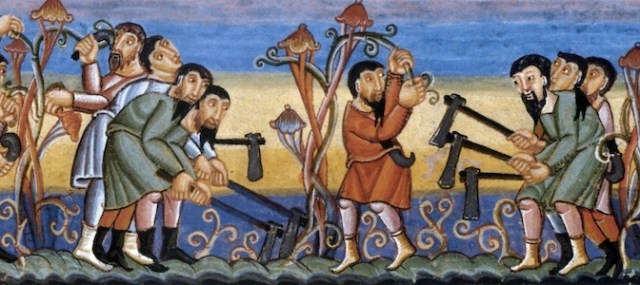
Parable of the Vineyard Workers, from Unknown Artist in the Middle Ages

Then he began to speak to them in parables. “A man planted a vineyard, put a fence around it, dug a pit for the winepress, and built a watchtower; then he leased it to tenants and went away. 

When the season came, he sent a slave to the tenants to collect from them his share of the produce of the vineyard. But they seized him and beat him and sent him away empty-handed. 

And again he sent another slave to them; this one they beat over the head and insulted. Then he sent another, and that one they killed. And so it was with many others; some they beat, and others they killed. 

He had still one other, a beloved son. Finally he sent him to them, saying, ‘They will respect my son.’ But those tenants said to one another, ‘This is the heir; come, let us kill him, and the inheritance will be ours.’ So they seized him, killed him, and threw him out of the vineyard. 

What then will the owner of the vineyard do? He will come and destroy the tenants and give the vineyard to others. Have you not read this scripture:

‘The stone that the builders rejected
    has become the cornerstone;
this was the Lord’s doing,
    and it is amazing in our eyes’?”

When they realized that he had told this parable against them, they wanted to arrest him, but they feared the crowd. So they left him and went away. (New Revised Standard Version)

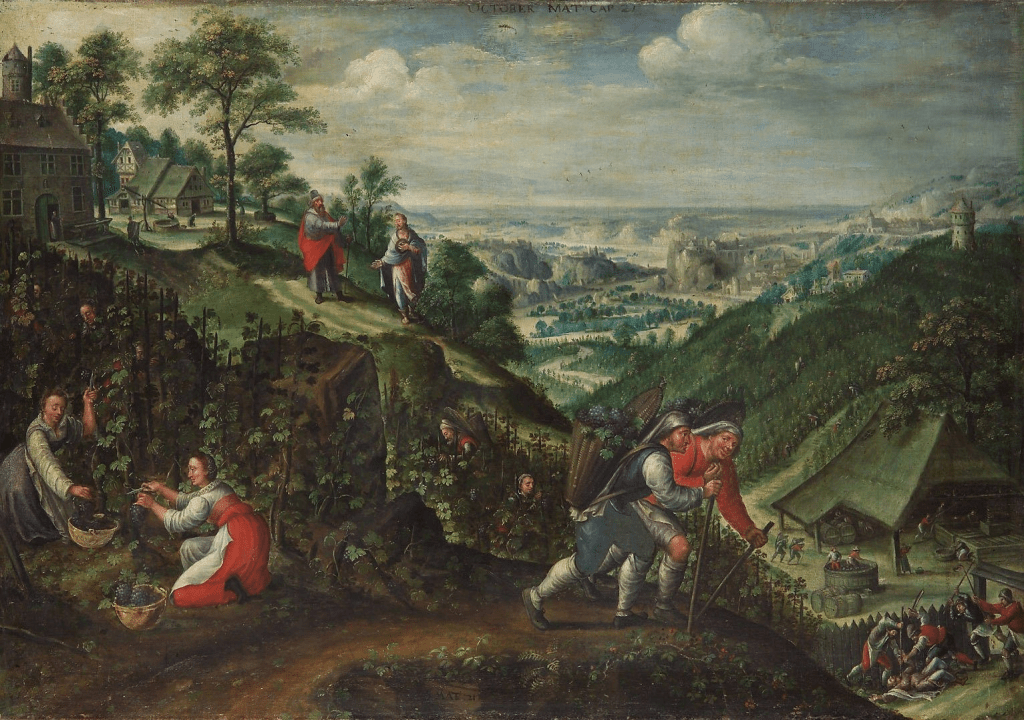
Parable of the Wicked Tenants, by Maarten Van Valckenborg (1535-1612)

Jesus was at the temple in Jerusalem. While there, the religious leaders confronted him over his supposed ministerial authority. Jesus, rather than become defensive, took the initiative by telling a parable.

The parable’s imagery comes directly from the second chapter of the prophet Isaiah in the Old Testament. It, too, was a parable concerning a vineyard. Isaiah leveled an accusation against the entire nation of Israel.

Jesus picked up the same imagery and directed his accusation against the people in front of him, the Jewish religious leaders. The connection between the parable of Isaiah and the parable of Jesus would not have been lost on those leaders.

In many ways, I can relate to the parable’s setting in the land. I grew up on a farm, and appreciate the deep connection of working the land and caring for it. I know something of owning land and having renters work it, since that it was my family did in my parent’s later years.

Anytime there is a relationship between owners, and renters or tenants or servants, it is an unequal relation. And whichever situation you relate to will affect your perspective of the parable.

If you understand what it means to be a landowner, with all of the rights and responsibilities of that ownership, and with the people who work that land, then you likely resonate with the landowner in Christ’s parable. You also will likely detest what the tenants in the parable do.

Perhaps you relate more to being a renter or a tenant. Having an understanding of what it means to rent from another, you may likely see the how the tenants in the parable think, and why they do what they do.

Having personal experiences on both sides of the owner/renter situation – for both good and bad – I can easily see how the violence in the parable could happen. I have my own stories of justice and injustice when it comes to each, the owners and the renters/tenants.

Much like today, ancient power dynamics were a fundamental part of life for many people. And those relations were, and are, fraught with all sorts of inequality.

Christ’s parable is a rather violent story. It’s not really bedtime reading. Notice that the owner has slaves, whom he sends to collect what is due him. Several of them are beaten and/or killed.

There is no backstory to the tenants situation. Yet, at the time of Christ’s ministry, there were many lower class folk who lost their land to unscrupulous owners, in a system of inequity. It’s possible that some of the men Jesus was talking to owned some land. And the religious leaders in the Gospels are rarely presented in a positive light.

Even today, there are violent struggles regarding land, especially in the Middle East. And the power dynamics and inequities are rife with injustice which is claiming to be justice. There are no easy answers to quelling the constant violence.

Feelings of hatred, anger, and fear are common. The desire to kill too often overcomes the desire for life. A group of people are outraged for being the brunt of murder, killing, and evil. Another group already feels neglected and have been the victims of unjust usury and death. They feel justified in their violence toward those they view as perpetrators.

Imagine how people on this earth, such as Palestinians, Israelis, Native Americans, and Ukrainians – just to name a few – feel about land. Land involves life, because the land has water, the potential for farming, trees, and a place to live. Thus, whoever controls land, in many ways, controls life. Agribusiness owns large chunks of land in the United States – and not the smaller family farms. Ah, but that is a topic for another time….

In Christ’s parable, everybody suffered in some way. Servants died. The landowner’s son died. The tenants were destroyed. Life was permanently altered for all involved.

Is that how any of us really want to live?

If we take a theological perspective, God owns everything. But we think we own the land and its resources. We believe we have the right to do whatever we want with it. And that is where the problem arises.

Until we truly hold to the notion that we humans are a society of equals, and that we are all subject to a God who owns everything, then we will continue to experience the effects of injustice, war, and death.

Can we, at least, change our minds? Yes, we can. And Christians are called to do just that:

Do not be conformed to this age, but be transformed by the renewing of the mind, so that you may discern what is the will of God—what is good and acceptable and perfect.

For by the grace given to me I say to everyone among you not to think of yourself more highly than you ought to think but to think with sober judgment, each according to the measure of faith that God has assigned. (Romans 12:2-3, NRSV)

The religious leaders of Christ’s day needed to change their minds about Jesus. Yet, no matter what they did, he would still become the cornerstone, if they rejected him as just one of the stones in the edifice of God’s kingdom.

Today, the parable is still meant to speak to people, to you and me. We have the chance to embrace the Prince of Peace, and walk in the way of peace, not violence. We still yet have the opportunity to be peacemakers, and live in a way that promotes human flourishing, and not human carnage.

If, like the parable of the prophet Isaiah, Christ’s parable is meant to speak to everyone, then it is most necessary that we heed the words of Jesus.

Almighty God our heavenly Father, guide the nations of the world into the way of justice and truth, and establish among them peace, which is the fruit of righteousness, so that they may become the kingdom of our Lord and Savior Jesus Christ. Amen.

Life (Genesis 1:20-2:4a)

The Creation of Heaven and Earth, by Unknown artist, c.18th century

God said, “Let the waters swarm with living things, and let birds fly above the earth up in the dome of the sky.” God created the great sea animals and all the tiny living things that swarm in the waters, each according to its kind, and all the winged birds, each according to its kind. God saw how good it was. Then God blessed them: “Be fertile and multiply and fill the waters in the seas, and let the birds multiply on the earth.”

There was evening and there was morning: the fifth day.

God said, “Let the earth produce every kind of living thing: livestock, crawling things, and wildlife.” And that’s what happened. God made every kind of wildlife, every kind of livestock, and every kind of creature that crawls on the ground. God saw how good it was. Then God said, “Let us make humanity in our image to resemble us so that they may take charge of the fish of the sea, the birds in the sky, the livestock, all the earth, and all the crawling things on earth.”

God created humanity in God’s own image,
        in the divine image God created them,
            male and female God created them.

God blessed them and said to them, “Be fertile and multiply; fill the earth and master it. Take charge of the fish of the sea, the birds in the sky, and everything crawling on the ground.” Then God said, “I now give to you all the plants on the earth that yield seeds and all the trees whose fruit produces its seeds within it. These will be your food. To all wildlife, to all the birds in the sky, and to everything crawling on the ground—to everything that breathes—I give all the green grasses for food.” And that’s what happened. God saw everything he had made; it was supremely good.

There was evening and there was morning: the sixth day.

The heavens and the earth and all who live in them were completed. On the sixth day God completed all the work that he had done, and on the seventh day God rested from all the work that he had done. God blessed the seventh day and made it holy, because on it God rested from all the work of creation. This is the account of the heavens and the earth when they were created. (Common English Bible)

God Created Man in His Image – Male and Female, by Jill Steenhuis

In this Christian season of Eastertide, believers remember and celebrate new life in Jesus Christ. In today’s Old Testament lesson, the lectionary reminds us of original life – when God created the heavens and the earth.

The Beginning of Life

This was the beginning, before there were any words like sin, disobedience, guilt, and shame. This was the time when the original people, Adam and Eve, knew nothing about trying to chase after unconditional love. They had no concept of estrangement or heartache. Everything was fresh and alive and shiny. Disappointment, hurt, and sadness were unknown to them. Everywhere, the earth was teeming with abundant life.

God made it all; and all that was created was very good, supremely reflecting the goodness of the Creator. Life existed everywhere. The predictable and consistent rhythms of the universe were in place. Day and night, work and rest, creation and care, were all woven into the fabric of the world’s sights and seasons. The possibilities for growth were incredible. Life was indeed good.

“New” was simply part of all there was. Without any want or need, every day was an adventure of discovering all the newness which existed.

The Complicated Life

We all, however, know that it did not remain this way. People are now all too familiar with the myriad ways of injustice, and with the film of sin that covers the entire world like a noxious pollutant. And it is this situation, of course, which created the need for a “new” life, because the present life had become a moldy old leftover in the refrigerator of a life that doesn’t keep anything cold nor fresh.

People were created as good human beings. Even though sin has profoundly touched everything in creation, goodness is still within us as God’s image-bearers. The later introduction of human sin into the world in no way whatsoever removes the inherent stamp of the divine image upon us.

Humanity is the only creature who bears this likeness to God. We are related to the animal world, having been created on the same day, and sharing the same blessings of life. Yet, people are distinctive, set above all other creatures.

The Responsible Life

This is why people are given dominion over all other creatures. This is not a claim to privilege; it is, however, very much a claim to responsibility. People have been tasked with being faithful stewards of creation, entrusted with caring for other creatures and the created order.

And humanity was created as both male and female, together expressing the will and character of God in creation as they tend to it and care for it. Together with God, we are relational beings, and not just a race of individuals inhabiting the same earth.

God is a social being, existing as a community within the Godhead. Therefore, to exist as an image-bearer of God means that people are social creatures who need community – with both God and other people.

After God did all the work of creating the world with all its plants and animals and birds and fishes and people, God “rested.” This is why the seventh day is set aside as sacred; its different than the other days, sort of like how people are similar but different from the other creation.

God is clearly separated from the work and the creation itself, that is, God is transcendent and above all things as the Creator. The world is good, but the world is not divine. In the same way, by observing a day of rest, humanity recognizes and affirms and remembers that the work they have done is not divine.

Our human works, good as they may be, are not a thing to be worshiped or equated with God. Therefore, the Sabbath both celebrates the creation and the created order of things, as well as separates us from the idol worship of our hands.

To live into our inherent image of God means that we will work hard and tend to the gardens that are around us. Yet, at the same time, we will understand that in doing our responsible tasks, people are to live in community and love one another, without idolizing any other part of creation or what we creatively build with our own two hands. That is for God alone, who is distinct from all that God has created.

God our Father, you created the world and sent your own Son to live among us, made of the same stuff, breathing the same air, marveling at sunrise and sunset just as we do. Help us to participate in the life around and within us as your life, as you living in us and we living in you and in each other.

God of love and life, restore us to your peace, renew us through your power and teach us to love all that you have created and to care for the earth as your gift and our home. Amen.