1 Timothy 5:9-16 – A Ministry of Giving and Receiving

No widow may be put on the list of widows unless she is over sixty, has been faithful to her husband, and is well known for her good deeds, such as bringing up children, showing hospitality, washing the feet of the Lord’s people, helping those in trouble and devoting herself to all kinds of good deeds.

As for younger widows, do not put them on such a list. For when their sensual desires overcome their dedication to Christ, they want to marry. Thus, they bring judgment on themselves because they have broken their first pledge. Besides, they get into the habit of being idle and going about from house to house. And not only do they become idlers, but also busybodies who talk nonsense, saying things they ought not to. So, I counsel younger widows to marry, to have children, to manage their homes and to give the enemy no opportunity for slander. Some have in fact already turned away to follow Satan.

If any woman who is a believer has widows in her care, she should continue to help them and not let the church be burdened with them, so that the church can help those widows who are really in need. (New International Version)

The subject of widows is throughout all of Holy Scripture. Since well over half of all women in the ancient world above age 60 were widows, there were continual and ongoing needs to be addressed.

Women were mostly dependent upon men in the biblical world. So, whenever a husband died, this put the widow immediately at risk. The children and other extended family needed to step up and care for her. And, if this didn’t happen for whatever reasons, then the church would fill the void of caring for them.

Because of their vulnerable situation, God especially cares about widows. This is made evident by the many instructions and exhortations of the Lord to Israel:

The Lord your God is the God of all gods and Lord of all lords, the great, mighty, and awesome God who doesn’t play favorites and doesn’t take bribes. He enacts justice for orphans and widows, and he loves immigrants, giving them food and clothing. (Deuteronomy 10:17-18, CEB)

A father to the fatherless, a defender of widows,
    is God in his holy dwelling.
God sets the lonely in families. (Psalm 68:5-6b, NIV)

Jesus maintained the stance of care and concern for widows in the Gospels:

 Soon afterward, Jesus went to a city called Nain. His disciples and a large crowd went with him. As he came near the entrance to the city, he met a funeral procession. The dead man was a widow’s only child. A large crowd from the city was with her.

When the Lord saw her, he felt sorry for her. He said to her, “Don’t cry.”

 He went up to the open coffin, took hold of it, and the men who were carrying it stopped. He said, “Young man, I’m telling you to come back to life!” The dead man sat up and began to talk, and Jesus gave him back to his mother. (Luke 7:11-15, GW)

So, it is no wonder that the Apostle Paul gave his young protégé Timothy some detailed instructions on how to handle ministry to widows in his church at Ephesus. The gist of that instruction is to encourage younger widows to remarry so that they would be properly cared for and enrolling older widows on a church list for support.

These widows within the church were expected to have a ministry of prayer and good works. This is truly wise counsel from Paul. Good relations and lifestyles require a healthy rhythm of giving and receiving. Widows are honored by having their needs met, as well as providing opportunities for them to give in ways they are able.

Religion that God accepts as pure and without fault is this: caring for orphans or widows who need help, and keeping yourself free from the world’s evil influence.

James 1:27, NCV

Whenever widows are only on the receiving end, they tend to become busybodies and gossips. And whenever they only give, then widows can be overlooked, and their daily needs neglected. All this is to say that there really needs to be thoughtful and intentional ministry to the widows among us.

Although in today’s modern society the status and station of many widows is different from the ancient world, there are still widows who need a life-giving ministry of both giving and receiving.

For this important dynamic to be successful, it’s necessary that adult children care for their elderly parents. I can testify firsthand as a hospital chaplain that there are many sons and daughters who fall woefully short of providing basic help to their aging mothers through a failure of consistent relational interactions, following through on needed paperwork, and answering calls in a timely manner.

Also, far too many aging widows are lonely with little to no resources and support in the form of both relationships and basic necessities. A truly Christian community is aware of the widows in their parish and seeks to honor them through establishing a ministry of giving and receiving.

Learn to do good.
 Seek justice.
Help the oppressed.
    Defend the cause of orphans.
    Fight for the rights of widows.

Isaiah 1:17, NLT

Families and churches have a responsibility to the elderly in giving sufficient financial help, practical assistance with driving to appointments, and consistent companionship. They also have a responsibility to arrange opportunities for widows to give their time in prayer and helping out others through good works and good wisdom.

If we ourselves who are not widows have healthy rhythms of giving and receiving in our own lives, then we are in a position to help the elderly establish healthy rhythms, as well. Perhaps it is telling that any lack of attention to widows reflects our own personal neglect of spiritual and emotional health.

May God be in my head and in my understanding. May God be in my eyes and in my looking. May God be in my mouth and in my speaking. May God be in my heart and in my thinking. May God be at my end and at my departing. May God be with us, in all things and in every way. Amen.


Mark 6:35-44 – You Want Us To Do What?

Late in the afternoon his disciples came to him and said, “This is a remote place, and it’s already getting late. Send the crowds away so they can go to the nearby farms and villages and buy something to eat.”

But Jesus said, “You feed them.”

“With what?” they asked. “We’d have to work for months to earn enough money to buy food for all these people!”

“How much bread do you have?” he asked. “Go and find out.”

They came back and reported, “We have five loaves of bread and two fish.”

Then Jesus told the disciples to have the people sit down in groups on the green grass. So, they sat down in groups of fifty or a hundred.

Jesus took the five loaves and two fish, looked up toward heaven, and blessed them. Then, breaking the loaves into pieces, he kept giving the bread to the disciples so they could distribute it to the people. He also divided the fish for everyone to share. They all ate as much as they wanted, and afterward, the disciples picked up twelve baskets of leftover bread and fish. A total of 5,000 men and their families were fed. (New Living Translation)

I once knew a dear church lady who made a pan of lasagna for a local soup kitchen. When she showed up, it turned out, other church ladies didn’t. Hers was to be one pan amongst many. Instead, it was the only one. When a long line formed of hungry impoverished people, she felt both compassion and heartsick. Her immediate thought was to go and buy several pans of lasagna. But she knew it would take too long, and she wasn’t even sure she could find enough to feed everyone.

So, rather than turning the people away, the dear woman looked up to heaven, uttered a prayer of thanksgiving to God for what little she had, and began serving. She said, “I just kept sticking my spatula into the pan, and lasagna kept coming out. By the time the last person in line came, I served the last of it. I can’t explain it. It just happened.”

No one left hungry.

Today’s Gospel lesson of Jesus feeding the five thousand men and their families is not just a nice account of something that happened a long time ago. Jesus is still doing miracles. The Lord is still expanding his benevolent reach all across God’s big world.

Jesus takes our meager resources and turns them into something with a large impact on a lot of people. For this to happen, all we need to do is follow our Lord’s simple instructions: “You feed them.” 

“But Jesus! I don’t have much money. I’m not a good organizer. I can’t do what you’re asking!”

“I don’t…” “I’m not…” “I can’t…” Jesus hears it every day.

Jesus really doesn’t want to hear about our “buts.” Maybe we ought to take the word “but” out of our language altogether. That’s because it’s not about us, at all.

Jesus can multiply whatever little we have to accomplish his benevolent work through us. 

Jesus could clearly do miracles without us having any involvement. Yet, he deliberately chooses to use us and our drop-in-the-bucket resources to participate in his work. Jesus wants to use our minds, our mouths, and the very marrow of our being to effect a miracle.

Our work is to bring Jesus our five small loaves and two fish. He’ll do the rest.

It is the compassion of Jesus which motivates him to miracles.

The crowd did not leave him alone. Rather than being annoyed by the situation because it was not on his agenda to deal with any people, Jesus looked at the large group of people and had compassion on them.  His heart went out to them.

God does not begrudgingly deal with us, as if we are an interruption to his day.

All these hungry people. What to do about it? “You feed them,” Jesus says. I perhaps detect a hint of sarcasm in the tone of the disciples reply: “We have only five loaves of bread and two fish.”  Their math was way off because they did not count Jesus. 

Through simple prayer and active obedience, we must give Jesus what we have, no matter how little or insignificant.

In this contemporary era, much of what we do is concerned to be reasonable and rational with a strong scientific or proven base for engaging ministry. Although I don’t have much of a stomach for believers who incessantly want a miracle for everything and see devils under every rock, I equally have no stomach for doing ministry as if it were an Enlightenment project, completely drained of all faith and the possibility of seeing God work in ways that are incomprehensible to our modern sensibilities.

Indeed, looking out at all the vast Western resources have accomplished with money and buildings and programs, it makes me want to explain, “This is amazing! It is incredible what we know-how American Christians can do without God!” 

I am curious what Christ’s Church would look like if we were to have an underlying presupposition and assumption that God is still in the business of doing miracles? I wonder: Would it impact the way we pray, and the way we act? 

What if we altogether forsook shame and had the boldness to say, “This might sound crazy, but what if we…”

  • “Found everyone in our city who needs food and go love on them and feed them” (instead of just going the rational route of only supplying the food pantry).
  • “Used our property to create a community garden and seek to help people grow their own food.” (instead of just giving out some food cards).
  • “Built a smart robot to plant the fields of disabled farmers and gave them the rights to the tech we developed.” (am I getting too crazy yet!?). 

In the kingdom of God, there are no boundaries – only unlimited opportunities to give our small ideas, little bits of strength, and puny resources to Jesus so that he can take it and feed the world.

Jesus is perfectly able to do his work without us and without what we have. However, he wants to use us and our meager resources to accomplish the miraculous meeting of needs far beyond what we could ever imagine. 

We too often do nothing. That’s because we mistakenly believe God either cannot or does not want to use me or what I have.

It just won’t do to stand afar off and expect God to work without us giving what we have, whether that something is time, money, conversation, food, hospitality, or whatever. Our excuses won’t do for Jesus – my home is too small, it is not clean enough, I don’t have enough money, I am not smart enough, my schedule won’t allow it, I don’t have enough resources…. All you need is something, no matter how seemingly insignificant it is.

You want me to do what? Feed thousands? The real pre-miracle work for many people is to be open, real, and transparent enough to believe Christ can do a miracle through confessing sin, participating in a ministry, having a spiritual conversation with somebody different than me, or just saying what I actually think and feel.  

The question is never, “Can God use me?” The real question is, “What miracle does Jesus want to do through me and through his Church?”

It was no accident when Jesus distributed the bread that it sounds a lot like communion.

The Lord’s Supper may seem to be irrelevant to some – as if it is only a way to remember Jesus, a mere regular ritual. Yet, God’s design is much bigger. Jesus wants to do a miracle through the distribution and ingestion of the common elements of bread and wine – a miracle of healing, a miracle of bringing true satisfaction the world can never give. 

It isn’t realistic to expect that Jesus can use the Table to feed and reach thousands. However, we don’t serve a God who is limited to work through rational means by only using our five senses. 

We serve a God who does unexpected miracles within the life of the community.

Lord, I believe. Help me in my unbelief! I open my mind and heart believing in your infinite power and possibility. I believe in your constant expression of perfect good in and through me. I know that with you all things are possible. All that I am, all I was, and all I hope to be I give to you. I am yours. Amen.

*Above painting: Feeding of the 5,000 by Laura James

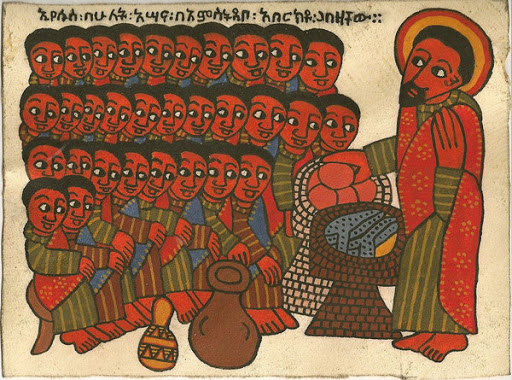
**Above: Ethiopian Orthodox Church depiction of Christ feeding the 5,000

Philippians 4:10-20 – Be Generous

I’m glad in God, far happier than you would ever guess—happy that you’re again showing such strong concern for me. Not that you ever quit praying and thinking about me. You just had no chance to show it. Actually, I don’t have a sense of needing anything personally. I’ve learned by now to be quite content whatever my circumstances. I’m just as happy with little as with much, with much as with little. I’ve found the recipe for being happy whether full or hungry, hands full or hands empty. Whatever I have, wherever I am, I can make it through anything in the One who makes me who I am. I don’t mean that your help didn’t mean a lot to me—it did. It was a beautiful thing that you came alongside me in my troubles.

You Philippians well know, and you can be sure I’ll never forget it, that when I first left Macedonia province, venturing out with the Message, not one church helped out in the give-and-take of this work except you. You were the only one. Even while I was in Thessalonica, you helped out—and not only once, but twice. Not that I’m looking for handouts, but I do want you to experience the blessing that issues from generosity.

And now I have it all—and keep getting more! The gifts you sent with Epaphroditus were more than enough, like a sweet-smelling sacrifice roasting on the altar, filling the air with fragrance, pleasing God to no end. You can be sure that God will take care of everything you need, his generosity exceeding even yours in the glory that pours from Jesus. Our God and Father abounds in glory that just pours out into eternity. Yes. (The Message)

“It takes generosity to discover the whole through others. If you realize you are only a violin, you can open yourself up to the world by playing your role in the concert.” 

Jacques-Yves Cousteau

Who is “you?”

That’s a question more significant than “you” might think….

In the English language, the words “you” and “your” can be either singular or plural. One must determine which it is by the sentence and surrounding context. 

In the language of New Testament Greek, however, this is not the case. We clearly know which words are singular and which are plural because they aren’t spelled the same, as in English. 

It is important to know that in the Apostle Paul’s letter to the Philippians, all the “you” pronouns are plural. Yep. Every single one of them. This is significant because the theme of unity and solidarity runs powerfully and affectionately through the entire book.

Everyone in the Philippian church, not just an individual or two, shared in Paul’s troubles with him. They partnered with him through financial resources, prayer, and ministry. Paul was quite confident that every need the Philippians encountered would be supplied by the riches of God because they had learned a valuable lesson from Paul and discovered a vital lesson about their church. 

The Philippians were taught by Paul that the practice of contentment in all circumstances would bring unity, not division. In fact, contentment eases a group’s normal anxieties. And contentment comes from the practice of gratitude. What’s more, the Philippians also experienced firsthand the seeming paradox that through the practice of giving they become rich. 

Trying to do any of this as a single solitary individual will not work – because gratitude, giving, and contentment are bonded to community. It’s a lot like spiritual gifts. We aren’t gifted with a speaking gift just to stand in front of the mirror and talk at ourselves. We aren’t gifted with serving gifts just to serve ourselves. And so, it is with giving and receiving, gratitude and thanksgiving, peace and contentment. They’re meant to be done in the context of a group.

We are not to be islands only operating at the level of individuation. Believers are designed by God and hard-wired into our spiritual DNA to know the blessing of partnering and working together in the unity of the gospel.  Learning contentment and generosity go hand-in-hand. 

Hoarding actually creates anxiety, whereas a collective generous spirit leads inexorably toward satisfaction and joy. If we want to be free of division and of having that constant uptight feeling, then we must be wildly generous. 

Generosity comes in all shapes and sizes. The big idea is that it is meant to bless others. Here are some ways anyone can be generous:

  1. If you can tip generously, do it. If not, be effusive in offering gratitude to others who serve you. If in doubt, always be on the side of grace and say thanks for everything.
  2. Share your knowledge, expertise, or ability. Hoarding doesn’t just have to do with money or stuff. People can also hoard their wisdom and abilities. Generously and freely sharing is a way to loosen up the gratitude and contentment so that burdens don’t become too heavy to bear.
  3. Give yourself to a cause or organization you believe in, either through donating time or money. Most places can’t have enough volunteers. Just be willing to let them dictate what needs to be done. Generously listen to their needs and wants.
  4. Compliment at least one person every day. Be generous with words of encouragement. It is a myth that complimenting another will give them a big head. Just the opposite is true. A lack of genuine encouragement causes a person to feel small.
  5. Give blood. It truly saves lives. Need I say more?

Go ahead, try it; you’ll like it. Be generous with your money, generous with your words of encouragement toward others, and generous with your gratitude to God.  Find out whether or not this changes your level of contentment in life.

Whether you do something big or small, the impact an act of generosity can have on someone else may be life changing. And it can completely change a group dynamic from stingy and critical to open and affirming.

Who ought to be generous? Yes, “you!”

Generous God, your storehouse of grace and mercy is infinite and unending.  Help me to partner with you in a manner that my generosity flows in the same way that yours does so that Jesus Christ is glorified, and his church is edified.  Amen.

Matthew 17:22-27 – Because We Can

When they came together in Galilee, Jesus said to them, “The Son of Man is going to be delivered into the hands of men. They will kill him, and on the third day he will be raised to life.” And the disciples were filled with grief.

After Jesus and his disciples arrived in Capernaum, the collectors of the two-drachma temple tax came to Peter and asked, “Doesn’t your teacher pay the temple tax?”

“Yes, he does,” he replied.

When Peter came into the house, Jesus was the first to speak. “What do you think, Simon?” he asked. “From whom do the kings of the earth collect duty and taxes—from their own children or from others?”

“From others,” Peter answered.

“Then the children are exempt,” Jesus said to him. “But so that we may not cause offense, go to the lake and throw out your line. Take the first fish you catch; open its mouth and you will find a four-drachma coin. Take it and give it to them for my tax and yours.” (NIV)

In ancient times, the Jerusalem Temple was designed to serve as the bridge between God and humanity. It was the place where God “came down” and accepted the offerings of the priests on behalf of the people. In Christian theology, Jesus came to this world to become the permanent bridge and the eternal temple.

Jesus saw himself as the ultimate connector who spans the great expanse between God and people. Christ ascended to heaven and gave the Spirit to his people, the Body of Christ. Basic Christian ecclesiology recognizes the Church (both individual Christians and the Church universal) as the Temple of the Holy Spirit. The Spirit is the continuing presence of Jesus on this earth. Jesus, Spirit, and Church are inextricably bonded with divine superglue to engage in the mission of being God’s Temple – the place of connection between the human and the divine.

Jesus used the situation of a question asked about taxes and the Temple to speak and illustrate the value and import of connecting with both God and others.

Why did Jesus pay the temple tax?

A “drachma” was about a day’s wage. In the time of Christ, there was a two-drachma tax which was levied by the Jewish authorities on every male Jew between the ages of 20-50. The tax was implemented to support the temple building and all the services that went into it.

The temple tax was not compulsory, so typically, the tax collectors did not impose it on the poor – which is why the collectors asked Peter whether Jesus pays the tax or not, because Jesus was poor. Jesus paid the temple tax out of humility, even though he was exempt, so to not offend and cause unnecessary scandal. Said another way, Jesus and his disciples did not have to pay the tax but instead chose to use their freedom for the benefit of others.

There is freedom in Christ. Yet, because of love, and a focus on need instead of rights, we can choose to use our freedom to serve larger purposes than just our own interests. The Apostle Paul later framed it this way:

It is necessary to submit to the authorities, not only because of possible punishment but also as a matter of conscience. This is also why you pay taxes, for the authorities are God’s servants, who give their full time to governing. Give to everyone what you owe them: If you owe taxes, pay taxes; if revenue, then revenue; if respect, then respect; if honor, then honor. (Romans 13:5-8, NIV)  

We exist to serve more than ourselves. God has purchased and adopted us through the death of Christ; we are now the Temple of the Spirit. We can emulate the Savior and choose humility to serve others. A logical question arises about all this: If I do this and focus on responsible service instead of rights, then how am I going to make ends meet?  Is any of this realistic or practical?

How did Jesus pay the temple tax?

Jesus cares about supplying needs. Jesus can and does take care of people who choose to give for the benefit of others. Jesus told Peter the fisherman to go out and fish. A crazy thing happened – Peter found not only a two-drachma coin to cover the annual tax but a four-drachma coin to cover both Jesus and Peter’s tax!  This was a powerful lesson about God’s abundant grace. 

As God’s people, we not only believe in the miraculous; we depend on miracles. We can bank on Jesus supplying our need. This is not a health and wealth gospel. Jesus was monetarily poor, so I am not sure how anyone can justify that God wants all believers to be financially rich.

There was once a man I knew who only had $100 to his name. He got to know another man who needed a suit for his job. The man with a $100 gave it all to the man who needed the suit. That man is alive and well today with all his needs met. He is not rich. However, he is quite happy. If we never need a miracle, we have never given of ourselves enough to need one.

Peter was a fisherman, so Jesus told him to fish and there was a miracle. Sometimes we might get the wrongheaded notion we must do something way outside of our given giftedness. God created each person with a unique intellect, abilities, and strengths and so, we are to use them to affect a miracle – just as Peter did.

We can have a big picture view of our shared humanity without narrow provincial views which are unable to see the vast scope of human need. And so, we can trust God to use us for divine purposes. We can exercise faith in the miraculous for both ourselves and others. We can embrace Christ’s mission in this world to such a degree that we would never consider living any other way. May we do it because we can.

God of all abundance and grace, help us to find firm ground in a shaky economy. Provide jobs for the unemployed; give us strength and peace when anxiety and worry come knocking; grant us patience when things look bleak; and, bring us the serenity of your presence so that we can do your will for the salvation of others through Jesus Christ our Lord in the power of your Holy Spirit. Amen.