Give Thanks and Praise (Luke 17:11-19)

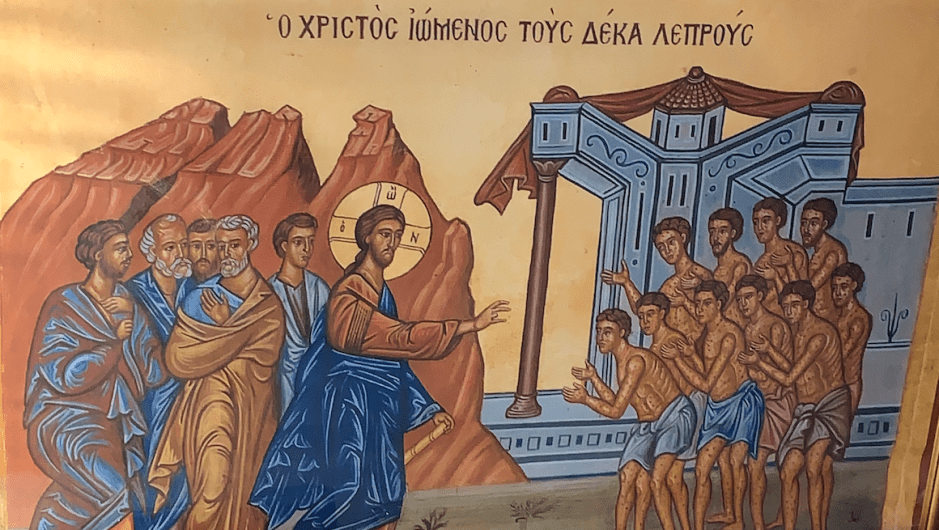
Eastern Orthodox depiction of Jesus Christ healing the ten lepers

Now on his way to Jerusalem, Jesus traveled along the border between Samaria and Galilee. As he was going into a village, ten men who had leprosy met him. They stood at a distance and called out in a loud voice, “Jesus, Master, have pity on us!”

When he saw them, he said, “Go, show yourselves to the priests.” And as they went, they were cleansed.

One of them, when he saw he was healed, came back, praising God in a loud voice. He threw himself at Jesus’ feet and thanked him—and he was a Samaritan.

 Jesus asked, “Were not all ten cleansed? Where are the other nine? Has no one returned to give praise to God except this foreigner?” Then he said to him, “Rise and go; your faith has made you well.” (New International Version)

Today’s Gospel story is both joyous and sad. The healing of ten lepers is astonishing and elicits praise and thanks… from only one. Maybe it’s because they stood at a distance. After all, it’s a close connection to God which causes praise and gratitude to arise within us – and not some appreciation from afar. Therefore, methinks we ought to consider what the nature of our own connection is. 

“Thanksgiving” to most Americans is Thanksgiving Day – a holiday filled with food, football, and family, the trifecta of American celebration. I myself admit to liberally indulging in all three. Although Thanksgiving has become a form of secular liturgical worship, I believe that underneath all the gravy, naps at halftime, and the occasional obnoxious relative, we know why we celebrate: To praise God and give thanks for our abundant blessings. 

It seems that even those who do not readily acknowledge the Divine intuitively know there is a power and source of blessing well beyond themselves which makes all good things occur.

Celebrations are a spiritual activity. God invented parties. When Israel was preparing for a new national life in the Promised Land, God told them to celebrate the Feast of Harvest with the first fruits of the crops (Exodus 23:16). The Levitical law prescribed how to go about giving thanksgiving offerings and offering praise (Leviticus 7:11-34).

Gratitude and praise was commanded, expected, and an important dimension of Old Testament worship. King David established a group of 288 full-time musicians to do nothing but praise and give thanks before God day and night (1 Chronicles 25).

Let us come into his presence with thanksgiving; let us make a joyful noise to him with songs of praise!

Psalm 95:2, NRSV

Enter his gates with thanksgiving
    and his courts with praise.
    Give thanks to him; bless his name.

For the Lord is good;
    his steadfast love endures forever
    and his faithfulness to all generations. (Psalm 100:4-5, NRSV)

It ought to have been reflexive for all ten lepers healed by Jesus to offer their worship to Jesus. A Samaritan, considered by many of the time as the lowliest of the low, a “half-breed,” was the lone person who came and fell at Christ’s feet with effusive praise and heartfelt gratitude. While the other nine went about their lives, free from disease and glad for it, only one guy took the time to thank Jesus and give glory to God. 

The Samaritan leper alone gives thanks to Christ, by Unknown artist

Sometimes we need to be reminded that celebration is a spiritual practice. It’s important to celebrate Jesus and for the ways God has provided and blessed us. In Holy Scripture, it is often the homeless, the sick, the lowly, and the outsiders who lead the way and demonstrate what genuine praise and honest thanksgiving looks like.

We, the Church, who belong to God and possess the Spirit, are to always remember and be mindful of what we truly have in Jesus Christ:

So then, just as you received Christ Jesus as Lord, continue to live your lives in him, rooted and built up in him, strengthened in the faith as you were taught, and overflowing with thankfulness. (Colossians 2:6-7, NIV)

We, like King David of old, are to establish continual worship of God:

Rejoice always, pray continually, give thanks in all circumstances; for this is God’s will for you in Christ Jesus.

1 Thessalonians 5:16-18, NIV

Our sacrifice as Christians is not with the blood of animals but with our lips and our lives:

Through Jesus, therefore, let us continually offer to God a sacrifice of praise—the fruit of lips that openly profess his name. (Hebrews 13:15, NIV)

And the worship service is eternal; it will never end:

And the twenty-four elders, who were seated on their thrones before God, fell on their faces and worshiped God, saying:

“We give thanks to you, Lord God Almighty,
    the One who is and who was,
because you have taken your great power
    and have begun to reign.” (Revelation 11:16-17, NIV)

Praising God and giving thanks to the Lord go together like mashed potatoes and gravy. Since God created everything, and since Jesus has brought healing to us through the cross, every juicy morsel of goodness we have is to be received with the full cognizance that God is behind it all.

Our lives need to be punctuated with times of celebration, praise, gratitude, and even blowout parties. Otherwise, we become dull, boring, lifeless, and bereft of Christ’s lifeblood coursing through our spiritual veins. A joyous and raucous group of healed believers jabbering incessantly with thanksgiving of God’s goodness are winsome and peculiar (in a good way and not in the strange way of your weird uncle who wants the turkey neck to gnaw on at the Thanksgiving meal).

Seems to me that Christians really ought to be at the forefront of having maximum fun because we are forgiven people; we know and experience the presence of God; our lives are hidden with God in Christ; we are confident and can approach the throne of God with boldness; and we possess the power of the Spirit and the shepherding ministry of Jesus.

Remember to give thanks. Plan to praise – out loud and with others – for the God who stands behind every good gift of creation. Let thanksgiving (not complaint) shape your life. Be the person who comes back to Jesus and offers praise and gratitude – and see how such gratefulness and glory can change the world.

Gracious God, Father of all mercies, we your unworthy servants give you humble thanks for all your goodness and steadfast love to us and to all whom you have made. We bless you for our creation, preservation, and all the blessings of this life; but above all praise you for your immeasurable love in the redemption of the world by our Lord Jesus Christ; for the means of grace, and for the hope of glory.

Give us such an awareness of your mercies, that with truly thankful hearts we may show forth your praise, not only with our lips, but in our lives, by giving up ourselves to your service, and by walking before you in holiness and righteousness all the days of our lives, through Jesus Christ our Lord, who with you and the Holy Spirit, be honor and glory throughout all ages and forevermore. Hallelujah! Amen!

Psalm 107:1-9, 43 – Let the Redeemed Say So

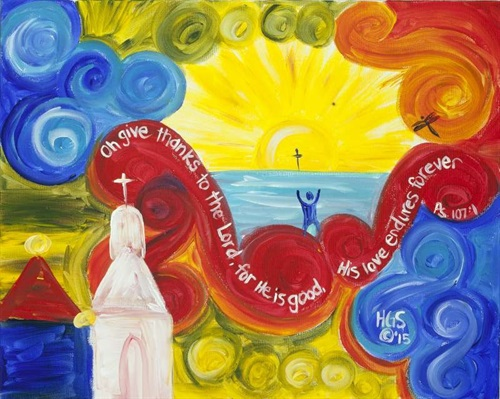
Psalm 107 by Hope Smith

O give thanks to the Lord, for he is good,
    for his steadfast love endures forever.
Let the redeemed of the Lord say so,
    those he redeemed from trouble
and gathered in from the lands,
    from the east and from the west,
    from the north and from the south.

Some wandered in desert wastes,
    finding no way to an inhabited town;
hungry and thirsty,
    their soul fainted within them.
Then they cried to the Lord in their trouble,
    and he delivered them from their distress;
he led them by a straight way,
    until they reached an inhabited town.
Let them thank the Lord for his steadfast love,
    for his wonderful works to humankind.
For he satisfies the thirsty,
    and the hungry he fills with good things….

Let those who are wise pay attention to these things
    and consider the steadfast love of the Lord. (New Revised Standard Version)

The psalmist encourages and invites us to consider God’s steadfast love (Hebrew “chesed”). In all truth, an eternity of pondering and discovering such love will never plumb the depths of the Lord’s faithful love.

Maybe there is so much hate, bitterness, and vitriol in this old fallen world because people don’t consider the God who is Love. After all, there isn’t much room for malicious anger whenever people are expressing gratitude.

We are divinely hard-wired to give and receive affirmation, gratitude, encouragement, and love. Doing the opposite of that throws a huge monkey wrench into our daily living. It’s not sustainable to live by criticism, ingratitude, judgmentalism, and hate. It goes against who we are as humans.

Instead, it is sage to acknowledge, appreciate, ponder, and express the great love of God for humanity. The Lord’s love never runs out – it is inexhaustible.

Many people have stories of wandering far from Love, stumbling in the darkness, and finding themselves in desperate straits. Like the prodigal son, they are found by the God who is Love. And instead of being chided for their herky-jerky life, they are given a prominent place in God’s kingdom.

Some of you wandered for years in the desert,
    looking but not finding a good place to live,
Half-starved and parched with thirst,
    staggering and stumbling, on the brink of exhaustion.
Then, in your desperate condition, you called out to God.
    He got you out in the nick of time. (Psalm 107:4-6, MSG)

Praise and thanksgiving become the reflexive practices of the folk who have returned home to God. And the psalmist calls us to speak out those stories of hope and deliverance.

Telling our spiritual stories to others is important – both for the storyteller, and also for those who listen. Together, the spiritual community of the redeemed becomes strengthened in their bonds of faith; and everyone is emboldened to share with others. 

Far too many Christians are reticent to talk about what God has done or is doing in their lives. Shame, embarrassment, or a host of other reasons might prevent us from being vulnerable enough to let others in on God’s deep work within.

We all likely have had the privilege of hearing another person share their heart and experience of hardship and God’s deliverance. It was uplifting, encouraging, and helpful. So, let’s not keep our stories to ourselves. Stories are meant to be told, not hidden. Bringing to light our faith journey is healing for all, as well as declaring that Jesus is the light of the world.

Author Frederick Buechner wrote a book several years ago entitled, “Telling Secrets.” Buechner tells of his own experience of keeping some stories inside and never letting them see the light of day. One of those stories was growing up with an alcoholic father and all the other stories that went along with that singular story.

It was only in finally telling the family secret of alcoholism that he discovered a better path forward to healing and blessing. He writes:

“What we hunger for perhaps more than anything else is to be known in our full humanness, and yet that is often just what we also fear more than anything else. It is important to tell at least from time to time the secret of who we truly and fully are because otherwise we run the risk of losing track of who we truly and fully are and little by little come to accept instead the highly edited version which we put forth in hope that the world will find it more acceptable than the real thing. It is important to tell our secrets, too, because it makes it easier for other people to tell us a secret or two of their own.”

Frederick Buechner, “Telling Secrets”

Buechner went on to say:

“My story is important not because it is mine, God knows, but because if I tell it, the chances are you will recognize that, in many ways, it is also your story. It is precisely through these stories in all their particularity, as I have long believed and often said, that God makes himself known to each of us more powerfully and personally. If this is true, it means that to lose track of our stories is to be profoundly impoverished not only humanly but also spiritually.”

Shame is like a vampire. It lives in the shadows, feeding upon secrets. But when our stories are told and see the light of day, the vampire of shame is destroyed by the bright rays of truth and vulnerability.

We then become open to genuine relationships without propping up a false self to pose for others. We place ourselves in a position to receive and give love. In other words, we can meaningfully connect with both God and others because we found our voice and told our story.

Great God of deliverance, I praise you that I have a story to tell of your grace and faithfulness. Help me to tell of your mercy in my life so that the name of Jesus will be exalted, and that your people might be built up in the faith.  Amen.

Psalm 75 – Don’t Talk Out the Side of Your Neck

We give thanks to you, O God;
    we give thanks; your name is near.
People tell of your wondrous deeds.

At the set time that I appoint,
    I will judge with equity.
When the earth totters, with all its inhabitants,
    it is I who keep its pillars steady.
I say to the boastful, “Do not boast,”
    and to the wicked, “Do not lift up your horn;
do not lift up your horn on high
    or speak with insolent neck.”

For not from the east or from the west
    and not from the wilderness comes lifting up,
but it is God who executes judgment,
    putting down one and lifting up another.
For in the hand of the Lord there is a cup
    with foaming wine, well mixed;
he will pour a draught from it,
    and all the wicked of the earth
    shall drain it down to the dregs.
But I will rejoice forever;
    I will sing praises to the God of Jacob.

All the horns of the wicked I will cut off,
    but the horns of the righteous shall be exalted. (New Revised Standard Version)

Way back in my college days, there were some lively characters within my group of friends and acquaintances. One of those friends had a phrase he called people out on, whenever he discerned there was some sort of insincerity or disingenuous talk… 

“Quit talkin’ out the side o’ ya’ neck!” he would say with a great deal of flavor. My friend’s phrase perfectly captures the psalmist when he exhorts the boastful person not to speak with an insolent or haughty neck.

Indeed, God will judge everyone on earth with equity, without favoritism. The Lord has no tolerance for evil speech. 

A telltale sign of the wicked is that they show ingratitude; they aren’t thankful. An ungracious boss will always point out mistakes and missteps; and rarely or never seeks to affirm someone for a job well-done. In those rare times when a “thanks” is given, its so mechanical that the person receiving feels the abject insincerity of it.

The parent who sparingly expresses gratitude tends to liberally correct and discipline, leaving the child in a pool of guilt and shame. Folks who enjoy airing their own opinions are usually bereft of thanksgiving; they leave in their wake of harsh words a group of angry or discouraged people.

You will likely not hear any of the aforementioned persons forthrightly declare the mighty acts of God. Rather, they highlight their own actions, even stealing the deserved attention of another onto themselves. Yet, the arrogant and insolent person will meet their match with the sovereign God who humbles and exalts according to divine standards of justice, mercy, and love.

Instead of talking out the side of our necks, the godly use their tongues in a different manner: They give thanks and practice gratitude for God’s wondrous deeds. 

The way to avoid the hubris of the proud person is to use our speech for thanksgiving. Humble, encouraging, and generous words cannot co-exist in the same sentence as insincere proud boasting. 

Freedom from useless, selfish, and harmful gibberish requires more than a decision to stop talking that way; it also includes a determination to speak words of encouragement, gratitude, and kindness. The following can be helpful advice when facing our own pride:

  1. Confess when you’re wrong. Acknowledge and admit the sinful speech without trying to put a spin on it to make it sound less offensive. Ask what you can do to make it right. Ask for forgiveness.
  2. Lighten up, man. Don’t take things so seriously. Learn to laugh at yourself. We all have our quirks, and we all make mistakes. Most stuff isn’t worth getting upset over. And some people are definitely not worth giving the satisfaction of making you get in a huff. Let it go, dude.
  3. Be good to yourself. Treat yourself with greater kindness. Arrogance is often a byproduct of failing to practice healthy self-care. Whenever we are obsessed with looking good and being good, we place unrealistic expectations not only on ourselves, but others, as well. It comes out in a “I-know-what-is-best-so-do-what-I-say” sort of attitude.
  4. Wake up and realize you are not always right. Arrogant people tend to think they are right most of the time, that their truth is the only truth that really matters. You’ve probably been wrong more than you realize, but arrogance tends to blind us to our own shortcomings. Not every battle is worth fighting. Sometimes you just have to smile and let things go.
  5. Learn to delegate. Let other people take the lead. Humility allows us to serve under another person or as a less dominant member of a team. Other people are not nincompoops. You aren’t the only one who can do the job.
  6. Ask for help. It takes humility to ask for help.Arrogant people wrongly believe they can do it themselves, especially thinking they are the best person for everything. Old Satan still believes he can do a better job of running the world than God. Don’t be like Satan.
  7. Offer meaningful encouragement and thanks. Go out of your way to build up others and thank them for their efforts and the job they did.
  8. Treat everyone with respect. No matter their position or station in life, acknowledge each human being as worthy of kindness and respect.

Remembering God’s gracious works in the world, and using our tongues to recount them, has the effect of putting us in our proper place and shooing away the arrogance.

One way of expressing gratitude to God is to take a few minutes each day, pause, and give thanks for the things you notice. 

If you take a walk, be intentional about noticing God’s creation. Then, give thanks for the specific things you see. At your workplace, take note of the blessings around you, and express gratitude for each of them. At home, notice the simple pleasures of being with family and be sure to offer God praise for them. 

For, if we do not observe the Lord in the common and the mundane, we will likely miss God when he shows up in the dramatic and the awesome.

Almighty God, you are the rightful Judge of all the earth. Today I forsake all proud and haughty speech, and, instead, give thanks to you for your mighty acts of salvation and deliverance in Jesus’ name. Amen.

Psalm 97 – Celebrate the Lord

The Lord rules! Let the earth rejoice!
    Let all the islands celebrate!
Clouds and thick darkness surround God.
    His throne is built on righteousness and justice.
Fire proceeds before him,
    burning up his enemies on every side.
His lightning lights up the world;
    the earth sees it and trembles!
The mountains melt like wax before the Lord,
    before the Lord of the whole world!

Heaven has proclaimed God’s righteousness,
    and all nations have seen his glory.
All those who worship images,
    those who are proud of idols,
    are put to shame.
    All gods bow down to the Lord!
Zion has heard and celebrates,
    the towns of Judah rejoice,
    because of your acts of justice, Lord,
    because you, Lord, are the Most High
        over all the earth,
    because you are so superior to all other gods.

Those of you who love the Lord, hate evil!
    God guards the lives of his faithful ones,
    delivering them from the power of the wicked.
Light is planted like seed for the righteous person;
    joy too for those whose heart is right.
Rejoice in the Lord, righteous ones!
    Give thanks to his holy name! (Common English Bible)

Being overwhelmed with a tremendous sense of majesty for King Jesus is an appropriate response, especially in the wake of Ascension Day – the Christian holiday celebrating Christ’s return to heaven.

Today’s psalm portrays the Lord as a huge God whose presence impacts the world in cataclysmic glory. God is truly large and in charge. 

Nothing moves God; but God moves mountains. 

This is no wimpy deity who needs creatures to sustain him and his memory. Conversely, all of creation is dependent upon God for life, sustenance, and flourishing.

Our view of God deeply impacts how we think, feel, and live. Whenever people catch a mere glimpse of God’s glory, it causes them to renounce useless idol worship, and brings forth humble celebration from the penitent. 

The sheer dearth of penitence and praise to God in today’s world ought to clue us to the reality that we are not seeing God for how God truly is. And what is the God of Holy Scripture? The Lord is the great and glorious king who is so immense and so concerned for justice that just a snort of his nostrils could thoroughly lay waste to the earth.

Confronted with such a majestic and awesome Being, the ultimate conclusion in how to order our lives is this: Love the Lord. Hate evil. Why? Because we are God’s people. 

Therefore, celebration and praise to God are in order. So, let us collectively make a simple choice to celebrate and praise God in some simple ways:  

  • Acknowledge God in both the big and the small things of life
  • Talk about God’s grace in your everyday conversations– we don’t have to be preachy, just real, genuine, and authentic
  • Praise God in public as well as in private
  • Pray to God with simple heartfelt prayers – they don’t need to be eloquent, because God simply wants to hear the voice we have been given
  • Be generous toward others through forgiveness and tangible help because the Lord is a generous God
  • Read God’s Word because it honors the Lord
  • Give thanks to God and have a predetermined mindset to find gratitude in all things God has put in your life
  • Count your blessings today, and then again, tomorrow, so that it eventually becomes a spiritual habit
  • Sing to God with the joyful noise you are able to make

The power of God is more than enough to bring effective and lasting transformation of body, mind, emotions, and spirit. The might of God is unlimited, able to establish social change, economic uplift, physical healing, relational peace, spiritual hope, mental rest, and so much more.

Celebrating the sovereignty of God is downright good for us. It releases our stress, energizes us, provides a positive way of reflection, challenges evil, and acknowledges realities which we might have forgotten – especially that God is with us, loves us, and has only good plans for us.

Praise and celebration are both organic acts on our part and need to be intentionally planned. That is, celebrating the Lord ought to be both spontaneous and prepared. Liturgical rhythms of worship to God need to be both formulaic and free.

The shape of our worship can remind us that we are in continuity with believers throughout history and in all places on earth. We are not alone. We are joined by the entire community of worshipers, offering our celebration – both old and new.

Having both fixed forms of worship and free expressions of worship enable us to tap into the full dimension of faith. Practicing both personal prayers in our secluded closet and corporate prayers together with others strengthens our faith, makes more sure our hope, and connects us with the God who is Love.

A big God ought to be worshiped with all the means available to us.

Mighty God, you are worthy of all the praise, honor, and glory I can give you. May my life be a simple offering to you, so that your kingdom comes not only in my own life but impacts the lives of others; through Jesus, my King. Amen.