Worship Is a Lifestyle (1 Chronicles 15:1-2, 16:4-13)

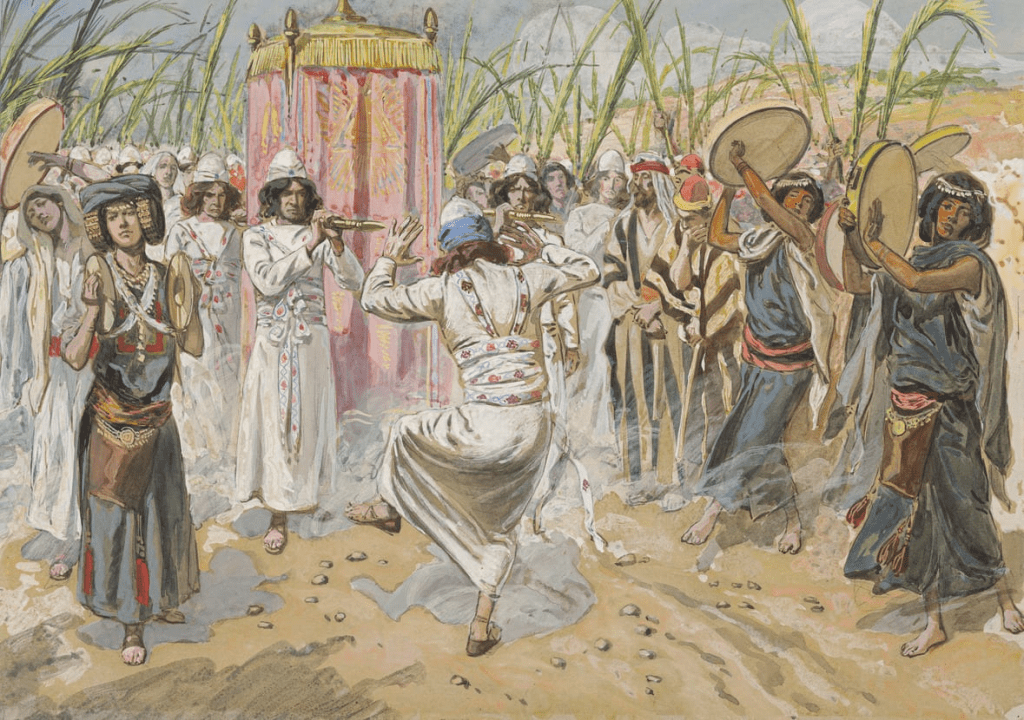
David Dancing Before the Ark, by James Tissot, c.1900

David built houses for himself in Jerusalem. Then he prepared a place for the Ark of God, and he set up a tent for it. David said, “Only the Levites may carry the Ark of God. The Lord chose them to carry the Ark of the Lord and to serve him forever….”

Then David appointed some of the Levites to serve before the Ark of the Lord. They had the job of leading the worship and giving thanks and praising the Lord, the God of Israel. Asaph, who played the cymbals, was the leader. Zechariah was second to him.

The other Levites were Jaaziel, Shemiramoth, Jehiel, Mattithiah, Eliab, Benaiah, Obed-Edom, and Jeiel. They played the lyres and harps. Benaiah and Jahaziel were priests who blew the trumpets regularly before the Ark of the Agreement with God. That day David first gave Asaph and his relatives the job of singing praises to the Lord.

Give thanks to the Lord and pray to him.
    Tell the nations what he has done.
Sing to him; sing praises to him.
    Tell about all his miracles.
Be glad that you are his;
    let those who seek the Lord be happy.
Depend on the Lord and his strength;
    always go to him for help.
Remember the miracles he has done,
    his wonders, and his decisions.
You are the descendants of his servant, Israel;
    you are the children of Jacob, his chosen people. (New Century Version)

Art by Sefira Lightstone

David was anointed as the future king by the priest and prophet Samuel, because God had rejected Saul as king. Yet, King Saul was still on the throne, still in power.

It’s a credit to David that he was faithful to the Lord, trusted God, and did nothing morally wrong or ethically suspect, such as trying to kill Saul. But King Saul certainly tried to kill David!

Saul’s jealousy morphed into murderous intent and evil machinations. Saul eventually died in battle, and David became king of Judah, then of all Israel. He did it the Lord’s way, and not his own.

So, it’s no surprise that once King David was securely on the throne, he paid attention to the Ark of the Covenant – the symbol of God’s presence with Israel – and made plans to have it in a protected and central place within the life of the Jewish people. What’s more, David sought to obey all of God’s laws and instructions which were graciously given to the people through Moses.

King David relocated the Ark from the house of Obed-Edom to Jerusalem – with the Levitical priests handling all of the sacred objects, as prescribed in the law of God.

The liturgical procession which moved the Ark of the Covenant was a grand and festive group, including military commanders, the elders of Israel, and the Levites. It was a celebration involving plenty of music, singing, and sacrifices. (1 Chronicles 13-14; 2 Samuel 6:12-19)

David prepared a tent for the Ark, in the tradition of the Tabernacle of Moses, to be located in Jerusalem at the heart of Jewish life.

After God’s Ark was moved and established in the new capitol, King David then organized the Levites for continued ministry around it. The work of the Levites was prayer, music, song, and praise, with Asaph as their leader.

Asaph along with Zechariah and eight other Levites, were responsible to ensure that musical instruments were played and trumpets blown before the Ark. (1 Chronicles 15:17-18)

All of the praise, singing, and music was to be a permanent ministry, because for David and the Jews, worship was a lifestyle, and not just an event.

So, we see that one of King David’s first initiatives in coming to power was to establish dozens of full-time Levites in the work of worship. David clearly knew where his royal position came from, and how he was supposed to rule. The king ensured that all of Jewish life was going to revolve around God, not himself. And he proved it both by his words and his actions as Israel’s leader.
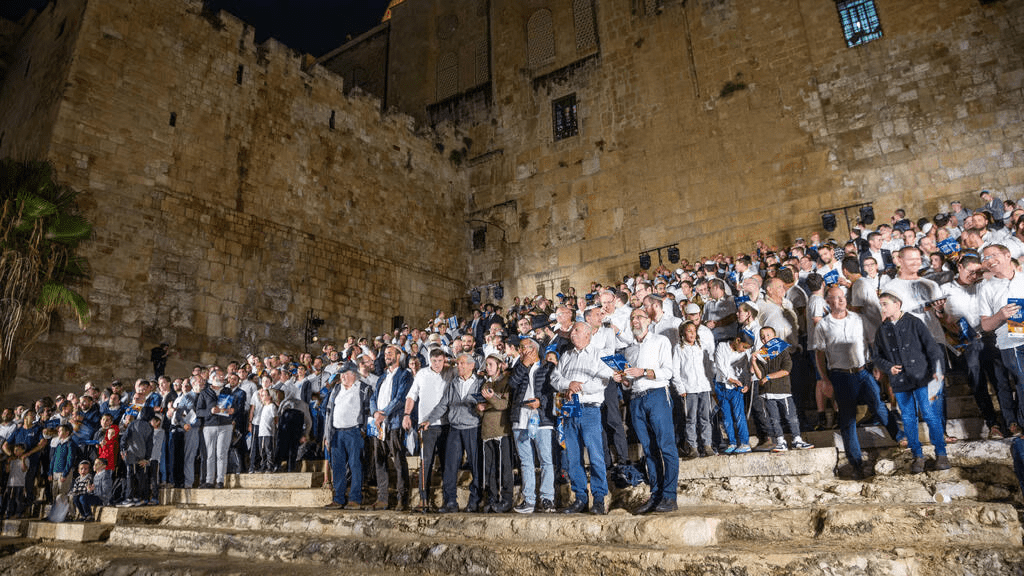
Levites singing chapters from Psalms in Jerusalem, photo by Dor Pazoelo

The approach and attitude of David makes sense, because he was the one, along with Asaph the musical director, who crafted songs of praise such as Psalm 96. We might imagine a great Levite choir singing out with lots of spiritual gusto:

Sing to the Lord a new song;
    sing to the Lord, all the earth.
Sing to the Lord and praise his name;
    every day tell how he saves us.
Tell the nations of his glory;
    tell all peoples the miracles he does,

because the Lord is great; he should be praised at all times.
    He should be honored more than all the gods,
because all the gods of the nations are only idols,
    but the Lord made the heavens.
The Lord has glory and majesty;
    he has power and beauty in his Temple.

Praise the Lord, all nations on earth;
    praise the Lord’s glory and power.
Praise the glory of the Lord’s name.
    Bring an offering and come into his Temple courtyards.
Worship the Lord because he is holy.
    Tremble before him, everyone on earth.
Tell the nations, “The Lord is king.”
    The earth is set, and it cannot be moved.
    He will judge the people fairly.
Let the skies rejoice and the earth be glad;
    let the sea and everything in it shout.
Let the fields and everything in them rejoice.
Then all the trees of the forest will sing for joy
before the Lord, because he is coming.
    He is coming to judge the world;
he will judge the world with fairness
    and the peoples with truth. (Psalm 96, NCV)

Amen.

The Grace of Redemption and Gratitude (Exodus 37:1-16)

Bezalel made the ark of acacia wood—two and a half cubits long, a cubit and a half wide, and a cubit and a half high. He overlaid it with pure gold, both inside and out, and made a gold molding around it. He cast four gold rings for it and fastened them to its four feet, with two rings on one side and two rings on the other. Then he made poles of acacia wood and overlaid them with gold. And he inserted the poles into the rings on the sides of the ark to carry it.

He made the atonement cover of pure gold—two and a half cubits long and a cubit and a half wide. Then he made two cherubim out of hammered gold at the ends of the cover. He made one cherub on one end and the second cherub on the other; at the two ends he made them of one piece with the cover. The cherubim had their wings spread upward, overshadowing the cover with them. The cherubim faced each other, looking toward the cover.

They made the table of acacia wood—two cubits long, a cubit wide and a cubit and a half high. Then they overlaid it with pure gold and made a gold molding around it. They also made around it a rim a handbreadth wide and put a gold molding on the rim. They cast four gold rings for the table and fastened them to the four corners, where the four legs were. The rings were put close to the rim to hold the poles used in carrying the table. The poles for carrying the table were made of acacia wood and were overlaid with gold. And they made from pure gold the articles for the table—its plates and dishes and bowls and its pitchers for the pouring out of drink offerings. (New International Version)

This section is, for the most part, a mirror image of Exodus 25:23-40 – which provides meticulous instructions from God on how to build the Ark of the Covenant and the Table that goes with it.

The purpose of this section in Holy Scripture is to give a detailed report that everything the Lord instructed Moses to do, was obediently done, down to every last detail.

This was of upmost importance to the biblical writer, because half-obedience is really not obedience, at all. And there needs to be obedience in order to realize blessing.

God had a purpose with ancient Israel to establish them as God’s people, with God dwelling amongst them. The way this would happen was by means of all the specific prescriptions for the Tabernacle with its worship implements.

Foremost amongst those worship implements was the Ark and the Table, simply because that was the place of meeting with God – and even more specifically – the place of redemption.

The Tabernacle was built, then erected and put into place, just as it was described by God to Moses. And that is the point. The Lord does not change. There was no Plan B or altering the agenda as things went along, because human sin and people’s foibles mucked up everything. No, that’s not how it went down.

Nothing detracts or sidelines God from accomplishing divine purposes – especially when it comes to redeeming people and coming alongside them.

Just because the Israelites disastrously made an idol in the form of a golden calf, and worshiped it as if it were God, did not mean God’s plan failed.

In fact, the Lord made the plan even better by showing exceeding grace in not wiping out the entire lot of them – but instead used the situation to demonstrate steadfast love and accomplish the divine purpose of redemption.

No matter how you slice or dice it, it always comes out as grace.

My hope is that you can see that through all of the details of worship implements and Tabernacle protocol, God bent over backwards to be with the people.

God is holy. God is absolute purity and light. That holiness and purity would incinerate us in a nanosecond if we didn’t have things in place to help us be with God. That was what the Ark and the Table helped to do for Israel.

There are times in Holy Scripture when things get repeated. Repetition, according to many scholars, communicates emphasis. The repeated details of the Ark and the Table, as well as all the other articles associated with worship, communicate the heart of God in wanting us to have access to the divine. In other words, its repeated because it’s important.

Access, redemption, worship, and mercy are all important for the believer. We learn from today’s seemingly mundane verses that:

  • Sin must be addressed in order to have access to God
  • A way has been made for us to be with God
  • We are enabled and empowered to approach God
  • We have received the mercy of redemption from God
  • We are to therefore give mercy to others through table fellowship and forgiveness
  • And we are to give thanks and have gratitude in our hearts to God

Listening to the instructions of God, obeying them, and enjoying them is at the heart of good religion. May it be so, to the glory of God.

Accept, O Lord, our thanks and praise for all that you have
done for us. We thank you for the splendor of the whole
creation, for the beauty of this world, for the wonder of life,
and for the mystery of love.

We thank you for the blessing of family and friends, and for
the loving care which surrounds us on every side.

We thank you for setting us at tasks which demand our best
efforts, and for leading us to accomplishments which satisfy
and delight us.

We thank you also for those disappointments and failures
that lead us to acknowledge our dependence on you alone.

Above all, we thank you for your Son Jesus Christ; for the
truth of his Word and the example of his life; for his steadfast
obedience, by which he overcame temptation; for his dying,
through which he overcame death; and for his rising to life
again, in which we are raised to the life of your kingdom.

Grant us the gift of your Spirit, that we may know him and
make him known; and through him, at all times and in all
places, may give thanks to you in all things. Amen.

Selective Memory (Psalm 25:1-10)

To you, O Lord, I lift up my soul.
O my God, in you I trust;
    do not let me be put to shame;
    do not let my enemies exult over me.
Do not let those who wait for you be put to shame;
    let them be ashamed who are wantonly treacherous.

Make me to know your ways, O Lord;
    teach me your paths.
Lead me in your truth and teach me,
    for you are the God of my salvation;
    for you I wait all day long.

Be mindful of your mercy, O Lord, and of your steadfast love,
    for they have been from of old.
Do not remember the sins of my youth or my transgressions;
    according to your steadfast love remember me,
    for the sake of your goodness, O Lord!

Good and upright is the Lord;
    therefore he instructs sinners in the way.
He leads the humble in what is right
    and teaches the humble his way.
All the paths of the Lord are steadfast love and faithfulness,
    for those who keep his covenant and his decrees. (New Revised Standard Version)

I admit there are things from my past I am neither proud of nor happy about. Yet, I give praise and thanksgiving to the Lord God Almighty because of divine selective memory. 

“I will forgive their iniquity and remember their sin no more.”

God (Jeremiah 31:34, NRSV)

God remembers according to the divine nature and God’s character of merciful grace and steadfast love. I’m glad the Lord doesn’t act based upon the stupid sins of my younger yesteryear. God freely chooses to forgive and has made the means available for us to experience daily cleansing and victory through the Lord Jesus Christ.

Memory is a major theme in the Old Testament. The importance of remembering pops up again and again throughout Holy Scripture. The way in which our minds and hearts remember past events is of great spiritual significance. 

Remember that you were a slave in the land of Egypt, and the Lord your God brought you out from there with a mighty hand and an outstretched arm; therefore the Lord your God commanded you to keep the Sabbath day. (Deuteronomy 5:15, NRSV)

“And remember, I am with you always, to the end of the age.”

Jesus (Matthew 28:20b, NRSV)

Remember Jesus Christ, raised from the dead, a descendant of David—that is my gospel, for which I suffer hardship, even to the point of being chained like a criminal. But the word of God is not chained. (2 Timothy 2:8-9, NRSV)

We are not to keep dwelling upon and remembering the former indiscretions of ourselves or others. To continue ruminating on a foolish decision or a poor choice only erodes our ability for resilience and perseverance.

The fact of the matter is that God does not hold those past regrets over our heads, and so, neither are we to do it. Forgiveness isn’t only for others; it’s meant to be directed to ourselves, as well. The ability to forgive enables us to leave the past in the past, without belching it up every day and chewing on it, like a cow with her cud.

Sometimes we are prone to remember the things we ought to forget, and forget those things we really should remember. Before us and in our minds continually is to remember the great works of God, especially in redemption. 

Forgetting what lies behind and straining forward to what lies ahead, I press on toward the goal, toward the prize of the heavenly call of God in Christ Jesus. (Philippians 3:13b-14, NRSV)

What we have done or failed to do, and what has happened to us in the past, is not the real problem; the most prescient issue right now is how you and I interpret those past events.

Today we can choose to remember the way God remembers. The health of all our relationships is dependent on this ability. Everyone on planet earth encounters difficult people, challenging relationships, obnoxious neighbors, and hurtful family members. Paying attention to our memory and how we choose to remember can be a significant part of interacting with others. 

I do not cease to give thanks for you as I remember you in my prayers, that the God of our Lord Jesus Christ, the Father of glory, may give you a spirit of wisdom and revelation as you come to know him. (Ephesians 1:16-17, NRSV)

If we like it that God has shown grace to us, then the least we can do is let that same grace flow from us to others – and to ourselves – we who neither deserve it, nor expect it. 

Let’s give thanks to the Lord, for God is good in forgiving sin and showing infinite mercy. And let’s express our gratitude through selfless words and acts of grace which reflect the nature of God.

Gracious God, you do not hold grudges; you always act according to your own loving character. Even though you could have condemned me, you saved me. Despite the fact that I have fallen short of your glory, you delivered me. I today remember your mighty redemptive deeds accomplished in your Son, my Lord, Jesus Christ, who with you and the Holy Spirit are one God, now and forever. To you, blessed Holy Trinity, I give my abiding praise and thanksgiving. Amen.

Generosity and Thanksgiving (2 Corinthians 9:6-15)

Remember this: Whoever sows sparingly will also reap sparingly, and whoever sows generously will also reap generously. Each of you should give what you have decided in your heart to give, not reluctantly or under compulsion, for God loves a cheerful giver. And God is able to bless you abundantly, so that in all things at all times, having all that you need, you will abound in every good work. As it is written:

“They have freely scattered their gifts to the poor;
    their righteousness endures forever.”

Now he who supplies seed to the sower and bread for food will also supply and increase your store of seed and will enlarge the harvest of your righteousness. You will be enriched in every way so that you can be generous on every occasion, and through us your generosity will result in thanksgiving to God.

This service that you perform is not only supplying the needs of the Lord’s people but is also overflowing in many expressions of thanks to God. Because of the service by which you have proved yourselves, others will praise God for the obedience that accompanies your confession of the gospel of Christ, and for your generosity in sharing with them and with everyone else. And in their prayers for you their hearts will go out to you, because of the surpassing grace God has given you. Thanks be to God for his indescribable gift! (New International Version)

Generosity is at the heart of any good family, neighborhood, workplace, organization, church, and individual. To be generous is to reflect the image of God, who is wildly generous, giving freely and liberally on our behalf.

We often associate being generous with giving a handout or money to someone or some organization in need. It is that, but much more. Generosity doesn’t have to do with the size of our check or the amount of our contribution. 

We can be generous with our time, abilities, words, and with what little or much we have of money, as well. Generosity means to go above expectations – to give with magnanimity, to go out of your way to do good when no one is looking – and experience giving as its own reward.

Jesus, for whom the Apostle Paul learned about the true nature of being generous, embraced generosity as a way of life while he was here on this earth. No one expected Christ to go out of his way to call the least, the lowly, the lost, and the last of society. The people on the margins of respectable culture had no expectations that the Messiah would head their way. But he did. 

Christ the Lord even went so far as to hang out with the despised tax collectors, and freely talk with sexual deviants. The high brows of society couldn’t raise their eyebrows high enough for Jesus. It was just too much for them. Not only was Jesus making them look bad with his generosity as a way of life, but he was also, in their minds, generous to the wrong sort of people.

The follower of Jesus does so by surveying the landscape of human need and giving to people in places where no one expects a handout. 

It’s interesting that Christ lived a simple life with little to no money. He largely depended on the generosity of others. Yes, my friend, generosity is a two-way street. Being generous to others is the easy part for many people; receiving the generosity of other people is often much harder.  Yet, Jesus did both – he gave and received.

Jesus was generous in ways which were consistent with the Father’s will. Christ gave of his time, and of his divine ability to heal and forgive. He was perhaps the most magnanimous person of all-time, due to his generosity of compassion, kindness, love, and humble service to others. 

And the height of Christ’s generosity was in giving his life so that you and I could live a life free from the power of guilt and shame. Such deliverance, through the cross, is offered and given, free of charge. That’s over-the-top generous.

Money is merely a barometer of one’s generosity, that is, of our stance and approach toward money. You don’t need to be rich to be generous. A large and expansive heart always finds ways to have a generosity of spirit wherever it goes.

Jesus warned against using generosity in order to be noticed:

“When you do good deeds, don’t try to show off. If you do, you won’t get a reward from your Father in heaven. When you give to the poor, don’t blow a loud horn. That’s what show-offs do in the meeting places and on the street corners because they are always looking for praise. I can assure you that they already have their reward. When you give to the poor, don’t let anyone know about it. Then your gift will be given in secret. Your Father knows what is done in secret, and he will reward you.” (Matthew 6:1-4, CEV)

A generous heart is a heart of gratitude. Giving thanks is the logical and organic way of expressing generosity.

Consider just a few biblical verses that encourage us toward thanksgiving: 

Let us come before him with thanksgiving and sing joyful songs of praise. (Psalm 95:2, GNT) 

Enter his gates with a song of thanksgiving.
Come into his courtyards with a song of praise.
Give thanks to him; praise his name. (Psalm 100:4, GW)

O give thanks to the Lord, for he is good; his steadfast love endures forever! (Psalm 118:1, NRSV)

In the Gospel of Luke, a story is told of ten men with leprosy who were miraculously healed by Jesus. A Samaritan, the lowliest of the low, was the lone person who came and fell at Christ’s feet with intense gratitude. While the other nine went about their lives free from disease and glad for it, only one guy took the time to thank Jesus. (Luke 17:11-19) 

Indeed, sometimes we must be reminded to give thanks and to show gratitude for the ways in which God has provided for us. Yet, if our hearts are abundantly full of generosity, no reminder is needed; it just comes pouring forth.

Those who have small hearts will only realize small blessings. But those who plant many seeds of generosity and gratitude will see abundant blessings.

May it be so, to the glory of God.