
The Plan Comes Together (Genesis 24:10-52)

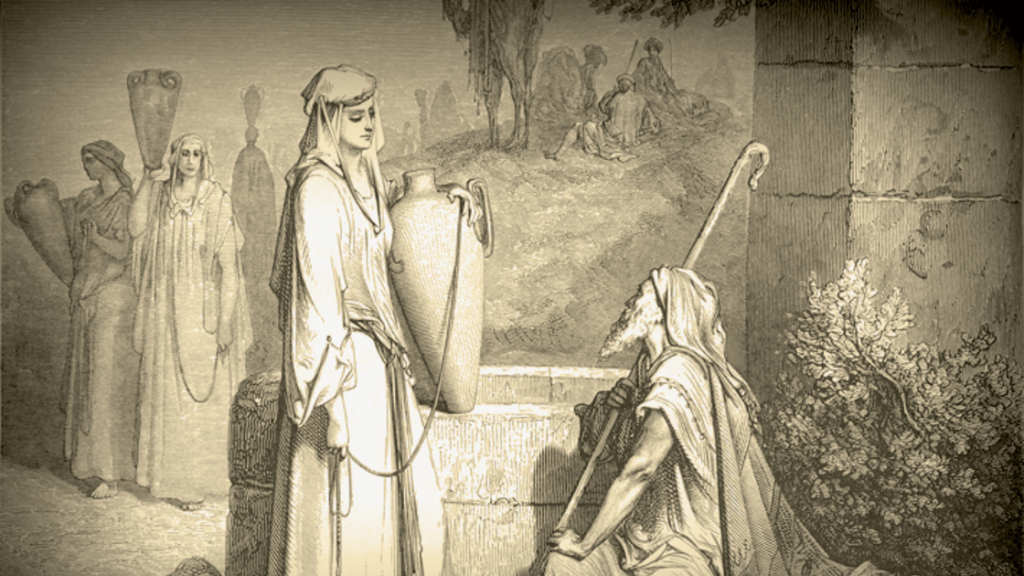
Rebekah and Abraham’s servant, an engraving by Gustave Dore (1832-1883)

Reading Holy Scripture is important. And the way we read it is significant. For the past several years, I have personally made it a practice to always read from the Bible out loud. There is something deeply powerful and impactful about the experience of reading aloud God’s Word.

I also try and read Scripture carefully and slowly. I deliberately make choices about my tone and inflexion, paying attention to which words are emphasized. I try to communicate as best I can the spirit and intent of the words.

I encourage you today to read aloud (and listen to) today’s Old Testament lesson. Take your time. Read it at your own pace. Notice which words you tend to accent, and what the Spirit may be saying to you in the reading…

Soon after that, the servant loaded ten of Abraham’s camels with valuable gifts. Then he set out for the city in northern Syria, where Abraham’s brother Nahor lived.

When he got there, he let the camels rest near the well outside the city. It was late afternoon, the time when the women came out for water. The servant prayed:

You, Lord, are the God my master Abraham worships. Please keep your promise to him and let me find a wife for Isaac today. The young women of the city will soon come to this well for water, and I’ll ask one of them for a drink. If she gives me a drink and then offers to get some water for my camels, I’ll know she is the one you have chosen and that you have kept your promise to my master.

While he was still praying, a beautiful unmarried young woman came by with a water jar on her shoulder. She was Rebekah, the daughter of Bethuel, the son of Abraham’s brother Nahor and his wife Milcah. Rebekah walked past Abraham’s servant, then went over to the well, and filled her water jar. When she started back, Abraham’s servant ran to her and said, “Please let me have a drink of water.”

“I’ll be glad to,” she answered. Then she quickly took the jar from her shoulder and held it while he drank. After he had finished, she said, “Now I’ll give your camels all the water they want.” She quickly poured out water for them, and she kept going back for more, until his camels had drunk all they wanted. Abraham’s servant did not say a word, but he watched everything Rebekah did, because he wanted to know for certain if this was the woman the Lord had chosen.

The servant had brought along an expensive gold ring and two large gold bracelets. When Rebekah had finished bringing the water, he gave her the ring for her nose and the bracelets for her arms. Then he said, “Please tell me who your father is. Does he have room in his house for me and my men to spend the night?”

She answered, “My father is Bethuel, the son of Nahor and Milcah. We have a place where you and your men can stay, and we also have enough straw and feed for your camels.”

Then the servant bowed his head and prayed, “I thank you, Lord God of my master Abraham! You have led me to his relatives and kept your promise to him.”

Rebekah ran straight home and told her family everything. Her brother Laban heard her tell what the servant had said, and he saw the ring and the bracelets she was wearing. So Laban ran out to Abraham’s servant, who was standing by his camels at the well. Then Laban said, “The Lord has brought you safely here. Come home with me. There’s no need for you to keep on standing outside. I have a room ready for you in our house, and there’s also a place for your camels.”

Abraham’s servant went home with Laban, where Laban’s servants unloaded his camels and gave them straw and feed. Then they brought water into the house, so Abraham’s servant and his men could wash their feet. After that, they brought in food. But the servant said, “Before I eat, I must tell you why I have come.”

“Go ahead and tell us,” Laban answered.

The servant explained:

I am Abraham’s servant. The Lord has been good to my master and has made him very rich. He has given him many sheep, goats, cattle, camels, and donkeys, as well as a lot of silver and gold, and many slaves. Sarah, my master’s wife, didn’t have any children until she was very old. Then she had a son, and my master has given him everything. I solemnly promised my master that I would do what he said. And he told me, “Don’t choose a wife for my son from the women in this land of Canaan. Instead, go back to the land where I was born and find a wife for my son from among my relatives.”

I asked my master, “What if the young woman refuses to come with me?”

My master answered, “I have always obeyed the Lord, and he will send his angel to help you find my son a wife from among my own relatives. But if they refuse to let her come back with you, then you are freed from your promise.”

When I came to the well today, I silently prayed, “You, Lord, are the God my master Abraham worships, so please lead me to a wife for his son while I am here at the well. When a young woman comes out to get water, I’ll ask her to give me a drink. If she gives me a drink and offers to get some water for my camels, I’ll know she is the one you have chosen.”

Even before I had finished praying, Rebekah came by with a water jar on her shoulder. When she had filled the jar, I asked her for a drink. She quickly lowered the jar from her shoulder and said, “Have a drink. Then I’ll get water for your camels.” So I drank, and after that she got some water for my camels. I asked her who her father was, and she answered, “My father is Bethuel the son of Nahor and Milcah.” At once I put the ring in her nose and the bracelets on her arms. Then I bowed my head and gave thanks to the God my master Abraham worships. The Lord had led me straight to my master’s relatives, and I had found a wife for his son.

Now please tell me if you are willing to do the right thing for my master. Will you treat him fairly, or do I have to look for another young woman?

Laban and Bethuel answered, “The Lord has done this. We have no choice in the matter. Take Rebekah with you; she can marry your master’s son, just as the Lord has said.” Abraham’s servant bowed down and thanked the Lord. (Contemporary English Version)

How was your experience in reading this story out loud? What did the Spirit bring to you through it? Will you share your experience with us?…


Go and Serve the Lord (Genesis 24:1-9)

Abraham was now a very old man. The Lord had made him rich, and he was successful in everything he did. One day, Abraham called in his most trusted servant and said to him, “Solemnly promise me in the name of the Lord, who rules heaven and earth, that you won’t choose a wife for my son Isaac from the people here in the land of Canaan. Instead, go back to the land where I was born and find a wife for him from among my relatives.”

But the servant asked, “What if the young woman I choose refuses to leave home and come here with me? Should I send Isaac there to look for a wife?”

“No!” Abraham answered. “Don’t ever do that, no matter what. The Lord who rules heaven brought me here from the land where I was born and promised that he would give this land to my descendants forever. When you go back there, the Lord will send his angel ahead of you to help you find a wife for my son. If the woman refuses to come along, you don’t have to keep this promise. But don’t ever take my son back there.” So the servant gave Abraham his word that he would do everything he had been told to do. (Contemporary English Version)

The Spirit of God operates through us, God’s people. Although the Lord could do everything without us, God chooses to use us as servants doing the divine will. All of life is really and ideally a divine/human cooperative of the Lord working in and through us to accomplish good and divine purposes.

The spotlight of today’s Old Testament lesson follows Abraham’s servant – which is a picture of the Holy Spirit’s work. God has given us the responsibility and privilege of being humble servants in the world. Much like Abraham’s faithful and trusted servant, we are to fulfill God’s expectations to leave and go do the Lord’s bidding.

We have both the duty and delight of giving ourselves to the task of going out and finding the person(s) for whom the Lord sends us to find.

Jesus once said to his disciples:

“If any of you wants to be my follower, you must give up your own way, take up your cross, and follow me. If you try to hang on to your life, you will lose it. But if you give up your life for my sake and for the sake of the Good News, you will save it.” (Mark 8:34-35, NLT) 

Blessing from God happens when we leave everything and follow Jesus. God is still holding out this promise of blessing that can be realized through leaving and going. As Abraham sent out his servant, the Lord sends out so that divine promises are realized and humanity is blessed. Consider some biblical examples:

  • In order to experience marital blessing, God said in the beginning that a man must “leave his mother and father and cleave to his wife.” (Genesis 2:24) 
  • The writer of Proverbs says that if we want to see blessing, to experience God’s presence and approval, you must “leave your simple ways.” (Proverbs 9:6) 
  • Jesus said that if you have relational problems and are getting ready to worship you must “leave your gift at the altar.” Then, “first go and be reconciled to your brother.” (Matthew 5:23-24)  
  • Christ stated that, as the Great Shepherd, he will leave the ninety-nine sheep to go after one lost one. (Luke 15:4) 
  • The Lord Jesus commissioned us to do the business of leaving: “Go, and make disciples of all nations.” (Matthew 28:19). 
  • Jesus also said, “If you want to be perfect, go, sell your possessions and give to the poor, and you will have treasure in heaven.”(Matthew 19:21) 
  • The invitation has gone out concerning God’s great banquet of blessing: “Go to the street corners and invite to the banquet anyone you find.” (Matthew 22:9)

Being sent, leaving and blessing, go together.

I “leave” you with some thoughts on stepping out of our friendly and familiar environment to know the blessing of God:

  1. Hang around with others who want the blessing of God. Spend time with those who are eager to do God’s will and be God’s servant. Light each other’s fire, and let the Holy Spirit kindle a fresh flame in your heart by being around passionate Christian people. Don’t be a lone ranger, but instead consult and collaborate with others.
  2. Walk across the room. God may not be calling all of us to leave this country and go to an unreached people-group, but he is calling us all to leave our seats and walk across the room to encourage another person in their faith; or across the street to strike up a spiritual conversation with a lost neighbor; or across town to a lonely or hurting elderly person; or down the street to hang out at the laundry mat to meet new people who need the good news of grace. And, by all means, we are to walk across the pages of Scripture to follow Jesus in obedience to the Holy Spirit’s promptings.
  3. Step out in faith, no matter who you are. We might all consider Mother Teresa, who died in 1997, to be a super-Christian. She once stated, “By blood, I am Albanian. By citizenship, an Indian. By faith, I am a Catholic nun. As to my calling, I belong to the world. As to my heart, I belong entirely to the Heart of Jesus. God still loves the world and He sends you and me to be His love and His compassion to the poor to quench His thirst for love and for souls.”  Yet, at the same time, Teresa struggled in her faith for most of her life and often felt like her own soul was desolate. She once confessed, “In my soul, I feel just the terrible pain of loss, of God not wanting me, of God not being God, of God not really existing.” Even in this, her dark night of the soul was still the salvation for thousands.
  4. Don’t talk it to death. There is always more research and information and counsel to obtain. At some point you need to act. We have no need to create a sub-committee to investigate the findings of that other committee in order to decide. Frederick Buechner said, “The place God calls you to is the place where your deep gladness and the world’s deep hunger meet.” Where does your passion and the world’s great need meet? Leave, and go there. 

We are servants, meant to fulfill the instructions of a God who is calling us and sending us to do good work in this world.

Lord Jesus Christ, you stretched out your arms of love on the hard wood of the cross that everyone might come within the reach of your saving embrace. Clothe us in your Spirit so that, reaching forth our hands in love, we may bring those who do not know you to the knowledge and love of you; for the honor of your Name. Amen.

From Infertility to Laughter (Genesis 21:1-7)

The Lord was attentive to Sarah just as he had said, and the Lord carried out just what he had promised her. She became pregnant and gave birth to a son for Abraham when he was old, at the very time God had told him. Abraham named his son—the one Sarah bore him—Isaac. Abraham circumcised his son Isaac when he was eight days old just as God had commanded him. Abraham was 100 years old when his son Isaac was born. Sarah said, “God has given me laughter. Everyone who hears about it will laugh with me.” She said, “Who could have told Abraham that Sarah would nurse sons? But now I’ve given birth to a son when he was old!” (Common English Bible)

Abram and Sarai had settled into an uncomfortable comfortableness. They lived in Ur of the Chaldees, childless and past child bearing years. I’m sure they expected to live out the rest of their days in the land they had grown up in.

But then, God shook up things. The Lord comes along and calls the two of them to leave their familiar country and go to a new land. Along with the calling came a promise of making them the progenitors of a great nation. And the heir would come from their own biological bodies.

It did not all happen at once. And there were lots of questions. Each time Abraham brought up the issue, God simply restated the promise (Genesis 13:16, 15:2-5, 17:5-6). Abraham and Sarah were (understandably) at some points impatient and took matters into their own hands – which is how we get Ishmael, a son from Sarah’s servant Hagar (Genesis 16).

After Hagar gave birth to Ishmael, God informed Abraham that his heir will be born from Sarah – which (again understandably) evoked laughter. It was downright far-fetched to imagine a 100-year-old man and a 90-year-old woman giving birth to a baby.

It turns out that infertility, even with an old woman, can be surmounted by God. So, anyone settling into an uncomfortable comfortableness may need to switch to a comfortable uncomfortableness of knowing that nothing is impossible with God – which is, of course, what the angel said to a young Mary about becoming pregnant without having been with a man. (Luke 1:26-38)

Plenty of couples today struggle to conceive – even with the availability of infertility treatments and assistive reproductive technologies. And some families still walk away without a child, and instead come away with thousands of dollars of debt. 

I am heartened that Abraham kept bringing up Sarah’s infertility issue to God. And the Lord was never silent about it, but remained adamant that the divine promise would come from the two of them together.

Individual Christians and churches tend to shy away from conversations about infertility. Yet, it’s something for which many people need spiritual and emotional support. Fertile couples may feel awkward talking to infertile couples, but it is very much needed. God didn’t remain silent, so let’s not keep quiet either.

It’s okay to talk about the struggles of infertility. Sometimes we need to name it as an experience of suffering seen and known by God. Many couples need to experience the presence of God and know God is with them in their struggle. For, indeed, God cares about the feelings of women experiencing infertility.

For many families with children, they have the luxury of discussing infertility as a theological issue. And they may offer easy solutions of prayer, or to simply ask for a miracle (as if the barren woman hadn’t already done that a thousand times). Yet, for females longing to carry a child full term, this is a very real problem which involves the whole person – and not only cerebral arguments.

It’s important that the stories and experiences of those who live with the pain and disappointment of infertility are heard by us, and what’s more, honored and lifted up. Women experiencing infertility need our support, and not our silence.

The Lord was attentive to Sarah. We can be attentive to the Sarah’s around us. The following are some ways we can do just that:

1. Validate their feelings

Many women with infertility do not share their struggles with family or friends. This secrecy may lead to feelings of depression, anxiety or low self-worth.  Asking open-ended questions like, “How can I best support you?” or, “What can I do for you during this time?” shows that you want to understand their situation and are willing to have helpful dialogue.

2. Ask, don’t assume

Constantly trying to figure out if someone is pregnant can be upsetting for a person with infertility. Just give them grace and space to talk. If you want to know something, ask. But never try to pull information out of another person.

3. Don’t minimize their situation

Statements such as, “It will happen soon enough” minimize the pain and sorrow a couple may be experiencing. And being overly positive about a situation does not help. Acknowledging the uncertainty is more helpful than giving a false sense of hope.

4. Don’t compare

Every person’s journey with infertility is different. Comparing someone’s situation with someone else’s can create stress and make them feel as if they’re doing something wrong.

Avoid statements such as: 

  • “I know a friend who…”
  • “Have you tried…”
  • “Maybe you should just…”
  • “Relax. All that stress is causing your infertility.”
  • “Why don’t you just adopt?”

5. Be thoughtful

If you have kids of your own, don’t complain. Things like lack of sleep from caring for a newborn can be painful reminders of what your infertile friend has not been able to have. Yet, that doesn’t mean avoiding your own situation. Be honest and real, but be thoughtful and sensitive. Let another be part of your life, while at the same time, asking about theirs.

6. Be involved

People don’t like to be excluded from knowing details about your experience with kids and want to be invited to important occasions. Let them decide what they want and can do.

If we learn to cry with others in their wondering and discouragement, we will be able to laugh with them when joy abounds. Just ask Sarah.

God of Life,
You fill what is empty,
You make abundant what is scarce,
You bring to bloom what is barren.

We ask your presence and care for all those who seek to be parents. Bless them with the conception, healthy delivery and joyful rearing of children made in your image and likeness. Dwell with them and console them as they wait for the gifts given in your good time.

With Sarah and Abraham, we are bold to pray. Amen.  

A Word of Faith (Genesis 15:1-20)

After this, the word of the Lord came to Abram in a vision:

“Do not be afraid, Abram.
    I am your shield,
    your very great reward.”

But Abram said, “Sovereign Lord, what can you give me since I remain childless and the one who will inherit my estate is Eliezer of Damascus?” And Abram said, “You have given me no children; so a servant in my household will be my heir.”

Then the word of the Lord came to him: “This man will not be your heir, but a son who is your own flesh and blood will be your heir.” He took him outside and said, “Look up at the sky and count the stars—if indeed you can count them.” Then he said to him, “So shall your offspring be.”

Abram believed the Lord, and he credited it to him as righteousness.

He also said to him, “I am the Lord, who brought you out of Ur of the Chaldeans to give you this land to take possession of it.”

But Abram said, “Sovereign Lord, how can I know that I will gain possession of it?”

So the Lord said to him, “Bring me a heifer, a goat and a ram, each three years old, along with a dove and a young pigeon.”

Abram brought all these to him, cut them in two and arranged the halves opposite each other; the birds, however, he did not cut them in half. Then birds of prey came down on the carcasses, but Abram drove them away.

As the sun was setting, Abram fell into a deep sleep, and a thick and dreadful darkness came over him. Then the Lord said to him, “Know for certain that for four hundred years your descendants will be strangers in a country not their own and that they will be enslaved and mistreated there. But I will punish the nation they serve as slaves, and afterward they will come out with great possessions. You, however, will go to your ancestors in peace and be buried at a good old age. In the fourth generation your descendants will come back here, for the sin of the Amorites has not yet reached its full measure.”

When the sun had set and darkness had fallen, a smoking firepot with a blazing torch appeared and passed between the pieces. On that day the Lord made a covenant with Abram and said, “To your descendants I give this land, from the Wadi of Egypt to the great river, the Euphrates—the land of the Kenites, Kenizzites, Kadmonites, Hittites, Perizzites, Rephaites, (New International Version)

Abrahamic Covenant II, by Wayne Forte, 2007

A Word about Abram and Sarai

We meet Abram and Sarai (later to be known as Abraham and Sarah) as a non-descript couple from a place called Ur of the Chaldees, a few chapters earlier in the opening biblical book of Genesis. It’s noted that Sarai is barren, or childless. (Genesis 11:30)

The Lord decided to choose a people for God’s own name, a singular people to become a kingdom of priest and a holy nation. The idea was that God would bless all the other nations through this one nation.

So, in what becomes something of a divine pattern, God chooses a most unlikely couple (old and childless) to become father and mother of this new nation to bless all other nations on earth. The Lord called them from their country of origin to leave and go to a new place. (Genesis 12:1-3)

Lo and behold, Abram and Sarai did just that. They left all they ever knew and journeyed to the new land, believing the promise of God, even though it didn’t make much sense. And there, they waited for a child, who would become the first of their many descendants, the child of promise.

And they waited. Time passed. They made a few sojourns into Egypt and back. But still no child. More time went by. Abram and Sarai were old when they came to the new land. Now, they’re really old! And still, no child. Then, finally, the Lord broke the silence.

The Word of the Lord

God’s initial words after all this time were, “Don’t be afraid.” We discover that anytime we hear that phrase spoken by the Lord, something good is about to happen. In fact, it’s great news.

But Abram seems discouraged, even with a fresh heart-to-heart with God. He and Sarai are still without a child. Instead of joy over God’s speech, Abram laments the ache of childlessness. Even though, by this time, Abram was wealthy, prosperous, and of good reputation, he feels the sting of a promise yet unfulfilled. God has still not granted him progeny for blessing the world.

A Word of Lament

Lament is, at its core, a complaint – an expression of grief in losing something or someone, or as in Abram’s case, of never having that something or someone to begin with.

It’s actually important for us to essentially make our problems into God’s problems. To tell God about our deepest hurts and unmet hopes is to implicate God in those hurts and hopes. It is to involve God in our disappointment.

In lament, we cry out to God in the belief that the Lord can and will respond to our painful cries and our deep desires. We believe God has the power and ability to respond. To complain to God is to have faith that God is faithful to divine promises—in spite of any nonsensical present circumstances.

Concerning matters about which God has made a promise, to complain is to remind the Lord of those unmet promises. In his lament, Abram was implying that God had not kept the promise, and had not yet proven faithful.

A Word of Response

Far from feeling perturbed that Abram laments instead of rejoices, God, in fact, responds by doubling-down on the original promise. Not only will there be a child, but that child’s descendants will be too many to even begin counting.

The Lord invited Abram to move his head from looking down at the bare ground to looking up at the magnificent stars. And in gazing upon the heavens, listening to the God whom he serves, Abram believed the Lord. And it was this faith which was credited to him as righteousness.

God is okay with being implicated in our problems. In fact, God welcomes it. Our deep grief, and our prayerful complaints, are a way of speaking which reminds God that God has promised to be faithful to divine promises. God doesn’t at all mind being held accountable to promises made.

Then, the Lord further responds by making a tangible expression of the intangible promise by means of a special sacrifice. God instructed Abram to involve some animal sacrifices and arrange them a certain way. When the sun had gone down and it was dark, a smoking fire pot and a flaming torch passed between the arranged pieces of the sacrifice.

A Covenant Word

On that day, through a ritual observance, God made a covenant with Abram.

To make a covenant in the ancient world, animals were cut in half, and then the persons making the covenantal commitment walked down the middle between the animals.

In Abram’s ritual, however, it was the Lord—in the form of a smoking pot and a flaming torch—who passed down the middle and thus was the one making the promise.

The symbolism of the covenant ritual is this: The one making the promise passes between dead animals as a ritual promise that, if they should be unfaithful to the terms of the covenant, they are to be cut in half just as the sacrificed animal.

In other words, when the Lord passed between the cleaved goat, sheep, ram and birds, God was pledging complete commitment to Abram.

A New Covenant Word

In Christianity, the gospel is a free promise by God that requires the death of God. The promise of God to Abram, Christians believe, ultimately led to the very death of the Son of God, Jesus.

In order to be faithful to the divine promise, to Abraham and Sarah and their descendants, and to David, God took on human flesh, walked between the pieces, and died so that we might have life.

Therefore, the promise comes by faith, so that it may be by grace and may be guaranteed to all Abraham’s offspring—not only to those who are of the law but also to those who have the faith of Abraham. He is the father of us all. As it is written: “I have made you a father of many nations.” He is our father in the sight of God, in whom he believed—the God who gives life to the dead and calls into being things that were not. (Romans 4:16-17, NIV)

Amen.