The All-Sufficient One (Genesis 17:1-13)

When Abram was ninety-nine years old, the Lord appeared to him and said, “I am God Almighty; walk before me faithfully and be blameless. Then I will make my covenant between me and you and will greatly increase your numbers.”

Abram fell facedown, and God said to him, “As for me, this is my covenant with you: You will be the father of many nations. No longer will you be called Abram; your name will be Abraham, for I have made you a father of many nations. I will make you very fruitful; I will make nations of you, and kings will come from you. I will establish my covenant as an everlasting covenant between me and you and your descendants after you for the generations to come, to be your God and the God of your descendants after you. The whole land of Canaan, where you now reside as a foreigner, I will give as an everlasting possession to you and your descendants after you; and I will be their God.”

Then God said to Abraham, “As for you, you must keep my covenant, you and your descendants after you for the generations to come. This is my covenant with you and your descendants after you, the covenant you are to keep: Every male among you shall be circumcised. You are to undergo circumcision, and it will be the sign of the covenant between me and you. For the generations to come every male among you who is eight days old must be circumcised, including those born in your household or bought with money from a foreigner—those who are not your offspring. Whether born in your household or bought with your money, they must be circumcised. My covenant in your flesh is to be an everlasting covenant. (New International Version)

There were 13 years between the events of chapters 16 and 17 of Genesis. God’s servant, Abram, did not hear from God in those years. Then, all of a sudden, the Lord showed up, with a new self-reference as “God Almighty.”

“God Almighty” (“El Shaddai,” the all-sufficient God) appeared to Abram. The Lord brought a self-revelation to Abram as the all-competent God, the adequate God, the God who has the big picture and knows what to do with it.

Within those 13 years before El Shaddai showed up, Abram tried his own plan for acquiring an heir to God’s covenant promises. It didn’t go quite as designed. Along with Abram, people in every age need to discover or recover the presence of God Almighty, El Shaddai, the Lord who is completely sufficient for anything and everything in life.

Our role, much like Abram’s, is to bring a wholehearted devotion to our walk with God – not looking for some extra supplement to the Lord, as if divine resources and help is inadequate or untrustworthy. We are to have a sincere and obedient stance toward God Almighty.

Too many people seek to serve two masters, as if this will help cover all the bases of what we need. But Jesus was savvy to this, understanding that it only complicates things:

“No one can serve two masters. Either you will hate the one and love the other, or you will be devoted to the one and despise the other.”

Jesus (Matthew 6:24; Luke 16:13, NIV)

God Almighty wanted Abram to know and believe that El Shaddai doesn’t allow any dual allegiances – mainly because all of us can only really serve one master.

This realization and determination to serve God Almighty alone elicits El Shaddai giving Abram a new name: Abraham. Knowing God in a new or different way always changes us, as if we are new people with new names. For Abram, now Abraham, the change is one of moving from the “exalted father” who had his own ideas, to the “father of many nations” who will bless all those with the same discovery and determination to let God be God, without all the puny human interference.

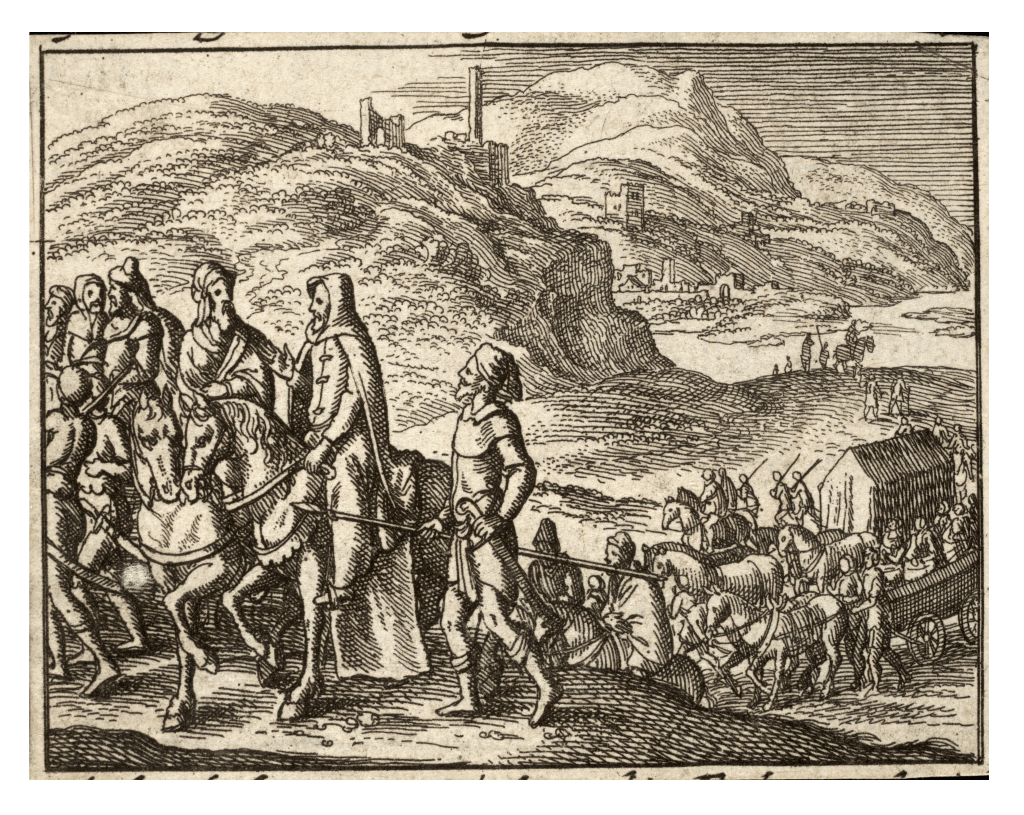
And You Shall Circumcise the Flesh of Your Foreskin, by Gerard Hoet (1648-1733)

With any seminal change of life, a very real and tangible sign is important, in order to never forget who God is, and who we as people are. For Abraham and those born to him, circumcision was that sign.

And what a sign it was! God actually told Abraham that all the males in his household were to have their foreskin removed. If anything, this was a sign given which could never get lost! It was enduring, always there, and unforgettable. It is a constant reminder that the people of Abraham, the Hebrews, are to be different and singularly devoted to El Shaddai.

In Christianity, we are to have a circumcision of the heart, and not necessarily the flesh. It is the heart, which is to be completely devoted to God Almighty, that is, the entirety of a person’s life. The whole person is to be oriented to one master who rules both body and soul.

A person is not a Jew who is one only outwardly, nor is circumcision merely outward and physical. No, a person is a Jew who is one inwardly; and circumcision is circumcision of the heart, by the Spirit, not by the written code. Such a person’s praise is not from other people, but from God. (Romans 2:28-29, NIV)

The one devoted to God Almighty in Jesus Christ is to use body, mind, emotions, and spirit for good divine purposes. Christians are meant to rely solely and completely upon Christ. They are to take every action, every thought, every feeling, every imagination and make it captive to Christ.

To be circumcised is to be set apart for good and noble purposes, to have a heart fully devoted to God Almighty as the ever-living, ever-loving, all-sufficient Sovereign of the universe.

God Almighty, open our eyes that we may see; incline our hearts that we may desire; and order our steps that we may follow the way of your commandments, now and forever, through Jesus Christ our Lord, who with you and the Holy Spirit are one God, for all time. Amen.

To Forgive Is Divine (Genesis 50:15-26)

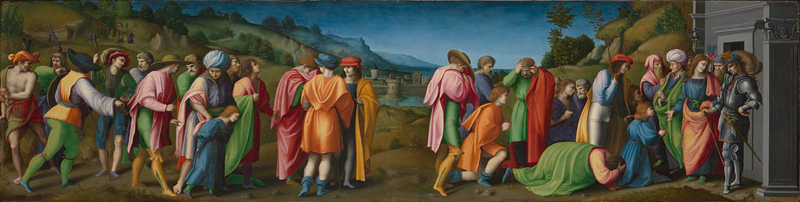
Joseph pardons his brothers, by Bacchiacca (1495-1557) http://www.nationalgallery.org.uk/paintings/NG1219

When Joseph’s brothers realized that their father was now dead, they said, “What if Joseph bears a grudge against us, and wants to pay us back seriously for all of the terrible things we did to him?” So they approached Joseph and said, “Your father gave orders before he died, telling us, ‘This is what you should say to Joseph. “Please, forgive your brothers’ sins and misdeeds, for they did terrible things to you. Now, please forgive the sins of the servants of your father’s God.”’” Joseph wept when they spoke to him.

His brothers wept too, fell down in front of him, and said, “We’re here as your slaves.”

But Joseph said to them, “Don’t be afraid. Am I God? You planned something bad for me, but God produced something good from it, in order to save the lives of many people, just as he’s doing today. Now, don’t be afraid. I will take care of you and your children.” So he put them at ease and spoke reassuringly to them.

Thus Joseph lived in Egypt, he and his father’s household. Joseph lived 110 years and saw Ephraim’s grandchildren. The children of Machir, Manasseh’s son, were also born on Joseph’s knees. Joseph said to his brothers, “I’m about to die. God will certainly take care of you and bring you out of this land to the land he promised to Abraham, to Isaac, and to Jacob.” Joseph made Israel’s sons promise, “When God takes care of you, you must bring up my bones out of here.” Joseph died when he was 110 years old. They embalmed him and placed him in a coffin in Egypt. (Common English Bible)

“All people commit sins and make mistakes. God forgives them, and people are acting in a divine way when they forgive.”

Alexander Pope, “An Essay on Criticism”

If there was anyone who had a supposed right to be bitter and unforgiving, it would be Joseph. His brothers had hated him, left him for dead, sold him into slavery, and lied to their father Jacob about him. For years, Joseph languished in servitude and prison – for no fault of his own.

And yet, Joseph was able to discern that it wasn’t his place to be the judge. At the end of his life, he had the perspective and the insight to understand that all the hardship earlier in his life was noticed by God, and then bent for good and divine purposes in the saving of many lives.

If we can keep in mind that it is God’s business to run the world, and our business to forgive others, then life will go a lot better for everyone.

Many people live discontented lives because they say to themselves, “I will not forget what you did, and I will not forgive.” Persistent thoughts of revenge only serve as a cancer that destroys the mind’s thoughts, erodes the soul, and hinders the heart’s ability to love. 

But people who practice forgiveness are much less likely to be hateful, hostile, and belligerent toward others. They are healthier and happier, and more at peace.

I’ve had many people tell me over the years, “But you don’t know what I’ve been through.” My typical response is, “You don’t know what I’ve been through, either. You may not even believe some of the things I have experienced, and some of the things that have happened to me and were said to me. So, can I tell you what I have done to forgive those who have sinned against me?”

1. When I am trying to forgive someone, I pray for them.

It’s hard to keep resenting someone and wish them ill, whenever you are praying for them on a regular basis. Joseph was the victim of his brothers’ abuse. If there was ever a dysfunctional family to grow up in, it was Joseph’s. Being sold into slavery by your own brothers and being the target of their derision would cause anyone to be upset. But, many years later, Joseph chose to forgive his brothers. He acted with their best interests at mind. He prayed for them and did not actively work against them. What’s more, he saw the hand of God in it all.

2. I write a letter of forgiveness (which I may or may not send).

In the letter I write in full detail how the person hurt me. I leave nothing out. I express exactly how it made me feel, and how it affected my life. Then, I express forgiveness and say that I will not hold the offense over their head. The following is a five-step process for forgiving others using the acrostic REACH:

Recall 

Name the hurt, and name it squarely. Don’t fudge by saying it’s not that bad, or as bad as others have experienced. Call it what it is: deceit, stealing, harassment, assault, abuse, adultery, verbal shaming, murder, etc. 

The Truth and Reconciliation Commission in South Africa after apartheid was based on providing full disclosure of all crimes. Those that stepped forward, giving a complete account of their actions, were offered a full pardon. 

Archbishop Desmond Tutu, who led the commission, was most struck by how many people wanted to hear what had happened to their loved ones from the perpetrators themselves so that they could know whom to forgive. Methinks we have much to learn from our African brothers and sisters.

Empathize

Try and see the offense from the other person’s perspective. Attempt to put yourself in the other’s shoes. This does not mean we paper over the offense; it just means we don’t demonize another as a monster. That only feeds and fuels our own lack of forgiveness. When we view others as non-human, then we feel no responsibility to forgive.

Altruistic

Choose to do the right thing and treat the other person well, not necessarily because they deserve it, but because it is within your control to extend grace. Again, this is what Joseph chose to do with his brothers. He gave them words of assurance, and promises of taking care of them and their children.

Commit

Commit to practicing forgiveness. Make the decision to do it. Don’t wait too long for your feelings to catch up to you.  

Bear with each other and forgive one another if any of you has a grievance against someone. Forgive as the Lord forgave you.

The Apostle Paul (Colossians 3:13, NIV)

Hold

Hold on to your forgiveness. Just because you make the decision to forgive does not mean you’ll never have to do it again. Once you have forgiven, let it be a stake in the ground in which you look back to it again and again, saying, “I forgave him/her, and I will not let the enemy of my soul keep trying to make me bitter about it all over again.” 

One of the reasons we repeat the Lord’s Prayer Sunday after Sunday in my church is to keep forgiving those who have sinned against us.

3. I talk to a trusted friend, mentor, or counselor about my effort to forgive.

Many people get stuck and have an inability to forgive because they don’t seek a wise person to help them walk through the process of forgiving. 

The easy path is to complain about the offense to someone we know who will react with the same level of disgust and spirit of revenge that we ourselves have in our hearts. But that only reinforces the bitterness. We must have someone who can offer us what we need to hear, and not only what we want to hear.

Forgiveness is at the heart of the gospel, and, so, ought to be at the core of a healthy spiritual life. It is always open season on offering grace, forgiveness, and reconciliation. To see all of life from a divine perspective is to forgive.

Pray like this:

Our Father who is in heaven,

uphold the holiness of your name.

Bring in your kingdom

so that your will is done on earth as it’s done in heaven.

Give us the bread we need for today.

Forgive us for the ways we have wronged you,

just as we also forgive those who have wronged us.

And don’t lead us into temptation,

but rescue us from the evil one.

If you forgive others their sins, your heavenly Father will also forgive you. But if you don’t forgive others, neither will your Father forgive your sins. (Matthew 6:9-15, CEB)

Pay Attention to Grief (Genesis 49:29-50:14)

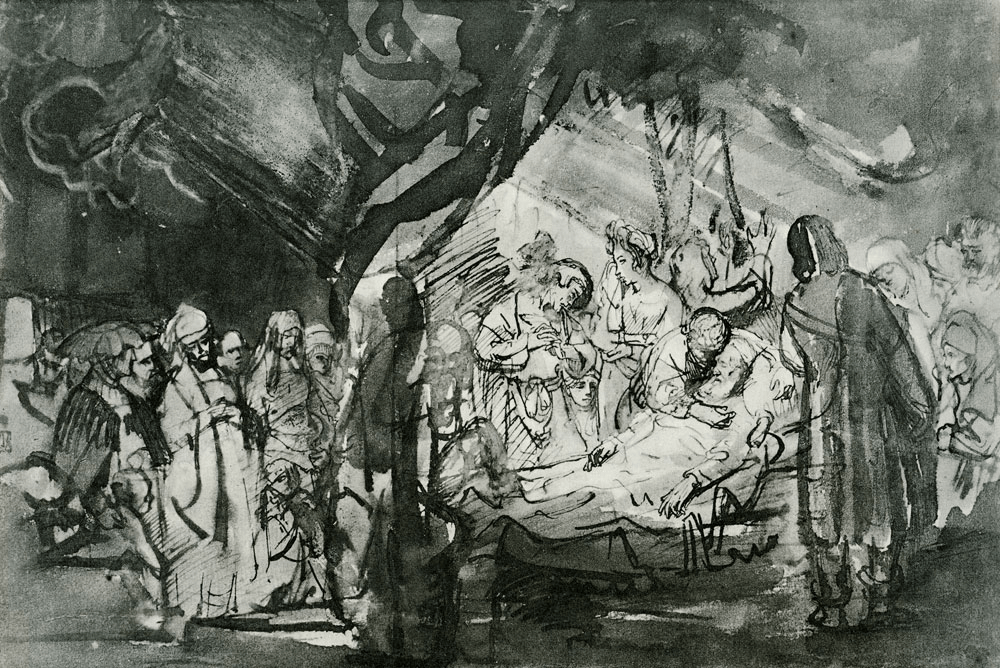
The Death of Jacob, by Rembrandt, c.1640

Jacob told his sons:

Soon I will die, and I want you to bury me in Machpelah Cave. Abraham bought this cave as a burial place from Ephron the Hittite, and it is near the town of Mamre in Canaan. Abraham and Sarah are buried there, and so are Isaac and Rebekah. I buried Leah there too. Both the cave and the land that goes with it were bought from the Hittites.

When Jacob had finished giving these instructions to his sons, he lay down on his bed and died. Joseph started crying, then leaned over to hug and kiss his father.

Joseph gave orders for Jacob’s body to be embalmed, and it took the usual 40 days.

The Egyptians mourned 70 days for Jacob. When the time of mourning was over, Joseph said to the Egyptian leaders, “If you consider me your friend, please speak to the king for me. Just before my father died, he made me promise to bury him in his burial cave in Canaan. If the king will give me permission to go, I will come back here.”

The king answered, “Go to Canaan and keep your promise to your father.”

When Joseph left Goshen with his brothers, his relatives, and his father’s relatives to bury Jacob, many of the king’s highest officials and even his military chariots and cavalry went along. The Israelites left behind only their children, their cattle, and their sheep and goats.

After crossing the Jordan River, Joseph stopped at Atad’s threshing place, where they all mourned and wept seven days for Jacob. The Canaanites saw this and said, “The Egyptians are in great sorrow.” Then they named the place “Egypt in Sorrow.”

So Jacob’s sons did just as their father had instructed. They took him to Mamre in Canaan and buried him in Machpelah Cave, the burial place Abraham had bought from Ephron the Hittite.

After the funeral, Joseph, his brothers, and everyone else returned to Egypt. (Contemporary English Version)

117 days. That’s how long Jacob’s family, along with the people of Egypt, mourned for him after his death. Yes, he was a patriarch. And yes, Joseph was the administrator of an entire nation. Yet this was not unusual behavior; it was normal.

When my mother-in-law was tragically and suddenly killed in a car accident, 30 years ago, I could not take any bereavement time off, because according to company policy, it was not my mother. So, since she lived a thousand miles from us, I had to use vacation time and take a week away. Then, when I returned to work, I was expected to pick up where I left off, as if nothing had happened.

Although I work under better conditions today, and workplaces are getting better at acknowledging the importance of tragic events in the life of employees, we still have a long way to go in dealing with grief, bereavement, mourning, and lament.

The modern funeral industry is a rather recent phenomenon in history. Beginning with, and then following, the American Civil War, death was a prominent specter, affecting every community and nearly every home. People like my second great grandfather became part of a growing business of handling the dead and providing services for grieving families. He became a coffin maker and a chief supplier for the burgeoning funeral parlor (which later morphed into a furniture business which lasted a hundred years).

Even though families needed help after a devastating war, over time, the unintended effect is that we became detached from death. Others could handle bodies and arrangements. We could choose to see or not see the dead. Folks began losing the ability to grieve and mourn their changes in life.

Grief doesn’t just go away with time. If it isn’t acknowledged, faced, accepted, and dealt with, it slowly begins to sit in the soul and rot. Eventually, it becomes spiritual gangrene; the person becomes bitter, without joy and stuck in unwanted emotions.

The point of all this is that grief and bereavement strikes us all; none of us gets off planet earth without having to deal with the loss of significant people in our lives. And when it happens, it’s imperative that individuals and societal structures allow for the time and space to mourn.

The ancients were on to something which we need to recover. They discerned the importance of allowing grief to run it’s course, instead of us trying to master grief, get over it, and move on. Grief will be dealt with when it is dealt with. Trying to tame it is like attempting to bench press 700 pounds; it’s only going to crush you if you try controlling it.

I’m not agitating for a 117 span of days for everyone’s mourning. But I am insisting that we have conversations about grief and confront it, rather than ignore it. Because grieving doesn’t mean you’re imperfect; it means you’re human.

The way we move through our grief is by telling our story – which requires someone to listen. That only happens if we have created the space for it to occur. Expectations of moving-on will leave grief where it is, poisoning us from the inside-out.

The only way to the mountain is through the valley. The only way to make the pain go away is to move through it – not by avoiding it, pretending it’s not there, or trying to go around it. Pain and suffering are inevitable; misery is optional. And letting bereavement and grief have it’s way for a while is the path away from the misery.

You will heal and you will rebuild yourself around the loss you have suffered. You will be whole again, but you will never be the same. And that’s a good thing. It gives us the ability and empathy to extend blessing to others who will eventually face their own terrible loss. They will need someone to listen. And you will be there for them.

Lord, do not abandon us in our desolation. Keep us safe in the midst of trouble, and complete your purpose for us through your steadfast love and faithfulness, in Jesus Christ our Savior. Amen.

Take the Long View (Genesis 49:1-33)

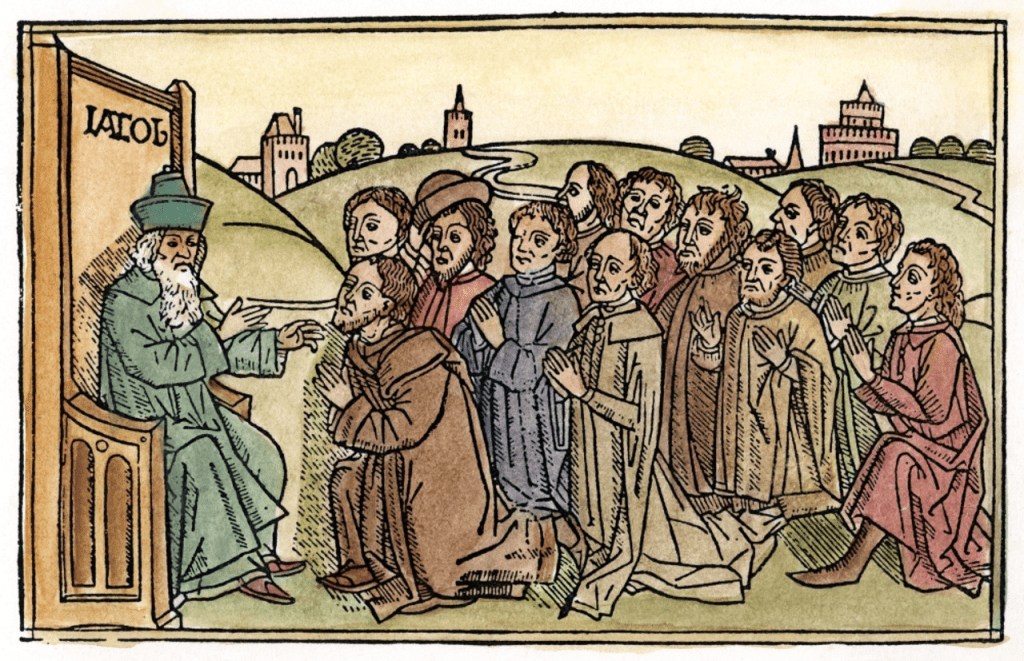
Jacob blesses his twelve sons, a woodcut from the Cologne Bible, c.1479

Then Jacob called together all his sons and said, “Gather around me, and I will tell you what will happen to each of you in the days to come.

“Come and listen, you sons of Jacob;
    listen to Israel, your father.

“Reuben, you are my firstborn, my strength,
    the child of my vigorous youth.
    You are first in rank and first in power.
But you are as unruly as a flood,
    and you will be first no longer.
For you went to bed with my wife;
    you defiled my marriage couch.

“Simeon and Levi are two of a kind;
    their weapons are instruments of violence.
May I never join in their meetings;
    may I never be a party to their plans.
For in their anger they murdered men,
    and they crippled oxen just for sport.
A curse on their anger, for it is fierce;
    a curse on their wrath, for it is cruel.
I will scatter them among the descendants of Jacob;
    I will disperse them throughout Israel.

“Judah, your brothers will praise you.
    You will grasp your enemies by the neck.
    All your relatives will bow before you.
Judah, my son, is a young lion
    that has finished eating its prey.
Like a lion he crouches and lies down;
    like a lioness—who dares to rouse him?
The scepter will not depart from Judah,
    nor the ruler’s staff from his descendants,
until the coming of the one to whom it belongs,
    the one whom all nations will honor.
He ties his foal to a grapevine,
    the colt of his donkey to a choice vine.
He washes his clothes in wine,
    his robes in the blood of grapes.
His eyes are darker than wine,
    and his teeth are whiter than milk.

“Zebulun will settle by the seashore
    and will be a harbor for ships;
    his borders will extend to Sidon.

“Issachar is a sturdy donkey,
    resting between two saddle packs.
When he sees how good the countryside is
    and how pleasant the land,
he will bend his shoulder to the load
    and submit himself to hard labor.

“Dan will govern his people,
    like any other tribe in Israel.
Dan will be a snake beside the road,
    a poisonous viper along the path
that bites the horse’s hooves
    so its rider is thrown off.
I trust in you for salvation, O Lord!

“Gad will be attacked by marauding bands,
    but he will attack them when they retreat.

“Asher will dine on rich foods
    and produce food fit for kings.

“Naphtali is a doe set free
    that bears beautiful fawns.

“Joseph is the foal of a wild donkey,
    the foal of a wild donkey at a spring—
    one of the wild donkeys on the ridge.
Archers attacked him savagely;
    they shot at him and harassed him.
But his bow remained taut,
    and his arms were strengthened
by the hands of the Mighty One of Jacob,
    by the Shepherd, the Rock of Israel.
May the God of your father help you;
    may the Almighty bless you
with the blessings of the heavens above,
    and blessings of the watery depths below,
    and blessings of the breasts and womb.
May my fatherly blessings on you
    surpass the blessings of my ancestors,
    reaching to the heights of the eternal hills.
May these blessings rest on the head of Joseph,
    who is a prince among his brothers.

“Benjamin is a ravenous wolf,
    devouring his enemies in the morning
    and dividing his plunder in the evening.”

These are the twelve tribes of Israel, and this is what their father said as he told his sons good-bye. He blessed each one with an appropriate message.

Then Jacob instructed them, “Soon I will die and join my ancestors. Bury me with my father and grandfather in the cave in the field of Ephron the Hittite. This is the cave in the field of Machpelah, near Mamre in Canaan, that Abraham bought from Ephron the Hittite as a permanent burial site. There Abraham and his wife Sarah are buried. There Isaac and his wife, Rebekah, are buried. And there I buried Leah. It is the plot of land and the cave that my grandfather Abraham bought from the Hittites.”

When Jacob had finished this charge to his sons, he drew his feet into the bed, breathed his last, and joined his ancestors in death. (New Living Translation)

The theme of confidence works its way through the patriarch Jacob’s deathbed prophecies and blessings – a resolute conviction in the promises of God, that he will accomplish what he said he would do.

Jacob expressed the hope and sure belief that God would bring the Israelites out of Egypt and into the land of Canaan as their inheritance – and, ultimately to the City of God, the eternal inheritance.

The Christian will find much in Judah’s blessing as the promise of the coming Christ, Jesus. Mentioning the implements of “staff” and “scepter” are symbols of authority. And, the reference to a donkey communicated a ruler was coming, as donkeys were the preferred mounts of royalty in ancient times.

What’s more, the washing of garments in wine, and eyes darker than wine, are allusions to the future blessing and abundance there will be through the tribe of Judah. In fact, the first miracle of Jesus was turning water into wine – a deliberate attempt by the Apostle John to connect Jesus with Old Testament messianic prophecies of abundance and blessing. (John 2:1-12)

It’s necessary to take a long view of life, keeping in mind that it took eighteen centuries for Jacob’s prophecy of Judah to occur. This long view is what gives us our confidence in life and provides the patience and perseverance we need right now. 

Keeping in mind the big picture of God’s work in this world is important, because if we do not, we will likely become discouraged with the circumstances we face right now.

The reason Jacob makes it into the great Hall of Faith in the New Testament book of Hebrews is not because he was squeaky clean and perfect in how he lived his life, but because he took the long view, the big picture, and saw that God was going to fulfill his promises to Israel:

By an act of faith, Jacob on his deathbed blessed each of Joseph’s sons in turn, blessing them with God’s blessing, not his own—as he bowed worshipfully upon his staff. (Hebrews 11:21, MSG)

Furthermore, when we string the following three verses together across both Testaments, we see the long view of God’s purposes:

It is true that you planned to do something bad to me. But really, God was planning good things. God’s plan was to use me to save the lives of many people. And that is what happened. (Genesis 50:20, ERV)

For I know the plans I have for you,” declares the Lord, “plans to prosper you and not to harm you, plans to give you hope and a future. (Jeremiah 29:11, NIV)       

And we know that all things work together for good to those who love God, to those who are the called according to his purpose. (Romans 8:28, NKJV)

In the Christian faith tradition, all God’s promises come together and are fulfilled in the person and work of Jesus. Christ is our salvation, our inheritance, and our hope. To give our lives to him in complete trust of faith is both our challenge and our privilege.

So, may you and I live by faith, and not by fear.

Be present, O merciful God, and protect us through these anxious times, so that we who are wearied by the changes of this life may rest in your eternal steadiness. Keep watch, dear God, with those who work, or watch, or weep this night, and give your angels charge over those who sleep. Tend the sick, Lord Christ; give rest to the weary, bless the dying, soothe the suffering, pity the afflicted, shield the joyous; and all for your love’s sake. Amen.