Genesis 46:2-47:12 – How to Live in the World

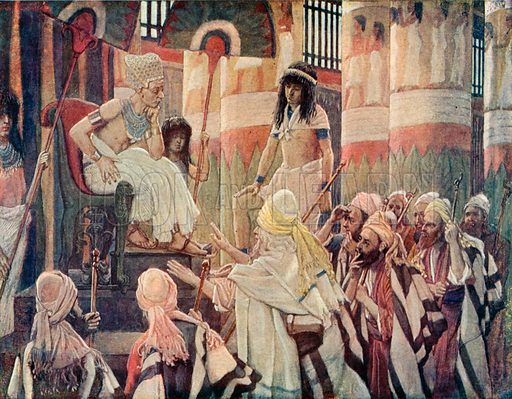
Joseph presents Jacob, his Father, to Pharaoh, Gen xlvii 7 and 8
Joseph presents Jacob and his brothers to Pharaoh by French artist James Jacques Joseph Tissot (1836-1902)

And God spoke to Israel in a vision at night and said, “Jacob! Jacob!”

“Here I am,” he replied.

“I am God, the God of your father,” he said. “Do not be afraid to go down to Egypt, for I will make you into a great nation there. I will go down to Egypt with you, and I will surely bring you back again. And Joseph’s own hand will close your eyes.”

Then Jacob left Beersheba, and Israel’s sons took their father Jacob and their children and their wives in the carts that Pharaoh had sent to transport him. So, Jacob and all his offspring went to Egypt, taking with them their livestock and the possessions they had acquired in Canaan. Jacob brought with him to Egypt his sons and grandsons and his daughters and granddaughters—all his offspring.

These are the names of the sons of Israel (Jacob and his descendants) who went to Egypt:

Reuben the firstborn of Jacob.  The sons of Reuben: Hanok, Pallu, Hezron and Karmi.

The sons of Simeon: Jemuel, Jamin, Ohad, Jakin, Zohar and Shaul the son of a Canaanite woman.

The sons of Levi: Gershon, Kohath and Merari.

The sons of Judah: Er, Onan, Shelah, Perez and Zerah (but Er and Onan had died in the land of Canaan).

The sons of Perez: Hezron and Hamul.

The sons of Issachar: Tola, Puah, Jashub and Shimron.

The sons of Zebulun: Sered, Elon and Jahleel.

These were the sons Leah bore to Jacob in Paddan Aram, besides his daughter Dinah. These sons and daughters of his were thirty-three in all.

The sons of Gad: Zephon, Haggi, Shuni, Ezbon, Eri, Arodi and Areli.

The sons of Asher: Imnah, Ishvah, Ishvi and Beriah.  Their sister was Serah.  The sons of Beriah: Heber and Malkiel.

These were the children born to Jacob by Zilpah, whom Laban had given to his daughter Leah—sixteen in all.

The sons of Jacob’s wife Rachel:

Joseph and Benjamin. In Egypt, Manasseh and Ephraim were born to Joseph by Asenath daughter of Potiphera, priest of On.

The sons of Benjamin: Bela, Beker, Ashbel, Gera, Naaman, Ehi, Rosh, Muppim, Huppim and Ard.

These were the sons of Rachel who were born to Jacob—fourteen in all.

The son of Dan: Hushim.

The sons of Naphtali: Jahziel, Guni, Jezer and Shillem.

These were the sons born to Jacob by Bilhah, whom Laban had given to his daughter Rachel—seven in all.

All those who went to Egypt with Jacob—those who were his direct descendants, not counting his sons’ wives—numbered sixty-six persons. With the two sons who had been born to Joseph in Egypt, the members of Jacob’s family, which went to Egypt, were seventy in all.

Now Jacob sent Judah ahead of him to Joseph to get directions to Goshen. When they arrived in the region of Goshen, Joseph had his chariot made ready and went to Goshen to meet his father Israel. As soon as Joseph appeared before him, he threw his arms around his father and wept for a long time.

Israel said to Joseph, “Now I am ready to die, since I have seen for myself that you are still alive.”

Then Joseph said to his brothers and to his father’s household, “I will go up and speak to Pharaoh and will say to him, ‘My brothers and my father’s household, who were living in the land of Canaan, have come to me. The men are shepherds; they tend livestock, and they have brought along their flocks and herds and everything they own.’ When Pharaoh calls you in and asks, ‘What is your occupation?’ you should answer, ‘Your servants have tended livestock from our boyhood on, just as our fathers did.’ Then you will be allowed to settle in the region of Goshen, for all shepherds are detestable to the Egyptians.”

Joseph went and told Pharaoh, “My father and brothers, with their flocks and herds and everything they own, have come from the land of Canaan and are now in Goshen.” He chose five of his brothers and presented them before Pharaoh.

Pharaoh asked the brothers, “What is your occupation?”

“Your servants are shepherds,” they replied to Pharaoh, “just as our fathers were.” They also said to him, “We have come to live here for a while, because the famine is severe in Canaan and your servants’ flocks have no pasture. So now, please let your servants settle in Goshen.”

Pharaoh said to Joseph, “Your father and your brothers have come to you, and the land of Egypt is before you; settle your father and your brothers in the best part of the land. Let them live in Goshen. And if you know of any among them with special ability, put them in charge of my own livestock.”

Then Joseph brought his father Jacob in and presented him before Pharaoh. After Jacob blessed Pharaoh, Pharaoh asked him, “How old are you?”

And Jacob said to Pharaoh, “The years of my pilgrimage are a hundred and thirty. My years have been few and difficult, and they do not equal the years of the pilgrimage of my fathers.” Then Jacob blessed Pharaoh and went out from his presence.

So, Joseph settled his father and his brothers in Egypt and gave them property in the best part of the land, the district of Rameses, as Pharaoh directed. Joseph also provided his father and his brothers and all his father’s household with food, according to the number of their children. (NIV)

Jacob Blesses Pharaoh
Jacob Blesses Pharaoh by Welsh artist Owen Jones, 1869

God likes fulfilling his promises to us – even and especially when we are in Egypt – in the world. Sometimes we work too hard at avoiding the world and creating heaven on earth right now.  God knew what the Israelites would face: four-hundred years of slavery in Egypt. Yet, God sent them anyway. Often, the people of God grow more in times of trial and hardship, than in times of plenty and peace.

The trip to Egypt included everyone in Israel. There is a genealogical list of those who made the journey because God fulfills his promises through people.  These are the folks who would carry on accomplishing the will of God.  Joseph and Jacob, the son, and the father, are reunited. Joseph diplomatically planned where the gang would live and work because Egyptians looked down on shepherds. Much like the ancient Israelites, we must navigate a world that is okay with us being in it yet not okay with us in the middle of things.

In the Old Testament, Egypt represents the world.  It is interesting God sent his people to live there. God seeks to create a people for his Name who are distinct from Egypt, yet, live among the people of the world.  There is a continual tension for God’s people to be holy and unique, not assimilating into the world’s mold; and, yet, at the same time, God wants them to have a constant engagement and interaction with the world. Therefore, two extremes are to be avoided: to focus solely on being a holy people through complete severance from the world as much as possible; and, to seek relevance in the culture through wholesale jettison of distinctiveness so that the sacred and the secular are connected.

God safeguards a distinct people so that they will be a preservative in the world. Godly people are neither to live in a vacuum, cut off from the world altogether, nor to be wed to the world so that the two are indistinguishable.  We live in a fundamentally broken world in need of the peace and grace of spiritual people within it. The Church has had to struggle with how to live in the world for two-thousand years.  We have the advantage of drawing from a rich Christian history. For there is nothing we face now which has not been faced by the church before.
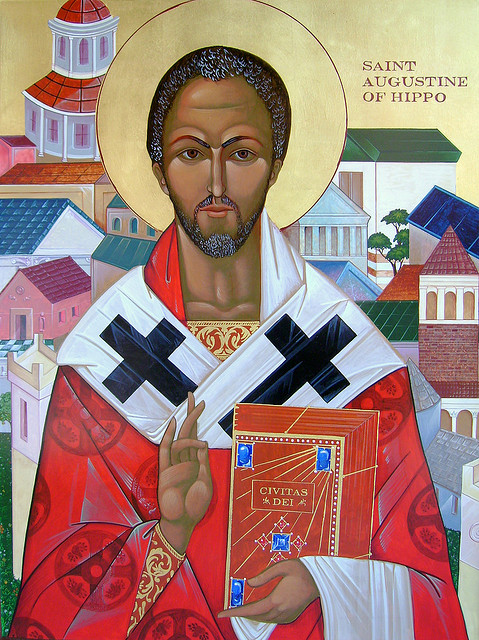
St Augustine

Saint Augustine wrote his seminal work, City of God, in about 413 C.E. The Roman empire had fallen, and pagans were blaming the Church because Christianity had become wed to the state. The people of God were unsure how to proceed.  So, Augustine sought to help Christians think about how to live in a post-Christian society.

Augustine’s work is lengthy and quite in-depth, so, the following is a brief distilling of his main arguments.  For Augustine, there are four essential institutions: two visible institutions; and, two invisible institutions:

  1. The Church – is a divinely established institution, designed to lead people to God.
  2. The State – is a political institution, adhering to political virtues to establish the peace.
  3. The City of Heaven – is made up of those predestined for salvation.
  4. The City of the World – is made up of those destined for eternal damnation.

We must pursue the City of Heaven, which for Augustine, is the pursuit of justice and righteousness. Augustine gave a clarion call for people to choose which city they will pursue, especially because many tended to blur the distinctions between the visible institutions of church and state.

Augustine’s conclusion is that the purpose of history is to show the unfolding of God’s plan. This involves fostering the City of Heaven and filling it with worthy citizens.  Therefore, the fall of Rome, a visible city so important to the people of Augustine’s day, was not near as important to the invisible God.

Maintaining an eternal perspective can help us today. The collapse of jobs, the scourge of a racialized society, the loss of life due to COVID-19, and injustice are significant events and circumstances – important enough to consider deeply how those issues will be handled. Augustine called out the people of his day for ignoring invisible spiritual solutions for the great problems among them.

Returning to the book of Genesis, a question arises: Will the Israelites become a nation through assimilation with Egypt and its institutions, or will they maintain their distinction as God’s people by relying on God’s covenant promises?  There are no easy answers to living in the world. However, it is important we struggle with how to get along in it.

God is the principal actor in the created world. God chooses to use his people as instruments of blessing to it.  Joseph’s wisdom and diplomacy, given by God, turned potentially catastrophic situations into times of prosperity. God, too, will use us as dispensers of wisdom – applying truth to concrete situations for the betterment of all involved.

Joseph handled the delicate situation of his brothers being shepherds while all shepherds were detestable to Egyptians.  Joseph brought the two worlds together through artful negotiation between the interests of both Pharaoh and the Israelites. He created a win/win scenario by setting up his brothers to help Pharaoh with his own needs in caring for livestock. In the end, all parties were satisfied because Joseph maintained a focus on needs instead of only advocating one side.

Rather than getting bogged down in promotion of methods and means, a sage approach is to maintain a focus on needs – which requires careful listening and a stance of empathy. Then, we can work toward prosperity for all instead of hardening into reified positions. A lot of problems in the church, work, society, and family can be turned to blessing if we seek the wisdom that comes from God.

May the Lord bless you and keep you; and, make his face shine on you and be gracious to you. May the Lord turn his face toward you and give you peace. Amen.

Genesis 9:8-17 – I Will Remember

Then God said to Noah and to his sons with him: “I now establish my covenant with you and with your descendants after you and with every living creature that was with you—the birds, the livestock and all the wild animals, all those that came out of the ark with you—every living creature on earth. I establish my covenant with you: Never again will all life be destroyed by the waters of a flood; never again will there be a flood to destroy the earth.”

And God said, “This is the sign of the covenant I am making between me and you and every living creature with you, a covenant for all generations to come: I have set my rainbow in the clouds, and it will be the sign of the covenant between me and the earth. Whenever I bring clouds over the earth and the rainbow appears in the clouds, I will remember my covenant between me and you and all living creatures of every kind. Never again will the waters become a flood to destroy all life. Whenever the rainbow appears in the clouds, I will see it and remember the everlasting covenant between God and all living creatures of every kind on the earth.”

So, God said to Noah, “This is the sign of the covenant I have established between me and all life on the earth.” (NIV)

The older I get the less I remember.  I tell my older parishioners when they have a “senior moment” that they have a lot more to remember from a lifetime of experiences and memories than everyone else does. My memory is now such that, if I do not write stuff down, it likely will not happen. On some level, I’m sure you can relate. We all have the common human experience of being forgetful.

Even though God is old, I don’t believe he has a problem with remembering. Yet, even God puts reminders in front of himself to remember. Most people, whether knowing much about the Bible, or not, are familiar with the story of Noah. You remember the story. The world was evil.  God decided to destroy the creatures of the earth because humanity was rife with wickedness. God sent a flood, but spared Noah and his family. Afterward, God made a covenant between himself and all the earth: He would never again send a calamitous flood, stating, “I have set my rainbow in the clouds, and it will be the sign of the covenant between me and the earth. Whenever I bring clouds over the earth and the rainbow appears in the clouds, I will remember my covenant between me and you.”

Maybe memory has less to do with actual forgetfulness and more with priority, commitment, and keeping something continually in front of us.  God did not set a rainbow in the sky because he was worried about a senior moment someday; he put a sign in the sky because having symbols that point to significant events are important, even for God.  We put pictures of our kids on our desks not because we will forget what they look like, but to keep them in front of us throughout the day because we love them.  We keep tokens from travels or vacations in prominent places at home not because we will ever forget the experience, but because something significant happened or was decided in that time that was important to us.

The objects and symbols we place around us have significance. Our predilection for having objective symbols comes from bearing the image and likeness of God. And, in some sense, we are all living icons, flesh and blood reminders of God’s creative work. When we choose to use our bodies and minds for good, we are living into our original design and tapping into the wondrous image within.

God wants us to remember – the Word of God, divine actions of old, and, most of all, the Son, which is why we have tangible symbols of bread and cup to remember the redemptive events of Jesus. Christ is to be continually in front of us, our priority, and our love as we live from day to day.

Soli Deo Gloria

Gracious God, you have made covenants with your people to remember and be committed to them.  I desire to remember you in everything I do and say, especially the Lord Jesus who loved me and gave himself for me so that my priorities will reflect your goodness, and your mercy will be shown. May I continually remember: churches everywhere throughout your world, that they may proclaim the risen Lord; creation, that the people of the earth may meet their responsibility to care; those in despair and darkness, that they may find the hope and light of Christ; and, those forgotten by others, but not forgotten by you; through Jesus Christ, I pray. Amen.

Genesis 6:5-22 – The God of Emotion

flood of tears

The Lord saw that the human beings on the earth were very wicked and that everything they thought about was evil. He was sorry he had made human beings on the earth, and his heart was filled with pain. So, the Lord said, “I will destroy all human beings that I made on the earth. And I will destroy every animal and everything that crawls on the earth and the birds of the air, because I am sorry that I made them.” But Noah pleased the Lord. 

This is the family history of Noah. Noah was a good man, the most innocent man of his time, and he walked with God. He had three sons: Shem, Ham, and Japheth. 

People on earth did what God said was evil, and violence was everywhere. When God saw that everyone on the earth did only evil, he said to Noah, “Because people have made the earth full of violence, I will destroy all of them from the earth. Build a boat of cypress wood for yourself. Make rooms in it and cover it inside and outside with tar. This is how big I want you to build the boat: four hundred fifty feet long, seventy-five feet wide, and forty-five feet high. Make an opening around the top of the boat that is eighteen inches high from the edge of the roof down. Put a door in the side of the boat. Make an upper, middle, and lower deck in it. I will bring a flood of water on the earth to destroy all living things that live under the sky, including everything that has the breath of life. Everything on the earth will die. But I will make an agreement with you—you, your sons, your wife, and your sons’ wives will all go into the boat. Also, you must bring into the boat two of every living thing, male and female. Keep them alive with you. Two of every kind of bird, animal, and crawling thing will come to you to be kept alive. Also gather some of every kind of food and store it on the boat as food for you and the animals.” 

Noah did everything that God commanded him. (NCV) 

When I was a kid, the picture of God I had in my little head was of a white-bearded old guy sitting in the clouds looking bored and paying little attention to the humans below. Maybe, once-in-a-while, he would take his divine BB gun and shoot people in the backside, just for some fun. Although I have considerably moved on from that type of theological vision, it seems to be a common caricature of God that he is often indifferent – and even more so that God lacks emotions (except maybe anger). 

The Holy Bible says a lot about humanity. It says even more about God. In fact, Scripture is primarily about revealing who God is – the Lord’s character, attributes – and, yes, emotions. Much like my childhood misunderstandings of God, I am not sure why so many people tend to view God as lacking in feeling and emotion. Maybe the Enlightenment with its focus on reason, logic, and classification simply drained all emotion from God. It could be that contemporary humans project on God their own stoicism toward emotions. Perhaps we see emotions as unreliable and fickle, characteristics that God would not possess – and, so, we jettison any thought of God as feeling deeply about things. Whatever the reason, we will fail to know God as God unless we come to grips with a verse like this:  

“The Lord saw that the human beings on the earth were very wicked and that everything they thought about was evil. He was sorry he had made human beings on the earth, and his heart was filled with pain.” (Genesis 6:6, emphasis mine) 

Broken Heart

Rather than our emotional human nature being a result of the Fall, it is instead a part of our original design of being in Paradise with God. As God’s image-bearers, we carry the mark of God with feeling deeply about things, just like our Creator. In those times when sadness seems as if it might swallow us whole, we just may be closer to God in that moment than any other. God has a heart, and that heart has been hurt and broken more times than we could ever imagine. God’s emotions moved him to action. God’s sorrow led to destroying injustice. 

The thoughts, attitudes, and actions of violent and unfeeling people very much trouble God – to the point of being heartsick. It is our emotional makeup which connects us and bonds us with the divine. The inability to feel is the ultimate disconnect from God. 

Jesus also felt deeply about a great many things – so much so that he died from a broken heart. Recall that in the seminal Sermon on the Mount Christ’s first words to the large gathering of people were: 

“Blessed are those who mourn.” (Matthew 5:4)  

We underestimate the importance and the power of emotions to our peril. Biblical writers often purposefully contrast differing persons in their stories. In today’s Old Testament lesson, that contrast is most vivid between God and wicked humanity. Humanity had gotten to a point where they felt nothing. The violent behavior was a direct result of their emotional selves split-off from the rest of them. People were bifurcated, their humanity chopped as if a meat cleaver separated their feelings from themselves. Whenever we observe belligerent bullying, hate speech, meanness, and oppression – there you find a paucity of emotions. It is not the presence of feelings that brings about wickedness; it is the lack of emotional awareness and the absence of feelings which is the highway to a watery grave. 

We are in the “Last Days,” that is, the time before the final event in the Christian tradition’s understanding of history. Christ will return to judge the living and the dead. The righteous will enjoy God’s presence forever; the wicked, not really. These days are too often characterized by the kinds of behavior which lack the emotional depth of godly love and a heart of compassion: 

“There will be terrible times in the last days. People will be lovers of themselves, lovers of money, boastful, proud, abusive, disobedient to their parents, ungrateful, unholy, without love, unforgiving, slanderous, without self-control, brutal, not lovers of the good, treacherous, rash, conceited, lovers of pleasure rather than lovers of God.” (2 Timothy 3:1-4, NIV) 

For me, learning to name my emotions and to observe where I carry those emotions in my body has been most helpful in connecting with my feelings – and connecting with my God. And, I must add, such an emotional awareness and kinship with feelings has brought personal wellness and compassionate ministry to others. 

So, receive this blessing today: 

The eyes of Jesus gaze upon you, stirring his heart with compassion. 

The gaze of Christ sees your heart, your joy and sorrow. 

The gaze of Christ sees your future, filled with the healing of emotions expressed. 

The eyes of Jesus gaze upon you, filling his heart with adoration. Amen. 

Genesis 12:1-3 – The Blessing

a5487-wisdom2bfrom2babove

The Lord had said to Abram, “Go from your country, your people and your father’s household to the land I will show you.

“I will make you into a great nation,
and I will bless you;
I will make your name great,
and you will be a blessing.
I will bless those who bless you,
and whoever curses you I will curse;
and all peoples on earth
will be blessed through you.” (NIV)

Words are powerful.  They have the power of life and of death, of blessing and cursing. Furthermore, withholding words of blessing and keeping silent is to withhold goodness and love from another.

Speaking words of blessing and backing up those words with an active commitment, is vital to humanity’s spiritual and emotional health.

The question for Abraham, and for us, is not only how we will respond to God’s commands but how we will react to his promise of blessing, and to be a blessing. Abraham left the city of Ur because he believed in the promise God was holding out to him of blessing.  It is the promises of God, not just the commands, which change our lives.  It is the promise, not only the command, which requires a decision and a change.  The world needs promise.  And promise is powered by blessing.

The term “blessing” in Scripture is a powerful communication of God’s presence and approval.  Notice some of the elements of God’s blessing to Abraham. God said that he would show Abraham the Promised Land, that is, he would be with Abraham. Abraham was neither alone nor on his own.  God provided Abraham with a peek into a special future – he would make Abraham into a great nation. What’s more, God would bless everyone else through Abraham. God’s approval was with Abraham – “I will bless you.”  Notice, also, God’s active commitment to Abraham: He would bless those who bless him and curse those who curse him.

This blessing was passed from generation to generation, from Abraham to Isaac, Isaac to Jacob, Jacob to his twelve sons; a blessing of God’s presence, approval; a blessing of a special future, and an active commitment.  The promise of the blessing found its ultimate fulfillment in the person of Jesus, who extended the original promise to the nations. I, as a Gentile believer, have come to faith because of this blessing.

Fathers and mothers everywhere across the world stand in a unique and special position as those who have the power of bestowing a blessing on their children – a blessing of being with them, approving of them, affirming their gifts and abilities, envisioning for them a special future of how God can use them. Those words of blessing have the power to help children navigate the world with assurance and confidence. Armed with blessing, they can filter-out the choices in front of them and walk in the way of God.

Notice in the New Testament Gospels how the God the Father blessed the Son:

As soon as Jesus was baptized, he went up out of the water.  At that moment heaven was opened, and he saw the Spirit of God descending like a dove and lighting on him.  And a voice from heaven said, “This is my Son, whom I love; with him I am well pleased.” (Matthew 3:16-17).

God communicated his constant presence and an active commitment through the Spirit; God spoke words of approval and affirmation; God the Father had a special future for Jesus the Son, which helped Jesus to repel the words of Satan. Since Jesus needed and received a blessing from his Father, how much more do we?

Notice how Jesus passed on the blessing to his disciples with promise and commitment (giving them much more than only the command):

“All authority in heaven and on earth has been given to me. Therefore, go and make disciples of all nations, baptizing them in the name of the Father and of the Son and of the Holy Spirit, and teaching them to obey everything I have commanded you. And surely, I am with you always, to the very end of the age.” (Matthew 28:18-20).

Jesus let his disciples know that his presence would be with them; he communicated an active commitment to give them authority to do the job of disciple-making; he pictured for them a special future of reaching the nations; he affirmed them and approved them. “The Great Commission” is really a re-statement of God’s original blessing to Abraham.

Once we begin to view Holy Scripture through the lens of promise and blessing, we begin to see it everywhere. Perhaps one more illustration of receiving and giving blessing will assist us:

Jesus entered Jericho and was passing through.  A man was there by the name of Zacchaeus; he was a chief tax collector and was wealthy.  He wanted to see who Jesus was, but being a short man, he could not, because of the crowd. So, he ran ahead and climbed a sycamore-fig tree to see him, since Jesus was coming that way.  When Jesus reached the spot, he looked up and said to him, “Zacchaeus, come down immediately.  I must stay at your house today.” So, he came down at once and welcomed him gladly.  All the people saw this and began to mutter, “He has gone to be the guest of a ‘sinner.’” But Zacchaeus stood up and said to the Lord, “Look, Lord!  Here and now I give half of my possessions to the poor, and if I have cheated anybody out of anything, I will pay back four times the amount.”  Jesus said to him, “Today salvation has come to this house, because this man, too, is a son of Abraham.  For the Son of Man came to seek and save what was lost.” (Luke 19:1-10).

Zacchaeus was transformed.  His life changed from one of cursing others through extortion to blessing others through giving. Jesus not once commanded him to do it. Instead, Jesus simply blessed him, and Zacchaeus, in turn, became a blessing. Being invited into someone’s house in the ancient world was in and of itself an act that communicated acceptance, approval, and encouragement.  The presence of Jesus changes people.

God is with us.  He has given us his very great and precious promises in Christ.  He has demonstrated his active commitment to us by giving us the Holy Spirit.  The Holy Spirit has gifted each believer for service so that every individual may be a blessing to both the church and the world.

You and I already possess God’s blessing; there is no need to try and earn it.

We have the privilege and the ability to reverse the world’s curse and turn it into a blessing. Those blessed with money can be a blessing by giving it away. Those blessed by growing up in a loving family can provide love to others who are unloved and need a special blessing. Those blessed with wisdom can mentor and instruct those who need wisdom. Those blessed with the mercy of God can be merciful to others. Those blessed with a wonderful relationship with God can pray people into the kingdom of God.

Parents, it is never too late to bless your children, even if they are adults. Children, it is never too late to bless your parents and your siblings, even if they are prickly and hard. To not bless is to curse. Bless through words that build up, and do not tear down. Use those words to picture a special future of what God can do. Follow through with those words by demonstrating an active commitment to embodying blessing.

I leave you with a blessing, my dear readers:

May God answer you when you are in distress; and, may the name of Jesus protect you. 

May God send you help when you need it and give you support when you cry out to him. 

May the God of heaven remember all your good deeds done in faith and accept you just as you are. 

May God give you the desire of your heart and make all your plans succeed.

When the Almighty answers your prayers and goes out of the way to use you for his glory; then, I will be the first to shout with the loudest shout of joy that there ever was on the earth! 

I know that the Lord is God, and that he has a special future for you beyond what you can even ask or think.  And I will be there on the sidelines, encouraging you all the way. 

Some people trust in the political process, others trust in the strength of the economy; but we trust in the name of the Lord our God. 

May God answer when you call.

May God bless you with an everlasting love. 

May you know Christ, and him crucified, risen, and coming again. 

May God’s presence and power be with you now and forever.  Amen.

Click Blessings by Laura Story to remember that even in difficulty we are blessed.