


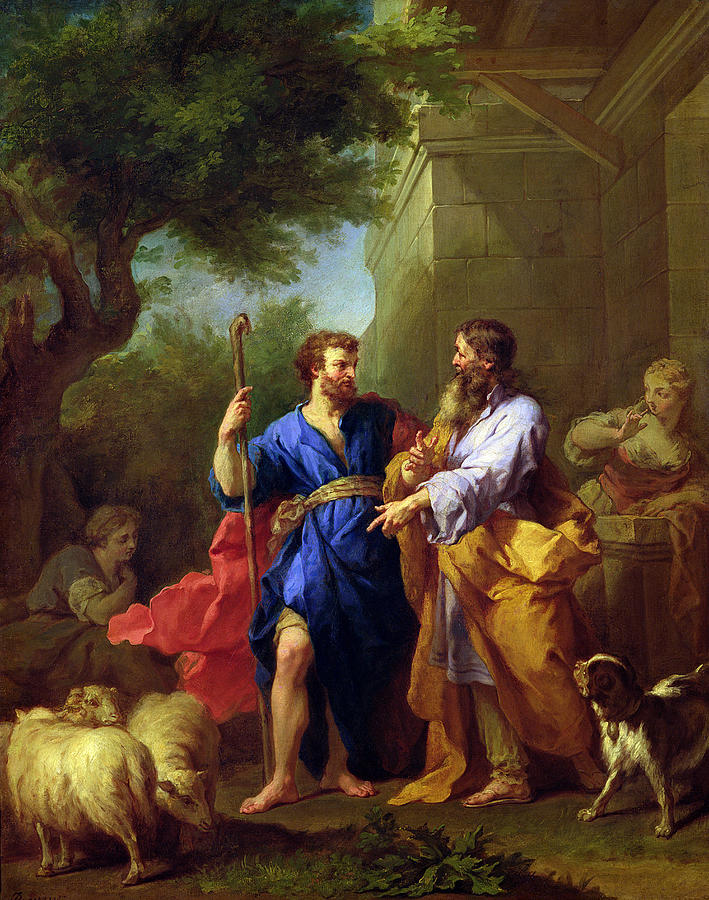
Then Jacob took some fresh branches from poplar, almond, and plane trees and peeled off strips of bark, making white streaks on them. Then he placed these peeled branches in the watering troughs where the flocks came to drink, for that was where they mated. And when they mated in front of the white-streaked branches, they gave birth to young that were streaked, speckled, and spotted. Jacob separated those lambs from Laban’s flock. And at mating time he turned the flock to face Laban’s animals that were streaked or black. This is how he built his own flock instead of increasing Laban’s.
Whenever the stronger females were ready to mate, Jacob would place the peeled branches in the watering troughs in front of them. Then they would mate in front of the branches. But he didn’t do this with the weaker ones, so the weaker lambs belonged to Laban, and the stronger ones were Jacob’s. As a result, Jacob became very wealthy, with large flocks of sheep and goats, female and male servants, and many camels and donkeys. (New Living Translation)
Jacob had been working for his father-in-law Laban for years. During that time, they both contested with each other in a chess match of trying to gain the upper hand. Mostly, Jacob had been outmaneuvered by Laban. But now he achieves a sort of coup de grace, a checkmate.
Having agreed between them that Jacob’s wages would be only the speckled and spotted sheep and goats, as well as every black lamb, Laban proceeded to remove all those animals from his flock and sent them off away from Jacob. This was yet another unfair practice in the chess game of his life.
Even if Jacob wanted to retaliate, he really had no means to do it – which is why Laban kept taking advantage of him. But Laban underestimated who he was playing against and dealing with.
Using an unusual method, something akin to sympathetic magic – a ritual using an object that resembles the sheep over which Jacob sought influence – he systematically grew his own flock of many strong sheep and goats. Jacob then separated these stronger animals from Laban’s flock. In doing this, Jacob became exceedingly wealthy.

It’s an incredible story, almost like achieving the modern day American dream of rags to riches in the face of adversity. Yet, behind all the success of Jacob, we as the readers know that this happens because God is working out divine promises to the family of Abraham, Isaac, and now Jacob.
The power, sovereignty, providence, and grace of God stand behind every good thing people have in this life. The Lord is the One who is not flummoxed by the impending moves in the chess game; God has the ability to rearrange the chess board, reorder the future, and make restoration possible.
Although separated by more than three millennia from the family of Jacob, we can relate to the ever-present human condition, the personal struggles of overcoming the past, and the wonderings of what will happen in the future.
In whatever way we want the future to shake-out, it ultimately is in the hands of God. We would like to live in a universally closed system where there is predictability with no trickery, posturing, manipulating, or anxiety about what’s next. Many people long for a life free from an uncertain and shadowy future.
But none of us can have the precise future we may wish for. So, some people despair that we are in a closed system in which nothing can change – that systemic evil, broken institutions, fragmented families, and wounded spirits are just the way it is.
There are lots of folks who continually feel the awkward push and pull of both hope and dread – wanting to believe that things can be better, but having a sinking sense that the other shoe is about to drop.
In truth, we do not live in a closed universal system; history is not yet finalized and the Lord has a few tricks up the divine sleeve. We actually live in an open system, where we can find both surety and hope. The future, although appearing bleak for some, shall be shaped and bent by God according to divine promises and good purposes.
And when we take the time to observe this grand open system, we begin to discern that no scheming of humanity nor any human machinations can do anything more than slightly delay the inevitable Day of the Lord. Justice will have its day, and it’s way on this earth; injustice shall not last forever.
In the meantime, we do the best we can with the resources we have, at this present moment. Today is all we have. God’s gracious provision for this day is enough. Tomorrow has enough worries of its own.
An open system says that there is a spiritual force outside of social interaction. A a closed system says there is no outside force influencing our actions and outcomes.
In a closed system, we have the illusion (and delusion) that control is possible because the number of variables remains static. People in this system long for simplicity and sameness – to be able to predict what will happen next. So, they focus on structures and processes that sustain control over organizations and people.
But in an open system, dynamics from other systems impact us, creating and expanding the number of variables. It’s a complex and fluid situation, but folks learn to focus on influence rather than control, knowing there are forces at play which impact the chessboard. That’s because ultimate control belongs to God; we, as people, are called to self-control.
Almighty God, Creator and Sustainer of all things: You uphold, direct, and govern all creatures, actions and objects, from the least to the greatest. Nothing escapes your sovereign and benevolent rule—not the most powerful institution or ruler imaginable, nor the least significant speck just biding its time. You sustain all things by your powerful word.
Help me to see your hand in my life specifically and in history worldwide. Although there is much that remains a mystery in your providence, there is much that is already revealed. Your providence reveals your infinite wisdom, power, justice, goodness, and mercy. To you be all glory and praise, through Jesus Christ our Lord, who with you and the Holy Spirit are one God, now and forever. Amen.


 Rev. Tim Ehrhardt