

The All-Sufficient One (Genesis 17:1-13)

When Abram was ninety-nine years old, the Lord appeared to him and said, “I am God Almighty; walk before me faithfully and be blameless. Then I will make my covenant between me and you and will greatly increase your numbers.”

Abram fell facedown, and God said to him, “As for me, this is my covenant with you: You will be the father of many nations. No longer will you be called Abram; your name will be Abraham, for I have made you a father of many nations. I will make you very fruitful; I will make nations of you, and kings will come from you. I will establish my covenant as an everlasting covenant between me and you and your descendants after you for the generations to come, to be your God and the God of your descendants after you. The whole land of Canaan, where you now reside as a foreigner, I will give as an everlasting possession to you and your descendants after you; and I will be their God.”

Then God said to Abraham, “As for you, you must keep my covenant, you and your descendants after you for the generations to come. This is my covenant with you and your descendants after you, the covenant you are to keep: Every male among you shall be circumcised. You are to undergo circumcision, and it will be the sign of the covenant between me and you. For the generations to come every male among you who is eight days old must be circumcised, including those born in your household or bought with money from a foreigner—those who are not your offspring. Whether born in your household or bought with your money, they must be circumcised. My covenant in your flesh is to be an everlasting covenant. (New International Version)

There were 13 years between the events of chapters 16 and 17 of Genesis. God’s servant, Abram, did not hear from God in those years. Then, all of a sudden, the Lord showed up, with a new self-reference as “God Almighty.”

“God Almighty” (“El Shaddai,” the all-sufficient God) appeared to Abram. The Lord brought a self-revelation to Abram as the all-competent God, the adequate God, the God who has the big picture and knows what to do with it.

Within those 13 years before El Shaddai showed up, Abram tried his own plan for acquiring an heir to God’s covenant promises. It didn’t go quite as designed. Along with Abram, people in every age need to discover or recover the presence of God Almighty, El Shaddai, the Lord who is completely sufficient for anything and everything in life.

Our role, much like Abram’s, is to bring a wholehearted devotion to our walk with God – not looking for some extra supplement to the Lord, as if divine resources and help is inadequate or untrustworthy. We are to have a sincere and obedient stance toward God Almighty.

Too many people seek to serve two masters, as if this will help cover all the bases of what we need. But Jesus was savvy to this, understanding that it only complicates things:

“No one can serve two masters. Either you will hate the one and love the other, or you will be devoted to the one and despise the other.”

Jesus (Matthew 6:24; Luke 16:13, NIV)

God Almighty wanted Abram to know and believe that El Shaddai doesn’t allow any dual allegiances – mainly because all of us can only really serve one master.

This realization and determination to serve God Almighty alone elicits El Shaddai giving Abram a new name: Abraham. Knowing God in a new or different way always changes us, as if we are new people with new names. For Abram, now Abraham, the change is one of moving from the “exalted father” who had his own ideas, to the “father of many nations” who will bless all those with the same discovery and determination to let God be God, without all the puny human interference.

And You Shall Circumcise the Flesh of Your Foreskin, by Gerard Hoet (1648-1733)

With any seminal change of life, a very real and tangible sign is important, in order to never forget who God is, and who we as people are. For Abraham and those born to him, circumcision was that sign.

And what a sign it was! God actually told Abraham that all the males in his household were to have their foreskin removed. If anything, this was a sign given which could never get lost! It was enduring, always there, and unforgettable. It is a constant reminder that the people of Abraham, the Hebrews, are to be different and singularly devoted to El Shaddai.

In Christianity, we are to have a circumcision of the heart, and not necessarily the flesh. It is the heart, which is to be completely devoted to God Almighty, that is, the entirety of a person’s life. The whole person is to be oriented to one master who rules both body and soul.

A person is not a Jew who is one only outwardly, nor is circumcision merely outward and physical. No, a person is a Jew who is one inwardly; and circumcision is circumcision of the heart, by the Spirit, not by the written code. Such a person’s praise is not from other people, but from God. (Romans 2:28-29, NIV)

The one devoted to God Almighty in Jesus Christ is to use body, mind, emotions, and spirit for good divine purposes. Christians are meant to rely solely and completely upon Christ. They are to take every action, every thought, every feeling, every imagination and make it captive to Christ.

To be circumcised is to be set apart for good and noble purposes, to have a heart fully devoted to God Almighty as the ever-living, ever-loving, all-sufficient Sovereign of the universe.

God Almighty, open our eyes that we may see; incline our hearts that we may desire; and order our steps that we may follow the way of your commandments, now and forever, through Jesus Christ our Lord, who with you and the Holy Spirit are one God, for all time. Amen.

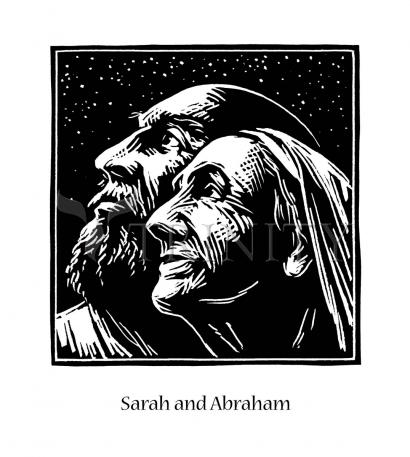
The Blessing (Genesis 17:15-22)

By American artist Julie Lonneman

God said to Abraham, “Don’t call your wife by the name Sarai anymore. Instead, her name is Sarah [Princess]. I will bless her, and I will also give you a son by her. I will bless her, and she will become a mother of nations, and kings will come from her.” Immediately, Abraham bowed with his face touching the ground. He laughed as he thought to himself, “Can a son be born to a hundred-year-old man? Can Sarah, a ninety-year-old woman, have a child?” Then Abraham said to God, “Why not let Ishmael be my heir?”

God replied, “No! Your wife Sarah will give you a son, and you will name him Isaac [He Laughs]. I will make an everlasting promise to him and his descendants. I have heard your request about Ishmael. Yes, I will bless him, make him fertile, and increase the number of his descendants. He will be the father of 12 princes, and I will make him a great nation. But I will make my promise to Isaac. Sarah will give birth to him at this time next year.” When God finished speaking with Abraham, he left him. (God’s Word Translation)

Life can only be lived with faith. We all believe in something, in someone. It’s just a matter of what or whom we place our faith in. Whomever we direct our faith, that is where we give our allegiance and obedience.

As for Abraham and his wife Sarah, they had their faith in the God who called them from Ur of the Chaldees. They demonstrated their belief by doing exactly what the Lord said to do – they went West to the land God would show them. (Genesis 12:1-5)

Abraham and Sarah listened to God and acted accordingly.

I don’t want to cross over into TMI territory (Too Much Information) yet I want us to consider what had to take place when the Lord tells the old couple they will have a baby next year. Here’s where the faith and action comes in: It is highly unlikely that a 100-year-old man and a 90-year-old woman were sexually active. But the Lord essentially told them to get going on conceiving a child. So, they did!

I can’t speak for Abraham and Sarah, but I know as a grandfather that I am really glad I don’t have to raise kids anymore. It makes me exhausted just thinking about it, at my age, so I’ve got to believe it crossed their minds, too. Maybe that’s why Abraham sort of pleaded with God to let Ishmael be the son of promise; the reality of being responsible for a newborn was maybe the last thing on old Abe’s mind.

But faith they had, as the New Testament attests:

Even when Sarah was too old to have children, she had faith that God would do what he had promised, and she had a son. Her husband Abraham was almost dead, but he became the ancestor of many people. In fact, there are as many of them as there are stars in the sky or grains of sand along the seashore. (Hebrews 11:11-12, CEV)

Genuine belief results in decisive action. At Abraham and Sarah’s age, sex may likely have seemed a safety hazard. Yet, they were submissive to God’s plan that divine promises would come through Isaac – who was indeed born the next year, just as the Lord said.

Abraham and Sarah by Marc Chagall, 1956

All this is consistent with the names “Abraham” and “Sarah.” Names were (and still are in most of the world) important identifiers of personal character – particularly toward what sort of person one would become.

God made a name change for the old couple. “Abram,” meaning “exalted father,” was changed to “Abraham,” “father of many nations.” “Sarai” was altered to “Sarah,” yet both names have the same meaning: “Princess.” (Genesis 17:3-8, 15-16)

The change of names was meant to communicate the promise of divine blessing from God for the future. All the world will be blessed through the covenant made with Abraham. Sarah’s alteration of name, though only in form and not substance, brought to the fore that Sarah, too, had a special purpose along with her husband in blessing the world.

Today, this blessing is still unfolding. Throughout all history, since the time of Abraham and Sarah over four millennia ago (c.2100 B.C.E.), the divine ripples of God’s covenant with them have moved across the earth.

Their progeny, through Isaac, the son of the promise, the Jewish people, continue to exist as arguably the most resilient group on the planet. We, especially Christians and Muslims, owe a great debt to the Jews for persevering in faith for such a long stretch of time. They have much to teach us, if we have ears to hear and hearts receptive.

Since the time of Christ, the blessing has extended well beyond the physical descendants of Abraham and Sarah:

Is this blessedness only for the circumcised [Jews] or also for the uncircumcised [Gentiles]? We have been saying that Abraham’s faith was credited to him as righteousness. Under what circumstances was it credited? Was it after he was circumcised, or before? It was not after, but before! And he received circumcision as a sign, a seal of the righteousness that he had by faith while he was still uncircumcised. 

So then, Abraham is the father of all who believe but have not been circumcised, in order that righteousness might be credited to them. And he is then also the father of the circumcised who not only are circumcised but who also follow in the footsteps of the faith that our father Abraham had before he was circumcised….

Therefore, the promise comes by faith, so that it may be by grace and may be guaranteed to all Abraham’s offspring—not only to those who are of the law but also to those who have the faith of Abraham. He is the father of us all. As it is written: “I have made you a father of many nations.” He is our father in the sight of God, in whom he believed—the God who gives life to the dead and calls into being things that were not.

Against all hope, Abraham in hope believed and so became the father of many nations, just as it had been said to him, “So shall your offspring be.” Without weakening in his faith, he faced the fact that his body was as good as dead—since he was about a hundred years old—and that Sarah’s womb was also dead. 

Yet he did not waver through unbelief regarding the promise of God but was strengthened in his faith and gave glory to God, being fully persuaded that God had power to do what he had promised. This is why “it was credited to him as righteousness.” The words “it was credited to him” were written not for him alone, but also for us, to whom God will credit righteousness—for us who believe in him who raised Jesus our Lord from the dead. He was delivered over to death for our sins and was raised to life for our justification. (Romans 4:9-12, 16-25, NIV)

May you know the depth and breadth of your faith, that it stretches far beyond this time and place. And may the blessing of God almighty – Father, Son, and Spirit – be upon you and remain with you, now and forever. Amen.