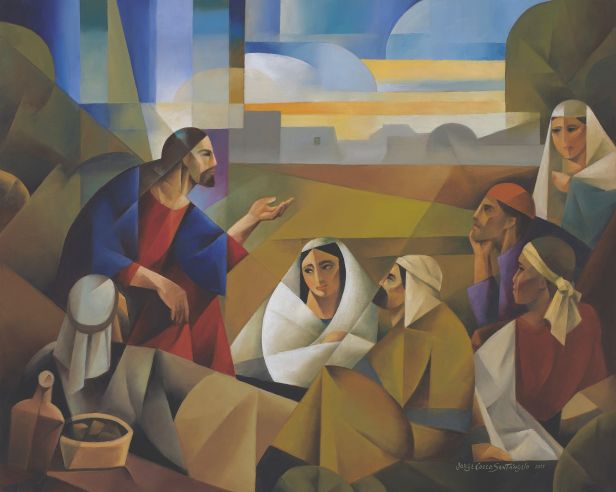
The Parable of the Talents

The Parables of Jesus by Argentine artist Jorge Cocco Santiago, 2018

What would you do with a million dollars?…  Maybe you would pay off some debts, finish some work on your house, or quit your job and take a vacation. Perhaps you might invest a good portion of it. However, your investment is only as good as your level of trust.   

When I worked at a senior citizen healthcare facility, there was a resident with an apartment in independent living, but he still owned his house. During one conversation, the old man admitted to me that over the past sixty years he owned his house, he had secretly bored holes in every door jamb of the house and had stuffed away $100,000 dollars in cash!  This dear resident had personally experienced the run on banks which began the Great Depression in 1929. He had zero trust for investment banking. 

A “talent” in Christ’s day was a monetary denomination.  A talent was worth 6,000 denarii, and one denarius was worth a day’s wage.  So, in Christ’s parable of the talents, Jesus was talking about millions of dollars (in today’s money) with the master who gave his servants five talents, two talents, and one talent. (Matthew 25:14-30) 

As Jesus was telling his parable, one of his chief points was to communicate that God is gracious and generous.  The three servants responded their master’s generosity according to their view of him.  Two of the servants regarded the master as gracious and generous, and so, freely took their talents and confidently invested them to create even more money.   

The two faithful servants took risks and acted with the idea that they were secure in their relationship with their master.  However, the third servant’s perception of his master was different.  This servant discerned his master as stern, serious, and angry, so therefore, he did nothing with his talent – he was afraid. 

The man was fearful because his view of the master was off.  If we consider God as primarily an angry Being, then we will almost certainly not use the gifts he has given us, for fear of messing up and experiencing his wrath.   

However, the truth is, God is gracious and generous.  The Lord has mercifully gifted everyone and expects us to use those gifts and not hide them away in a door jamb!  God wants us to actively display grace and generosity – which will require addressing our fears. If we want to hear the Lord Jesus say, “Well done, good and faithful servant,” then taking initiative is necessary. 

Fear is perhaps the greatest block in preventing God’s people from being productive Christians in serving the church and the world.  Beneath our fears are powerful feelings of inferiority, inadequacy, and an inner conviction that we are not enough. Oftentimes, a low view of self can come from a low view of God. 

Fear paralyzes our potential to serve God’s kingdom.   

Being continually afraid, drains our energy and lessens whatever impact we could have for God in the world, diminishing our resolve to act and leaving us ineffective in service. 

Fear destroys our dreams and godly desires.   

We are meant to enjoy the gracious and generous God, and in our enjoyment of the Lord, godly dreams will be placed within us that God is pleased to fulfill: 

Take delight in the Lord, and he will give you the desires of your heart. (Psalm 37:4, NLT) 

Our enjoyment of God gives us the security and confidence to act upon godly desires and produces a generous harvest of righteousness and peace. We then can share the bounty with others, as a way of giving back to God.   

Yet, if fear gets thrown into the mix, it dilutes and destroys everything.  Fear paralyzes us, and we do nothing, like the third servant in the parable.  What is more, fear can force us into hiding, just like the servant hid and buried his talent.   

In the Old Testament book of Numbers, the Israelites were immobilized by fear.  God had a grand vision and a big dream for the people to enter the Promised Land.  But ten of the twelve spies who came back after checking out the land were paralyzed by fear.  “The land has giants, and we are like grasshoppers!” they nervously said.   

Caleb and Joshua, however, had a different view of taking the land because they had a different view of God.  They didn’t see giants – they saw a gracious and generous God who could easily take care of whoever might be in the land, and they wanted to act on the faith they had in a mighty and merciful God.  The God of the other spies wasn’t big enough to handle the giants.  Their low view of themselves as grasshoppers betrayed their low view of God. (Numbers 13:26-33) 

We might wrap a lot of our fears in morbidly sanctified self-belittling.  That is, we might feel good about feeling bad and wrap ourselves with a blanket of secret shame. As a result, those self-deprecating feelings stop us from exploring God’s dream and vision for us.   

We could use some bold God-sized dreams!  We can speak and act in the world with confidence because we serve a God who sees giants as gnats. 

Some of the greatest fears that hold back people from exploring their faith is: 

  • Fear of criticism – being afraid of what others may think or say.   
  • Fear of taking a risk – being afraid of going outside the comfort zone of how something has always been done.  
  • Fear of ourselves – being afraid to explore our vast inner world with its guilt, shame, insecurity, and mixed motives. 

Fear snatches away God’s dreams for us.  If you once had a dream and you think that dream is dead because of your sins and bad habits, you are misguided.  Dreams evaporate because of fear, by being duped into believing that we are not enough, and never will be. So, we end up doing nothing. 

Fear ruins our relationship with God and others. 

Living a spiritual life, meanwhile always looking over our shoulder to see if God is going to sneak up on us and rap our knuckles with a ruler, is no way to live.  I think the hardest people to get along with are those who have a low view themselves.  Because they do not like themselves, they do not like others. They continually wonder if God is upset with them about something.  The man in the parable blamed God for his own lack of investment.  Yet, blame shifting is really our own fear and insecurity seeping through onto others – it helps no one, especially ourselves.   

God wants us to bloom with the talents given us.  God wants us to shine and succeed. God is on our side, has our backs, and wants us to live a good life. 

Fear sabotages our service. 

“I can’t!” is the cry of the person locked in fear.  I cannot stand up in front of people, meet strangers, sing, serve like that other person can or love like Jesus did.  I cannot because I am afraid, and I only have one talent!   

Perhaps you have observed that God typically uses tongue-tied people, worriers, and those with a sordid past – and not superstars – as servants commissioned with a set of talents. The less a person has, the more God shows up and shows off with generous power and gracious ability through that person. 

Nothing sabotages serving more than being afraid, worried, and believing we have so little. Give God a chance!  Step out.  Take a risk.  Act on that dream. 

Conclusion 

Once in a small village in India, a farmer brought to the open-air market a whole covey of quail, with a string tied around a foot of each bird.  The other end of the string was tied to a ring on a central stick.  The quail were all walking in a circle because of the strings on their feet.  As the day went on no one seemed interested in buying the farmer’s quail.   

Finally, an old man came and bought every one of the quail.  After he bought the quail, the old man told the farmer to cut the strings and set all the quail free.  So, the farmer did.  But none of the quail flew away.  They kept marching around in a circle as if they were still tied to the string.  Finally, the farmer had to shoo them away to get them to move, and even then, the quail landed somewhere else and just started marching in a circle again. 

God has freed and forgiven us.  Yet, we can so easily remain tethered to imaginary strings and march around in vicious circles of fear, afraid to venture into the unexplored world God has for us, to spread our wings and be free. 

God loves you.  God has wonderful plans for you.  God created you with your unique personality, gave you unparalleled experiences, and gifted you with uncommon abilities. God wants you to tap into that passion and dream placed down deep in your heart to serve the world.   

What would you do with a million dollars?  You already have it.  Now, go and invest it. 

Philippians 4:10-15 – Generosity is Like a Warm Bowl of Grits

Jethro Bodine
Max Baer, Jr. playing the incomparable country as corn flakes Jethro Bodine on The Beverly Hillbillies

I rejoiced greatly in the Lord that at last you renewed your concern for me. Indeed, you were concerned, but you had no opportunity to show it. I am not saying this because I am in need, for I have learned to be content whatever the circumstances. I know what it is to be in need, and I know what it is to have plenty. I have learned the secret of being content in any and every situation, whether well fed or hungry, whether living in plenty or in want. I can do all this through him who gives me strength. Yet it was good of you to share in my troubles. Moreover, as you Philippians know, in the early days of your acquaintance with the gospel, when I set out from Macedonia, not one church shared with me in the matter of giving and receiving, except you only. (NIV)

In the English language, the words “you” and “your” can be either singular or plural. Unless, of course, we go with the southern “y’all.” But for a northerner like me, I’ve got to determine which by looking at the context that it’s in.  In the language of the New Testament, Greek, we know which words are singular and which are plural because, well, they’re different words which aren’t spelled the same.  It’s important to know in the book of Philippians that all the “you” pronouns are plural.  That’s important because the theme of unity and solidarity runs affectionately throughout the Apostle Paul’s letter to the Church in Philippi. In fact, for Paul, the reason he gibbers on so much about joy in his letter is because it’s only realized when unity is around. Unity really dills Paul’s pickles.

The entire Philippian church and not just those two really caring parishioners like Uncle Bundlejoy and Cousin Cozysweet, shared in Paul’s troubles with him. The whole kit-and-caboodle partnered with him through financial resources, prayer, and ministry.  Paul had confidence that every need the Philippians had would be supplied just as sure as God put worms in sour apples.

They learned a valuable lesson from Paul: that unity through generosity brings contentment in all circumstances and eases anxieties. The Philippian believers got a glimpse of the paradox that through giving they become rich. When tightwad believers are around, a church frets so much they could worry the horns off a billy goat. But when generosity settles in, people are more content than a flea on a pup.

Folks who only care about their personal needs and independent wealth aren’t right in the head – their cornbread’s not done in the middle. God wants everyone to know the blessing of working together in a worthy common cause.  Generosity and contentment go together like bacon and eggs. A charitable spirit in a group of people leads to more joy and happiness than a gopher in soft dirt.

Hoarding makes a church more nervous than a long-tailed cat in a room full of rocking chairs. If we want to be free of backbiting and worry, then we need to be wild about generosity. Give like the sun and the whole world grows tall.

Be generous with your money, generous with your words of encouragement toward others, and generous with your gratitude to God. Besides, giving is more fun than a sack full of kittens. And if you do give till you laugh, maybe you’ll see good ol’ Paul standing there grinning like a possum eating a sweet potato.

Generous God, your storehouse of grace and mercy is infinite and unending.  Help me to partner with you in a way that makes my generosity flow in the same direction yours does so that Jesus Christ is glorified, and his church is edified through the power of the Holy Spirit.  Amen.

1 Peter 4:7-11 – Practicing Hospitality

hospitality
“They broke bread in their homes and ate together with glad and sincere hearts.” –Acts 2:46

The end of all things is near. Therefore, be alert and of sober mind so that you may pray. Above all, love each other deeply, because love covers over a multitude of sins. Offer hospitality to one another without grumbling. Each of you should use whatever gift you have received to serve others, as faithful stewards of God’s grace in its various forms. If anyone speaks, they should do so as one who speaks the very words of God. If anyone serves, they should do so with the strength God provides, so that in all things God may be praised through Jesus Christ. To him be the glory and the power for ever and ever. Amen. (NIV)

One of the most practical and biblical ways of demonstrating love is through hospitality. Hospitality, at its heart, is an invitation to come into my home and into my life. It is a ministry of acceptance, encouragement, restoration, and healing.  The loving work of hospitality “covers a multitude of sins” through the power of influence. When we have face-to-face conversations around the table, it prevents us from engaging in sins that would otherwise be committed if left to ourselves.

Because the end of all things is near, we need our wits about us through a determined focus on prayer, love, and hospitality. The word “hospitality” literally means, “love of the stranger.” I invite someone whom I do not know very well into my home and befriend them. This is what Jesus did for us. Although we were all estranged from God and on the outside, Jesus came to eat with us.

“Listen! I stand at the door and knock; if any hear my voice and open the door, I will come into their house and eat with them, and they will eat with me.” (Revelation 3:20, GNT)

Jesus invites us into the life of God; and, we are to invite others into our lives. Jesus has so closely identified with his people that when we practice hospitality, we are inviting Jesus in. In fact, we may not realize that some people we host are angels:

Do not forget to show hospitality to strangers, for by so doing some people have shown hospitality to angels without knowing it. (Hebrews 13:2, NIV). 

Inviting another person into my home and heart takes time and effort. Doing it without grumbling is a necessity. In an ideal world we always receive something back for our work of hospitality – an invitation from the other person, or, at least, a simple thank you. That does not always happen and cannot be the driving reason why we are generous. Hospitality is a work of love which originates from a heart that has been touched by the hospitality of God. Our earthly hospitality is a form of saying “thank you” to God for his grace to us. Complaints break into the house like unwanted burglars when we expect to receive, and do not. If you receive another person as though they were Christ himself, grumbling will likely be far from you. Instead, there will be rejoicing over the opportunity to serve Jesus.

Jesus said, “Anyone who welcomes you welcomes me. And anyone who welcomes me also welcomes the one who sent me.” (Matthew 10:40, CEV).

In the New Testament world, a concrete expression of love to other believers in Jesus was providing food and shelter for Christians traveling throughout the Roman Empire. Often, the traveling strangers were itinerant evangelists spreading the message of the gospel from place to place.

Dear friend, you are faithful in what you are doing for the brothers and sisters, even though they are strangers to you. They have told the church about your love. Please send them on their way in a manner that honors God. It was for the sake of the Name that they went out, receiving no help from the pagans. We ought therefore to show hospitality to such people so that we may work together for the truth. (3 John 5-8, NIV)

At other times, believers were deprived of necessities due to occasional waves of persecution. The people Peter addressed were mostly Jewish Christians. As they faced persecution in Jerusalem, they fled to geographical places dominated by pagan Gentiles. As refugees, they were often poor and needy; and, the townspeople where they went were not hospitable. So, they had to rely on the love and hospitality of those believers they could connect with who had the means to help.

Contribute to the needs of God’s people, and welcome strangers into your home. (Romans 12:13, CEB) 

There is a great need for hospitality in our world.  Many American’s circle of friends is shrinking. According to one study the number of people who said they had no one to talk to about important matters has more than doubled in the past 10 years. 35 million Americans now live alone (which is 28% of all households).  Hospitality cuts both ways for us.  We are to invite the lonely into our hearts and homes; and, the lonely are to invite others into their hearts and homes, instead of waiting for somebody to just show up.

Matthew 25.35

Food is to hospitality what weightlifting is to bodybuilders; you really need food, meals, and the sharing that goes with it to make a difference in another’s life. In biblical times, eating a meal together was a sacred affair.  To have another person in your house, sitting around your table, communicated acceptance, care, and friendship. That is why the religious leaders had such difficulty with Jesus eating with “sinners.” Jesus was unequivocally loving and accepting of such persons.

When we think about our world, it can be a sad place. Can people of different races live in peace?  Can Democrats find common ground with Republicans?  Can a Christian family carry on a civil friendship with neighbors down the street far from Christianity?  Can people worlds apart from each other get along?  The early church did. And they did it without all the stuff we have.  The early believers did it through the simplest tool of the home. No matter our gifts and abilities, each one of us can be hospitable. Something mystical happens at a dinner table that does not happen anywhere else – it opens the door to true community.

While they were eating, Jesus took a loaf of bread, and after blessing it he broke it, gave it to the disciples, and said, “Take, eat; this is my body.” Then he took a cup, and after giving thanks he gave it to them, saying, “Drink from it, all of you; for this is my blood of the covenant, which is poured out for many for the forgiveness of sins. (Matthew 26:26-28, NRSV)

For the Christian, eating and ingesting bread and wine serves as a tangible way of understanding what life is to be like. We take Jesus into the depths of our lives. We ingest him, that is, we engage in an intimate relationship whereby the two of us can never be separated.

We are meant for life together, to enjoy eating and drinking together. True life is sharing both our resources and our hearts with one another.

Loving God, thank you for your generosity. I am a stranger in this world, yet, you invite me to be your guest. You lavishly offer me your hospitality and welcome me into your family. You invite me to share in the abundance of your kingdom. Help me remember that when I offer hospitality to others, I am receiving Christ into my home. Gracious God, I open my heart to those who are wounded; those who have wounded me; those who are outcasts; and to all who are searching. I want my everyday ordinary life to please you. I am grateful that there is always room at your Table; through Jesus, my Lord. Amen.

Isaiah 25:6-9 – Celebrate!

village in front of the mountains
Photo by Quang Nguyen Vinh on Pexels.com

On this mountain the Lord Almighty will prepare
    a feast of rich food for all peoples,
a banquet of aged wine—
    the best of meats and the finest of wines.
On this mountain he will destroy
    the shroud that enfolds all peoples,
the sheet that covers all nations;
    he will swallow up death forever.
The Sovereign Lord will wipe away the tears
    from all faces;
he will remove his people’s disgrace
    from all the earth.
The Lord has spoken. 

In that day they will say, 

“Surely this is our God;
    we trusted in him, and he saved us.
This is the Lord, we trusted in him;
    let us rejoice and be glad in his salvation.” (NIV) 

Mountains are a prominent and symbolic part of Holy Scripture. Abraham sojourned to a mountain where the pinnacle of faith was exhibited. The Law was given on a mountain. Elijah met God on a mountain. Jesus preached the most famous sermon ever on a mountain. From such references, and more, we routinely refer to extraordinary events as “mountaintop experiences.”  

The mountain is a great contrast and antithesis to the valley of death below. It signifies God’s power and reign over all earthly rulersOn the mountain we enjoy a great feast of the soul, not to mention an actual meal full of celebration. After all, food and celebration always go together in God’s kingdom. 

85985-the2blast2bsupper

Whenever healing and/or emancipation happen, it is time for celebration. To celebrate significant events, and even to ritualize them so we remember them, is not only wise – it is much needed and vital to how we are wired as humans. The lack of celebration creates spiritual amnesia. When we need support in the future, we don’t recall the mighty acts of God. Yet, if we consistently practice celebration, the redemption experienced in the past is constantly fresh, like a sumptuous meal which is always before us. We can eat of it anytime we want. 

Banquets are rightly associated with hospitality, generosity, and fellowship. Meals in the ancient Near East culture were much more than utilitarian; eating together was (and, frankly, still is in most parts of the world) a deeply spiritual event which communicates acceptance, encouragement, and love to one another.  

God is the ultimate host. He throws the best parties. God ensures that there is plenty of food, fellowship, and fun. God’s joy knows no bounds. In the middle of a world beset with sadness, loss, and grief, God’s boundless generosity swallows up people’s disgrace and mourning. At God’s Table, no one cries alone; everyone is comforted; nobody walks away hungry; and, every person is waited upon, no matter who they are or where they have come from. Indeed, there is always room at the Table. 

Through Christ’s resurrection, “death has been swallowed up in victory” (1 Corinthians 15:54). Death no longer has any power to control, humiliate, or shame us into submission. Death’s threats are emptyThe Grim Reaper’s teeth have been pulled and his scythe has been broken. He is the party-pooper who is barred from entry. Conversely, there is life and abundance for all who ascend the mountain and feast with God at his Table. The invitation has gone out. The Table is spread. We need only to come. 

In the joy of your Son, Jesus Christ, through his mighty resurrection and in expectation of his coming again, we offer ourselves to you, Almighty God, as holy and living sacrifices. Together with all your people everywhere and in every age, we proclaim the mystery of the faith: 

Christ has died! 

Christ is risen! 

Christ will come again! 

Send your Holy Spirit upon us, we pray, that the bread which we break and the cup which we bless may be to us a sacred communion, a holy celebration of Christ’s body, blood, and victory over death. We declare: 

God has spoken! 

God has acted! 

God has provided! 

May you gather all into your hospitable and abundant kingdom; through Jesus Christ, your Son, our Lord, who lives and reigns with you and the Holy SpiritOne benevolent God, now and forever. Amen. 

Click Celebrate Jesus to keep the Easter songs coming in this season of celebrating new life.