How Do You Want To Be Remembered?

Someday when I am dead and buried, I would be fine with my gravestone stating, “He was humble and wise.” For I have always sought (however imperfectly) to embrace and live a life characterized by poverty of spirit, largeness of heart, and a sage mind.

Yet, most of all, I’d like to be remembered by the phrase, “He loved God.” The Great Command of Jesus to love God and each other is something I pray and seek in my daily life. And I hope that at the end of my earthly life, the love of God within me has made the world a better place.

In saying this, it means I forsake a lot of other ambitions to be remembered by. I don’t really care if I am remembered for any other virtues or abilities other than love, humility, and wisdom.

For the times that I have unknowingly pursued other things above what is of concern to my Lord Jesus, I admit and renounce those things. Because that is what humility and love does. And it’s the wisest thing a person could do.

That is in direct contrast and opposition to worldly ambitions for wealth and financial resources, power and authority, attention and greatness. Such desires arise from pride, not humility. With arrogance, ignorance and hate are not far behind.

Such virtue is itself the good life. And it is not out of touch for any of us. For Christ himself repeatedly told and reminded his disciples that the kingdom of God is near, so near as to be within us.

“The time has come, and God’s kingdom is near. Change the way you think and act, and believe the Good News.” (Mark 1:15, God’s Word Translation)

“The Kingdom of God is near you now.” (Luke 10:9, New Living Translation)

And we are told to make God’s kingdom a priority. We are to humble ourselves before God and seek the reign of God and the values of how God operates, rather than putting all our equity into material possessions.

“Seek first the kingdom of God and his righteousness, and all these things (material resources) will be given to you as well.” (Matthew 6:33, New International Version)

The super-rich of this world have a super difficult time ever humbling themselves to anyone, including God, because they can so easily rely upon their vast earthly resources.

“Truly I tell you, it will be hard for a rich person to enter the kingdom of heaven. Again I tell you: It is easier for a camel to go through the eye of a needle than for someone who is rich to enter the kingdom of God.” (Matthew 19:23-24, New Revised Standard Version)

God’s kingdom is not something that is so far out of touch for us, or way out there somewhere, as if we could not, and therefore need not, pay much attention to it. No, it is much closer than any of us realize.

You and I have the light within us. For some people (maybe most people) this light has diminished to a tiny little flame or spark. They themselves either cannot or will not perceive there is something right and good that exists down deep in this soul created in the image and likeness of God.

Phrases such as “Let us rely upon our better angels,” and “Get in touch with our nobler instincts,” are more modern ways of expressing that there is inherent worth within us that we can tap into. It doesn’t even take a Christian or a religious person to recognize this reality.

We really do have a higher self, a conscience containing a moral compass, a given benevolent nature, altruistic impulses, and a compassionate side to us. Will we seek this part of ourselves? Will we tap into it? Will we allow it to come out into the world in order to bless it, not curse it?

Yet, as we know all too well, we also a have within us a depraved part which wants to rule over others and acquire as much wealth and power as possible. As with most things, we ourselves are a paradoxical conundrum of competing desires.

How do you want to be remembered? We can pursue the kingdom of God within us, or we can seek the kingdoms of this world outside of us. It’s your choice. But you will need help, if going after such things as humility, wisdom, and love as your way of life – not only help from God, but also help from others.

“Ask, and it will be given to you; search, and you will find; knock, and the door will be opened for you. For everyone who asks receives, and everyone who searches finds, and for everyone who knocks, the door will be opened. Is there anyone among you who, if your child asked for bread, would give a stone? Or if the child asked for a fish, would give a snake? If you, then, who are evil, know how to give good gifts to your children, how much more will your Father in heaven give good things to those who ask him!

“In everything do to others as you would have them do to you, for this is the Law and the Prophets. (Matthew 7:7-12, New Revised Standard Version)

What is true of you, that you would like engraved on your gravestone? How do you want to be remembered? That’s what we need in this world, for this time and for this place.

Struggling in the Season (Genesis 25:19-28)

Art by Sefira Lightstone

These are the descendants of Isaac, Abraham’s son: Abraham was the father of Isaac, and Isaac was forty years old when he married Rebekah, daughter of Bethuel the Aramean of Paddan-aram, sister of Laban the Aramean. Isaac prayed to the Lord for his wife because she was barren, and the Lord granted his prayer, and his wife Rebekah conceived. The children struggled together within her, and she said, “If it is to be this way, why do I live?” So she went to inquire of the Lord. And the Lord said to her,

“Two nations are in your womb,
    and two peoples born of you shall be divided;
the one shall be stronger than the other;
    the elder shall serve the younger.”

When her time to give birth was at hand, there were twins in her womb. The first came out red, all his body like a hairy mantle, so they named him Esau. Afterward his brother came out, with his hand gripping Esau’s heel, so he was named Jacob. Isaac was sixty years old when she bore them.

When the boys grew up, Esau was a skillful hunter, a man of the field, while Jacob was a quiet man, living in tents. Isaac loved Esau because he was fond of game, but Rebekah loved Jacob. (New Revised Standard Version)

As we near the end of Advent and the anticipation of the Christ child, today’s Old Testament lesson is a reminder to us of a much earlier birth.

The birth of the twins Jacob and Esau from Rebekah and the patriarch Isaac, are part of the promise given to Abraham, which would find its fulfillment centuries later, according to Christians, with the incarnation of Christ.

In this time of year, we may commonly associate the season with an emphasis on peace and unity. Yet, we must bear in mind that the need to emphasize these positive elements arises because enmity and discord exists among us.

In our story for today, we are reminded that God also works within conflict, even family conflict, to further divine purposes and promises. God’s presence exists through times of strife and disagreement, just as much as it does in times of joy of celebration.

The sibling rivalry between Jacob and Esau began within the womb and at their birth. Their adverse relationship and continual competition was something God used, and bent it toward the Lord’s good plans and purposes for people.

Just as Mary and Elizabeth were mothers central to the direction of God’s will accomplished on this earth, so Rebekah is a pivotal character in the early history of the people of Israel, and their covenantal promises.

And similar to Mary and Elizabeth in the New Testament, Rebekah in the Old Testament was given children by means of God’s gracious power. We are meant to see God’s sovereign authority over all things, including control of the future. The text of Scripture values faith, and trusting in divine promises.

The two babies, Esau and Jacob, are more than twins. They each are ancestors of entire nations of people: Esau of Edom, and Jacob of Israel.

Against all odds, Jacob is the one who kept coming out on top of things. His character reveals something of the nation of Israel’s understanding of themselves. Israel is a small, and by all appearances, an insignificant nation; and yet, they become identified as God’s covenant people.

The ways of the Lord are often quite contradictory to societal convention and cultural expectations. The smallest and the youngest, the least and the forgotten, become prominent in God’s economy of things. This is a common pattern throughout Holy Scripture. (e.g. Genesis 17:18-19; 42:6-9; 1 Samuel 16:10-13; 17:33, 50)

Even though the two of them are twins, Esau and Jacob have very different personalities and interests. Esau was an outdoorsman, a hunter, who wasn’t home much. He had an extroverted life which had him interacting with all sorts of different people, especially women from other places. Jacob, however, hung around the home tents, an introvert. He comes across a stereotypical mama’s boy.

Yet, despite Jacob’s continual conniving, and Esau’s constant disdain for his family’s heritage with God, the Lord nevertheless showed generosity to both brothers.

But for a long time, it seemed as if one might kill the other, or both of them may do away with each other. Yet, eventually, there is a reunion between the brothers.

Ultimately, their story as brothers ends without any more sibling rivalry or hatred. Instead, there is reconciliation, blessing, and peace, as they positively accept one another and share in the burial of their father Isaac.

Especially in this time of year, when families gather around tables to eat, watch football games together, and go outside for semi-ceremonial smokes and drinks – and all that goes with being together around family, there is the inevitable conflict.

And when it comes, each individual responds in their typical way of either avoidance, confrontation, or quick-fix resolution. But there is also another way to respond.

Know that struggle, rivalry, emotion, longing, and belonging are all part of our human experience. And God is just as much present within those times, as God is in the blessing before eating, or the spiritual conversation between friends, or the collective sojourn to church on Christmas Eve and/or Christmas Day.

The blessing and abundance of God comes through all sorts of means. The ways of the Lord are often beyond what we might think or believe.

This season is an opportunity to embrace the conflict and the struggle, in order to know God better, know friends and family better, and better know what it means to be blessed.

Almighty, ever-living, and ever-loving God, the Nativity of your Son draws near. May divine mercy flow from your Word, made flesh for us of the Virgin Mary, to us, your unworthy yet faithful servants. Let him establish his dwelling on this earth, and in our hearts, Jesus Christ, our Lord, who lives and reigns with you in the unity of the Holy Spirit, one God, now and forever. Amen.

Redeem One Another (Ruth 3:1-7)

Boaz and Ruth, by John August Swanson (1938-2021)

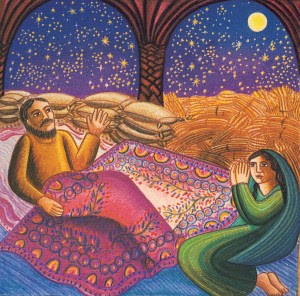
Naomi her mother-in-law said to her, “My daughter, I need to seek some security for you, so that it may be well with you. Now here is our kinsman Boaz, with whose young women you have been working. See, he is winnowing barley tonight at the threshing floor. Now wash and anoint yourself, and put on your best clothes and go down to the threshing floor, but do not make yourself known to the man until he has finished eating and drinking. When he lies down, observe the place where he lies; then go and uncover his feet and lie down, and he will tell you what to do.” She said to her, “All that you say I will do.”

So she went down to the threshing floor and did just as her mother-in-law had instructed her. When Boaz had eaten and drank and was in a contented mood, he went to lie down at the end of the heap of grain. Then she came stealthily and uncovered his feet and lay down. (New Revised Standard Version)

Naomi and Ruth were two widows – a mother-in-law and daughter-in-law – living in an ancient time when women were dependent upon men for survival.

Ruth had been out in the barley fields during harvest, gleaning as much as she could by walking behind the harvesters. It was what people in need did back then.

The owner of the land, Boaz, had heard of Ruth and took notice of her. He was kind and made sure she had enough for herself and Naomi.

So, Naomi, although too old to be out in the fields gleaning barley, could still use her wisdom. She decided to help Ruth have some security for the future. Naomi wanted to help her daughter-in-law,  so she instructed Ruth to make herself available to Boaz.

Boaz was a kinsman, connected to Naomi’s extended family. Naomi intended on using this connection to bring Ruth and Boaz together in marriage, thus settling her daughter-in-law in a good and secure life.

The approach of Naomi underscores her thoughtfulness, creativity, and limited resources. Most of all, however, Naomi’s plan rests entirely on the goodwill and generosity of Boaz. Naomi was observing Boaz, and assessed him as a person she could put her faith into.

Would Boaz be willing to act in Ruth’s favor, as a near kinsman to Naomi? Would he take up the mantle of kinsman-redeemer and enter a levirate marriage with Ruth?

A “levirate” is reference to an ancient marital system which involved in-laws. If a man died without children, the dead man’s name could be perpetuated through the widow’s marriage with a man related to the dead person.

Israel and Judah had a strong sense of community and family solidarity which is evidenced in God’s law. Members of the family and the community had a duty to watch out for each other and care for one another. For example:

“If anyone of your kin falls into difficulty and sells a piece of property, then the next of kin shall come and redeem what the relative has sold. If the person has no one to redeem it but then prospers and finds sufficient means to do so, the years since its sale shall be computed and the difference refunded to the person to whom it was sold, and the property shall be returned. But if there are not sufficient means to recover it, what was sold shall remain with the purchaser until the year of Jubilee; in the Jubilee it shall be released, and the property shall be returned. (Leviticus 25:25-28, NRSV)

Naomi did her best to try and prepare for a marriage to happen. And her best chance was with Boaz on the threshing floor after the barley harvest. Considering that arranged marriages were the norm, none of this was weird at the time.

She wanted to stir up this sense of duty in Boaz, and help him take responsibility for the family, so that Ruth could be properly cared for.

Israelites had a strong theological sense that their God had redeemed them out of Egypt, and therefore, they themselves were to act as redeemers, whenever needed, within their families and communities.

Another way of putting the matter, is that Israel’s covenant with Yahweh their God was to have the wider implication of covenanting to help and care for each other as Israelites. And this was especially true for one’s family.

Boaz was related to Naomi through her late husband Elimelech; and related to Ruth through Elimelech’s son Mahlon, who was Ruth’s late husband.

As you can imagine, not every scenario in Judah which involved redeeming one’s in-law’s actually happened. The question was whether Boaz would do anything. And Naomi was betting on the farm that he would care and help. Hence, Naomi’s advice to Ruth concerning Boaz.

Naomi instructed Ruth to make clear to Boaz that she wanted him to marry her. All of the preparation for the nighttime visit was designed to spark within Boaz that Ruth is asking for a levirate marriage.

Ruth did exactly what her mother-in-law told her. I believe that not only was Naomi looking out for her daughter-in-law, but Ruth was also looking out for her mother-in-law.

Neither one of them had to do what they did. Naomi didn’t have to make arrangements for Ruth to be cared for. But she did. And Ruth, as a foreigner from Moab, didn’t have to succumb to any Jewish covenantal understandings of things. And yet, she did.

Individualistic Western societies reflexively think of personal interest first, and often only think of the personal implications to just about everything – even concerning family. Many persons abandon their families and take up a sort of surrogate family.

They may feel no duty or responsibility to biological family connections. Even more persons move from place to place without much thought to the communities they leave, nor to how they might contribute to the wellbeing of their new community.

A careful reading of the Book of Ruth ought to challenge those types of approaches to family and community. Although none of us are living in the covenant society of Ruth, Naomi, and Boaz, there is an inherent universal ethic of caring for those closest to us, especially family.

Each day is an opportunity to act in redemptive ways which lift up and help others in whatever their need may be. I pray we all to have the sensibilities of persons like Boaz, Ruth, and Naomi.

Gracious God, enable us to understand and care about the needs of others. May your way of love open up for all those who suffer or are in any kind of trouble. Thank you for your steadfast love and abundant mercy. Help us to both accept your love and mercy, and to give it. Amen.

A Reason To Hope (Ruth 2:15-23)

When she got up to glean, Boaz instructed his young men, “Let her glean even among the standing sheaves, and do not reproach her. You must also pull out some handfuls for her from the bundles and leave them for her to glean, and do not rebuke her.”

So she gleaned in the field until evening. Then she beat out what she had gleaned, and it was about an ephah of barley. She picked it up and came into the town, and her mother-in-law saw how much she had gleaned. Then she took out and gave her what was left over after she herself had been satisfied. 

Her mother-in-law said to her, “Where did you glean today? And where have you worked? Blessed be the man who took notice of you.”

So she told her mother-in-law with whom she had worked, saying, “The name of the man with whom I worked today is Boaz.” 

Then Naomi said to her daughter-in-law, “Blessed be he by the Lord, whose kindness has not forsaken the living or the dead!” Naomi also said to her, “The man is a relative of ours, one of our nearest kin.”

Then Ruth the Moabite said, “He even said to me, ‘Stay close by my young men until they have finished all my harvest.’ ” 

Naomi said to Ruth, her daughter-in-law, “It is better, my daughter, that you go out with his young women, otherwise someone might bother you in another field.” 

So she stayed close to the young women of Boaz, gleaning until the end of the barley and wheat harvests, and she lived with her mother-in-law. (New Revised Standard Version)

Ruth was both a widow and a foreigner from Moab. She and her mother-in-law Naomi had no land. Widowed foreign women were likely to be poor. They were vulnerable to abuse by being out in the fields during harvest time, trying to glean whatever leftovers they could find after the harvesters came through.

The covenant code of Israel prescribed laws concerning how to treat the poor. There was even instruction on what to do in just such a situation of the landowning harvester Boaz and the poor gleaner Ruth:

“When you reap your harvest in your field and forget a sheaf in the field, you shall not go back to get it; it shall be left for the alien, the orphan, and the widow, so that the Lord your God may bless you in all your undertakings. When you beat your olive trees, do not strip what is left; it shall be for the alien, the orphan, and the widow.

“When you gather the grapes of your vineyard, do not glean what is left; it shall be for the alien, the orphan, and the widow. Remember that you were a slave in the land of Egypt; therefore I am commanding you to do this. (Deuteronomy 24:19-22, NRSV)

The law stipulated a spirit of generosity toward the poor in the land. The reason for the law is that the Israelites had been slaves in Egypt, and experienced the cruelty of abusive slavedrivers. Israel was to remember this, and ensure that no foreigners would experience what they themselves had to go through for 400 hundred years in Egypt.

Ruth gleaning, by James Tissot, c.1898

Fortunately for Ruth, Boaz was an observant Jew, concerned for the intent and spirit of God’s law. He held to the covenant law both legally and spiritually.

Boaz remembered God’s grace to Israel. He blessed Ruth, and commended her for placing herself in God’s hands.

If not for the covenant code’s opportunity for the poor to glean, Boaz would have faced a dilemma. Once he became aware Ruth and Naomi’s poverty, he surely would not have let them starve. Yet, neither would he likely have made them dependent upon himself.

It is important to preserve the dignity of people, which is why the Old Testament is filled with social and economic laws concerning the poor in Israel.

Ruth was given the chance to glean and work for the harvest. This allowed her to use the grain for making bread. Furthermore, her own labor freed herself and her mother-in-law from being dependent as beggars. All of this helped make the two of them less vulnerable to exploitation by those with little concern for God’s covenant code.

Rather than being smothered either by sheer dependency, or through being used and exploited, God’s law operated as intended, thanks to the pious concern of Boaz.

This did not go unnoticed by Naomi. She clearly saw the gracious hand of God acting through Boaz.

Regardless of who we are, whether rich or poor, old or young, we can be gracious. We can commit ourselves to working hard for one another. We can be concerned for the common good of everyone.

God’s grace turns our hearts and minds, our heads and hands, toward ensuring that all persons have what they need to grow, thrive, and flourish in this life. This is exactly what biblical justice is all about. It’s what Boaz was about.

This will include concerns about equity. A just society will involve some sort of distribution of resources. It will mean making sure that our collective values, communal priorities, and social structures uphold the inherent dignity of human life. We will protect the most vulnerable among us.

A culture attuned to grace will champion the underprivileged and not use them as political pawns to achieve personal goals. A people focused on grace will place faith in God’s presence and provision for us all.

Those with much will care for the disadvantaged, and will uphold laws that do so. Those with little will take advantage of opportunities to both receive and give, and will make their voices heard on behalf of the needy.

Since God is just toward all, so we who are created in God’s image are to also be just.

Since God is good in all that God does, we too, are to be good.

Since God is gracious, merciful, and kind to the poor, so we are to be full of grace, mercy, and kindness.

Since God is love, so we are to love, not hate.

Faith and hope are born within the heart, because there is a reason to do so. Let us all be the people who give others a reason to trust God, hope for a better tomorrow, and love, despite any unloving situations.

Soli Deo Gloria