The Church Playground (Galatians 1:6-12)

I’m surprised that you’re so quickly deserting Christ, who called you in his kindness, to follow a different kind of good news. But what some people are calling good news is not really good news at all. They are confusing you. They want to distort the Good News about Christ. Whoever tells you good news that is different from the Good News we gave you should be condemned to hell, even if he is one of us or an angel from heaven. I’m now telling you again what we’ve told you in the past: If anyone tells you good news that is different from the Good News you received, that person should be condemned to hell.

Am I saying this now to win the approval of people or God? Am I trying to please people? If I were still trying to please people, I would not be Christ’s servant.

I want you to know, brothers and sisters, that the Good News I have spread is not a human message. I didn’t receive it from any person. I wasn’t taught it, but Jesus Christ revealed it to me. (God’s Word Translation)

At first glance, driving by any school at recess, the whole thing looks like a bunch of random kids descending into chaos bordered by a fence to keep it all from spilling out into the streets. But there’s more going on than the quick peek tells you. There are all kinds of petty little groups that make up the playground. 

It kind of reminds me of church.

The Presbyterians head outside to recess and cannot believe the lack of order going on. They try their darnedest to get some organized games happening.

But the Baptists aren’t having it. They’re too far separated from all the other kids to care about playing with any of them. Besides, nobody is playing by the rules and if there’s one thing Baptists can’t stand, it’s a lack of legalism. 

The Pentecostals all seem completely oblivious to anything that’s going on. They’re just having too much fun going as fast as they can on the merry-go-round to see that the Catholics are totally aghast at their lack of guilt feelings over hogging the equipment.

The little group of Episcopalians are lost in some morbid inferiority complex and retreat into their liturgical games.

Meanwhile the popular kids, the Non-denominational group, break out singing Chris Tomlin songs so loud that the Methodists go scrambling for their Book of Discipline to see what to do about it. 

The Lutheran kids are so busy fighting each other about who is the true Lutheran that they don’t hear any of the kids anyway. 

And the Reformed are those annoying kids who keep acting like the teacher instead of just enjoying being a kid on the playground.

The Church playground includes:

  • Groups of kids who don’t seem to play very well together; they all think they’re better than the other group.
  • Cliques who believe they’re the only playground in town; they don’t realize there are other playgrounds with all kinds of other kids.

How we interact with others in the world is going to determine if the school gets shut down, with no more playground. After all, what parent wants to send their kid to the school where nobody gets along with each other?

How we interact with each other on the playground of Christianity says a lot about our view of God. For many, God is the high and lofty Principal who’s only seen when something goes wrong, not realizing that God is really the encouraging teacher who’s daily in the classroom offering kind words and self-sacrifice that changes your life forever.

Instead of lamenting that Christendom has vanished from its grand position in society and that the moral fabric of our country is down the toilet along with the janitor’s cigarette butt, maybe we should stop giving the other kid a swirlie long enough to see that our bullying and belligerent ways are anything but the words and ways of Jesus to a world who needs spiritual care, not spiritual abuse.

I’d suggest we use our detention time to think about what we’ve done. And the Apostle Paul is here to help us do just that.

Paul was willing to tolerate a lot, but when it came to taking good news and twisting it into bad news, he was downright beside himself with shock and anger about the entire situation.

The Apostle had absolutely no tolerance for a bunch of honyocks who take spiritual deliverance and turn it back into spiritual bondage. It’s as if a group of immigrant refugees have been rescued from their terrible plight of homelessness and poverty to another gracious country; and then are deceitfully convinced to return to that previous state and leave the good confines of their new home.

It’s so appalling to Paul that he pronounced a severe curse upon them for doing such a thing. To emphasize his point, he belches out the curse a second time.

The good news of Jesus Christ is that there is forgiveness and deliverance from sin, death, and hell. It’s a gospel of grace that mercifully gives to us – a spiritual amnesty declaring us new citizens of God’s benevolent country of love.

Yet, many people are deceived with the legalist’s bargain from the devil: Take a nice handy list of do’s and don’ts and you will become godly. he false teacher is quite glad to provide the list so that there’s no guessing about what to do. And, for some reason, it seems it’s that teacher who always has playground duty at recess.

The list is presented as either principles to change your life; or rules to follow; or particular prayers to pray; or an approved list of things to give your money to. In other words, check off the items on the list and all will be well.

In reality, however, it’s a highway to the grave. And those who lead the way to death with their accursed legalistic ways will find themselves condemned by their own words and actions. In the end, the teacher will be dismissed to a very different school.

There is a need to repent of religious lists, political agendas, and teachings which ignore and demean the gracious good news of Christ’s person and work.

One telltale sign of holding to a conjured list is not being honest with one another about our struggles. The bald fact of list-living is that we cannot fulfill it. So, when we know we are not measuring up to the list, the temptation is to keep up appearances as if we are.

List-living eschews showing any weakness or imperfection and creates unholy disconnections between people:

  • I cannot admit my sin to anyone because the list pronounces me a failure if I do. 
  • I cannot enter a deep and prolonged grief over my loss because the list says I need to stay strong. 
  • I cannot profess my doubts about God because the list says if I doubt, I am not a real Christian.

The Apostle Paul’s (and mine, too!) response to the legalistic list-living is this: To hell with the list! 

Instead, give praise to Jesus Christ who has given us the way of freedom and peace! It’s grace which transforms hearts, turns lives around, and provides genuine joy and satisfaction. If grace is not the answer, we aren’t asking the right question.

I’ll take Jesus the Teacher any day over the list-loving false teacher.

Law and Gospel (Galatians 3:6-14)

Nativity by He Qi

The Scriptures say that God accepted Abraham because Abraham had faith. And so, you should understand that everyone who has faith is a child of Abraham. Long ago the Scriptures said God would accept the Gentiles because of their faith. This is why God told Abraham the good news that all nations would be blessed because of him. This means everyone who has faith will share in the blessings given to Abraham because of his faith.

Anyone who tries to please God by obeying the Law is under a curse. The Scriptures say, “Everyone who doesn’t obey everything in the Law is under a curse.” No one can please God by obeying the Law. The Scriptures also say, “The people God accepts because of their faith will live.”

The Law isn’t based on faith. It promises life only to people who obey its commands. But Christ rescued us from the Law’s curse, when he became a curse in our place. This is because the Scriptures say that anyone who is nailed to a tree is under a curse. And because of what Jesus Christ has done, the blessing promised to Abraham was taken to the Gentiles. This happened so that by faith we would be given the promised Holy Spirit. (Contemporary English Version)

We are just a day away from the Nativity of the Lord, Christmas Eve, the night Christians everywhere observe the birth of Christ.

And just two days from now Christians throughout the world will have a grand celebration of Christ’s incarnation – God breaking into this old fallen world to be with us and redeem us.

Many will be show up at a church worship service on that day, perhaps especially because Christmas Day falls on a Sunday, in the year of 2022. All might be in the same place; yet they’re there for different reasons.

Some come to the worship service because that’s what they have done every Sunday throughout the year – and they wouldn’t think of being anywhere else.

Others choose to be a part of the gathering because they enjoy the specialness of the day, the beauty of the celebration, and the traditions which surround it all.

There are also those who show up because the season has been hard; while others may bask in the joy of Christmas, they’re just looking for something positive to get them through for a while.

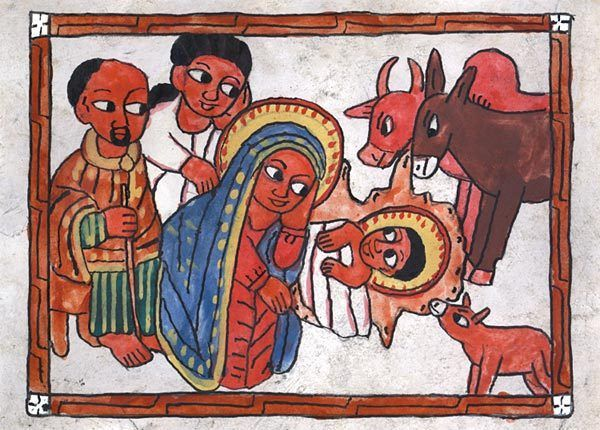
Ethiopian Orthodox icon of the Nativity of the Lord

And then there are those who enter the day for none of the previous mentioned reasons. No, they simply show up because they feel it is their duty to do so, or at the least, because they might receive some special spiritual Brownie points from God. In other words, they gather with the rest with the sheer motivation of Law.

Such an approach illustrates the “curse” of the Law. The Law itself is not bad. But if the rest of the equation isn’t factored into life, Law becomes a hard taskmaster and keeps the law-keeper in a terrible bondage without any delight to go with the duty.

People also need Gospel, the good news which fulfills all the requirements and demands of Law. Law is good, but by itself, apart from Gospel, it becomes an insidious tool of evil.

Whereas Law focuses solely on what we do, Gospel homes in on why we do it.

Law bosses us around and tells us what to do. Gospel frees us to embrace the spirit of Law to love God and neighbor.

It doesn’t take faith to obey the rules and regulations of Law. Gospel, however, can only be realized, internalized, and lived by faith.

It takes faith to receive grace and forgiveness – and to give it. Faith requires an acceptance of spiritual realities. It is the key to tapping into the power of love in the universe.

By faith, people throughout history, like Abraham, have listened with spiritual ears to the God of all. They step out, not merely because of Law, but because they rely on divine promises. Such faith enables them to wait patiently for the coming of eternal forces to take permanent residence on earth. Law can’t do that; only Gospel can.

Faith in the Bible is a complete trust in God, in who God is and what God has done. Because God has demonstrated faithfulness through steadfast love, people are gifted with faith to know the Lord and exhibit love through good works. 

God Is with Us by Hanna Varghese

In Christianity, the height of faith is to place one’s life completely in God’s hands, believing in the person and work of Jesus Christ.

Jesus said, “I assure you that if you have faith the size of a mustard seed, you could say to this mountain, ‘Go from here to there,’ and it will go. There will be nothing that you can’t do.” (Matthew 17:20, CEV)

The size of faith isn’t the issue – it’s in whom that faith is placed. The littlest of faith in Jesus can have massive results, whereas the biggest of faith in someone who cannot get you to where you need to go, is useless.

Outward rituals and observance of Law have their place; but they don’t deliver anyone from sin, death, or hell. Only faith can do that.

If you are a follower of Christ Jesus, it makes no difference whether you are circumcised or not. All that matters is your faith that makes you love others. (Galatians 5:6, CEV)

It’s one thing to be kind and love others during a holiday season; it’s quite another thing to have that be your default character throughout the entire year. Love for a season comes merely from Law. But Love for a lifetime grows from the rich soil of the Gospel.

And it’s the Gospel of Jesus Christ which we celebrate and give thanks.

Gracious God, we thank you for sending your Son. Even before we loved you, you loved us and gave us the gift of faith. Help us to love one another and to see all people in the same way you do – to love them even when they don’t love us back. Enable us by your Spirit to show continual love throughout the entire year, for the sake of Jesus Christ our Savior. Amen.

Slave or Free? (Galatians 4:21-5:1)

Tell me, you who want to be under the law, are you not aware of what the law says? For it is written that Abraham had two sons, one by the slave woman and the other by the free woman. His son by the slave woman was born according to the flesh, but his son by the free woman was born as the result of a divine promise.

These things are being taken figuratively: The women represent two covenants. One covenant is from Mount Sinai and bears children who are to be slaves: This is Hagar. Now Hagar stands for Mount Sinai in Arabia and corresponds to the present city of Jerusalem, because she is in slavery with her children. But the Jerusalem that is above is free, and she is our mother. For it is written:

“Be glad, barren woman,
    you who never bore a child;
shout for joy and cry aloud,
    you who were never in labor;
because more are the children of the desolate woman
    than of her who has a husband.”

Now you, brothers and sisters, like Isaac, are children of promise. At that time the son born according to the flesh persecuted the son born by the power of the Spirit. It is the same now. But what does Scripture say? “Get rid of the slave woman and her son, for the slave woman’s son will never share in the inheritance with the free woman’s son.” Therefore, brothers and sisters, we are not children of the slave woman, but of the free woman.

It is for freedom that Christ has set us free. Stand firm, then, and do not let yourselves be burdened again by a yoke of slavery. (New International Version)

Get your hermeneutics together, man

First of all, I want to say that I have little tolerance for Bible readers who insist on an exclusive literal interpretation of Scripture – because it’s downright nonsensical.

Today’s New Testament lesson is one of many biblical passages which really ought to put a wooden stake to the heart of such a misguided hermeneutic. The Apostle Paul himself uses an allegorical or figurative approach to interpreting an Old Testament story.

Holy Scripture interprets itself in many ways. It is, at the least, hubris to believe one has the corner on biblical interpretation through a single mode of literal Bible interpretation; and it is, at the worst, damaging to other’s souls to restrict them in their reading and reflection – not to mention destructive whenever a literalist (who is typically also a legalist) brings their judgmentalism forward to condemn the other approaches.

Okay, I feel better now, getting that off my chest. But, unfortunately, we’ve still got to deal with legalism – which is what Paul set out to do with his writing to the churches in the region of Galatia.

Let go of the legalism

There can be something oddly comforting about law. Having clear black-and-white no-nonsense rules can give a sense of security. You always know where you stand. You’re either in or you’re out, either pure or sinful. 

Yet, here’s the score on the law: it is meant for the immature and is designed as a guide to lead us to maturity. 

If we live by law, we are bound by law. Law can only take us so far in our walk with God. A slavish commitment to rules must, at some point, give way to the greater virtues of grace and love. 

The Galatian churches wanted a religion they could see and hold in their hands. But Paul would have none of it; he was dogged about the devotion to a life of grace. Since Christ has set us free, we are truly and really free. So now, we are to embrace the freedom and never go back to being slaves to the law again – which is closely akin to relapsing into spiritual immaturity. 

We (hopefully) expect a kid to be a kid. When the kid grows up and is an adult with adult responsibilities, we expect him to speak and act like an adult, not a kid.

What’s more, we ought also to expect the adults in the room to treat one another like adults. Layering a bunch of rules and regulations on grown-up people is nothing more than handling them like they’re kids. It’s a nonsensical approach to dealing with each other.

Embrace your freedom

Freedom means that we have no obstacles in expressing grace, love, and hope to others. We are free to bask in the forgiveness we possess in Christ. 

If our Christianity is reduced to a point system or following a list of juvenile rules, then we have missed what the law was all about in the first place. The law is meant to lead us to Christ, and it must, at some point, give way to the larger law of love.

The law has its place. Yet, if we are perpetual slaves to it and never outgrow it’s intended purpose for us, then we need to move onto maturity and embrace the freedom we have in Christ. 

To live in freedom doesn’t mean we can simply do whatever we want, as if there’s no consequences to our words and actions. It’s not “anything goes.” Rather, Christian freedom is a life attuned to the Spirit; an awareness of living for Jesus through the fruit of the Spirit. It doesn’t break laws; it fulfills them. 

All Christians must grow up and become spiritual adults. That means leaving childish ways of the law behind and embracing the freedom of the Spirit. 

So, where are you in your Christian life? Are you a slave to Law or a free person to Love?

The Time Is Ripe (Galatians 4:1-7)

What I am saying is that as long as an heir is underage, he is no different from a slave, although he owns the whole estate. The heir is subject to guardians and trustees until the time set by his father. So also, when we were underage, we were in slavery under the elemental spiritual forces of the world. 

But when the set time had fully come, God sent his Son, born of a woman, born under the law, to redeem those under the law, that we might receive adoption to sonship. Because you are his sons, God sent the Spirit of his Son into our hearts, the Spirit who calls out, “Abba, Father.” So you are no longer a slave, but God’s child; and since you are his child, God has made you also an heir. (New International Version)

The three greatest persons in biblical history – Abraham, Moses, and Jesus – are connected. God entered into a covenant with Abraham and promised to bless everyone on the earth through his progeny. God gave Moses the Law as a sort of school teacher and guide, alongside Abraham’s covenant. God fulfilled the covenant promise in Jesus. Thus, everyone who is led and tutored toward Christ, inherits all of God’s promises.

Under the Law

The Apostle Paul, speaking to a group of new believers who were confused about the relation between the Law and Christ, helped them understand with a metaphor. It’s like a boy who is the heir to a great estate. Someday, it will all be his. But now, he’s too young to possess it. So, during his childhood, he’s subject to trustees who oversee the estate, and teachers who instruct him in how to actually use the wealth once he actually inherits it.

While the boy is in the middle of the guidance, he’s not in control of much, just like the servants on the estate. The child will remain in this state until his time comes, until the date in which his father says he can take possession of the inheritance.

Before Christ, people were under the Law. They were heirs to God’s great kingdom promises. Yet, they needed the Law to guide and instruct them until it was time for them to receive the inheritance. Much like a present day kid in school, they see themselves in a sort of bondage, even though it’s a necessary part of their lives.

It’s bondage in the sense that the Law, the schoolmaster, has no power or ability to give the inheritance nor to save them from their current condition. In other words, the Law is good, yet lacks the potency to actually deliver one from sin, death, and hell.

What’s more, the elemental spirits of the age, namely Satan and his wicked spirits, wormed their way into the process of guidance and twisted the Law for their own advantage, to keep people in bondage. Just as the guardian of the boy may mistreat him in ways his father never intended, so the devil has exploited the Law in order to have it be a tyrannical presence over people.

Whereas God intended the Law to reveal humanity’s sin and drive them to a Savior, evil uses the Law to shame people and drive them to despair. The Law was meant for good, to be a gracious leading of people to the Messiah; yet Satan co-opted the Law to bring condemnation to folks and keep them under his insidious thumb.

In Christ

But when the time was ripe, God sent the Son so that people would be done with their guardians and inherit divine promises. To use yet another metaphor, when the scaffolding on a building has served it’s intended purpose in construction, it’s taken down; it’s no longer needed. It would be weird if the shiny new building were erected, and the owner decided to keep the scaffolding beside the structure.

The Law of Moses had done its work of preparing people for Christ. So, God sent Jesus, the Son, to redeem humanity, to transform slaves into sons and daughters. The Lord adopted us and granted us full rights as children of the King.

Christ redeemed us from the curse of the Law by becoming a curse for us—because it is written, Everyone who is hung on a tree is cursed.

Galatians 3:13, CEB

Jesus is uniquely qualified to be such a Redeemer of humanity. He is God’s Son, born of a human mother. Therefore, as both divine and human – the God Man – Jesus is the person for whom all the covenant promises of God have their fulfillment.

In the past God spoke to our ancestors many times and in many ways through the prophets, but in these last days he has spoken to us through his Son. He is the one through whom God created the universe, the one whom God has chosen to possess all things at the end. He reflects the brightness of God’s glory and is the exact likeness of God’s own being, sustaining the universe with his powerful word. After achieving forgiveness for the sins of all human beings, he sat down in heaven at the right side of God, the Supreme Power. (Hebrews 1:1-3, GNT)

In Christian trinitarian theology, God is Three in One, the Holy Trinity. God sent the Son into the world, of which believers celebrate the incarnation of Christ each year at Christmas. God sent the Spirit into our hearts; and from that place we cry “Abba! Father!” The Spirit testifies with our own spirit that we are truly adopted children of God. (Romans 8:15-16)

The Spirit is like the seal on a document, proving that our inheritance papers are all in order. And, much more than that, the Spirit also does this sealing work with affection. Christianity is not merely a legal transaction; it’s an experience of grace and love in which we enter into a new life, free from bondage, and alive to all the possibilities that humanity was originally meant for.

Both our status and our sensibilities are changed. It happens because of God’s good grace and purpose, fulfilled in Christ and impressed on us by the Spirit.

Conclusion

The French philosopher and writer, Blaise Pascal (1623-1662), once said that there is a God-shaped vacuum in the heart of each person which needs to be filled:

“There was once in man a true happiness, of which all that now remains is the empty print and trace. This he tries in vain to fill with everything around him, seeking in things that are not there the help he cannot find in those that are, though none can help, since this infinite abyss can be filled only with an infinite and immutable object; in other words by God himself.” Blaise Pascal, Pensées

If we want to find happiness, satisfaction, and goodwill, then the empty void within us creatures and within the systems and the cultures we create, needs to be filled with our Creator.

The Christian season of Advent is an appropriate time to reconnect with the infinite and the immutable. The time is ripe to be filled not only with love and goodness, but with the very source of Love itself.

May it be so, to the glory of God.