
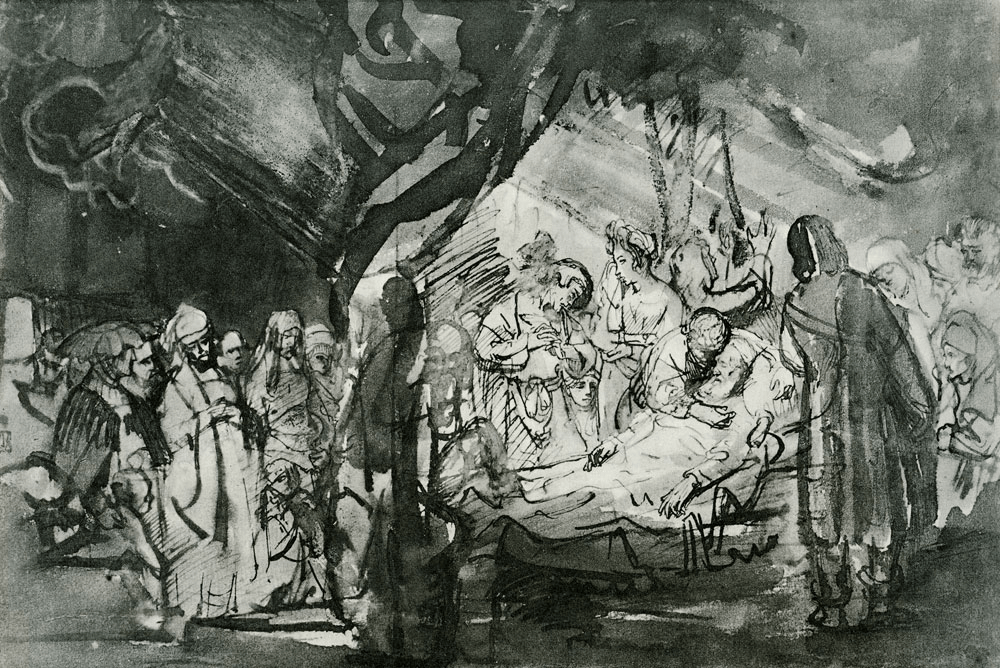
Pay Attention to Grief (Genesis 49:29-50:14)

The Death of Jacob, by Rembrandt, c.1640

Jacob told his sons:

Soon I will die, and I want you to bury me in Machpelah Cave. Abraham bought this cave as a burial place from Ephron the Hittite, and it is near the town of Mamre in Canaan. Abraham and Sarah are buried there, and so are Isaac and Rebekah. I buried Leah there too. Both the cave and the land that goes with it were bought from the Hittites.

When Jacob had finished giving these instructions to his sons, he lay down on his bed and died. Joseph started crying, then leaned over to hug and kiss his father.

Joseph gave orders for Jacob’s body to be embalmed, and it took the usual 40 days.

The Egyptians mourned 70 days for Jacob. When the time of mourning was over, Joseph said to the Egyptian leaders, “If you consider me your friend, please speak to the king for me. Just before my father died, he made me promise to bury him in his burial cave in Canaan. If the king will give me permission to go, I will come back here.”

The king answered, “Go to Canaan and keep your promise to your father.”

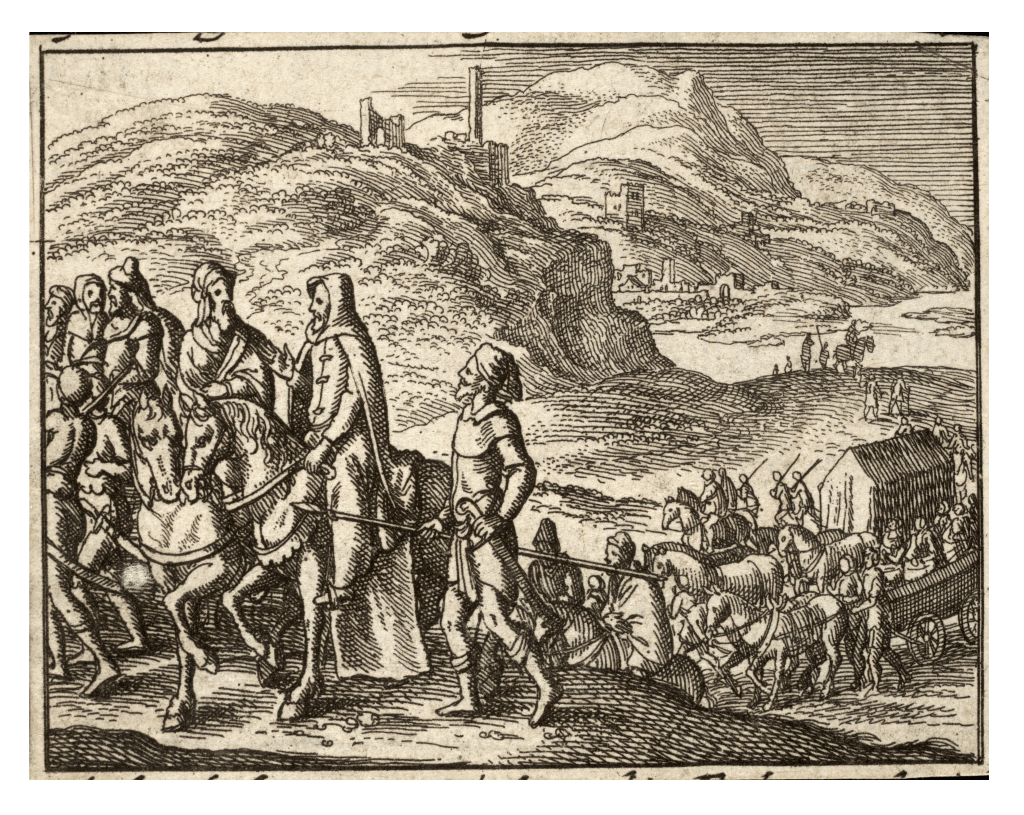
When Joseph left Goshen with his brothers, his relatives, and his father’s relatives to bury Jacob, many of the king’s highest officials and even his military chariots and cavalry went along. The Israelites left behind only their children, their cattle, and their sheep and goats.

After crossing the Jordan River, Joseph stopped at Atad’s threshing place, where they all mourned and wept seven days for Jacob. The Canaanites saw this and said, “The Egyptians are in great sorrow.” Then they named the place “Egypt in Sorrow.”

So Jacob’s sons did just as their father had instructed. They took him to Mamre in Canaan and buried him in Machpelah Cave, the burial place Abraham had bought from Ephron the Hittite.

After the funeral, Joseph, his brothers, and everyone else returned to Egypt. (Contemporary English Version)
117 days. That’s how long Jacob’s family, along with the people of Egypt, mourned for him after his death. Yes, he was a patriarch. And yes, Joseph was the administrator of an entire nation. Yet this was not unusual behavior; it was normal.

When my mother-in-law was tragically and suddenly killed in a car accident, 30 years ago, I could not take any bereavement time off, because according to company policy, it was not my mother. So, since she lived a thousand miles from us, I had to use vacation time and take a week away. Then, when I returned to work, I was expected to pick up where I left off, as if nothing had happened.

Although I work under better conditions today, and workplaces are getting better at acknowledging the importance of tragic events in the life of employees, we still have a long way to go in dealing with grief, bereavement, mourning, and lament.

The modern funeral industry is a rather recent phenomenon in history. Beginning with, and then following, the American Civil War, death was a prominent specter, affecting every community and nearly every home. People like my second great grandfather became part of a growing business of handling the dead and providing services for grieving families. He became a coffin maker and a chief supplier for the burgeoning funeral parlor (which later morphed into a furniture business which lasted a hundred years).

Even though families needed help after a devastating war, over time, the unintended effect is that we became detached from death. Others could handle bodies and arrangements. We could choose to see or not see the dead. Folks began losing the ability to grieve and mourn their changes in life.

Grief doesn’t just go away with time. If it isn’t acknowledged, faced, accepted, and dealt with, it slowly begins to sit in the soul and rot. Eventually, it becomes spiritual gangrene; the person becomes bitter, without joy and stuck in unwanted emotions.

The point of all this is that grief and bereavement strikes us all; none of us gets off planet earth without having to deal with the loss of significant people in our lives. And when it happens, it’s imperative that individuals and societal structures allow for the time and space to mourn.

The ancients were on to something which we need to recover. They discerned the importance of allowing grief to run it’s course, instead of us trying to master grief, get over it, and move on. Grief will be dealt with when it is dealt with. Trying to tame it is like attempting to bench press 700 pounds; it’s only going to crush you if you try controlling it.

I’m not agitating for a 117 span of days for everyone’s mourning. But I am insisting that we have conversations about grief and confront it, rather than ignore it. Because grieving doesn’t mean you’re imperfect; it means you’re human.

The way we move through our grief is by telling our story – which requires someone to listen. That only happens if we have created the space for it to occur. Expectations of moving-on will leave grief where it is, poisoning us from the inside-out.

The only way to the mountain is through the valley. The only way to make the pain go away is to move through it – not by avoiding it, pretending it’s not there, or trying to go around it. Pain and suffering are inevitable; misery is optional. And letting bereavement and grief have it’s way for a while is the path away from the misery.

You will heal and you will rebuild yourself around the loss you have suffered. You will be whole again, but you will never be the same. And that’s a good thing. It gives us the ability and empathy to extend blessing to others who will eventually face their own terrible loss. They will need someone to listen. And you will be there for them.

Lord, do not abandon us in our desolation. Keep us safe in the midst of trouble, and complete your purpose for us through your steadfast love and faithfulness, in Jesus Christ our Savior. Amen.

Difficult Funerals


I do my fair share of funerals.  Many of them are a ministry to families who truly celebrate an aged parent or grandparent, having lived a full and blessed life.  But then there are those occasions when a death is nothing less than a sad and tragic event.  Last week I had one of those funerals.  I officiated a service of a young woman who left three small children and lots of questions from friends, parents, and siblings.  Addiction was at the center of her passing from this life into the next.  The following is the biblical substance of what I said at that funeral, based in a Scripture passage from Isaiah 65:17-25.
 
This Scripture passage from the prophet Isaiah portrays a vision of hope – a hope for better days when the brokenness of this world will be mended, when that which is lost will be found, and a time when what is incomplete will be made whole.  There is a confident expectation for the believer that our troubles, our sufferings, and our failings are not the last word; instead, the promises of God will have the final say, and those promises will all be realized.
 
            If it were left up to us, to fallen and fallible humanity, there would be no hope because it is our sin that has made such a mess of things.  But, thanks be to God, that hope is built on what Godsays and his promises to his people.  And every promise finds its fulfillment in Jesus Christ.  In the beginning God created the heavens and the earth, and formed man and woman as his greatest creation.  To human beings alone God created them in his own image and likeness.  But tragedy happened when the people God formed for himself and for his glory decided to rebel and go their own way.  That act of disobedience plunged the entire world into darkness.  To this day we feel and experience the effects of that original Fall into sin and separation from God.  Yet, the story of the Holy Bible does not end there because God, in his grace, did not abandon his creatures but promised to redeem them.  The ultimate act of this grace was God the Father sending God the Son to this earth.  It is the life and teaching of Jesus, his death on a cross, his resurrection from the dead, and his ascension to heaven that has taken care of the sin issue and the brokenness of the world once for all.  God’s Holy Spirit is at work, even now, bringing the effects of Christ’s finished work to the lives of people so that they may live new lives.  And this is where hope is kindled – that there is coming a time when all things will be made new and the world will be made right because of Jesus Christ.
 
            Sin, death, and hell do not have the last word.  Everything in this world that is unfair, unjust, twisted, and broken will be healed.  The prophet Isaiah speaks of a vision that is ahead, which is coming.  This is a vision of the future that helps give us some sense and a bit of meaning to our present questions and grief.
 
            The ancient Israelites, for whom this prophecy was directed, did not always live as they ought to have lived.  The history of the Israelites is a complicated picture of sincere worship of God punctuated with sad times of rebellion and disobedience.  It is true of us all that we are at many times a convoluted mix of both good and bad, capable of both wise decisions and foolish actions.  The reality is that we all bear the marks of being in the image of God, but also of a sinful nature that resembles the Fall of our original ancestors. 


There are times in life when we exemplify the image of God within us – times when we have sincere spiritual excitement and a desire for prayer – times when we can freely share Scripture with family or friends to help them in their hour of need.  Our giftedness and abilities can go far when used for good.  Yet, tragically, we also carry within us the burden of our fallen natures and we are, at times, carried away by that which enslaves.  We are by no means alone in that struggle.  The Apostle Paul, by whom much of the New Testament was written, captured this tension and difficulty.  He said to the Church at Rome:  I do not understand what I do.  For what I want to do I do not do, but what I hate I do.  Paul went on to say:  For I have the desire to do what is good, but I cannot carry it out.  For what I do is not the good I want to do; no, the evil I do not want to do – this I keep on doing.  He concluded his thought with this:  What a wretched man I am!  Who will rescue me from this body of death?  Thanks be to God – through Jesus Christ our Lord!  Men and women, but for the grace of God, but for the cross of Jesus Christ, we would all be given completely over to trouble!
 
The prophet Isaiah has given us a glimpse that God’s plans and purposes move toward a climax – that life as we know it right now is not how it will be forever.  Death sometimes cuts off life before it has had a chance to begin well.  Sometimes when that happens, we ponder our own failings and wonder if things could have been different if we had acted a certain way or said a certain thing.  But what transcends all of our human words and earthly actions is the promise of God to make all things new, restore all things, and bring a new era of righteousness into the world.  The hope the Christian has because of the resurrection of Jesus Christ is that the power of death itself has been destroyed.  A whole new order of things is coming, and it will be so new that the past will be forgiven and forgotten in Jesus’ name.


So, today we have a choice:  to place our faith and hope in Christ, or to go our own way.  God gives us everything we need.  Yet, being human, we, at times, fail to use that which God has given.  But God always has the last word, and his last word to us is salvation and deliverance from the power of sin and death in Jesus’ name.