Hebrews 9:23-28 – Once for All

Ethiopian Orthodox Church icon of Christ’s crucifixion

It was necessary for the sketches of the heavenly things to be purified with these rites, but the heavenly things themselves need better sacrifices than these. For Christ did not enter a sanctuary made by human hands, a mere copy of the true one, but he entered heaven itself, now to appear in the presence of God on our behalf. Nor was it to offer himself again and again, as the high priest enters the Holy Place year after year with blood that is not his own; for then he would have had to suffer again and again since the foundation of the world.

But as it is, he has appeared once for all at the end of the age to remove sin by the sacrifice of himself. And just as it is appointed for mortals to die once, and after that the judgment, so Christ, having been offered once to bear the sins of many, will appear a second time, not to deal with sin, but to save those who are eagerly waiting for him. (NRSV)

Once for all. Those few words are some of the most gruesome and beautiful in the entirety of Holy Scripture.  The sacrifices of bulls and goats in the Old Testament had its place. Yet, those were mere shadows pointing to the reality of the Messiah – the one whose sacrifice is so potent as to do away with sacrifice forever.

The cross of Christ was the once for all sacrifice that has settled the sin issue forever.

This is the heart of New Testament good news. Forgiveness of sins comes through the sheer grace of God in Christ. Through faith, we have the privilege of entering new life. Jesus has paved the way for eternal life, everlasting salvation, and complete remission of sins.

If it has not yet become self-apparent as to why Christ’s once for all sacrifice is such a game changer, then let’s perceive the cross from this angle: guilt is done away with, forever. Do you believe your life would change forever if you never had guilt hanging over your head?  What if all your past indiscretions, unhealthy life decisions, failures to speak or act when needed, overt things done which you cannot take back, or even the little things said or done in anger or hate were all washed away, forever?

Just as Jesus was nailed to a cruel cross, so guilt and shame was nailed there – once for all. There are three options of dealing with a guilty conscience when it happens…

Rationalize

First, you can rationalize it away, as if you have no responsibility or no culpability. One simply ignores their conscience. This is a one-way path to hardness of heart. Whenever we sin in speech or in action, and do not acknowledge it as our fault, then there is a little piece of us which hardens. The next time it happens, it’s a bit easier to respond with callousness. If you’ve ever encountered someone who seems utterly unfeeling to your situation, then there has likely been a pattern in that person’s life of keeping distance from pain. It only leads to hardness of heart.

Punish

A second way of facing guilt is just the opposite of rationalization. It is to punish and beat yourself for your faults and sins. Heaping abuse on ourselves for our sins takes two different tracks with either: discouragement, defeat, and depression resulting in inaction; or, working like crazy to try and earn God’s favor with hyper-activity. Both ways are a kind of self-imposed penance to try and atone for one’s sins or failures.

Confess

Fortunately, there is a better way to face and deal with our guilt. When there is true guilt for things done or undone, said, or unsaid, we must confess it, repent of it, and believe God has taken care of it. Unlike dealing with guilt in unhealthy ways resulting in callousness, discouragement, and hyperactivity, the path of confession and repentance allows the person to have a clear conscience, resulting in freedom. Christ’s once for all sacrifice is completely able to clear the conscience of the worshiper so that they may live into the grace and freedom of an enjoyable daily life. 

Nothing needs to hang over the believer’s head because Jesus Christ, the pioneer of our salvation, has accomplished deliverance from and forgiveness of sin, once and for all. Jesus didn’t just put a nice-looking veneer over sin; he took care of it, thoroughly and completely. Jesus didn’t whitewash things so that we looked okay; the salvation he offers is permanent.

The cross which held Christ’s naked and tortured body exposed the true violence and injustice of sin. The cross revealed what kind of world we have and what kind of God we have: a world of gross unfairness and sin, and, a God of extreme sacrificial love and grace.

What I believe this world, including you and me, need more than anything else is forgiveness – not a cheap sentimental forgiving, but a real forgiveness which lasts forever.

To justify or to judge is God’s business. Our business is to believe in the once-for-all sacrifice of Jesus that brings permanent and lasting forgiveness; and, to share that life-giving message with others so that they, too, might experience deliverance from sin and its horrible effects.

“For he delivered us from the domain of darkness and transferred us to the kingdom of his beloved Son, in whom we have redemption, the forgiveness of sins.” (Colossians 1:13-14, NIV)

May you know the freedom and joy today which comes from knowing Christ as Savior.

Galatians 5:2-15 – Faith Expressing Itself Through Love

Mark my words! I, Paul, tell you that if you let yourselves be circumcised, Christ will be of no value to you at all. Again, I declare to every man who lets himself be circumcised that he is obligated to obey the whole law. You who are trying to be justified by the law have been alienated from Christ; you have fallen away from grace. For through the Spirit, we eagerly await by faith the righteousness for which we hope. For in Christ Jesus neither circumcision nor uncircumcision has any value. The only thing that counts is faith expressing itself through love.

You were running a good race. Who cut in on you to keep you from obeying the truth? That kind of persuasion does not come from the one who calls you. “A little yeast works through the whole batch of dough.” I am confident in the Lord that you will take no other view. The one who is throwing you into confusion, whoever that may be, will have to pay the penalty. Brothers and sisters, if I am still preaching circumcision, why am I still being persecuted? In that case the offense of the cross has been abolished. As for those agitators, I wish they would go the whole way and emasculate themselves!

You, my brothers, and sisters, were called to be free. But do not use your freedom to indulge the flesh; rather, serve one another humbly in love. For the entire law is fulfilled in keeping this one command: “Love your neighbor as yourself.” If you bite and devour each other, watch out or you will be destroyed by each other. (NIV)

Faith, expressing itself through love, is the grace others need from us. I did not grow up committed to learning the Bible or following Christ. I pretty much went my own way throughout childhood, and especially my teenage years. I still remember what it feels like to not be a Christian. 

I have found throughout my Christian life that folks with a past in which they did not live by grace, but only looked out for themselves, have a temptation to embrace strict rules when they become Christians. They know what it feels like to not have Jesus in their lives, so they sometimes go beyond Scripture and impose standards on themselves, and then others, to keep on the straight and narrow.

If, and when, that happens, the Apostle Paul has something to say about it. Embracing certain practices to obtain or maintain righteousness mean nothing in God’s kingdom. For the Galatian church who went down the path of strict outward rule-keeping, Paul had strict words. Here is how one version of the New Testament puts it:

“You people who are trying to be made righteous by the Law have been estranged from Christ. You have fallen away from grace! We eagerly wait for the hope of righteousness through the Spirit by faith. Being circumcised or not being circumcised doesn’t matter in Christ Jesus, but faith working through love does matter.” (Galatians 5:4-6, CEB)

Any Christian tradition or individual believer which ignores God’s grace in favor of controlling one’s own faith through certain rules is no Christianity, at all. Paul would have nothing to do with it. His position was clear and pointed. We are called to freedom, and we are to use that freedom to serve others through love. Freedom is not something where we do whatever we want without regard to others. That is selfishness, not freedom.

“Grace must find expression in life, otherwise it is not grace.”

karl barth

Freedom is a gift of grace. It is given to us so that we will live freely into who we are meant to be as humanity. In other words, there are to be no obstacles of extra-biblical or unbiblical rules impeding us to realize our full potential as Christians saved by grace through faith. Our possibilities include full unhindered expressions of love, joy, peace, patience, kindness, goodness, faithfulness, gentleness, and self-control for the benefit of ourselves and the entire community of the redeemed.

Grace is the currency of God’s kingdom, flowing freely through love. God has your back. Grace forgives, and never runs out. Love endures and never withdraws. When we grab hold of this essential and beautiful truth about God with spiritual gusto, then the only rule we want to keep is the continuing debt to love one another.

Are there any practices, rules, beliefs, or doctrines you impose on yourself which are burdensome to you, or others?  Why do you do them?  Do you expect others to keep them?  What would change if you threw grace and love into the mix?

Gracious God, your love has extended so far as to give your one and only Son on our behalf.  Through Jesus, I embrace the faith and love gifted to me through his redeeming work.  Help me to daily die to myself and my propensity for outward rule-keeping, and to live the gracious life you died to procure for me.

Matthew 12:43-45 – True Repentance

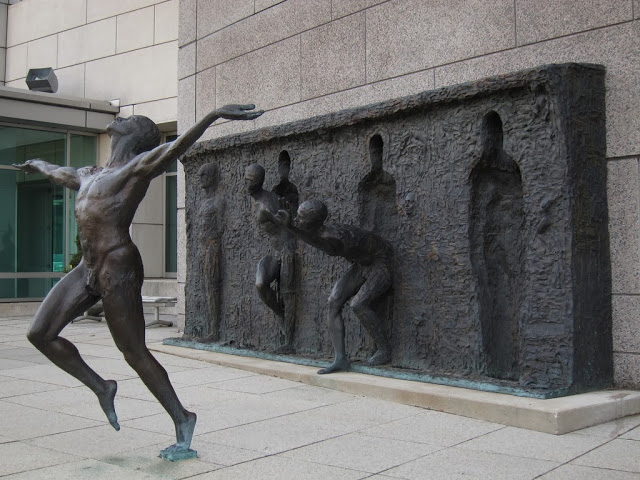
Freedom by Zenos Frudakis in Philiadelphia, Pennsylvania

Jesus said, “When an evil spirit comes out of a person, it travels through dry places looking for a place to rest, but it finds none. So, it says, ‘I will go back to the home I left.’ When it comes back, it finds that home still empty. It is all neat and clean. Then the evil spirit goes out and brings seven other spirits more evil than itself. They all go and live there, and that person has even more trouble than before. It is the same way with the evil people who live today.” (ERV) 

Nature abhors a vacuum. A tilled plot of soil will be overtaken with weeds if nothing is planted and nurtured in the turned-over dirt. The pecking order of a brood of chickens cannot handle the death of the top hen without filling the position almost immediately. And, in the spiritual realm, the exorcising of a demon will not simply leave a person empty of evil – his/her life will be filled with something in its place. 

Today’s Gospel story, told by Jesus, about the man who is delivered from an unclean spirit, is a powerful and simple narrative on the necessity of true repentance. Genuine freedom is more than getting rid of something bad and destructive; the evil must be replaced with something good and useful. That is, biblical repentance is both a turning away from ungodliness and an embrace of righteousness.

We are delivered from evil so that we can start living into the righteousness and peace intended for us. 

For example, the Apostle Paul exhorted the Ephesian believers to not only stop stealing but also to get a job and start sharing with others. They were not only to stop lying and using their tongues for gossip and slander and start using their words to speak truth that builds up others. (Ephesians 4:25-32) 

The spiritual principle is the same as the nature principle: A empty vacuum will always be filled. The man who did not fill his life with God ended up having a problem with evil seven times greater than when he started. 

If anything, or anyone, is emptied of its unhealthy elements and practices, it is imperative that the hole be immediately filled with healthy disciplines for life. 

Whether dealing with addictions, bad habits, or any kind of evil influence, a two-pronged approach is needed for its eradication. We expel the evil by replacing it with godliness. The man struggling with pornography or adultery must not only stop the behavior but take up the mantle of being a champion for women’s issues. The woman who has no healthy boundaries and allows herself to be used and abused must not only separate from the problem or person but adopt her identity in Christ as a precious child of God and enforce righteous limitations.   

None of these examples are meant to be simplistic answers to complex situations. Rather, they illustrate why so many people do not experience freedom and continue to have even greater enslavement to their passions and sufferings. 

Freedom is realized through replacing old practices with new disciplines that directly attack the old. 

We all have needs. How we get those needs met is often a mixed bag of both legitimate and illegitimate ways. In a perfect world, everyone would be aware of their needs and be able to express them to one another without shame, anxiety, or anger. Since we live on a blemished fallen planet, we end up trying to meet our needs indirectly through hustling for love, hoarding resources, and controlling others – all harmful ways which destroys souls and relationships. 

So, unless we focus on positively meeting our needs, we must go a step beyond dropping a toxic relationship, cutting up a credit card, or saying “no” to another responsibility. We often get into our mess to begin with because we are out of touch with ourselves and our needs. We need affection and encouragement, and there is no shame in needing this. We need security and safety, and there is no problem in acquiring this. There are some things we need to control, and that is okay. 

If we fail to address our needs, we might do the necessary work of deliverance, then turn right around and become worse off than before by filling the empty place of our lives with:  

  • Being all things to all people, as if we were the Messiah.  
  • Being successful so that we stay ahead of being needy.  
  • Pulling inside ourselves and trusting nobody.  
  • Distancing from our needs and pretending they are not there.  
  • Being continually vigilant so that we are never hurt that way again.  
  • Keeping a positive spin on everything, as if there is no negative stuff in the world.  
  • Challenging other’s opinions and behaviors to keep the focus off our needs.  
  • Becoming a wallflower so that we can never be the brunt of someone else’s vitriol or evil. 

Instead, we can let Jesus fill the emptiness with love, purpose, peace, joy, attention, and grace. Christ is the Savior who delivers us from evil, and the Holy Spirit is the Sanctifier who carefully applies the work of salvation to our lives.

When our hearts and minds are full of God, there is no place for the demons to get in. 

True repentance equally forsakes evil and embraces righteousness; replaces the unhealthy with the healthy; jettisons the illegitimate and seeks the legitimate; and puts away unnecessary suffering and pursues peace and joy in the Spirit.  

O God, I no longer want to live with saying I’m sorry and going right back to the old pig slop of sin. I cannot change on my own.  I need Jesus to both take away the sin and give me a new life of living for him.  Lead me not into temptation but deliver me from evil Help me to make choices that put to death the old way of life, and the courage to live into my forgiveness in the power of the Holy Spirit. Amen. 

Matthew 17:22-27 – Because We Can

When they came together in Galilee, Jesus said to them, “The Son of Man is going to be delivered into the hands of men. They will kill him, and on the third day he will be raised to life.” And the disciples were filled with grief.

After Jesus and his disciples arrived in Capernaum, the collectors of the two-drachma temple tax came to Peter and asked, “Doesn’t your teacher pay the temple tax?”

“Yes, he does,” he replied.

When Peter came into the house, Jesus was the first to speak. “What do you think, Simon?” he asked. “From whom do the kings of the earth collect duty and taxes—from their own children or from others?”

“From others,” Peter answered.

“Then the children are exempt,” Jesus said to him. “But so that we may not cause offense, go to the lake and throw out your line. Take the first fish you catch; open its mouth and you will find a four-drachma coin. Take it and give it to them for my tax and yours.” (NIV)

In ancient times, the Jerusalem Temple was designed to serve as the bridge between God and humanity. It was the place where God “came down” and accepted the offerings of the priests on behalf of the people. In Christian theology, Jesus came to this world to become the permanent bridge and the eternal temple.

Jesus saw himself as the ultimate connector who spans the great expanse between God and people. Christ ascended to heaven and gave the Spirit to his people, the Body of Christ. Basic Christian ecclesiology recognizes the Church (both individual Christians and the Church universal) as the Temple of the Holy Spirit. The Spirit is the continuing presence of Jesus on this earth. Jesus, Spirit, and Church are inextricably bonded with divine superglue to engage in the mission of being God’s Temple – the place of connection between the human and the divine.

Jesus used the situation of a question asked about taxes and the Temple to speak and illustrate the value and import of connecting with both God and others.

Why did Jesus pay the temple tax?

A “drachma” was about a day’s wage. In the time of Christ, there was a two-drachma tax which was levied by the Jewish authorities on every male Jew between the ages of 20-50. The tax was implemented to support the temple building and all the services that went into it.

The temple tax was not compulsory, so typically, the tax collectors did not impose it on the poor – which is why the collectors asked Peter whether Jesus pays the tax or not, because Jesus was poor. Jesus paid the temple tax out of humility, even though he was exempt, so to not offend and cause unnecessary scandal. Said another way, Jesus and his disciples did not have to pay the tax but instead chose to use their freedom for the benefit of others.

There is freedom in Christ. Yet, because of love, and a focus on need instead of rights, we can choose to use our freedom to serve larger purposes than just our own interests. The Apostle Paul later framed it this way:

It is necessary to submit to the authorities, not only because of possible punishment but also as a matter of conscience. This is also why you pay taxes, for the authorities are God’s servants, who give their full time to governing. Give to everyone what you owe them: If you owe taxes, pay taxes; if revenue, then revenue; if respect, then respect; if honor, then honor. (Romans 13:5-8, NIV)  

We exist to serve more than ourselves. God has purchased and adopted us through the death of Christ; we are now the Temple of the Spirit. We can emulate the Savior and choose humility to serve others. A logical question arises about all this: If I do this and focus on responsible service instead of rights, then how am I going to make ends meet?  Is any of this realistic or practical?

How did Jesus pay the temple tax?

Jesus cares about supplying needs. Jesus can and does take care of people who choose to give for the benefit of others. Jesus told Peter the fisherman to go out and fish. A crazy thing happened – Peter found not only a two-drachma coin to cover the annual tax but a four-drachma coin to cover both Jesus and Peter’s tax!  This was a powerful lesson about God’s abundant grace. 

As God’s people, we not only believe in the miraculous; we depend on miracles. We can bank on Jesus supplying our need. This is not a health and wealth gospel. Jesus was monetarily poor, so I am not sure how anyone can justify that God wants all believers to be financially rich.

There was once a man I knew who only had $100 to his name. He got to know another man who needed a suit for his job. The man with a $100 gave it all to the man who needed the suit. That man is alive and well today with all his needs met. He is not rich. However, he is quite happy. If we never need a miracle, we have never given of ourselves enough to need one.

Peter was a fisherman, so Jesus told him to fish and there was a miracle. Sometimes we might get the wrongheaded notion we must do something way outside of our given giftedness. God created each person with a unique intellect, abilities, and strengths and so, we are to use them to affect a miracle – just as Peter did.

We can have a big picture view of our shared humanity without narrow provincial views which are unable to see the vast scope of human need. And so, we can trust God to use us for divine purposes. We can exercise faith in the miraculous for both ourselves and others. We can embrace Christ’s mission in this world to such a degree that we would never consider living any other way. May we do it because we can.

God of all abundance and grace, help us to find firm ground in a shaky economy. Provide jobs for the unemployed; give us strength and peace when anxiety and worry come knocking; grant us patience when things look bleak; and, bring us the serenity of your presence so that we can do your will for the salvation of others through Jesus Christ our Lord in the power of your Holy Spirit. Amen.