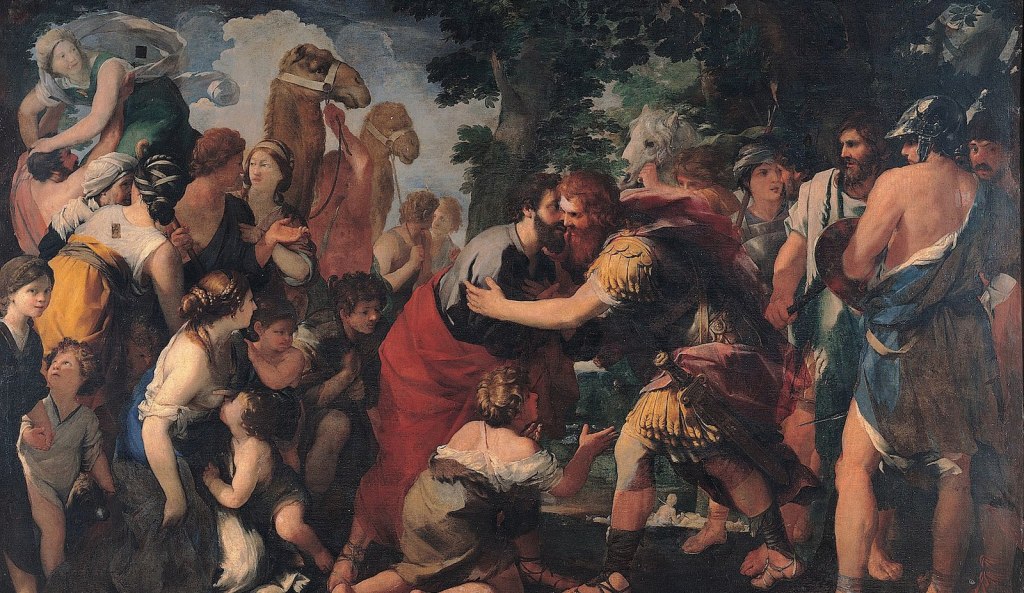
Genesis 33:1-17 – Reconciled

Meeting Between Jacob and Esau by Italian painter Bottalla Raffaellino (1613-1644)

Later that day Jacob met Esau coming with his four hundred men. So, Jacob had his children walk with their mothers. The two servant women, Zilpah and Bilhah, together with their children went first, followed by Leah and her children, then by Rachel and Joseph. Jacob himself walked in front of them all, bowing to the ground seven times as he came near his brother.

But Esau ran toward Jacob and hugged and kissed him. Then the two brothers started crying.

When Esau noticed the women and children he asked, “Whose children are these?”

Jacob answered, “These are the ones the Lord has been kind enough to give to me, your servant.”

Then the two servant women and their children came and bowed down to Esau. Next, Leah and her children came and bowed down; finally, Joseph and Rachel also came and bowed down.

Esau asked Jacob, “What did you mean by these herds I met along the road?”

“Master,” Jacob answered, “I sent them so that you would be friendly to me.”

“But, brother, I already have plenty,” Esau replied. “Keep them for yourself.”

“No!” Jacob said. “Please accept these gifts as a sign of your friendship for me. When you welcomed me and I saw your face, it was like seeing the face of God. Please accept these gifts I brought to you. God has been good to me, and I have everything I need.” Jacob kept insisting until Esau accepted the gifts.

“Let’s get ready to travel,” Esau said. “I’ll go along with you.”

But Jacob answered, “Master, you know traveling is hard on children, and I have to look after the sheep and goats that are nursing their young. If my animals travel too much in one day, they will all die. Why don’t you go on ahead and let me travel along slowly with the children, the herds, and the flocks. We can meet again in the country of Edom.”

Esau replied, “Let me leave some of my men with you.”

“You don’t have to do that,” Jacob answered. “I am happy, simply knowing that you are friendly to me.”

So, Esau left for Edom. But Jacob went to Succoth, where he built a house for himself and set up shelters for his animals. That’s why the place is called Succoth. (Contemporary English Version)

Repentance includes more than saying sorry. It also involves admitting wrong and making things right. Turning from erroneous thinking and forsaking past hurtful actions, lays the groundwork for an earnest attempt at reconciliation. 

For example, the Christian does more than a simple acceptance and acquiescence of Jesus, as if merely adding a bit of Christ to life will dash it up and make it better. Rather, we are invited into the very life of Christ. This life turns us upside-down and inside-out in a new and radical allegiance.

Repentance and reconciliation are a way of life. They are necessary skills requiring development through continual practice and use.

Broken relationships are the stuff of life. So, we need gracious approaches to deal with them so that bitterness does not take root in our souls. Connection and peace between two people are a beautiful thing. They bring emotional health, spiritual wholeness, and life enrichment.
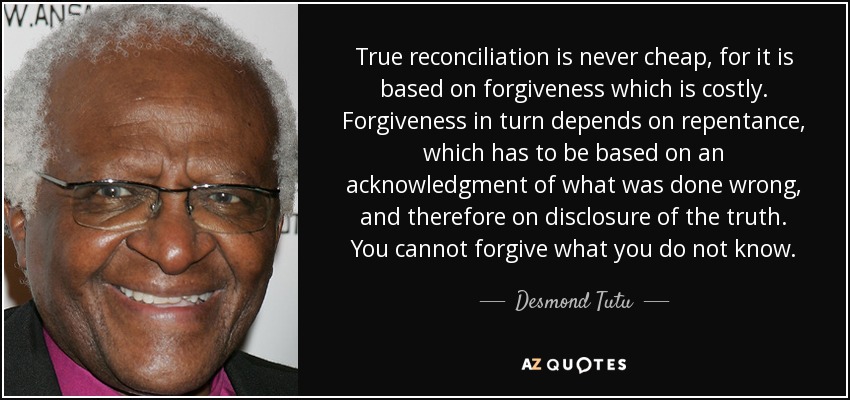
From the get-go, twin brothers Jacob and Esau in the Old Testament book of Genesis had a contentious relationship. Their relations became so bad that Esau had homicidal ideation toward his brother. Neither Esau nor Jacob handled things well. Jacob ended up leaving, finding a wife, growing a family, and becoming wealthy.

Twenty years passed before they came together again.

Jacob, knowing he was about to meet his brother, had an encounter with God. It changed his identity from the old deceiver to the new Israel (Genesis 32:22-31).  In a demonstration of his new identity as Israel, Jacob worked at making amends for his old cheating ways. He sought to give the blessing he had stolen from his brother.

Jacob understandably had some dread in meeting Esau. He had connived and manipulated to take the family birthright and blessing from his brother. Fresh from wrestling with God, Jacob demonstrated a newfound courage and humility. He offered Esau respect, gifts, and honor – reversing his past pattern of disrespect, stealing, and dishonor.

True repentance is making things right. Merely having feelings of remorse is not repentance. To repent involves genuine sorrow; an earnestness to make restitution and reconciliation; an indignation over what happened; and, perhaps most importantly, a deep concern for the person(s) harmed by our wrongdoing (2 Corinthians 7:8-11).

The reconciliation between the brothers was a surprise. Jacob was not expecting Esau’s response. It seems Jacob was bracing for the worse, which explains his high anxiety before the encounter.

Esau’s gracious response was an answer to Jacob’s prayer.  For Jacob, seeing Esau’s face was like seeing the face of God. In fact, he saw both faces and lived! Jacob likely would not have seen his brother’s face until he had first seen God’s. His divine experience prepared the way for the human encounter.

We all experience times when relationships unravel and need to be mended. Jacob procrastinated for twenty years before working at reconciliation with his brother. What made the difference for Jacob was trusting God, who always works out divine promises, despite our human foibles. 

May you know and experience the God who reconciles and restores, and in so doing, extend that same earnestness to others.

Merciful God, I confess that I have sinned against you and against others through my own fault by thought, word and deed in things done and left undone. Especially I confess that I have _____.  I therefore repent; for these and all my sins I am terribly sorry and pray for forgiveness. I firmly intend to make amends and seek for help. I ask for strength to serve you in newness of life through Jesus Christ, my Lord, in the power of your Holy Spirit. Amen.

Romans 8:1-11 – Life in the Spirit

Therefore, there is now no condemnation for those who are in Christ Jesus, because through Christ Jesus the law of the Spirit who gives life has set you free from the law of sin and death. For what the law was powerless to do because it was weakened by the flesh, God did by sending his own Son in the likeness of sinful flesh to be a sin offering. And so he condemned sin in the flesh, in order that the righteous requirement of the law might be fully met in us, who do not live according to the flesh but according to the Spirit.

Those who live according to the flesh have their minds set on what the flesh desires; but those who live in accordance with the Spirit have their minds set on what the Spirit desires. The mind governed by the flesh is death, but the mind governed by the Spirit is life and peace. The mind governed by the flesh is hostile to God; it does not submit to God’s law, nor can it do so. Those who are in the realm of the flesh cannot please God.

You, however, are not in the realm of the flesh but are in the realm of the Spirit, if indeed the Spirit of God lives in you. And if anyone does not have the Spirit of Christ, they do not belong to Christ. But if Christ is in you, then even though your body is subject to death because of sin, the Spirit gives life because of righteousness. And if the Spirit of him who raised Jesus from the dead is living in you, he who raised Christ from the dead will also give life to your mortal bodies because of his Spirit who lives in you. (New International Version)

I feel tremendously privileged to be a Christian and enjoy the very Spirit of God. The people of God are spiritual people, possessing God’s own Spirit. The Apostle Paul wanted Christians to know what they truly have as believers in Jesus.

No Condemnation

There is now no condemnation, no judgment, for those who are in Christ. God has pronounced a verdict, and that decision is final. We have been united to Christ by means of God’s Spirit. Since God condemns neither you nor I, there is no need whatsoever to condemn ourselves or other believers.

Since no condemnation is our reality as Christians, we are to believe this promise of God and swim in its wonderful privilege. 

Believe that the sin issue has been taken care of once for all through the life and death of Christ. If you do not feel forgiven, then put yourself in a position to believe. 

It would be silly to go into the bathroom, turn on the shower, and then just stand in the middle of the bathroom without getting under the showerhead. It would be silly because you did not put yourself in a position to actually become clean. You may believe that a shower and using soap and shampoo will make you clean, but if you do not actually avail yourself of the privilege of actually taking the shower but just stand there and look at it, you will not really be clean. 

We must put ourselves in a position to experience the privilege of knowing our wonderful state of cleanliness and no condemnation by actually reading the Word of God on a regular basis; praying in the Spirit on all occasions; and practicing the silence and solitude necessary to receive the cleansing work of the Holy Spirit.

Two people are declared “married” in a formal wedding ceremony. The couple then works out their shared union together over a lifetime. The minister does not pronounce condemnation at the ceremony; he declares a blessing. Yet, from that point forward, the two people must work on their marriage. They must believe their relationship is important enough to warrant putting themselves in a position to grow together. They will intentionally create date nights and conversations on the couch. They’ll seek to learn, appreciate, and participate in the other’s interests and life. 

“Grace is not opposed to effort; it is opposed to earning. Earning is an attitude. Effort is an action. Grace, you know, does not just have to do with forgiveness of sins alone.”

Dallas Willard, The Great Omission

Just as we do not marry ourselves and pronounce ourselves a married couple, so we do not save ourselves. However, having a marriage license does not mean there is no effort to be done in the relationship. A marriage is both a legal reality, and a kind of mystical union between two married persons.

It is a beautiful thing to be in a relationship where there is no condemnation. Because of Jesus Christ we are free to be the people God created us to be – forgiven and no longer burdened by sin’s condemnation.

Freedom from Sin and Death

In Holy Scripture, sin is not only a personal struggle but a present ubiquitous reality in the world. The power and presence of sin is found everywhere. There is personal, institutional, and systemic sin. Because sin is everywhere, death is everywhere. Biblically, death doesn’t only refer to physical death but is also a relational term referring to spiritual death. Death means relational separation from God. Conversely, life is relational connection with God. 

God did all the action necessary to make the union possible. God sent the Son. God became incarnate. God’s Son became a sin-offering, an atoning sacrifice for our sins. God condemned sin in sinful humanity. God met the righteous requirements of the law. God effects holiness in us by means of the Spirit. 

Rather than saving us from sin then simply telling us to live a holy upright life, God the Father and Son sent God the Holy Spirit to indwell us so that we can live like Jesus. 

Therefore, we must put ourselves in a position to experience life through dwelling in the Scriptures and letting the Spirit and the Word work together to effect practical change in our lives. 

Having the Mind of Christ

A problem we all face is that we inhabit a fallen world. Our mindset can easily get screwy. If we want life and peace, we need the mind of Christ and the Spirit. Whatever our minds are occupied with, that’s what determines whether we will have life and peace, or not. 

If the objects of our thoughts, interests, and affections are continually away from Christ and the Spirit, we will experience death, not life. If we put ourselves in a position to indulge the sinful nature, we will miss real life. A loose mind only leads to relational separation.

The addict knows very well that there are two choices, life or death. The first of twelve steps in Alcoholics Anonymous is to admit that I am powerless over alcohol and that my life has become unmanageable. The second step is to believe that a Power greater than myself can restore me to sanity. The third step is to turn my life and my will over to that Power. So, it is the same for us. 

We are powerless over sin, which will, if left unchecked, lead to death. But in the Spirit (and not in the alcoholic spirits) we have life. Sin, like alcohol, is a daily possibility, even after giving my life and my will to God. Yet, there is also the possibility of life. And that hope of life comes with possessing the mind of Christ and the Spirit. 

We have hope that through the Spirit’s power that we will overcome the power of choices that lead to death, and instead, embrace choices that lead to life. So, whatever we put into our minds is vitally important. 

The Spirit Indwelling Us

The Spirit is the sine qua non of the Christian life, that is, the distinguishing mark of the believer in Jesus. The Spirit opposes the sinful nature and expects us to do the same. There’s no need to try and live the Christian life on our own power when we possess spiritual power.

Pentecost by Edgardo De Guzman

There exists an internal struggle within us that desires to do right but has a compulsion to do otherwise. Yet, the indwelling Spirit gives us victory. Jesus lived the life for us that we could not live. His life, as much as his death, achieved salvation from sin for us. 

The very same Spirit that helped Jesus live his life, and raised him from death, is the same Spirit whom we possess.

When I was a kid, I remember my grandmother canning preserves. I would sit on a stool in the kitchen and watch her, looking forward to having some grape preserves on my next piece of toast. I once asked her, “Why are you always melting that wax over the fruit?” I didn’t understand how wax could make my toast taste any better. 

Grandma answered, “The wax seals the jar tightly so the fruit can’t be contaminated. If I didn’t seal it, the fruit would eventually rot.” As an amateur in the canning business, I could see the importance of picking grapes, boiling them, and canning them. But I now know how important sealing and preserving are.

You and I are God’s preserves. God not only chose us, redeemed us, and called us to life in the Son – God also had a plan for preserving us as heirs of eternal life. God gave us the indwelling Spirit so that we can live as we ought, free from sin and doing the will of God through spiritual power working within us. 

I hope today that you have a deep appreciation for the privileges of no condemnation, freedom from sin, possessing the mind of Christ and the power of the indwelling Spirit. And more than that, that you will avail yourselves of this tremendous gift of the Spirit and experience life and peace.

Gracious God, fill us with the knowledge of your will through all spiritual wisdom and understanding. May we live lives worthy of the Lord Jesus and please him in every way; bearing fruit in every good work, growing in the knowledge of God; being strengthened with all power according to your glorious might so that we may have great endurance and patience, joyfully giving thanks to you.  For you have rescued us from the dominion of darkness and have brought us into the kingdom of the Son you love, in whom we have redemption, the forgiveness of sins. Amen.

Hebrews 10:10-18 – Out with the Old, In with the New

Because Jesus Christ did what God wanted him to do, we are all purified from sin by the offering that he made of his own body once and for all.

Every Jewish priest performs his services every day and offers the same sacrifices many times; but these sacrifices can never take away sins. Christ, however, offered one sacrifice for sins, an offering that is effective forever, and then he sat down at the right side of God. There he now waits until God puts his enemies as a footstool under his feet. With one sacrifice, then, he has made perfect forever those who are purified from sin.

And the Holy Spirit also gives us his witness. First he says,

“This is the covenant that I will make with them
    in the days to come, says the Lord:
I will put my laws in their hearts
    and write them on their minds.”

And then he says, “I will not remember their sins and evil deeds any longer.”So, when these have been forgiven, an offering to take away sins is no longer needed. (Good News Translation)

As I sit at my computer, easily keyboarding my thoughts, it is almost inconceivable to me that I made it through my undergraduate college days in the early 1980s with a manual typewriter and notetaking with the old-fashioned pen and spiral notebook.  No cell phone, no tablet, no electronic devices aiding me through my education. Typewriters are now obsolete, along with corded dial telephones and wringer washers.

Yet even more incredible is the complete replacement of an old mundane system of ritual sacrifice to a religion of the heart in which God remembers the people’s sins no more. This is such a radical change that it would be like having self-cleaning dishes or total speech-to-text “writing” of “papers.” 

The new order of things described in Hebrews is so much more than a labor-saving device; it is a completely different system that leaves the old system obsolete forever. That is what Jesus Christ’s once-for-all sacrifice did on our behalf.

We live in a New Covenant era in which God has put divine laws on our hearts and written them on our minds. No typewriter, no computer, no keyboard necessary, because the blood of Christ has introduced a seminal change in how we relate to God. 

There is now a thorough forgiveness that no longer requires any labor, ritual, or work. Indeed, it is finished. Now, we have the privilege and opportunity of living into the new reality graciously provided for us. It is an era of great peace, joy, and goodwill.  It is so good that it would be absolutely ridiculous to go back to the old way.

So, slow down enough in this season to connect or re-connect with a most wonderful truth: Jesus Christ came to save sinners. Gratitude for our salvation from sin, death, and hell, recognized and acknowledged each day, helps to stave off living in the past.

Continually looking at a bygone era as the good old days probably wasn’t, in reality, near as great as it’s remembered. That’s because when things are hard in the present, we often reflexively retreat into the past, cherry-picking some good memories, then constructing a mental narrative without all the bad stuff which actually went along with it.

Instead, in this Advent season, Christians purposely focus upon and remember God’s merciful descent to live among humanity. Christ lived, died, rose from death, and is alive – interceding for us continually. Past and present come together in the person of Jesus.

The Word became flesh and blood,
    and moved into the neighborhood.
We saw the glory with our own eyes,
    the one-of-a-kind glory,
    like Father, like Son,
Generous inside and out,
    true from start to finish. (John 1:14, MSG)

The good news of Christianity is that we are gloriously forgiven and redeemed because of Christ, given for us, the once for all sacrifice for sin.

May this season be full of grace and wonder for you, as you pilgrim to the manger and adore Christ the newborn king.

Saving God, you have completely taken care of the sin issue once and for all through the blood of your Son.  Forgive me for my predilection to retreat into old obsolete ways of trying to earn peace and joy, instead of adopting the new, which sometimes seems almost too good to be true.  Thank you for deliverance and new life in Jesus Christ.  Amen.

Hebrews 9:24-28 – Forgiveness Is Real

Photo by Pixabay on Pexels.com

For Christ did not enter a sanctuary made with human hands that was only a copy of the true one; he entered heaven itself, now to appear for us in God’s presence. Nor did he enter heaven to offer himself again and again, the way the high priest enters the Most Holy Place every year with blood that is not his own. Otherwise Christ would have had to suffer many times since the creation of the world. But he has appeared once for all at the culmination of the ages to do away with sin by the sacrifice of himself. Just as people are destined to die once, and after that to face judgment, so Christ was sacrificed once to take away the sins of many; and he will appear a second time, not to bear sin, but to bring salvation to those who are waiting for him. (New International Version)

Jesus is the central figure of the Bible. I could preach on the finished work of Christ every Sunday and never exhaust the immensely rich implications of his death for us. 

Maybe today’s verses seem like a re-hashing of things we already know. Yet, it is important to keep plumbing the depths of Christ’s once for all sacrifice because it is through continually examining Jesus that we will experientially know our forgiveness is real. Having this reality sink deep into our souls enables us to extend forgiveness to others.

The original recipients of Hebrews were experiencing spiritual fatigue due to their difficult circumstances. The believers were so tired from swimming upstream that they considered quitting and giving up on Christianity (or at least the Church). 

The author of Hebrews truly believed that the way to combat this tiredness was through a robust understanding of Christ.  So, he sought to demonstrate that Jesus is superior to the old sacrificial system and has even superseded it. 

There are three main distinctions between the old sacrificial system and the new way of Christ. They are meant to encourage us so that we will know our forgiveness is real. This awareness will help us persevere and live for Jesus in all we say and do, until he returns.

First Distinction: Reality versus a Simulated Copy

The Old Testament sacrificial system, and its worship rituals in dealing with the sin issue, were only a copy and a shadow of the real sacrifice, which is Christ. The Temple sacrifices, in other words, were merely a facsimile of the real thing.

When my girls were small, they always enjoyed going to our local large grocery store. At that store they had a row of mechanical horses that only cost a penny to ride for one minute.  Riding the horses was always the highlight of shopping for them. Their Aunt once came for a visit and brought a coffee can full of pennies and took them to the grocery store just to ride the horses for an afternoon. 

All three of my girls are now grown adult women. They do not ride mechanical horses anymore. They now ride real live horses. My daughters, as excited as they were to ride mechanical horses as small girls, now have no desire to do so because those horses were only a simulation of the real thing.

As Christians, since Christ has come as the true and real sacrifice for sin, we are no longer to be content with simulations and copies of the real deal.  And we are to know the difference between them. Our forgiveness is neither a simulation nor a copy because Christ is the real thing. 

As my girls were growing up, my wife and I had a certain process we went through with them when they did something wrong toward one another. We would talk about the offense, and then they would need to say the words, “I am sorry.” 

However, the matter was never over until they hugged each other and told each other they loved the other. If they could do that, it was the real deal. You see, they could mouth the words to get us off their backs, but to hug and express love was the reality.

“To be a Christian means to forgive the inexcusable because God has forgiven the inexcusable in you.”

C.S. Lewis

Jesus did not just mouth words of forgiveness to us. He secured it through his death on a cross. It is not a cheap imitation kind of forgiveness. It is real. Christ died a violent death. The emphasis in Scripture on blood and sacrifice can be upsetting for many people.

Yet, we need to understand that the brokenness of this world is so bad that it requires drastic action. Christ’s death reflects the horrible sin of humanity. Since Jesus has secured forgiveness for us at such a steep price, we are to receive it with great humility and joy that God loves us that much.

Second Distinction: Once versus Endless Repetition

Jesus Christ came to deal with the sin issue once for all through his blood. He came to do away with sin, not just veneer over it. The old sacrificial system was like whitewashing a barn – it took care of the issue for a while, but it would need to be done over and over again.

We are familiar with temporary arrangements. For example, annual fees need to be paid and renewal stickers have to be put on a car’s license plate every year. Christ’s atonement, however, is no temporary arrangement. The forgiveness Jesus offers is permanent. 

There is no need to keep offering sacrifices over and over because Christ is the sacrifice to end all sacrifices. The forgiveness we possess is not like paying an annual fee and getting a forgiveness sticker for the year. In Jesus Christ, we are forgiven! And this forgiveness was purchased with Christ’s own blood.

Author Henri Nouwen once told a story of a family he knew in Paraguay. The father, a doctor, spoke out against the military regime there and its human rights abuses. Local police took their revenge on him by arresting his teenage son and torturing him to death. Enraged townsfolk wanted to turn the boy’s funeral into a huge protest march, but the doctor chose another means of protest.

At the funeral, the father displayed his son’s body as he had found it in the jail—naked, scarred from electric shocks and cigarette burns, and beatings. All the villagers filed past the corpse, which lay not in a coffin but on the blood-soaked mattress from the prison. It was the strongest protest imaginable, for it put injustice on grotesque display.

“Forgiveness means that I continually am willing to forgive the other person for not being God.”

Henri Nouwen

The cross that held Christ’s naked and marred body exposed the violence and injustice of this world. The cross revealed what kind of world we have and what kind of God we have: a world of gross unfairness, and a God of sacrificial love. Because Jesus was willing to do this on our behalf, we have forgiveness once and for all through his blood.

This world needs forgiveness – not a cheap sentimental forgiving but a real forgiveness that lasts forever. 

Third Distinction: Salvation versus Judgment

A lot of religious energy can be spent trying to figure out how to make ourselves acceptable to God. Part of the good news is that, in Christ, we do not need to fear the future.  We have been made right with God through the death of Jesus. Through Christ’s sacrifice the doors to heaven and earth get flung wide open. The way has been secured, the trail has been blazed, and the road has been made smooth to come to God.

Jesus, unlike any Levitical priest, has entered God’s presence, providing access to the living God. Christ did not need to offer sacrifice for his own sins but offered himself solely on our behalf. Jesus did more than offer the sacrifice; he himself became the sacrifice. It was a sacrifice to bring deliverance to humanity, not judgment.

Either to justify or to judge is God’s business, not ours. Our concern is to believe in the once for all sacrifice of Jesus that brings a permanent forgiveness; and, to share that life-giving message with others so that they, too, can experience deliverance from sin, death, and hell.

We can have such a hard time forgiving others because we struggle with experiencing our own forgiveness. The path to extending grace to others is in deepening our knowledge, understanding, and awareness of God’s grace in Christ.

Conclusion

The author of Hebrews meant for the Christian life to be an exciting and abundant adventure following Jesus, the pioneer of our salvation. And yet, many Christians do not know anything about this kind of life. They only see the Christian life as a duty and a chore, a kind of cross to bear. 

It is important we recognize it is our Lord and Savior, Jesus Christ, the object of our faith, who has delivered us so that we can live a new life of freedom enjoying our forgiveness and inviting others on the journey.

There was once an immigrant that booked passage on a ship with just enough money to buy a ticket, a block of cheese and some crackers for a long voyage. The first few days at sea the crackers and cheese tasted good, but eventually they became stale.

As he watched the porters carry large steaks, lobsters, chicken, beautiful salads and many other delicious foods to the other guests, he became so hungry that he finally stopped one of the porters. “I’II do anything to get one of those steaks,” he said. “I’II wash dishes, clean rooms, even mop the deck.” The porter replied, “You bought a ticket, didn’t you? The meals come with the ticket.”

Too many people today are cheese and cracker Christians—missing out on all of God’s steak dinners. All the resources of God are available to us, yet far too many of us live in self-imposed spiritual poverty. 

For he has rescued us from the dominion of darkness and brought us into the kingdom of the Son he loves, in whom we have redemption, the forgiveness of sins. (Colossians 1:13-14, NIV)

Jesus did not die on the cross and rise from the dead so that we could live ho-hum Christian lives. He has granted us forgiveness so that we will eagerly enjoy the Word of God; enjoy laboring together in the Gospel; and look forward to how the Spirit will transform lives through Christ’s forgiveness. 

Real forgiveness opens our minds, hearts, and our energies to live for Jesus, the pioneer of our salvation.