To Forgive Is Divine (Genesis 50:15-26)

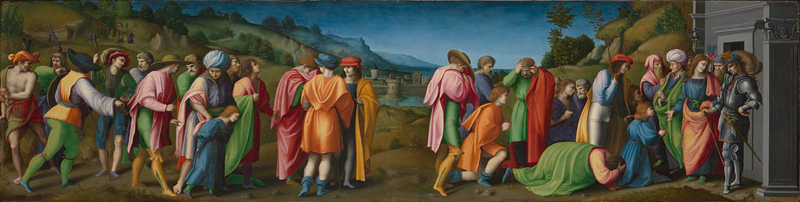
Joseph pardons his brothers, by Bacchiacca (1495-1557) http://www.nationalgallery.org.uk/paintings/NG1219

When Joseph’s brothers realized that their father was now dead, they said, “What if Joseph bears a grudge against us, and wants to pay us back seriously for all of the terrible things we did to him?” So they approached Joseph and said, “Your father gave orders before he died, telling us, ‘This is what you should say to Joseph. “Please, forgive your brothers’ sins and misdeeds, for they did terrible things to you. Now, please forgive the sins of the servants of your father’s God.”’” Joseph wept when they spoke to him.

His brothers wept too, fell down in front of him, and said, “We’re here as your slaves.”

But Joseph said to them, “Don’t be afraid. Am I God? You planned something bad for me, but God produced something good from it, in order to save the lives of many people, just as he’s doing today. Now, don’t be afraid. I will take care of you and your children.” So he put them at ease and spoke reassuringly to them.

Thus Joseph lived in Egypt, he and his father’s household. Joseph lived 110 years and saw Ephraim’s grandchildren. The children of Machir, Manasseh’s son, were also born on Joseph’s knees. Joseph said to his brothers, “I’m about to die. God will certainly take care of you and bring you out of this land to the land he promised to Abraham, to Isaac, and to Jacob.” Joseph made Israel’s sons promise, “When God takes care of you, you must bring up my bones out of here.” Joseph died when he was 110 years old. They embalmed him and placed him in a coffin in Egypt. (Common English Bible)

“All people commit sins and make mistakes. God forgives them, and people are acting in a divine way when they forgive.”

Alexander Pope, “An Essay on Criticism”

If there was anyone who had a supposed right to be bitter and unforgiving, it would be Joseph. His brothers had hated him, left him for dead, sold him into slavery, and lied to their father Jacob about him. For years, Joseph languished in servitude and prison – for no fault of his own.

And yet, Joseph was able to discern that it wasn’t his place to be the judge. At the end of his life, he had the perspective and the insight to understand that all the hardship earlier in his life was noticed by God, and then bent for good and divine purposes in the saving of many lives.

If we can keep in mind that it is God’s business to run the world, and our business to forgive others, then life will go a lot better for everyone.

Many people live discontented lives because they say to themselves, “I will not forget what you did, and I will not forgive.” Persistent thoughts of revenge only serve as a cancer that destroys the mind’s thoughts, erodes the soul, and hinders the heart’s ability to love. 

But people who practice forgiveness are much less likely to be hateful, hostile, and belligerent toward others. They are healthier and happier, and more at peace.

I’ve had many people tell me over the years, “But you don’t know what I’ve been through.” My typical response is, “You don’t know what I’ve been through, either. You may not even believe some of the things I have experienced, and some of the things that have happened to me and were said to me. So, can I tell you what I have done to forgive those who have sinned against me?”

1. When I am trying to forgive someone, I pray for them.

It’s hard to keep resenting someone and wish them ill, whenever you are praying for them on a regular basis. Joseph was the victim of his brothers’ abuse. If there was ever a dysfunctional family to grow up in, it was Joseph’s. Being sold into slavery by your own brothers and being the target of their derision would cause anyone to be upset. But, many years later, Joseph chose to forgive his brothers. He acted with their best interests at mind. He prayed for them and did not actively work against them. What’s more, he saw the hand of God in it all.

2. I write a letter of forgiveness (which I may or may not send).

In the letter I write in full detail how the person hurt me. I leave nothing out. I express exactly how it made me feel, and how it affected my life. Then, I express forgiveness and say that I will not hold the offense over their head. The following is a five-step process for forgiving others using the acrostic REACH:

Recall 

Name the hurt, and name it squarely. Don’t fudge by saying it’s not that bad, or as bad as others have experienced. Call it what it is: deceit, stealing, harassment, assault, abuse, adultery, verbal shaming, murder, etc. 

The Truth and Reconciliation Commission in South Africa after apartheid was based on providing full disclosure of all crimes. Those that stepped forward, giving a complete account of their actions, were offered a full pardon. 

Archbishop Desmond Tutu, who led the commission, was most struck by how many people wanted to hear what had happened to their loved ones from the perpetrators themselves so that they could know whom to forgive. Methinks we have much to learn from our African brothers and sisters.

Empathize

Try and see the offense from the other person’s perspective. Attempt to put yourself in the other’s shoes. This does not mean we paper over the offense; it just means we don’t demonize another as a monster. That only feeds and fuels our own lack of forgiveness. When we view others as non-human, then we feel no responsibility to forgive.

Altruistic

Choose to do the right thing and treat the other person well, not necessarily because they deserve it, but because it is within your control to extend grace. Again, this is what Joseph chose to do with his brothers. He gave them words of assurance, and promises of taking care of them and their children.

Commit

Commit to practicing forgiveness. Make the decision to do it. Don’t wait too long for your feelings to catch up to you.  

Bear with each other and forgive one another if any of you has a grievance against someone. Forgive as the Lord forgave you.

The Apostle Paul (Colossians 3:13, NIV)

Hold

Hold on to your forgiveness. Just because you make the decision to forgive does not mean you’ll never have to do it again. Once you have forgiven, let it be a stake in the ground in which you look back to it again and again, saying, “I forgave him/her, and I will not let the enemy of my soul keep trying to make me bitter about it all over again.” 

One of the reasons we repeat the Lord’s Prayer Sunday after Sunday in my church is to keep forgiving those who have sinned against us.

3. I talk to a trusted friend, mentor, or counselor about my effort to forgive.

Many people get stuck and have an inability to forgive because they don’t seek a wise person to help them walk through the process of forgiving. 

The easy path is to complain about the offense to someone we know who will react with the same level of disgust and spirit of revenge that we ourselves have in our hearts. But that only reinforces the bitterness. We must have someone who can offer us what we need to hear, and not only what we want to hear.

Forgiveness is at the heart of the gospel, and, so, ought to be at the core of a healthy spiritual life. It is always open season on offering grace, forgiveness, and reconciliation. To see all of life from a divine perspective is to forgive.

Pray like this:

Our Father who is in heaven,

uphold the holiness of your name.

Bring in your kingdom

so that your will is done on earth as it’s done in heaven.

Give us the bread we need for today.

Forgive us for the ways we have wronged you,

just as we also forgive those who have wronged us.

And don’t lead us into temptation,

but rescue us from the evil one.

If you forgive others their sins, your heavenly Father will also forgive you. But if you don’t forgive others, neither will your Father forgive your sins. (Matthew 6:9-15, CEB)

Put To Death (Acts 7:55-60)

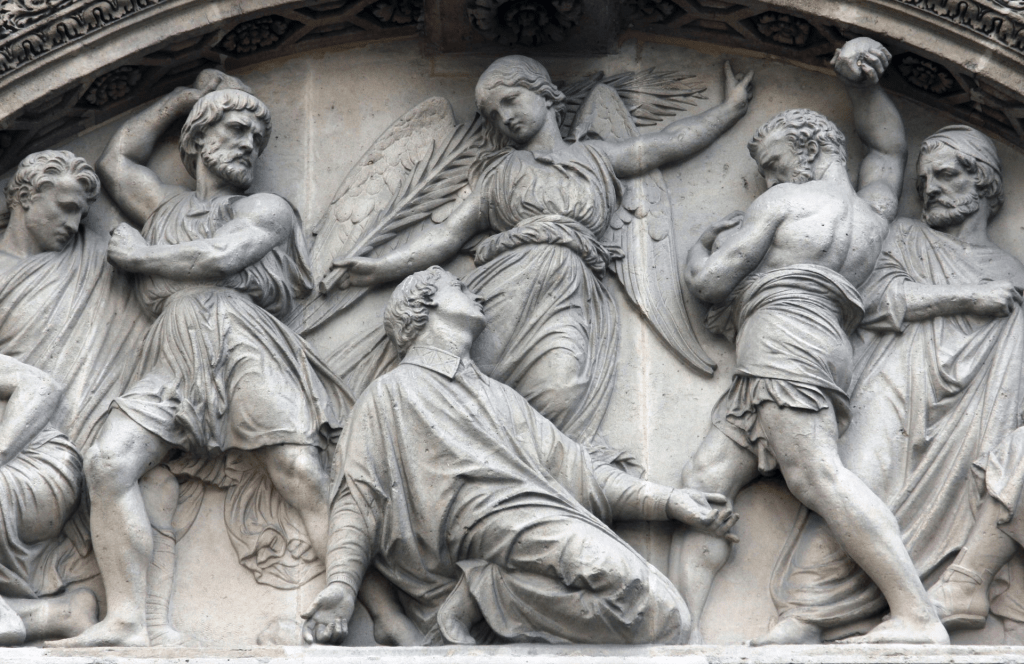
The Martyrdom of Stephen, by sculptor Gabriel-Jules Thomas (1824-1905)

But Stephen, full of the Holy Spirit, looked up to heaven and saw the glory of God, and Jesus standing at the right hand of God. “Look,” he said, “I see heaven open and the Son of Man standing at the right hand of God.”

At this they covered their ears and, yelling at the top of their voices, they all rushed at him, dragged him out of the city and began to stone him. Meanwhile, the witnesses laid their coats at the feet of a young man named Saul.

While they were stoning him, Stephen prayed, “Lord Jesus, receive my spirit.” Then he fell on his knees and cried out, “Lord, do not hold this sin against them.” When he had said this, he fell asleep. (New International Version)

Although I am a trained in biblical exegesis and hermeneutics (interpreting Scripture) I believe that most insights come from making simple observations about the text. So, I want to point out: Stephen was not martyred by the Romans, a religiously pagan group, nor Gentile people; he was martyred by those of his own ethnicity, by “God’s people.”

The religious authorities were more than just unhappy with Stephen. The Sanhedrin (the Jewish ruling council) were incensed with him, so mad that they were grinding their teeth at him. The council sincerely believed Stephen was a blasphemer of God, that what he was saying was so subversive and religiously radical, they could stone him to death with a clear conscience, as if this act were upholding God’s honor and God’s Law.

The result was not only the death of a humble man; it also sparked an intense persecution against the church which caused a new Christian diaspora (Acts 8:1-3). Many believers in Jesus found themselves as Christian refugees trying to eke out a living and worshiping Christ in foreign places.

I wish I could say the greatest opposition I’ve ever experienced as a Christian came from non-Christians who simply misunderstood and misinterpreted me. However, my most hurtful wounds have come from the hands of church folk, believing they were acting on God’s behalf by exacting an emotional martyrdom upon me with the stones of gossip, slander, backbiting, blame-shifting, and outright lying (and a few threats of violence).

Whenever I encounter persons who no longer attend church and have no intention of ever returning to any local congregation, I get it. I understand. Yet, although the church is sometimes like a woman of disrepute, I still love her, and will do whatever I can to edify her and not repay evil with evil.

Stoning a believer, either actually with physical rocks or virtually with verbal stones, is akin to persecuting Jesus himself. That’s because Christ so closely identifies with his people that it is as if he is a head, and his followers are a body – joined together in a vital union.

So, when Christ’s Body is subjected to what I call, “hermeneutical hubris,” in which one group of people insists there is only one way to interpret Scripture, and then uses their authority and structures of power to force compliance on another group, the result is persecution.

And that is precisely why Christians can abuse other Christians.

Rather than discerning that all Christians belong to God, one narrow-minded and small-hearted group excludes all other groups who disagree with them as blaspheming the name of Christ.

For example, insisting that a literal interpretation in the only means of understanding the Bible’s authority is to ignore and abuse the actual and real authority which exists with the Bible. I am in no way encouraging an “anything goes” type of approach to Holy Scripture that lets it say whatever you want it to say. 

What I am saying is that the biblical writers themselves employed different methods of interpretation, as well as the early church fathers (which is one reason I hold to the interpretive guides of the ancient Christian creeds, i.e. The Apostles’ Creed and Nicene Creed).

Far too often, churches stick to a particular interpretation because they believe they are keeping biblical fidelity. This is many times born of a fear that Christendom will be lost, and society will sink into an abyss of egregious sin. The irony is that many churches are sinking into forms of abusive and ungracious behavior by fighting battles that Scripture does not call them to fight.

The binary thinking of “I’m right and you’re wrong” is not an approach you’ll find in God’s Holy Word.

Even if the Sanhedrin in Stephen’s day intended on upholding the holiness of their God and the rightness of their cause, the impact it had on the church was martyrdom, death, and diaspora.

Unfortunately, throughout Christian history, the tables have too often turned with Christians persecuting Jews. I myself would like to avoid being the persecutor. If I kill anything, may it be putting to death my own sin – because that is what the Bible calls me to do.

Dear brothers and sisters, you have no obligation to do what your sinful nature urges you to do. For if you live by its dictates, you will die. But if through the power of the Spirit you put to death the deeds of your sinful nature, you will live.

The Apostle Paul (Romans 8:12-13, NLT)

Since, then, you have been raised with Christ, set your hearts on things above, where Christ is, seated at the right hand of God. Set your minds on things above, not on earthly things. For you died, and your life is now hidden with Christ in God. When Christ, who is your life, appears, then you also will appear with him in glory.

Put to death, therefore, whatever belongs to your earthly nature: sexual immorality, impurity, lust, evil desires and greed, which is idolatry. Because of these, the wrath of God is coming.You used to walk in these ways, in the life you once lived. But now you must also rid yourselves of all such things as these: anger, rage, malice, slander, and filthy language from your lips. 

Do not lie to each other, since you have taken off your old self with its practices and have put on the new self, which is being renewed in knowledge in the image of its Creator. Here there is no Gentile or Jew, circumcised or uncircumcised, barbarian, Scythian, slave or free, but Christ is all, and is in all.

Therefore, as God’s chosen people, holy and dearly loved, clothe yourselves with compassion, kindness, humility, gentleness and patience. Bear with each other and forgive one another if any of you has a grievance against someone. Forgive as the Lord forgave you. And over all these virtues put on love, which binds them all together in perfect unity.

Let the peace of Christ rule in your hearts, since as members of one body you were called to peace. And be thankful. Let the message of Christ dwell among you richly as you teach and admonish one another with all wisdom through psalms, hymns, and songs from the Spirit, singing to God with gratitude in your hearts. And whatever you do, whether in word or deed, do it all in the name of the Lord Jesus, giving thanks to God the Father through him. (Colossians 3:1-17, NIV)

Gracious God, as your Son humbled himself on this earth, so may your church walk continually in such humility that believers everywhere work together in unity for the sake of gospel of grace as a blessing to the world in the power of your Holy Spirit. Amen.

Jesus Shows Up (John 20:19-31)

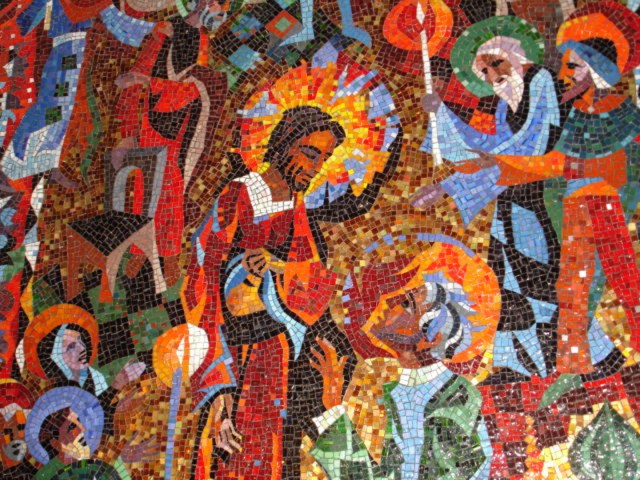
Jesus shows himself to Thomas, by Rowan and Irene LeCompte

On the evening of that first day of the week, when the disciples were together, with the doors locked for fear of the Jewish leaders, Jesus came and stood among them and said, “Peace be with you!” After he said this, he showed them his hands and side. The disciples were overjoyed when they saw the Lord.

Again Jesus said, “Peace be with you! As the Father has sent me, I am sending you.” And with that he breathed on them and said, “Receive the Holy Spirit. If you forgive anyone’s sins, their sins are forgiven; if you do not forgive them, they are not forgiven.”

Now Thomas (also known as Didymus), one of the Twelve, was not with the disciples when Jesus came. So the other disciples told him, “We have seen the Lord!”

But he said to them, “Unless I see the nail marks in his hands and put my finger where the nails were, and put my hand into his side, I will not believe.”

A week later his disciples were in the house again, and Thomas was with them. Though the doors were locked, Jesus came and stood among them and said, “Peace be with you!” Then he said to Thomas, “Put your finger here; see my hands. Reach out your hand and put it into my side. Stop doubting and believe.”

Thomas said to him, “My Lord and my God!”

Then Jesus told him, “Because you have seen me, you have believed; blessed are those who have not seen and yet have believed.”

Jesus performed many other signs in the presence of his disciples, which are not recorded in this book. But these are written that you may believe that Jesus is the Messiah, the Son of God, and that by believing you may have life in his name. (New International Version)

When Jesus shows up, there is peace. Wherever Jesus goes, the Spirit of God is there. When Jesus appears, people believe.

The Meeting

After the crucifixion of Christ, the disciples were huddled together, mostly in fear of being found out and put out by the religious authorities. Out of nowhere, Jesus showed up, smack in the middle of the anxious group of men.

Christ in the center makes all the difference. From this central place, Jesus bestowed to the disciples his peace. The very first word the risen Christ spoke to his disciples was neither a command to stop being afraid, nor a rebuke for sitting around and doing nothing, or disappointment that they all ran away in the final hour of need at the crucifixion; instead, the first word of Christ was a gift of peace.

The presence and peace of Christ melted the disciples’ fear. Christ-centered peace is graciously given; so let us gratefully receive it.

The Reality

Jesus showed up, then showed off his hands and his side. He was not fabricated out of the disciples’ imagination; he was not some ghostly apparition. Rather, Christ was standing in the middle of them, very real, very physical, and very alive.

Christ gave his disciples real truth: actual wounded hands and side on a real body. Christ is risen and alive – not just spiritually, but physically. Since the resurrection of Jesus really happened, then nothing else matters; our joy is complete. We have what we need.

The Mission

As Jesus was sent by the Father, so Jesus sent his disciples; and is still sending us out into the world. And as Jesus came not to condemn the world but to save it, so we go out with words of grace and peace. The church exists for the life of the world – to bless it with the presence and peace of Christ.

“Whoever believes in me does not believe in me only, but in the one who sent me. The one who looks at me is seeing the one who sent me. I have come into the world as a light, so that no one who believes in me should stay in darkness.” (John 12:44-46, NIV)

Our spiritual DNA makes us little Christ’s walking around, doing the will of God, for the benefit of a world in darkness. We bear the name of Christ: Christians, proclaiming a message of life, delighting in God and creation; and not destroying the earth and its inhabitants.

The Gift

Right now, we are not alone. The Holy Spirit has been graciously given to us by Jesus. Although our mission is a big one, our resource for accomplishing it is even bigger. Jesus gives the Spirit in the same way he gives himself – as a sheer gift with no strings attached. Just as God breathed life into the very first people on earth, so Jesus breathes on the disciples and gives them new life and a new heart.

I will give you a new heart and put a new spirit in you; I will remove from you your heart of stone and give you a heart of flesh. And I will put my Spirit in you and move you to follow my decrees and be careful to keep my laws… and you will be my people, and I will be your God. (Ezekiel 36:26-28, NIV)

The Privilege

Christ has redeemed us, forgave us of our guilt and shame. Now, we have the privilege of passing the forgiveness to others. The special mission of the Church is giving Jesus to others with grace and peace, so that they may believe he is truly the risen Lord; and so, receive Jesus, the Spirit, forgiveness, and purpose in life, with Christ at the center of all things.

For the one whom God has sent speaks the words of God, for God gives the Spirit without limit. The Father loves the Son and has placed everything in his hands. Whoever believes in the Son has eternal life, but whoever rejects the Son will not see life, for God’s wrath remains on them.” (John 3:34-36, NIV)

The Risen Lord, by He Qi

The Appearance

When Jesus appears, its good if we also show up to see him. It seems Thomas was late for church and missed the beginning of the service. He wasn’t with the other gathered disciples. Nobody knows where he was or what he was doing. But the important thing is that he did eventually show up, because showing up is the beginning of a changed life.

The Witness

After Jesus showed up, the disciples bore witness to what they saw and heard to Thomas. Yet Thomas, bless his doubting heart, wasn’t having it. He’s a realist. He wants proof, some actual physical evidence. Thomas was clearly a tactile learner because he needs some touch to believe any of this crazy talk of his disciple brothers.

Sometimes Thomas gets a bad rap, but he is really our Everyman. Doubt and skepticism are an important part of a full-orbed and honest faith. Jesus gave Thomas some space, time, and respect to begin wrapping his head and heart around this new reality of resurrection. I wonder if we all can do the same with others.

The Middle

A second time, Jesus shows up in the middle of the disciples. The Word became flesh and dwelt among us – and didn’t become a ghost and hang out in secret places. Once again, peace is given by Jesus to his followers.

Both appearances happen on a Sunday (which is why Christians have always worshiped on Sundays); and both meetings are literally Christ-centered (which every Christian meeting is supposed to be). Every Sunday. Christ always in the middle. Keep those two, and keep them together, and you can’t go wrong.

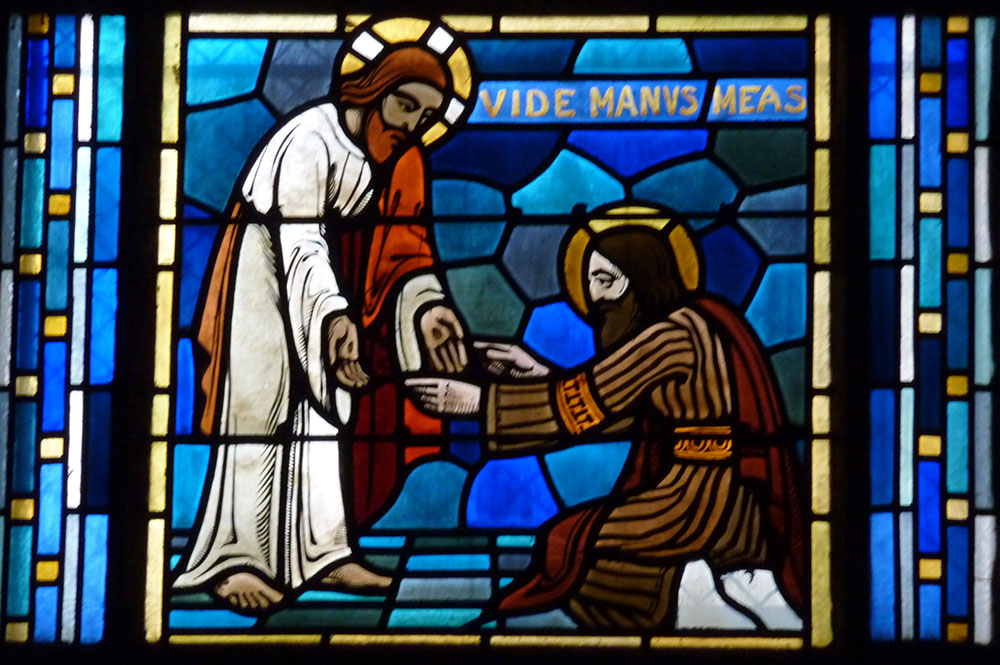
Jesus appears to Thomas with the Latin words, “See my hands,” in Notre-Dame-du-Rosaire Church, Saint-Ouen, France 

The Invitation

There’s no beating around the bush with Jesus. He immediately engaged Thomas and invited him to touch the wounds on his very real body. Christ knew Thomas’ hang-up, and went right to it. Thomas wanted evidence; Jesus offered it. If we get anything out of this encounter, it is that risen Christ honors honest doubt.

The evidence is here. Now believe it, and stop disbelieving. We have documentary evidence of the Old and New Testaments; the Church’s witness in Creeds, Confessions, and contemporary narratives of changed lives; and the internal testimony of the Holy Spirit. Therefore, look into them carefully and draw a sound conclusion.

The Confession

“My Lord and my God!” That’s the confession and the conclusion Thomas drew from the evidence – not only that Jesus is real, alive, existed, a good teacher; or other people’s Lord and God – but that he is my Lord and my God.

Jesus cared enough for Thomas to specifically meet him personally at his point of need. The grace of God keeps coming and never runs out. Jesus is filled up to the full in both grace and truth.

The Believer

Thomas had the physical evidence. But it doesn’t take that to truly believe. God blesses those who’ve never seen nor touched, but still believe. Jesus was thinking of you and me, and not only the people in front of him at the time. The Lord Jesus blesses us with the gift of peace, grace, and faith.

Though you have not seen him, you love him; and even though you do not see him now, you believe in him and are filled with an inexpressible and glorious joy, for you are receiving the end result of your faith, the salvation of your souls. (1 Peter 1:8-9, NIV)

The Conclusion

All this is for our benefit, so that we, too, may believe that Jesus is the Christ, the Son of the living God. Since Jesus is alive, he continues to bless us with his presence, power, and peace.

Jesus is with us:

  • through the Word of God, giving us his peace, showing up and meeting needs people.
  • at the Table in the sacrament of communion, bringing grace and forgiveness
  • in the person of the Holy Spirit, enabling and energizing us for mission and ministry to the world

It’s a life worth living, a Christ-centered life, full of God’s blessing.

O God and Father of our Lord Jesus Christ, in whom we receive the legacy of a living hope, born again not only from his death but also from his resurrection. May we who have received forgiveness of sins, set others free, until we enter the inheritance that is imperishable and unfading, where Christ lives and reigns with you and the Holy Spirit, one God, now and forever. Amen.

New Rules for a New Society (Ephesians 4:25-32)

We are part of the same body. Stop lying and start telling each other the truth. Don’t get so angry that you sin. Don’t go to bed angry and don’t give the devil a chance.

If you are a thief, quit stealing. Be honest and work hard, so you will have something to give to people in need.

Stop all your dirty talk. Say the right thing at the right time and help others by what you say.

Don’t make God’s Spirit sad. The Spirit makes you sure that someday you will be free from your sins.

Stop being bitter and angry and mad at others. Don’t yell at one another or curse each other or ever be rude. Instead, be kind and merciful, and forgive others, just as God forgave you because of Christ. (Contemporary English Version)

New life means being a part of a new society; and a new society means new rules to live by which benefit and uplift the entire community. Old destructive practices must be replaced with new encouraging and supportive ways of being together. Stop taking the broad easy road to destruction and start walking the hard path to life and contentment.

Stop Lying and Start Telling the Truth

Lying exists because people believe that being truthful and transparent is too traumatic. Many people don’t think that being open, honest, real, vulnerable, and genuine is worth the risk. They have believed the lie that they won’t be accepted, that they’ll lose face with others, or that people will just gossip about me if they really knew about me. So, we hide from others and avoid the truth.

In truth, we are responsible for one another – to make and keep promises to each other because that is what God does with us. Churches that love truth will make a safe place for the awkwardness of confession, forgiveness, and healing.

Truthful communities are places of hospitality where we are safe to be real. No one ought to ever suffer in silence, cry alone, or wonder whether others will forsake them. We belong to one another. Therefore, to have union with Christ is to have union with one another; you can’t have one without the other.

Stop Stealing and Start Giving

Theft comes in many forms, especially in our contemporary age. Embezzlement, shoplifting, fraud, plagiarism, and robbery are just a few examples of the ways in which we humans steal from one another.

Embezzlement is the theft of assets (money or property) by a person who has been trusted to keep those assets safe. Instead of embezzling funds, we are to steward those assets well, distributing them with care and a conscience – using them for the benefit of others, not simply ourselves.

Shoplifting involves stealing goods from retail establishments. Some people steal because they are in dire need. Many more steal because they can and want to. We must stop taking things we want, and learn to be satisfied with what we have. And we will only do this by using our own money to buy things for others who are in need.

Fraud is stealing that involves convincing the victim to surrender their money or property under false pretenses. This is nothing more than manipulating someone to get what you want. Work hard to defend the defenseless and ensure their justice, rather than commit a gross injustice against them.

Plagiarism is the practice of taking someone else’s work or ideas and passing them off as one’s own. It’s cheap. It’s easy. And don’t do it, period. Someone else worked very hard to create what you may nonchalantly use for your quick benefit. Take the pains to credit someone else’s work and document the sources you use.

Robbery is a theft that involves using violence, intimidation, or threats to obtain property. Put the threats, guns, and false confidence away. In it’s place, do whatever it takes to do things right, hold a job, and give something back to society.

Stop All the Unhelpful Talk and Start Encouraging

Corrupt or dirty talk is totally unnecessary. It’s unwholesome and benefits nobody. Rather, make it your aim to use your words for good by encouraging others.

Encouragement involves strongly urging someone to do something with an equal commitment to lovingly come alongside and help. This requires both verbal exhortations and tangible assistance. Encouragement is the glue which holds a people together. Without it, a society degenerates into watching-out-for-number-one, and destructive personal survival tactics which will say anything to get what one wants.

Stop the Bitterness and Start Forgiving

Forgiveness is choosing not to hold another’s persons offensive words or actions over their head. It is:

  • Specific to an event, action, or words.
  • A process: it takes time to truly forgive.
  • Something anybody can do, regardless of race, creed, religion, etc.
  • Hard.
  • Freeing.
  • Ongoing.
  • Gracious.

“To forgive is to set a prisoner free and discover that the prisoner was you.”

Lewis Smedes, Forgive and Forget: Healing the Hurts We Don’t Deserve

Bitterness, however, wants to hold onto a grudge and seeks to punish the one who has offended them. That’s the way of Satan, not God. Even if the person has set themselves up as your enemy, we have clear exhortations from Jesus to love our enemies and do good to them, not harm. (Matthew 5:43-48)

The world revolves on the axis of mercy, not judgment. The sooner we get in the groove of how things actually operate for us to live a good life, the better that our relationships and society will be.

Good and gracious God, we ask that you make our life journey safe as we choose integrity, not disintegration. Shed light on those who follow crooked paths. May their dishonesty be exposed so that corrections can be made before further damage occurs. Help our nations, neighborhoods, and faith communities choose a path of mercy and goodness, rather than the crooked way of lies, theft, vitriol, and grudge-bearing. May we see a new wave of integrity sweeping over our world, through Jesus Christ our Lord, by the power of your Holy Spirit. Amen.