Psalm 51:1-12 – Facing Our Darkness

Photo by cottonbro on Pexels.com

Have mercy on me, O God,
    according to your steadfast love;
according to your abundant mercy
    blot out my transgressions.
Wash me thoroughly from my iniquity,
    and cleanse me from my sin.

For I know my transgressions,
    and my sin is ever before me.
Against you, you alone, have I sinned,
    and done what is evil in your sight,
so that you are justified in your sentence
    and blameless when you pass judgment.
Indeed, I was born guilty,
    a sinner when my mother conceived me.

You desire truth in the inward being;
    therefore teach me wisdom in my secret heart.
Purge me with hyssop, and I shall be clean;
    wash me, and I shall be whiter than snow.
Let me hear joy and gladness;
    let the bones that you have crushed rejoice.
Hide your face from my sins,
    and blot out all my iniquities.

Create in me a clean heart, O God,
    and put a new and right spirit within me.
Do not cast me away from your presence,
    and do not take your holy spirit from me.
Restore to me the joy of your salvation,
    and sustain in me a willing spirit. (NRSV)

David experienced a lot of hard things. Through it all, he held fast to walking with God. Eventually, David became king. He used his power and authority to do exactly what God likes – showing grace and kindness to those in need. Except in the case of Bathsheba, another man’s wife. He made one unwise decision, which led to a bad decision, and then to another and another – until the prophet Nathan came and called David on the carpet.

Whereas King David began his reign using his royal position to show kindness, he ended up acting like any other worldly king by giving orders and using his authority to get what he wanted. Just as David sent others to do his personal bidding, God finally sent Nathan for a divine intervention.

If we confess our sins, God will forgive us. We can trust God to do this. He always does what is right. He will make us clean from all the wrong things we have done.

1 John 1:9, ERV

Nathan wisely helped David see his sin for what it really was. Irresponsibility, adultery, and murder are serious matters. The mental and spiritual gymnastics people make to justify their poor decisions always ends up devaluing what is right and making sin less heinous than it really is.

Good news can only be properly understood considering the bad news.

Without seeing our true predicament of being held in the vice grip of sin and unable to move, we will go on wondering why nothing ever goes like we want. A person who is lost, and doesn’t know it, is in the worst of situations. Calamity is just around the corner.

Like a restaurant owner who fails to see the health violations all around him, the business is about to be shut down with him scratching his head or blaming others for his misfortune. Only when the owner comes to recognize and agree with established health standards will there be a turn around and a renewed existence for the establishment.

We must agree and comply with God about how bad things really are without sugar coating any of it.

Only then can best practices be put into place which help everyone to be safe, healthy, and happy. To King David’s credit, he saw his terrible decisions and actions for what they were and faced them squarely with a repentant heart and a renovated life.

Thus, we have today’s psalm, crafted by David as a response to his own egregious wandering from how God wanted him to reign as king. David’s sin was mercifully outdone by God’s grace. The main event to the psalm is not David’s wrongs but God’s forgiveness. Prayer is the mechanism which accesses divine pardon to even the most awful of transgressions.

The appropriate posture of the devout Christian is to pray.

Specifically, to confess our great and many sins, shortcomings, and moral failures. This might sound negative and a major downer. Yet, to not look evil square in the face and call it out for what it is, is at best denial, and at worst, allows a bitter seed of unforgiveness to gestate in the depths of your soul. 

I believe one of the best ways to confront the darkness within is by using the ancient prayer book, the Old Testament Psalms. Sometimes when we pray apart from considering the psalms, our prayers go along the lines of something like, “Change my situation so I can praise you, God.” Rather, the psalms guide us toward a shift in direction by praying:

“Change me, God, because I am the problem.”

I encourage you to pray Psalm 51 out loud, slowly, with a generous amount of emotional flavor – even, and especially, if you don’t feel like it. Pray it over more than once, and perhaps several times punctuated throughout the day today. In doing so, you will be joining the faithful across the world who today offer God a prayer of subversion against the blackness on this earth.

What places in your life allow you the freedom to confess your sins?  What places seem to keep you from confession? How might a regular practice of repentance help you beyond this season of Lent?

May almighty God, who has promised forgiveness of sins to all who turn in faith, pardon you and set you free from all your sins, strengthen you for right living, and keep you in eternal life, through Jesus Christ our Lord. Amen.

Ephesians 1:7-14 – Even More Blessings!

Interior of St. Vitus Cathedral, Prague, Czech Republic

We have been ransomed through his Son’s blood, and we have forgiveness for our failures based on his overflowing grace, which he poured over us with wisdom and understanding. God revealed his hidden design to us, which is according to his goodwill and the plan that he intended to accomplish through his Son. This is what God planned for the climax of all times: to bring all things together in Christ, the things in heaven along with the things on earth. 

We have also received an inheritance in Christ. We were destined by the plan of God, who accomplishes everything according to his design. We are called to be an honor to God’s glory because we were the first to hope in Christ. You too heard the word of truth in Christ, which is the good news of your salvation. You were sealed with the promised Holy Spirit because you believed in Christ. The Holy Spirit is the down payment on our inheritance, which is applied toward our redemption as God’s own people, resulting in the honor of God’s glory. (CEB)

Believe it or not, the first chapter of Paul’s letter to the Ephesian church comprises only two sentences in the Greek language for which he originally wrote. Ephesians 1:3-14 are one sentence, and Ephesians 1:15-23 is the other sentence. Thankfully, understandably, and mercifully, English translators have created multiple sentences for us so that we can better make sense of the text. 

It’s almost as if Paul was so excited to talk with the Ephesian believers about who they are in Jesus Christ and what they possess in him that he blurted out in writing with a flurry of enthusiasm and excited fervor without stopping to take a breath or a break.

Paul stacked word after significant word on top of each other to communicate the spiritual blessings believers in Christ enjoy.

Redemption, forgiveness, insight, protection, inheritance, and salvation are just some of the blessings given. If that wasn’t enough, God has graciously given us the Holy Spirit, the Paraclete, the one who comes alongside and helps us to live into the blessings we possess because of the person and work of Christ.

It’s as if we came to Christmas day expecting a package of underwear and found instead a bunch of big boxes with some of the most lavish and expensive gifts we’ve ever seen!  This says much more about the giver than it says about us. It was according to God’s good pleasure in Christ that believers in Jesus have such privileges.  Like the parent who sits back and watches the unpackaging of presents happen with great joy, so God delights and is pleased with the gifts given to us. 

First and foremost, in the entirety of Holy Scripture, all the stories and narratives, teachings and writings, are about God. The Lord of all creation is both the subject and object of each book of the Bible. Every good thing we have in this life is because of God’s grace. Each positive experience is a direct result of God’s steadfast love toward people. All good gifts come from a good God who is delighted and pleased to give them.

Not even one of us purchased our own gifts and stuck them under the tree. God bought them all with the precious blood of Jesus and sent the Spirit to deliver them to us. 

Take some time today in a quiet place and reflect on just one of the words in today’s New Testament lesson. Think about redemption or forgiveness, salvation, or grace, or any of the words which grab you. Say it repeatedly, quietly, and loudly, thoughtfully and with flavor. Consider what God did to bring you that gift.  Contemplate the way(s) in which you have received the gift.  Plan one way in which you might share your gift with another person.  Then, give glory and praise to God for the grace lavishly given to you.

May your meditation lead to a deeper appreciation of what God has done for you; and may that revelation result in praise, honor, and glory to the One who accomplished so much on our behalf.

Gracious God, you have revealed and made known the way of deliverance from the power of darkness and brought me into your marvelous light.  Help me to better understand all the ways you have acted on my behalf so that my life might reflect your grace and steadfast love to the world, through Jesus Christ, my Savior, in the enablement of the Holy Spirit.  Amen.

Hebrews 9:23-28 – Once for All

Ethiopian Orthodox Church icon of Christ’s crucifixion

It was necessary for the sketches of the heavenly things to be purified with these rites, but the heavenly things themselves need better sacrifices than these. For Christ did not enter a sanctuary made by human hands, a mere copy of the true one, but he entered heaven itself, now to appear in the presence of God on our behalf. Nor was it to offer himself again and again, as the high priest enters the Holy Place year after year with blood that is not his own; for then he would have had to suffer again and again since the foundation of the world.

But as it is, he has appeared once for all at the end of the age to remove sin by the sacrifice of himself. And just as it is appointed for mortals to die once, and after that the judgment, so Christ, having been offered once to bear the sins of many, will appear a second time, not to deal with sin, but to save those who are eagerly waiting for him. (NRSV)

Once for all. Those few words are some of the most gruesome and beautiful in the entirety of Holy Scripture.  The sacrifices of bulls and goats in the Old Testament had its place. Yet, those were mere shadows pointing to the reality of the Messiah – the one whose sacrifice is so potent as to do away with sacrifice forever.

The cross of Christ was the once for all sacrifice that has settled the sin issue forever.

This is the heart of New Testament good news. Forgiveness of sins comes through the sheer grace of God in Christ. Through faith, we have the privilege of entering new life. Jesus has paved the way for eternal life, everlasting salvation, and complete remission of sins.

If it has not yet become self-apparent as to why Christ’s once for all sacrifice is such a game changer, then let’s perceive the cross from this angle: guilt is done away with, forever. Do you believe your life would change forever if you never had guilt hanging over your head?  What if all your past indiscretions, unhealthy life decisions, failures to speak or act when needed, overt things done which you cannot take back, or even the little things said or done in anger or hate were all washed away, forever?

Just as Jesus was nailed to a cruel cross, so guilt and shame was nailed there – once for all. There are three options of dealing with a guilty conscience when it happens…

Rationalize

First, you can rationalize it away, as if you have no responsibility or no culpability. One simply ignores their conscience. This is a one-way path to hardness of heart. Whenever we sin in speech or in action, and do not acknowledge it as our fault, then there is a little piece of us which hardens. The next time it happens, it’s a bit easier to respond with callousness. If you’ve ever encountered someone who seems utterly unfeeling to your situation, then there has likely been a pattern in that person’s life of keeping distance from pain. It only leads to hardness of heart.

Punish

A second way of facing guilt is just the opposite of rationalization. It is to punish and beat yourself for your faults and sins. Heaping abuse on ourselves for our sins takes two different tracks with either: discouragement, defeat, and depression resulting in inaction; or, working like crazy to try and earn God’s favor with hyper-activity. Both ways are a kind of self-imposed penance to try and atone for one’s sins or failures.

Confess

Fortunately, there is a better way to face and deal with our guilt. When there is true guilt for things done or undone, said, or unsaid, we must confess it, repent of it, and believe God has taken care of it. Unlike dealing with guilt in unhealthy ways resulting in callousness, discouragement, and hyperactivity, the path of confession and repentance allows the person to have a clear conscience, resulting in freedom. Christ’s once for all sacrifice is completely able to clear the conscience of the worshiper so that they may live into the grace and freedom of an enjoyable daily life. 

Nothing needs to hang over the believer’s head because Jesus Christ, the pioneer of our salvation, has accomplished deliverance from and forgiveness of sin, once and for all. Jesus didn’t just put a nice-looking veneer over sin; he took care of it, thoroughly and completely. Jesus didn’t whitewash things so that we looked okay; the salvation he offers is permanent.

The cross which held Christ’s naked and tortured body exposed the true violence and injustice of sin. The cross revealed what kind of world we have and what kind of God we have: a world of gross unfairness and sin, and, a God of extreme sacrificial love and grace.

What I believe this world, including you and me, need more than anything else is forgiveness – not a cheap sentimental forgiving, but a real forgiveness which lasts forever.

To justify or to judge is God’s business. Our business is to believe in the once-for-all sacrifice of Jesus that brings permanent and lasting forgiveness; and, to share that life-giving message with others so that they, too, might experience deliverance from sin and its horrible effects.

“For he delivered us from the domain of darkness and transferred us to the kingdom of his beloved Son, in whom we have redemption, the forgiveness of sins.” (Colossians 1:13-14, NIV)

May you know the freedom and joy today which comes from knowing Christ as Savior.

Matthew 9:2-13 – Why Jesus Came

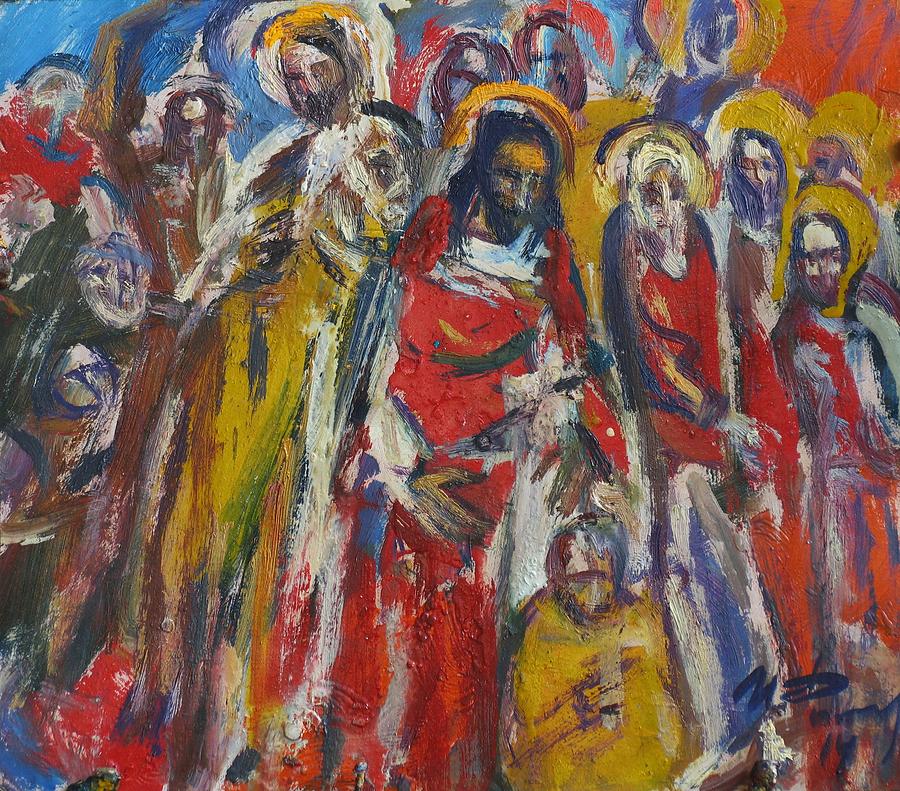
Healing by Russian painter Ivan Filichev

Some men brought to Jesus a paralyzed man, lying on a mat. When he saw their faith, Jesus said to the man, “Take heart, son; your sins are forgiven.”

At this, some of the teachers of the law said to themselves, “This fellow is blaspheming!”

Knowing their thoughts, Jesus said, “Why do you entertain evil thoughts in your hearts? Which is easier: to say, ‘Your sins are forgiven,’ or to say, ‘Get up and walk’? But I want you to know that the Son of Man has authority on earth to forgive sins.” So, he said to the paralyzed man, “Get up, take your mat and go home.” Then the man got up and went home. When the crowd saw this, they were filled with awe; and they praised God, who had given such authority to man.

As Jesus went on from there, he saw a man named Matthew sitting at the tax collector’s booth. “Follow me,” he told him, and Matthew got up and followed him.

While Jesus was having dinner at Matthew’s house, many tax collectors and sinners came and ate with him and his disciples. When the Pharisees saw this, they asked his disciples, “Why does your teacher eat with tax collectors and sinners?”

On hearing this, Jesus said, “It is not the healthy who need a doctor, but the sick. But go and learn what this means: ‘I desire mercy, not sacrifice.’ For I have not come to call the righteous, but sinners.” (NIV)

The late Abigail Van Buren, better known as the newspaper columnist, “Dear Abby,” was the person who made famous the phrase: “The church is a hospital for sinners, not a museum of saints.” That quote is an accurate reflection of what Jesus was doing and saying. We occasionally need words like Dear Abby’s to remind and reorient us toward why the church exists.  

The church of the Lord Jesus does not remain on this earth solely for our benefit, any more than a hospital exists for the benefit of the doctors or insurance companies! Rather, the church lives to extend the mission of Jesus through proclamation of good news with the restorative touch of grace. The church’s calling is not to find others who can help them with their tithing and keep warm seats in the pew. Instead, the church is the community of the redeemed, gathered and sent to be the continuing presence of Jesus on this earth.

Some who are reading this are not healthy. Some are sick with sin; others are heart-sick; yet others are plain sick-and-tired of being sick-and-tired. Jesus came neither to condemn nor heap a pile of unrealistic expectations on us. Christ points us to the source of healing and change and invites us to admit our need and come to him. 

Conversely, many others today are healthy, spiritually alive, and well. It is our job to roll up our sleeves and serve, participating fully in the mission of Jesus to the world. The question I want us to grapple with is this: Why did Jesus come to this earth? The answer to that question is to also answer the question of our own purpose and existence as followers of Christ.

Jesus came to forgive sin and transform sinners.In today’s Gospel healing, it was a case where the person’s sin was connected to his paralysis – and the paralytic found in Jesus not only physical healing, but new spiritual life.

The religious insiders observed the healing. Yet there was no rejoicing by them about the transformation. Instead, they became hung up on Jesus claiming to be God. Granted, this was a hard truth for them to get a hold of. But Jesus labeled such thinking as evil – the inability to see and perceive the situation as a divine intervention, and that Jesus really is the Lord who graciously did it. Because they wrongly discerned who Jesus is, they wrongly interpreted the situation. 

Therefore, it is important to see Jesus as the Human One who extends compassion and forgiveness. If we fail to see this about Christ, we will get caught up in all kinds of silly matters of personal preference and ridiculous power plays, based in how we think things should go, rather than the gospel.

Jesus came to forgive sin. Healing the body is good but not enough. Just focusing on the physical well-being of individuals was not why Christ came. At the heart of the human condition is spiritual brokenness, and Jesus is all about taking away guilt and shame, creating a new person and a new community. It is a radical vision which seeks to encompass all persons – which means Jesus touched many people overlooked by others.

Jesus came to call the despised people of society, the “sinners.” He called Matthew, a tax collector. Tax collectors were hated. They were corrupt characters who extorted money from innocent people. Jesus not only called the despised Matthew but had dinner with him and all his unsavory buddies. This kind of behavior by Jesus was deeply offensive to upstanding citizens.

However, Jesus did not back down. He responded by saying that it is not the healthy who need a doctor, but the sick. And he backed up his social actions with Scripture by encouraging offended folks to meditate on what this biblical phrase means: “I desire mercy, not sacrifice.” (Hosea 6:6)

For I desire mercy, not sacrifice, and acknowledgment of God rather than burnt offerings.

hosea 6:6, niv

It is possible to engage in outward rituals of worship, do all the right things, fulfill our duty, yet still miss the heart of God wants for humanity. Mercy is what God wants. Jesus knew this. So, Christ entangled himself with sinners to bring spiritual healing and restoration.

When Corrie Ten Boom sought to bring deliverance of the Jews from the Nazis during World War II, she had to entangle herself with Jewish refugees. When Christian missionaries seek to be the light of Jesus to people, they must entangle themselves with the people’s culture. If we want to see God deliver people from their situations, we must entangle ourselves with them, into complicated lives that are not pretty, with persons who have been tainted by sin. 

Lots of people are in awful predicaments. Christians, like their Lord, will need to get their hands dirty and their feet wet to extend Christ’s ministry of mercy and forgiveness. The gospel was never intended to be proclaimed from afar, but up close and personal through entanglement in people’s lives. If the merciful mission of Jesus is to occur, it requires the following three activities:

  1. Intimacy with Jesus. Engaging in the spiritual disciplines of prayer, giving, fasting, reading, and meditating on Scripture are the activities which help us to know Christ better and know and how to respond with mercy.
  2. Intimacy with fellow believers. We are hard-wired by God for community. Superficial relationships can only provide superficial community. Christians need to help one another with spiritual growth. They must hold one another accountable for the mission of Christ.
  3. Intimacy with “sinners.” This world is filled with sick, needy, hurting, lonely, unhealthy people who are locked in unhealthy patterns of living. They need a merciful change of life that comes from the merciful Jesus acting through merciful Christians. 

Mercy, not judgment, is at the heart of all change. If we desire others to be different, we will need to be acquainted with the mercy of God.

Most merciful God, we confess we have sinned against you in thought, word, and deed, and by neglect. We have not held fast to your commandments and have strayed from your teachings. We turn from our self-centered actions and pride. For the sake of your Son, Jesus Christ, have mercy on us and forgive us so that we are released from anything that seeks to keep us from delighting in your presence. Empower us with your wisdom, revelation, and discernment so that we might be your merciful hands, feet, and words to one another and those who do not yet know you. Amen.