Luke 14:25-33 – The Cost of Being a Disciple

Large crowds were traveling with Jesus. And turning to them he said: “If anyone comes to me and does not hate father and mother, wife and children, brothers and sisters—yes, even their own life—such a person cannot be my disciple. And whoever does not carry their cross and follow me cannot be my disciple.

“Suppose one of you wants to build a tower. Won’t you first sit down and estimate the cost to see if you have enough money to complete it? For if you lay the foundation and are not able to finish it, everyone who sees it will ridicule you, saying, ‘This person began to build and wasn’t able to finish.’

“Or suppose a king is about to go to war against another king. Won’t he first sit down and consider whether he is able with ten thousand men to oppose the one coming against him with twenty thousand? If he is not able, he will send a delegation while the other is still a long way off and will ask for terms of peace. In the same way, those of you who do not give up everything you have cannot be my disciples. (New International Version)

The goal of the Christian life is to be a disciple, and to do the work of discipleship. “Disciple” is another word for “follower.” We are to be faithful followers of Jesus; and the Church is to engage in the task of inviting others to join us along the way of following Jesus.

Jesus made it clear to the large crowds of people following him that the disciple’s life and work of discipleship (following Jesus) is to be of highest importance to us – it is why we exist as the Church. We are to discover what this kind of life entails, and we are to decide volitionally and intentionally to follow Jesus in every area of our lives with everything we have. 

Therefore, it is necessary to carefully consider the implications of Christ’s words to us and weigh the cost of following Jesus. 

Discipleship (following Jesus) requires obedience. Love of family must not stand in the way. Jesus said we are to “hate” family and even self. In our culture, we typically use the words “hate” and “love” as descriptions of our emotions or feelings. However, in Scripture, love and hate are primarily terms of allegiance or priority. 

In other words, Jesus is saying that our primary loyalty must clearly lie with following him over every earthly relationship. To follow Jesus means that we will not use family responsibilities to avoid obeying Christ, nor use other commitments to work or school as a reason to put our cross down.

The bottom line is this: In this life, with all its competing loyalties, the call of Jesus to discipleship not only takes precedence, but it also redefines all the other loyalties we have. 

The call of discipleship involves some detachment from other things in order to pursue following Jesus. All of life is to be infused with being a disciple and doing the work of discipleship. If we insist on making other commitments and loyalties as high a priority as following Jesus, we will find ourselves in a pickle. 

Several years ago, I took a trip with some other church leaders into the Canadian wilderness. We were so far out in the boonies that we needed special first aid training because if someone got hurt it would be hours before help could come. We canoed the lakes, carrying our backpacks and canoes between the lakes for an entire week.

Whatever we took with us, we had to carry. Some people thought they needed all kinds of clothes and other accessories. Not far into the week, they quickly began to leave things along the trail and learned, over time, to see that what they thought was important in their life wasn’t really important to what they were doing.

We must get back to basics and do what is essential; and what is of most importance is following Jesus. An un-salty disciple is worthless. Making a commitment to Christ without counting the cost is foolish.  Discipleship was never designed to be easy; it was intended to be a public display that Jesus is Savior and Lord in every area of my life. 

That means we will struggle with questions such as: 

  • How do I be a faithful follower of Jesus in my family? 
  • How do I be a disciple, and do the work of discipleship at work? 
  • How do I practice following Jesus in my neighborhood, and everywhere I go?

If we do not plan to follow Jesus at home and in the world, we won’t, because all kinds of competing loyalties will take over if we are not intentional about being disciples and making disciples. 

Everything and everyone is to take a back seat to Jesus, who is to be our primary loyalty.  Jesus used two examples to illustrate that we need to count the cost of discipleship. In the first, a builder plans and should ensure that he has enough money and materials to complete the entire structure. 

We must take stock to finish what we have started; if we started well with Christ, we need to do whatever it takes to finish well as a disciple of Jesus. What will we do when the going is difficult?

“Jesus has many who love his kingdom in heaven, but few who bear his cross. He has many who desire comfort, but few who desire suffering. He finds many to share his feast, but few his fasting. All desire to rejoice with him, but few are willing to suffer for his sake. Many follow Jesus to the breaking of bread, but few to the drinking of the cup of his passion. Many admire his miracles, but few follow him in the humiliation of the cross.”

Thomas à Kempis, The Imitation of Christ

We only know real joy whenever we give up pursuing happiness. In God’s upside-down kingdom, to live is to die, and to die is to live. Until we grasp this, we will be endlessly frustrated with our circumstances and other people.  

The second illustration from Jesus is of a king and war. The king makes a battle plan, and if he thinks he cannot defeat the opposing army, he wisely seeks a peace treaty. My friends, no one is going to oppose God and win, so it is best to make peace. 

Rather than trying to fit Jesus into our calendar, we are to let our calendar fill out around the center of following Jesus. If we insist we are too busy for prayer; do not have time for daily reading of the Scriptures; for loving one another; for making disciples (which requires much time and effort) then we have lost our way and must listen to this call of Jesus to be his disciple.

What then, shall we do?  

Imagine that in our heart is a big conference room: a big table, leather chairs, coffee, bottled water, and a whiteboard. A committee sits around the table in your heart. There is the social self, the private self, the work self, the sexual self, the recreational self, the religious self, and others.

The committee is arguing and debating and voting, constantly agitated and upset. Rarely can they come to a unanimous, wholehearted decision. We may tell ourselves we are this way because of so many responsibilities or too little abilities. Yet, the truth is that we’re just divided, unfocused, hesitant, and not free. 

One way to deal with the situation is to invite Jesus onto the committee. Give him a vote, too. But then he becomes just one more complication. A better way is to say to Jesus, “My life isn’t working. Please come in and fire my committee, every last one of them. I hand myself over to you. I am your responsibility now. Please run my whole life for me.” 

Being a disciple of Jesus is not just adding Jesus. It is also subtracting the idols that are in our hearts. Saying that we belong to Jesus means that he will come in with a whip, overturn tables, and throw out a bunch of people.

If you are ready for that, pray with me…

Almighty and everlasting God, from our recliners and comfortable chairs, we solve all the world’s problems. We take people to task for what they say and do, without lifting a finger to be a part of the solution. We are too often de-sensitized to your mercy and compassion because we are not involved in your dream for all people to be your disciples. 

Remove the scales from our eyes and lift the indifference from our hearts, so that we may see your vision – a vision of people following Jesus in the mission of being disciples and of making disciples. 

Transform our lives, so that we may accomplish your purpose. 

Anoint us with your Spirit that we might bring good news to the oppressed, bind up the brokenhearted, and proclaim release to the captive. 

Give us a new urgency to reach out to those whom no one else will touch, to accept the unacceptable, to embrace the enemy, to do justice and love mercy. 

Surround us with your love, fill us with your grace, and strengthen us for your service. Empower us to respond to the call of Jesus – to deny ourselves, take up our crosses, and follow Christ our Lord, in whose name we pray. Amen.

Mark 10:17-22 – Jesus Intervenes

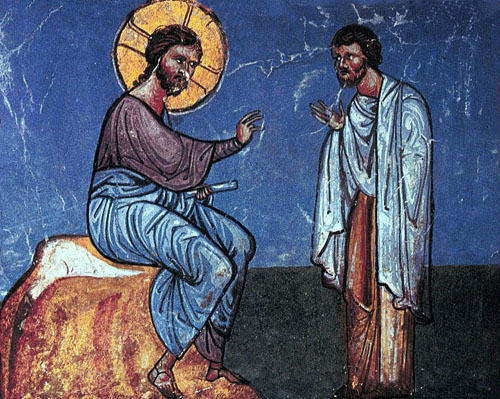
Eastern Orthodox mural of Jesus and the rich man

As Jesus started on his way, a man ran up to him and fell on his knees before him. “Good teacher,” he asked, “what must I do to inherit eternal life?”

“Why do you call me good?” Jesus answered. “No one is good—except God alone. You know the commandments: ‘You shall not murder, you shall not commit adultery, you shall not steal, you shall not give false testimony, you shall not defraud, honor your father and mother.’”

“Teacher,” he declared, “all these I have kept since I was a boy.”

Jesus looked at him and loved him. “One thing you lack,” he said. “Go, sell everything you have and give to the poor, and you will have treasure in heaven. Then come, follow me.”

At this the man’s face fell. He went away sad because he had great wealth. (New International Version)

We are all addicts. 

We all have our own sin addictions which keep us stuck in guilt and shame.

We may not all struggle with the same sin. Yet we all have some besetting sin(s) that we must be weaned off of. The most pervasive addiction found in Holy Scripture is neither substance abuse nor alcohol – it is the addiction to wealth and money.

Maybe your initial response was of someone else, besides yourself: “I don’t have as much money as____” or, “So-and-so has a real problem with that!” Those statements are what we call, in terms of addiction, denial. 

In truth, all of us are in some sort of denial about how much we really trust in paychecks, bank accounts, investments, and owning material stuff. I’m no exception. I own more books than I’ll be able to read in a lifetime, and yet, I tend to believe I don’t have enough of them.

Even the poor can have an addiction wealth and money by thinking about it and wishing for it to an unhealthy degree, as if wealth is the thing that will ultimately make them happy.

People in denial rarely have any idea how much they are hurting others, themselves, and God.  In fact, the consistent witness of the early church fathers is that the sheer accumulation of stuff is the same as stealing from the poor. 

Because of denial, people need an intervention. They need to be jolted back to their senses. Intervention is a gift. Someone cares enough about the person to intervene. Yet, interventions don’t always work. The person can choose to walk away and refuse to change.

Jesus did a gracious intervention with a rich young man. The man was addicted to wealth and money, but he didn’t see it. In fact, he thought he was quite godly and spiritual. It’s a sad story because the man walks away untransformed by his encounter with Jesus and did not accept the gracious invitation to follow the Lord. 

Chinese depiction of Jesus and the rich man, 1879

The man simply did not see himself as hopeless and desperately needing to change. He held to his denial.

The man approached Jesus with a question: “What must I do to inherit eternal life?” Whereas I would probably get all excited about being asked a question like this and launch into some long-winded gospel answer, Jesus immediately picked up on the attitude and the need behind the question. 

What must I do to get? It’s almost as if the man wants to acquire eternal life like he would acquire wealth. “I am a successful businessman with plenty of money, and a respected citizen with lots of wealth – now I want to be a success with God, as well.” 

The question may have been sincere, yet it was misguided. Eternal life is not spiritual real estate for an upwardly mobile person to acquire and possess. The man seems to believe he can purchase eternal life, as if everyone has their price, even God. “After all,” he may have been reasoning, “I have gotten everything else in life, so why not obtain eternal life?”

Jesus questioned the question. He went after the underlying assumption of doing something good to obtain eternal life. The fact of the matter is that the man cannot do anything. He can’t because only God is good. Jesus points him to God by changing the action from getting to entering. And he changed the language from a market acquisition to entering into a journey.

Jesus was inviting the man to walk with him.

Eternal life is a journey of faith in the God who is good, and not a transaction to get it. And, we too, must be careful not to treat eternal life as if it were a transaction, as if we must get a person to sign on the dotted line through a “sinner’s prayer” or some other formula that will seal the deal for eternal life. 

Instead, eternal life is a walk of obedience with God and his commands.

Jesus responded to the rich man with the Ten Commandments, specifically the ones which focus on human relationships. Jesus wanted him to realize that the path into the kingdom of God and eternal life goes through and not around how we treat our fellow human beings.

Christ and the Rich Young Ruler by Heinrich Hofmann, 1889

The Lord sought to expose the impossibility of continuing in life on the rich man’s terms. The guy just could not imagine what he might be lacking. So, Jesus helped him out. Christ gave him some major interventional language…. Sell. Give. Follow.

Sell everything. Give to the poor. Come, follow me.

One cannot simply add Jesus to their life, like adding a new car or a new fishing rod. Rather, one’s heart must change in order to accommodate real, genuine eternal life. 

Jesus offered the rich man someone to be, rather than something to get

It’s one thing to give from what you have; it’s another thing to surrender your life and all you have. 

In the New Testament Gospels, there are no easy conversations with Jesus. He gets personal in every encounter and gets under everybody’s skin. Christ doesn’t settle with superficial small talk when there are people whose hearts are little more than idol factories. 

Jesus never leaves us alone, because there is always the invitation to “Come, follow me.”

Christ exposed the wealthy man’s divided loyalties – he was trying to serve both God and money. But he would have to choose between the two. 

And that is our choice, as well. 

The question for us is not, “Am I completely devoted to money?” Instead, the question from our Gospel story today is, “Am I trying to serve God while maintaining a moonlighting job with the world?” 

God wants from us an undivided heart; the Lord desires absolute allegiance.

Jesus is looking for those who are poor in spirit, who recognize their great need for God – instead of believing that they are okay and just need to add a little Jesus to their lives. 

God is looking for spiritual beggars who understand their desperate situation and don’t practice denial by sugar-coating their actual spiritual state.

Like a drunkard who won’t give up his vodka; like a sex addict who won’t give up strip clubs or emotional affairs; or like a workaholic who just can’t come home; the rich man would not give up his disordered love for money and possessions. 

So, Jesus did an intervention. 

The Lord Jesus didn’t ask everybody to do exactly as he called the rich man to do. He didn’t ask the very wealthy Zacchaeus to do it, and he didn’t tell Peter to sell his fishing business. 

But Jesus does tell us to do something which seems impossible. Yet, where the impossible exists, so exists grace.

Blessed Lord, you have taught us that all our doings without loving generosity are worth nothing. Send your Holy Spirit and pour into our hearts your gift of love, the true bond of peace and of all virtues, without which whoever lives is counted dead before you. Grant this for the sake of your only Son Jesus Christ, who lives and reigns with you, in the unity of the Holy Spirit, one God, now and forever. Amen.

Luke 9:51-62 – The Cost of Following Jesus

As the time approached for him to be taken up to heaven, Jesus resolutely set out for Jerusalem. And he sent messengers on ahead, who went into a Samaritan village to get things ready for him; but the people there did not welcome him, because he was heading for Jerusalem. When the disciples James and John saw this, they asked, “Lord, do you want us to call fire down from heaven to destroy them?” But Jesus turned and rebuked them. Then he and his disciples went to another village.

As they were walking along the road, a man said to him, “I will follow you wherever you go.”

Jesus replied, “Foxes have dens and birds have nests, but the Son of Man has no place to lay his head.”

He said to another man, “Follow me.”

But he replied, “Lord, first let me go and bury my father.”

Jesus said to him, “Let the dead bury their own dead, but you go and proclaim the kingdom of God.”

Still another said, “I will follow you, Lord; but first let me go back and say goodbye to my family.”

Jesus replied, “No one who puts a hand to the plow and looks back is fit for service in the kingdom of God.” (New International Version)

“The will of God, to which the law gives expression, is that men and women should defeat their enemies by loving them.”

Dietrich Bonhoeffer, The Cost of Discipleship

In his earthly ministry, Jesus made it clear to the large crowds of people following him that the life of a disciple is of utmost importance. People are to discover what following Jesus truly entails. They are to count the cost of Christian discipleship.

Following Jesus in Christian discipleship requires radical obedience. 

Love of family must not stand in the way. Jesus insisted our primary loyalty must lie with following him over every earthly relationship. To follow Jesus means that we will not use family responsibilities to avoid obeying Christ or use other loyalties and commitments to work and/or school as a reason to lay down our cross. 

This talk of Christian discipleship might smack of being like a cult. I don’t believe it is. Whereas a cult typically requires a radical withdrawal from the world so that the leader has complete control over the group, Jesus requires a radical engagement with the world.

Following Jesus is meant to impact the world with grace and love. Jesus went out of his way to not be like other leaders who use power, control, and gaslighting as the means of ruling and leading. Instead, Jesus shares his power with others. Christians are to bless the world and be involved in it.

The call of Jesus to Christian discipleship not only takes precedence, but it also re-defines the other loyalties we have. 

This call involves some level of detachment in order to pursue following Jesus. All of life is to be infused with being a disciple of Jesus. If we insist on making other commitments and loyalties as high a priority as following Jesus, we will find ourselves torn between two masters. 

Several years ago, I took a trip with some other church leaders into the Canadian wilderness. We were so far out in the boonies that we needed special first aid training because, if someone got hurt, it would be hours before help could come. 

We canoed the lakes and carried our backpacks and canoes between lakes for an entire week. Whatever we took with us, we had to carry. Some people thought they needed all kinds of clothes and other accessories. Not far into the week, they quickly began to leave things along the trail and learned, over time, that what they thought was important in their life, wasn’t really important to what they were doing.

It’s good to get back to basics and do what is essential. And what is of most importance is following Jesus. 

An un-salty disciple is worthless. Making a profession of Christ, without counting the cost, is foolish. Christian discipleship was never designed to be easy; it was intended to be a public display that Jesus is Savior and Lord in every area of life. That means we will struggle with questions, such as: 

  • How do I be a faithful follower of Jesus in my family? 
  • How do I be a disciple, and do the work of discipleship at my job? 
  • How do I practice following Jesus in my neighborhood, and everywhere I go?

If we do not plan to follow Jesus at home, at work, in the neighborhood, and in the world, we won’t, because all kinds of competing loyalties will take over.

Christians need to be very intentional about being disciples who loyally follow the words and ways of Jesus.The going will get difficult. And that’s okay.

“Jesus has many who love his kingdom in heaven, but few who bear his cross. He has many who desire comfort, but few who desire suffering. He finds many to share his feast, but few his fasting. All desire to rejoice with him, but few are willing to suffer for his sake. Many follow Jesus to the breaking of bread, but few to the drinking of the cup of his passion. Many admire his miracles, but few follow him in the humiliation of the cross.”

Thomas à Kempis, The Imitation of Christ

“Anyone who does not carry his cross and follow me cannot be my disciple.”

Jesus (Luke 14:27)

Joy comes not by pursuing happiness; it comes through discovering that to live is to die to self. Until we come to grips with that reality, we will likely be frustrated with our circumstances and other people.  

So, rather than trying to fit Jesus into our calendar, we are to let our calendar fill-out around the center of following Jesus. If Christians feel too busy for prayer; or for daily reading of Holy Scripture; or for loving one another; or for making disciples, then they have lost their way and must listen to the call of Jesus to be his disciple.

How, then, shall we live? What shall we do?

“Jesus stands between us and God, and for that very reason he stands between us and all other people and things. Christ is the Mediator, not only between God and people, but between person to person, between humanity and reality.”

Dietrich Bonhoeffer, The Cost of Discipleship

Imagine that in our heart is a big conference room including a big table, leather chairs, coffee, bottled water, and a whiteboard. A committee sits around this table in your heart. There is the social self, the private self, the work self, the sexual self, the recreational self, the religious self, and others.

The committee is arguing, debating, and voting. They’re agitated and upset. Rarely can they come to a unanimous, wholehearted decision.

We tell ourselves we’re this way because of our many responsibilities or our high level of stress. Yet, the truth is that we are internally divided, unfocused, hesitant, and feeling trapped. 

One way of dealing with this situation is to invite Jesus to come sit as a committee member. Give him a vote, too. But then he becomes just one more complication.

A better way is to say to Jesus, “My life isn’t working. Please come in, become my CEO and fire my committee, every last one of them. I hand myself over to you. I am your responsibility now. Please run my whole life for me.” 

Being a disciple of Christ is not just adding Jesus; it is also subtracting the idols that are in my heart. 

Following Jesus is not for the faint of heart; it is for those who humbly acknowledge that Jesus is the way, the truth, and the life. This is the path of Christian discipleship. Let’s give Jesus his due: our very lives.

Gracious and almighty God, all hearts are open to you, all desires known, and no secrets are hid. Cleanse the thoughts of our hearts by the inspiration of your Holy Spirit so that we may perfectly love the Lord with all our hearts and magnify the holy Name of Jesus Christ our Lord. Amen.

Luke 9:18-27 – Jesus Makes All the Difference

Christ the Redeemer, Rio De Janeiro, Brazil

Once when Jesus was praying in private and his disciples were with him, he asked them, “Who do the crowds say I am?”

They replied, “Some say John the Baptist; others say Elijah; and still others, that one of the prophets of long ago has come back to life.”

“But what about you?” he asked. “Who do you say I am?”

Peter answered, “God’s Messiah.”

Jesus strictly warned them not to tell this to anyone. And he said, “The Son of Man must suffer many things and be rejected by the elders, the chief priests and the teachers of the law, and he must be killed and on the third day be raised to life.”

Then he said to them all: “Whoever wants to be my disciple must deny themselves and take up their cross daily and follow me. For whoever wants to save their life will lose it, but whoever loses their life for me will save it. What good is it for someone to gain the whole world, and yet lose or forfeit their very self? Whoever is ashamed of me and my words, the Son of Man will be ashamed of them when he comes in his glory and in the glory of the Father and of the holy angels.

“Truly I tell you, some who are standing here will not taste death before they see the kingdom of God.” (New International Version)

In my work as both a church pastor and hospital chaplain, not to mention just being a regular guy, I rarely encounter people who characterize Christians as setting self-interest aside to follow Jesus completely with humble ministry which is willing to suffer on behalf of others.

Instead, I daily interact with folks who have long left the Church with stories of Christians squelching genuine questions about God and faith; being judgmental toward others who are not like them; having a hypocritical double-standard approach to most issues; and verbally abusing individuals who don’t conform to their cultural ideas and biblical interpretations.

We need Christians who make a difference in this world. We need Jesus.   

A right and real confession of Jesus by his Church speaks a relevant word into the culture; proclaims the gospel of grace (not judgment); and consistently and lives what it believes.

Confessing Jesus as Lord makes all the difference.

After interacting with a lot of people on their ministry journeys, Jesus asked two questions of his disciples: “Who do people say I am?” and “Who do you say I am?” Out of all the questions we can ask people, these are two good ones: “Who do others say Jesus is?” and “Who do you say Jesus is?”  

The disciples gave a variety of answers, which is to be expected. Today, you will also get variegated answers, such as, Jesus is a good teacher, a model humanitarian, a myth or a legend. A few times I’ve been told that Jesus was an alien from another planet. My all-time personal favorite response is that Jesus was a nudist and that if we all just took off our clothes, there would be peace in the world.

Although the disciples are sometimes clueless, Peter as the spokesperson, gave an insightful answer: “You are God’s Messiah.” 

Messiah or Christ literally means, “The Answer.”  Peter confessed Jesus as being The Answer, the person for whom it all comes down to. Peter may not have fully understood what he was saying, but he said it, nevertheless.

Being called by God makes all the difference.

“The Answer” was revealed to Peter by the heavenly Father. Faith in Jesus Christ is a gift given to us by God.

“My Father has entrusted everything to me. No one truly knows the Son except the Father, and no one truly knows the Father except the Son and those to whom the Son chooses to reveal him.” (Matthew 11:27, NLT)

Peter was blessed – not because he did anything to deserve it – but because of sheer grace. It was revealed to Peter who Jesus really is, The Answer. We know who God is and who Jesus is by revelation, by God’s gracious self-revealing to people. Scripture is God’s revelation, a self-disclosure. It is through Scripture that we know. 

Revelation isn’t just a matter of waiting for some spiritual zap to occur, in which God bonks me in the brain and deposits the knowledge and understanding of who Jesus is. 

Peter put himself in a position to know by obeying the voice of Jesus to follow him. Then, Peter got to know Jesus over time.

Since it took years of being with Jesus for Peter and the other disciples to make a right confession of faith, then we need to have a great deal of patience for others, as well as ourselves. Others need time to get to know us, they need some time in the Scriptures, and they need some time with Jesus, too.

People do not typically come to a right confession of Jesus without having spent a good deal of time around us and within Holy Scripture.

Denying self, taking up our cross, and following Jesus makes all the difference.

God chooses to use you and me. The Lord only knows why. We are most certainly an imperfect people. Yet, it seems that our imperfections are the very thing God keeps using to reveal Jesus to others. Another way to put the matter is this: Genuine openness and vulnerability is needed, and not perfection or keeping up a tidy appearance.

Most people aren’t crazy about the word “vulnerable.”  We might expect openness in others yet have no intention of being vulnerable ourselves. If you have ever poured out your heart to someone or a group of people and only got blank stares in return; sincerely loved someone and they did not love you back; shared your genuine thoughts on something important to you and received only criticism; well then, we may believe vulnerability is a bad thing and not worth the emotional effort.

However, Jesus became vulnerable – descending from heaven, submitting to the machinations of evil persons, and exposed on a cruel cross. (Philippians 2:5-11)

In the Gospel of John, Mary displayed vulnerability in pouring expensive perfume on Jesus’ feet and wiping them with her hair, all the while exposing her true feelings for her Lord. In return, Mary got pushback and criticism from Judas. But Jesus upheld Mary’s actions and told Judas to leave her alone. (John 12:1-8).

In the Psalms, even a cursory reading reveals a boatload of vulnerability on the part of the psalmists. They were unafraid to explore the depth of human emotion, misery, joy, and praise of God.

Maybe we need the person who will stand up and say they are finally learning patience by being among a group of really annoying co-workers. Perhaps instead of laboring so hard to keep our thoughts and emotions in check, we need a church environment that lends itself to a person bawling their eyes out, while others just sit and cry with them.

That kind of vulnerability won’t happen unless we ourselves are real with God, who is never fooled by our deceitful hearts. Our evil-radar might be carefully attuned to others’ sin, but we are woefully inept at identifying the blackness within ourselves.

Jesus became completely exposed, naked, abandoned, alone and vulnerable on a cruel cross. Yet, instead of being shamed by the whole thing, Jesus scorned the shaming power of his crucifixion and embraced the suffering as the means of victory for our salvation. 

Vulnerability might seem ugly, but it turns whatever it touches into beauty. God can change our weakest, worst, and most shameful places into incredible strength and newfound love.

The broken and despised, the struggling and the lost, are the ones worthy of God’s kingdom. 

Whenever we are too afraid to walk into the mud of people’s lives, including our own, and are enamored instead with every spiritual shiny thing that comes along, we may have lost sight of our Lord, whom we are to imitate in his vulnerability. 

Christians don’t  have all the answers. But we do know the One who knows all things.

Methinks people will be drawn to Jesus when they observe Christians forsaking the path of the self-righteous prick, in favor of the humble servant who loses their life, only to find it.