Lord, Have Mercy (Mark 10:46-52)

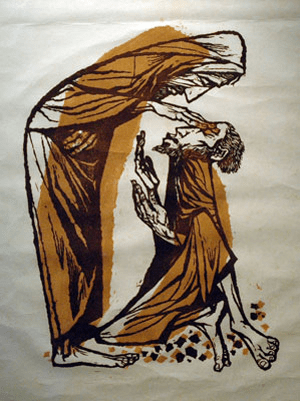
“Christ Healing the Blind Man” by Robert Hodgell

Then they came to Jericho. As Jesus, his disciples, and many people were leaving Jericho, a blind beggar named Bartimaeus, son of Timaeus, was sitting by the road. When he heard that Jesus from Nazareth was passing by, he began to shout, “Jesus, Son of David, have mercy on me!”

The people told him to be quiet. But he shouted even louder, “Son of David, have mercy on me!”

Jesus stopped and said, “Call him!” They called the blind man and told him, “Cheer up! Get up! He’s calling you.” The blind man threw off his coat, jumped up, and went to Jesus.

Jesus asked him, “What do you want me to do for you?”

The blind man said, “Teacher, I want to see again.”

Jesus told him, “Go, your faith has made you well.”

At once he could see again, and he followed Jesus on the road. (God’s Word Translation)

“I’d like to live my life so close to the bottom that when the system collapses I don’t have far to fall.” Dorothy Day

This is one of my very favorite stories in the entirety of Holy Scripture. And I will tell you why….

Because Jesus listens with ears of mercy

Jesus was headed to Jerusalem and had a lot on his mind and his heart. He knew what was coming, that his passion and death awaited him. No one would fault Jesus for not hearing a blind man shouting. But Jesus was listening so that he might hear someone just like the needy blind man. Rather than being distracted and lost in his head, Jesus was just the opposite – being attentive and aware of the humble folk right in front of him.

The Lord is always and continually listening for honesty and vulnerability. His ears of mercy are specially tuned, even today, for those who cry out to him from a place of genuine openness and humility.

Because Jesus speaks with words of mercy

Once Jesus listened, he responded by asking a question. I am impressed with Jesus throughout the Gospels. Christ gave people the gift of choice. He acknowledged people and respected them by not simply and indiscriminately healing, as if he were some fix-it guy. Jesus Christ bestowed on the lowliest of people the human dignity of choice by empowering them to answer a question.

Whereas everyone around Bartimaeus was looking down on him, both literally and figuratively, Jesus granted him the gift of dignity and basic human kindness – which are gifts we can all bestow on one another.

Because Jesus pays attention with a divine appointment of mercy

Our Lord took the time to heal blind Bartimaeus. Jesus could have simply healed him without even stopping his journey. He could have just waved his hand and the man would be healed. What’s more, Jesus could have even started a healing factory where everyone with a need got healed: bring ‘em in, move ‘em out, and keep the line moving!

Jesus was doing more than giving sight; he was giving a man the blessing of time and personal attention. The Gospel is never impersonal, which is why we ought to resist being non-relational in ministry to others. Christian ministry isn’t simply about meeting a need; it’s about blessing other people with the gift of relationship.

Coptic Church icon of Christ healing the blind man

Because Jesus reaches out with the touch of mercy

Jesus touched the man’s eyes (included in Matthew 20:29-34). He didn’t have to do that. The Lord of all most certainly could have healed without touching. In fact, it most likely may have been downright gross. A lot of people had eye diseases with runny pussy eyes in the ancient world.

Because the blind man didn’t listen to the crowd

I really love that! Maybe it’s the rebel in me. I just believe it is such a beautiful thing whenever someone refuses to be shamed by another and embraces their need. That is exactly what the blind man did. He not only refused to give-in to peer pressure, but he also responded to them by shouting all the louder. May his tribe increase!

Blind Bartimaeus teaches us that, when we know Love is there, we can freely acknowledge our needs, our wants, and our pain. With Jesus, who is Love incarnate, it doesn’t matter what anyone else thinks around us; there is no pretense, no propping up a false self to present for others to see. The true self is able to express what is really on the inside.

Because the blind man could actually see

In truth, Bartimaeus already had sight – not physical sight but spiritual eyes which could see better than anyone else in the crowd. One of the great ironies throughout the Gospels is that the sighted crowd seems to never see who Jesus really is, while blind folk see Christ clearly for who he is: the Son of David, the rightful king, the Savior of all.

It matters not how much faith one possesses; but it very much matters in whom that faith is placed. A thimble-full of faith is enough to move mountains, whereas a water tower full of misplaced faith in someone else cannot even provide a single glass of refreshment.

Because the blind man followed Jesus

Throughout the healing ministry of Jesus, there were plenty of persons who simply walked away and went about their lives after receiving what they desired. Yet, Bartimaeus, now given the gift of physical sight, immediately started following Jesus on the road.

This account feels a lot like my own testimony of experiencing the love of God in Christ and not ever wanting to leave it. So, I’ve been following Jesus for over forty years, still profoundly grateful in my heart for the One who loves and heals.

Because one lowly non-descript blind man made a difference

I don’t think Bartimaeus ever set out to change the world. And yet, he did. Here we are reading his testimony all these millennia later. One person, becoming a simple follower of Jesus and living a life of discipleship, changes a crowd from being a group of shushing church ladies to a robust throng of worshipers.

One individual makes a difference. Don’t let anyone tell you otherwise.

Lord Jesus Christ, Son of God, have mercy on me, a sinner.

Lord Jesus Christ, Son of David, heal me, a broken person.

Lord Jesus Christ, Son of Man, help me, a lost and lonely individual.

Lord have mercy, Christ have mercy, Lord have mercy on my love-starved soul and grant me your peace.

Amen.

Pride Comes Before the Fall (Luke 22:31-33, 54-62)

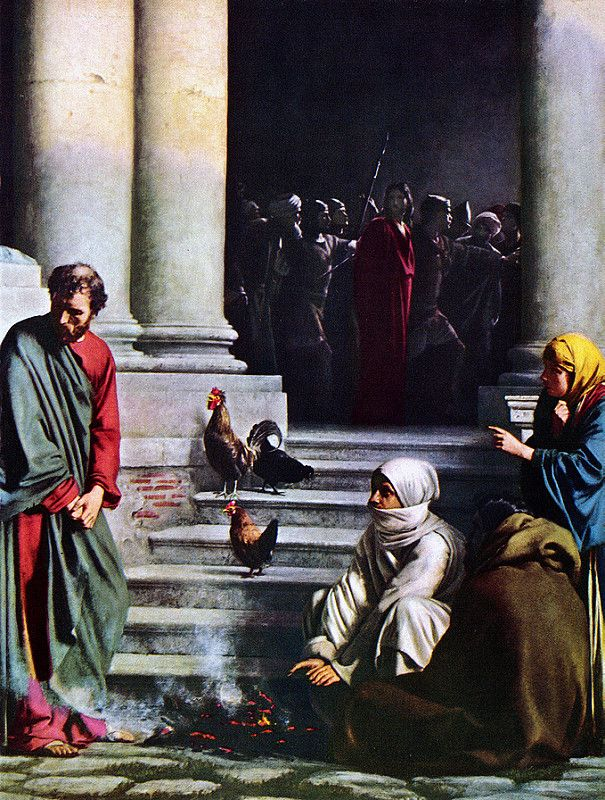
The Denial of Peter by Carl Bloch (1834-1890)

“Simon, Simon, Satan has asked to sift all of you as wheat. But I have prayed for you, Simon, that your faith may not fail. And when you have turned back, strengthen your brothers.”

But he replied, “Lord, I am ready to go with you to prison and to death….”

Then seizing Jesus, they led him away and took him into the house of the high priest. Peter followed at a distance. And when some there had kindled a fire in the middle of the courtyard and had sat down together, Peter sat down with them. A servant girl saw him seated there in the firelight. She looked closely at him and said, “This man was with him.”

But he denied it. “Woman, I don’t know him,” he said.

A little later someone else saw him and said, “You also are one of them.”

“Man, I am not!” Peter replied.

About an hour later another asserted, “Certainly this fellow was with him, for he is a Galilean.”

Peter replied, “Man, I don’t know what you’re talking about!” Just as he was speaking, the rooster crowed. The Lord turned and looked straight at Peter. Then Peter remembered the word the Lord had spoken to him: “Before the rooster crows today, you will disown me three times.”And he went outside and wept bitterly. (New International Version)

A Lesson In Trust

One day I watched a lifeguard handle a group of kids for their first time in the pool. She went to each one and told them to put their ears in the water and their belly buttons in the air while she was holding them up. “When I count to three, you won’t feel my hands underneath you, but they’re there,” she said. 

Most of the kids frantically jerked their knees toward their chins and flailed their arms.

Even though nearly all people float when they assume a posture of rest, many believe they’ll sink, and don’t keep their posture for long. 

The disciples had a hard time trusting Jesus. They couldn’t seem to rest and relax because Jesus said and did things that they were not expecting him to say and do. 

Jesus preached the necessity of humility and loving one’s enemies; and he focused on ministry to the least persons around them. The disciples had not yet really bought into Christ’s kingdom agenda because they kept pulling their knees up by thinking Jesus was going to lead a rebellion against the Romans and put Israel back on the map – believing it would be just like the old days of Jewish domination of the land.

But Jesus is all about a different agenda: transformation of the inner person that leads to greater submission to God’s will so that the least persons among us will be reached.

Bad News Before Good News

Many already believe they know what God wants and how to follow Jesus, and so, aren’t much open to the Spirit. They acknowledge they’re sinners, yet don’t believe their sin is as bad as others. “O, sure, we sin, but not like murderers and child molesters. Our sins are ‘respectable’– a little resentment, a little prejudice, and a little gossip is even necessary to make sure people submit to the unwritten rules.”

We must first hear the bad news before we can hear the good news. Once we hear the bad news and accept it, we must receive God’s remedy for it. In order to do this, let’s compare and contrast two disciples: Peter and Judas.

Peter’s Denial, 17th Century Ethiopian

Peter and Judas

Peter and Judas shared a similar vision about seeing Israel restored to its previous glorious prominence. Judas was a Zealot, ready to take military action, if necessary; and Peter had no problem taking up the sword when it seemed the time was ripe for a political rebellion and takeover.

Even though Peter insisted he would never turn on Jesus, Jesus knew better. And, sure enough, Peter did a full-fledged moral belly flop in the pool of denial by disowning Jesus three times.

Judas actually caught on, quicker than Peter, that Jesus wasn’t going to lead a military coup. Judas had enough of wasting time on poor marginalized people; they weren’t going to make good soldiers. After Judas clearly saw that Jesus had no intention of forcing an earthly political kingdom, he actively sought an opportunity to betray him.

Neither Judas or Peter, nor any of the disciples wanted to take a step into the world of suffering as the means of reaching others and embracing the kingdom of God. They wanted glory not suffering. But Jesus chose the cup of suffering.

Both Judas and Peter realized after denying Jesus that they had made a terrible mistake. But that is where the similarities end. 

Judas realized what he had done, and so, went out and died by suicide. Rather than throw himself upon the mercy of God, Judas tried to atone for his own sin. He tried to fix something that could not be undone. It was a refusal of grace.

Peter responded by weeping bitterly, consistent with someone experiencing repentance. He realized he was poor in spirit and mourned over his sin. Peter later becomes a genuinely meek person with God’s righteousness taking root within him as he, in the book of Acts, demonstrated mercy and became a preacher of truth and grace.

The Need for Transformation

There cannot be systemic and structural renewal without personal transformation. And there cannot be personal transformation without a brutally honest assessment of myself. “I will never fall,” comes from a heart of pride that believes “I’m not so bad.”

Our sins and failures stem ultimately from a lack of trust. We keep pulling our knees up because we are too anxious to let the agenda of Jesus control our lives. 

Proud people don’t pray much because they are self-sufficient. But humble people pray a lot because they don’t want to fall into temptation. They pray because they discern they’re prone to being like a cockeye little dog who thinks he is a big dog. 

Even Jesus felt the need to watch and pray so that he could face his hour of pain and suffering on behalf of all mankind.

Following Either Close or From a Distance

Jesus was arrested and Peter followed him at a distance. If we are brutally honest with ourselves, this too, describes much of our own following of Jesus. We want to see how everything will shake-out before we commit. 

Christ is asking us to trust him, to make and keep promises before we even know what it all means. We need to acknowledge and admit that we have commitment-it is; we have made a mess of our lives by our stubbornness and holding on to our own ideas for how we think things ought to go.

If you find yourself in a mess, whether it is of your own making or of somebody else, the only thing that can handle it is a close following of grace. We are to approach God with brutal honesty, humility, and a willingness to rest and relax when he is telling you to. 

The Lord will give you his righteousness; you need not try to obtain it on your own. So, let the knees go down and stick the belly button out – rest in Jesus.

2 Peter 2:1-10a – Beware of Spiritual Predators

But there were also lying prophets among the people then, just as there will be lying religious teachers among you. They’ll smuggle in destructive divisions, pitting you against each other—biting the hand of the One who gave them a chance to have their lives back! They’ve put themselves on a fast downhill slide to destruction, but not before they recruit a crowd of mixed-up followers who can’t tell right from wrong.

They give the way of truth a bad name. They’re only out for themselves. They’ll say anything, anything, that sounds good to exploit you. They won’t, of course, get by with it. They’ll come to a bad end, for God has never just stood by and let that kind of thing go on.

God didn’t let the rebel angels off the hook but jailed them in hell till Judgment Day. Neither did he let the ancient ungodly world off. He wiped it out with a flood, rescuing only eight people—Noah, the sole voice of righteousness, was one of them.

God decreed destruction for the cities of Sodom and Gomorrah. A mound of ashes was all that was left—grim warning to anyone bent on an ungodly life. But that good man Lot, driven nearly out of his mind by the sexual filth and perversity, was rescued. Surrounded by moral rot day after day after day, that righteous man was in constant torment.

So, God knows how to rescue the godly from evil trials. And he knows how to hold the feet of the wicked to the fire until Judgment Day.

God is especially incensed against these “teachers” who live by lust, addicted to a filthy existence. They despise interference from true authority, preferring to indulge in self-rule. (The Message)

I wish everyone who claims the name of Christ was safe to talk to, interact with, and share life together. However, not everyone is. *Sigh*

Unfortunately, there exists spiritual predators who create chaos, keep others off-balance, and speak and act in ways that benefit their own consolidation of authority. They are like Sith Lords who come-off as well-meaning but always have a secret agenda for more power and control. *Sigh*

So-called teachers and leaders are not all trustworthy. Like mosquitoes drawn to warm blood, they seek to feast on the godly, taking advantage of their good nature – slowly, carefully, and insidiously draining the life out of them. All the while, the true believer doesn’t know what’s going on until it is too late. *Sigh*

Some are even more sinister. Like tarantulas, they immobilize their victims and slowly suck out their insides with the prey’s full awareness. Unable to scream or seek help, they lie in silent pain wishing for a miracle. *Sigh*

Yet, at the same time, none of those false teachers, emotional manipulators, and spiritual charlatans are putting anything over God. The Lord sees it all – and is incensed about it. The ungodly, masking as benevolent authorities, will not be able to carry-on with their hidden agenda of evil forever. Their time will run out. Judgment Day is coming.

The Lord knows how to deliver victims from their victimization. It rarely comes fast enough for us. Nevertheless, the destruction of all injustice is just around the corner. But how do we deal with all the unethical and immoral behavior now!?

We stay the course. Do not give-in to the temptation to play another’s Machiavellian game. The Christian life begins with humility, is sustained by a gentle spirit, embraces right ways of being with others, and typically results in trouble, even persecution. (Matthew 5:1-12)

We strive to always live into personal peace and be peacemakers. We understand that he who is within us is greater than he who is in the world. (1 John 4:4)

We choose to love and pray for our enemies, all the while being wise as serpents and gentle as doves. (Matthew 5:44, 10:16)

We embrace patience and persevere through each frustratingly mad situation, knowing that the Lord has promised to be with us, even until the very end of the age. (James 5:7-12; Matthew 28:20)

We give no one a reason to speak ill of us, blessing others and not cursing them. (Titus 3:2; James 4:11; Romans 12:14)

We trust God in all things, while being careful not to put a pearl necklace around a pig. (Proverbs 3:5-6; Matthew 7:6)

We keep encouraging and affirming others, even when we don’t get encouragement and affirmation ourselves. (Ephesians 4:29; 1 Thessalonians 5:11; Hebrews 3:13)

We stick to a community of people with like-minded values and refuse to withdraw into isolation. (Galatians 6:2; Philippians 1:27-30)

We follow Christ, our true Teacher and Lord, one day at a time, one step at a time – focusing continually on his words and ways as our polestar through the morass of confusion and iniquity. (Matthew 16:24; John 8:12, 10:27, 12:26; 1 Peter 2:21)

Jesus knew the sobering truth of spiritual predators acting as godly when he said:

Not everyone who calls me their Lord will get into the kingdom of heaven. Only the ones who obey my Father in heaven will get in. On the day of judgment many will call me their Lord. They will say, “We preached in your name, and in your name we forced out demons and worked many miracles.” But I will tell them, “I will have nothing to do with you! Get out of my sight, you evil people!” (Matthew 7:21-23, CEV)

May you remain encouraged in faith, steadfast in hope, and forever in love with the Savior who has loved you and given himself to you.

Christ, light of light, brightness indescribable, the wisdom, power and glory of God, the Word made flesh: you overcame the forces of Satan, redeemed the world, then ascended again to the Father. Grant me, I pray, in this tarnished world, the shining of your splendor. Send your holy angels to defend me, to guard my going out and coming in, and to bring me safely to your presence, where you reign in the one holy and undivided Trinity, now and forever. Amen.

Luke 18:18-30 – A Rich Man’s Question

A certain ruler asked him, “Good teacher, what must I do to inherit eternal life?”

“Why do you call me good?” Jesus answered. “No one is good—except God alone. You know the commandments: ‘You shall not commit adultery, you shall not murder, you shall not steal, you shall not give false testimony, honor your father and mother.’”

“All these I have kept since I was a boy,” he said.

When Jesus heard this, he said to him, “You still lack one thing. Sell everything you have and give to the poor, and you will have treasure in heaven. Then come, follow me.”

When he heard this, he became very sad, because he was very wealthy. Jesus looked at him and said, “How hard it is for the rich to enter the kingdom of God! Indeed, it is easier for a camel to go through the eye of a needle than for someone who is rich to enter the kingdom of God.”

Those who heard this asked, “Who then can be saved?”

Jesus replied, “What is impossible with man is possible with God.”

Peter said to him, “We have left all we had to follow you!”

“Truly I tell you,” Jesus said to them, “no one who has left home or wife or brothers or sisters or parents or children for the sake of the kingdom of God will fail to receive many times as much in this age, and in the age to come eternal life.” (New International Version)

The sorts of questions we ask say a lot about us. We might classify all questions into genuine curiosity and self-justification. This includes the tone of voice and affect in which the question is asked.

The wealthy man in today’s Gospel lesson asked a question. Rather than his tone being one of truly seeking to know, and his affect reflecting an authentic desire to know, instead he had his nose held high with a sanctimonious sounding expression. The man was mostly after a divine sanction of his lifestyle and his spirituality.

It doesn’t take the Son of God to know that this guy was pompously trying to angle for some kudos from Jesus about his superior life. But Christ, rather than blowing off the rich man or just blasting him for being a peacock, answered his question and led the man to what is most important.

One way of looking at the interaction between the rich man and Jesus is that it was an intervention. The rich man was addicted to wealth and money, but he didn’t see it. And he wanted validation that his way of life was sanctioned by the Almighty. 

The rich man believed himself to be quite godly and spiritual – an upstanding citizen, a religious man, attentive to God’s law. It’s a sad story because he walked away un-transformed by his encounter with Jesus and refused to follow him. He didn’t see himself as hopeless and desperately needing to change. He held to his denial.

We are all addicted to sin.  If you want to push back on that statement and are thinking, “Well, I don’t have as much money as _____” or, “So-and-so really has a problem with this…” then you are practicing what we call, in terms of addiction, denial. 

Truth be told, all of us are in some sort of denial about how much we really trust in paychecks, bank accounts, investments, and a wealth of stuff. Even people who are truly in poverty can also be addicted to wealth by always thinking about money and wishing for it as the answer to their problems, as if wealth is the highest good to attain in life.

Jesus put the problem out there for us all to see by communicating to us that sin cannot be managed – rather, sin needs to die. 

The good news is that by honestly facing up to our own addiction to things we can find grace. Grace always has the last word. Grace trumps addiction to money, stuff, and anything else. 

God’s love and acceptance is not conditional. Both the wretched sinner and the pompous peacock will find Christ’s forgiveness through the cross. Jesus put sin to death. We are simply invited to bring it out in the open, confess it, and follow Jesus.

One question that delights the heart of God, and reflects a humble and penitent spirit from us is this: “Will you forgive me, Lord?”

Most merciful God, we confess that we have sinned against you in thought, word, and deed, by what we have done, and by what we have left undone. We have not loved you with our whole heart; we have not loved our neighbors as ourselves. We are truly sorry and we humbly repent. For the sake of your Son Jesus Christ, have mercy on us and forgive us; that we may delight in your will, and walk in your ways, to the glory of your Name. Amen.