Follow Me (Mark 1:14-20)

Come Follow Me, by Jorge Cocco Santángelo 

Now after John was arrested, Jesus came to Galilee proclaiming the good news of God and saying, “The time is fulfilled, and the kingdom of God has come near; repent, and believe in the good news.”

As Jesus passed along the Sea of Galilee, he saw Simon and his brother Andrew casting a net into the sea, for they were fishers. And Jesus said to them, “Follow me, and I will make you fishers of people.” And immediately they left their nets and followed him. As he went a little farther, he saw James son of Zebedee and his brother John, who were in their boat mending the nets. Immediately he called them, and they left their father Zebedee in the boat with the hired men and followed him. (New Revised Standard Version)

For all the talk of leadership, developing leaders, and being a leader, there is precious little conversation these days about becoming a follower. Perhaps we have such a dearth of leadership for this very reason, because one can only become a good leader if they experientially know what being a follower is.

The Call of Jesus

The call of Jesus is to pursue him, and he will develop us. Follow Jesus, and he’ll show you how to fish for people. All of Christ’s original disciples listened to Jesus, dropped everything they were doing, and immediately followed him.

I am wondering what would make you drop literally everything you are presently doing to pursue an entirely new life. I am curious what would cause you to follow Jesus without any conditions attached whatsoever. 

I am impressed that Peter and Andrew immediately responded to Jesus. They didn’t question Jesus as to whether this was a short term project or a long term assignment he was calling them to. They did not seek a contract with Jesus or ask how he would impact their stock portfolio. 

The first disciples simply dropped everything and left with Jesus.

I suspect they followed Jesus for the same reason I originally decided to follow him – because Jesus is such a compelling person, so gracious, interesting, and loving, that it was really no decision at all. Everything else pales in comparison with Jesus.

Read all four Gospels and the book of Acts and you will find that believers in Jesus follow Jesus; and those who do not follow Jesus are not believers. Followers follow, and those who do not follow are not Christ’s followers.

Jesus still calls people. He calls us to follow him and he will make us fishers of humanity. Maybe you are concerned about this and say, “I have no idea how to fish for people.” The good news is that Jesus said he would make us fishers of people. Jesus is not looking for people with skills he can use; instead, he calls, then develops people into fishers.

Christ always forms people with the ability to follow his call. Jesus will train us; we only need to answer the call to follow. 

When I was five years old my Dad took the training wheels off my bike and told me to ride it. I told him I couldn’t. He told me to get on the bike and he would run beside me. I got on the bike and started to ride with him holding it. When I began to panic, approaching a tree, I started talking to my Dad. But he didn’t answer… because he wasn’t beside me. He dropped out from shagging me a long way back.

We are not called to follow Jesus based on our skills, but on the lack of them so that Jesus will do in us a work of total allegiance and loyalty to the kingdom of God. 

Jesus will make sure to develop the skills we need in order to do what he has called us to do. We only need to hear and answer the call of Jesus to follow. The following is a parable about the church and being fishers of people: 

“Now it came to pass that a group existed who called themselves fishermen. Week after week those who called themselves fishermen met in meetings and talked about their call to fish, the abundance of fish, and how they might go about fishing. They discussed the importance of fishing and that fishing is the task of every fisherman.  They listened to special speakers talk about fishing and they promoted fishing and looked at all the latest equipment for fishing. They built large buildings called ‘Fishing Headquarters’ so that they could tell as many people as possible about fishing. They organized boards of people to send out fishermen to other places. They offered teaching and classes on how to fish and the best and latest fishing methods. With much training a good many persons got their fishing licenses and became upstanding members of Fishing Headquarters. There was just one thing that they did not do: They didn’t fish. When one person dared to suggest that those who do not catch fish are really not fishermen, the group became angry and kicked that crazy person out their group.”

The Message of Jesus

Jesus said the kingdom of God is near, so repent and believe the good news. For Jesus, the word “kingdom” means God’s intentions and will for this world to come true. Jesus was saying that he is creating a new society – which meant Caesar was not Lord and that people’s loyalty was not ultimately to the Roman Empire. 

The kingdom of heaven, God’s dream society, will eventually spread across the entire earth so that the whole world is God’s sacred space, devoted to love, shaped by justice, living in peace, and abounding with wisdom.  Jesus encouraged us to pray consistent with this idea saying, “May your kingdom come and your will be done on earth as it is in heaven.” (Matthew 6:10)

If we find ourselves not really working toward Christ’s idea of kingdom, then we need to “repent and believe the good news” that God is working toward restoring all things to their original beauty and luster. The word “repent” means a change of mind which leads to a change of behavior. And “believe” means to put all your eggs in God’s kingdom basket.

None of this is a suggestion, but is rather a straightforward call to follow Jesus in his kingdom building enterprise on this earth. It would, therefore, be a travesty to simply think about the message for a while and follow Jesus if we feel like it, or get around to it.

Jesus wants to make fishers within family systems, workplaces, neighborhoods, and all the places within a typical sphere of living: This requires the following:

  1. Go where the fish are. Fishing would be easy if we could put a basket by the water and have the fish jump into them! But that is not how it works. Rather, it takes intentional activities that connect people together.
  2. Cast the nets. Peter and Andrew did more than take their boat out to the middle of the lake. To catch fish, they threw their nets into the water. Here is what I believe this means for us: We do what is fair and just to our neighbors. We extend compassion to them and are steadfast in our love, even when others are unlovely. And we do not take ourselves too seriously.
  3. Obey Jesus and walk with him. After Christ’s resurrection, Jesus came to some of the disciples, who had fished unsuccessfully all night. He told them to throw their nets on the other side of the boat – which seemed like nonsense, but they did it anyway. It resulted in a great catch (John 21:1-14). During the three years of Christ’s earthly ministry, the disciples did everything with him – they walked, talked, and ate with Jesus. And when he ascended to heaven, they acted on the Great Commission given to them by Jesus to make other disciples.

May God cleanse our lips and our lives so that we might proclaim the good news of Christ’s kingdom with glad and sincere hearts to the glory of Father, Son, and Spirit.

Eternal God, the refuge and help of all your children, we praise you for all you have given us, for all you have done for us, for all that you are to us. In our weakness, you are strength, in our darkness, you are light, in our sorrow, you are comfort and peace. We cannot number your blessings; we cannot declare your love: For all your blessings we bless you. May we live as in your presence, and love the things that you love, and serve you in our daily lives, through Jesus Christ our Lord. Amen.


“Follow Me” (John 1:43-51)

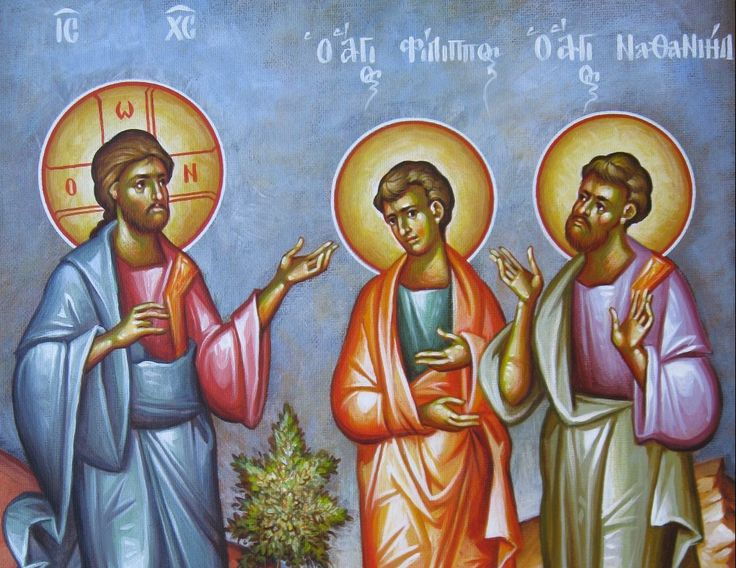
The next day Jesus decided to go to Galilee. He found Philip and said to him, “Come, follow me.” Philip was from Bethsaida, Andrew and Peter’s hometown.

Philip went to look for Nathanael and told him, “We have found the very person Moses and the prophets wrote about! His name is Jesus, the son of Joseph from Nazareth.”

“Nazareth!” exclaimed Nathanael. “Can anything good come from Nazareth?”

“Come and see for yourself,” Philip replied.

As they approached, Jesus said, “Now here is a genuine son of Israel—a man of complete integrity.”

“How do you know about me?” Nathanael asked.

Jesus replied, “I could see you under the fig tree before Philip found you.”

Then Nathanael exclaimed, “Rabbi, you are the Son of God—the King of Israel!”

Jesus asked him, “Do you believe this just because I told you I had seen you under the fig tree? You will see greater things than this.” Then he said, “I tell you the truth, you will all see heaven open and the angels of God going up and down on the Son of Man, the one who is the stairway between heaven and earth.” (New Living Translation)

I describe myself as a follower of Jesus. I have been for decades. I found, and continue to find, in Jesus Christ a compelling person full of grace, truth, and love.

But my early life was not characterized with knowing Christ. I certainly learned about Jesus, that this ancient guy lived an altruistic life, got tortured and killed on a cross, and that Christians believe in his resurrection from death. However, back then it was more like some strange history lesson. The information made no difference to me.

That is, until I heard a voice – not an audible one that others could hear. Yet, it was just a real as any daily conversation with another person. I heard the call of Jesus. The Ancient of Days showed up.

I know with every epistemic fiber in my being that it wasn’t an undigested bit of beef, a blot of mustard, a crumb of cheese, a fragment of an underdone potato. I am sure beyond certainty that there was more of an empty grave than gravy about my experience of the risen Christ.

I experienced the call of Jesus to “follow me.” And that is really, at its simplest, the call which continually goes out to all humanity. It is a gracious and merciful call. It isn’t a summons to experience a cataclysmic event of total belief in one fell swoop. Rather, it’s a call to believe that is much more an unfolding awareness of the deep spirituality and connection with the divine within.

Important to that faith process is another call to “come and see.” Whereas there are some Christian traditions which focus solely on a singular one-time experience of saving faith in Christ, the Gospel of John displays a drama of faith with multiple layers which people move through.

There is no egalitarian zap in which God grants total and immediate understanding. Instead, faith is an ever-increasing process. It is appropriate and biblical to say that our salvation has happened, is happening, and will happen. We follow, we come and see, and we keep following, keep coming, keep seeing more and more.

Like a muscle, our faith grows, develops, stretches, and strengthens over time. To use another metaphor, we ascend a stairway to heaven, one step at a time, day after day, following Jesus and ascending to spiritual maturity.

Orthodox icon of Christ calling Philip and Nathanael

Methinks this is likely part of what Jesus was getting at with Nathaniel in today’s Gospel lesson. Nathaniel would have quickly picked up on the reference Jesus was making, way back to the first book of Genesis. The Jewish patriarch, Jacob, had an experience of seeing the angels of God on some celestial stairway, ascending and descending. It was an encounter of God’s presence with Jacob, assuring him of divine intervention into the muck of humanity. (Genesis 28:10-17)

Jesus connected that ancient portrait to himself so that Nathaniel would understand, would believe, that God has again broken into this world with a special divine presence. To look at Jesus and follow him, is to see and follow God.

Christ Jesus is the ultimate example and embodiment of God with us. Throughout John’s Gospel, Jesus presents himself as:

  • Living water – connecting to Jacob’s well (John 4:5-14)
  • The Temple of God – the place where the Lord dwells in all divine fullness (John 2:18-22)
  • Bread from heaven – linking the giving of manna to the Israelites in the desert (Exodus 16:4-7; John 6:1-59)
  • The good shepherd – fulfilling divine Old Testament imperatives of caring for people (Ezekiel 34:11-16; John 10:1-30)

In all these ways, and more, Jesus intentionally connects himself as fulfilling God’s ancient promises to people.

In whichever way we need to hear the call to follow, Jesus accommodates to us. For some, Christ comes knocking on the front door. For others, he enters the side door, or slips into the backdoor of our lives.

And, if we will come and see, Jesus will also accommodate us by being the authority over us, the teacher to us, or the friend beside us. The Lord Jesus shall shepherd us and woo us to the flock for guidance and protection.

However it may be that Jesus comes to you, it most likely will be in ways you aren’t expecting. Surely, nothing good can come from Nazareth! Yet, it did. Can anything good come from Calcutta, India, or Juarez, Mexico, or Hoboken, New Jersey, or Milwaukee, Wisconsin, or even from a small rural area that doesn’t show up on a map? Yes, it can. Because with Jesus, God has entered this world, and, as it turns out, the Lord’s presence is everywhere.

Follow me. Come and see. Two of the simplest exhortations ever uttered. Yet, two of the most gracious phrases ever said, with profound implications for us beyond what we can fathom or imagine.

Guide us waking O Lord, and guard us sleeping; that awake we may watch with Christ and asleep we may rest in peace. May the shape of each day be formed by the pedantic following of my Lord; and may I come and see the wonders you have done, are doing, and will do. Almighty and merciful God – Father, Son and Holy Spirit – bless us and keep us. Amen.

The Ministry of Jesus (Matthew 4:12-23)

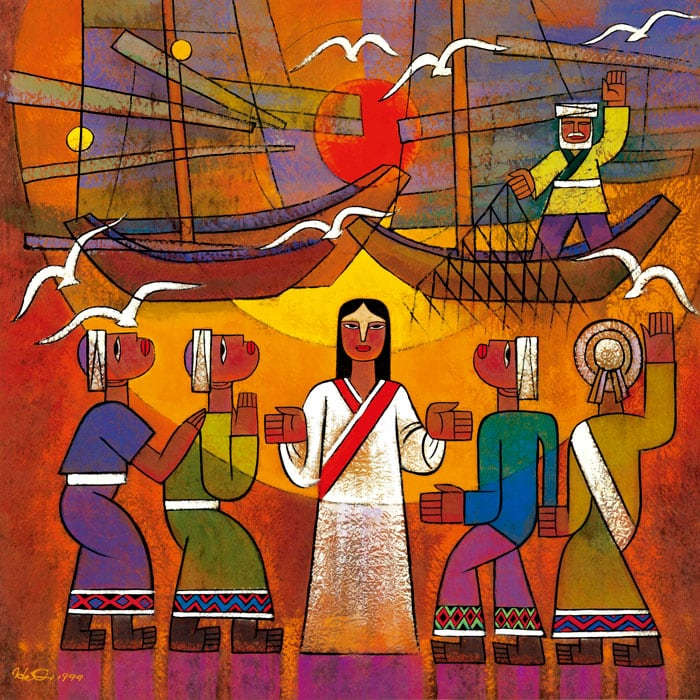
Jesus Calls His Disciples by He Qi

When Jesus heard that John had been put in prison, he withdrew to Galilee. Leaving Nazareth, he went and lived in Capernaum, which was by the lake in the area of Zebulun and Naphtali—to fulfill what was said through the prophet Isaiah:

“Land of Zebulun and land of Naphtali,
    the Way of the Sea, beyond the Jordan,
    Galilee of the Gentiles—
the people living in darkness
    have seen a great light;
on those living in the land of the shadow of death
    a light has dawned.”

From that time on Jesus began to preach, “Repent, for the kingdom of heaven has come near.”

As Jesus was walking beside the Sea of Galilee, he saw two brothers, Simon called Peter and his brother Andrew. They were casting a net into the lake, for they were fishermen. “Come, follow me,” Jesus said, “and I will send you out to fish for people.” At once they left their nets and followed him.

Going on from there, he saw two other brothers, James son of Zebedee and his brother John. They were in a boat with their father Zebedee, preparing their nets. Jesus called them, and immediately they left the boat and their father and followed him.

Jesus went throughout Galilee, teaching in their synagogues, proclaiming the good news of the kingdom, and healing every disease and sickness among the people. (New International Version)

What is “ministry”? 

For some, ministry is only about the souls of people; it is seeing as many people respond to the message of salvation in Christ as possible. 

For others, ministry is meeting the tangible needs of people because there is such a breadth and depth of human social and physical problems. 

And, for others, ministry is defined in terms of what takes place within the four walls of a church building, led by pastors and church leaders.

“Ministry takes place when divine resources meet human needs through loving channels to the glory of God.”

Warren Wiersbe

Problems, however, arise whenever we:

  • Focus on one dimension of ministry. Because, in reality, ministry is multidimensional.
  • Fulfill the outward, administrative demands of ministry – without going after the relational heart of what ministry entails. 
  • Forget about whole groups of people who are different than us. Ministry is for everyone, not some.

We need to look at the ministry of Jesus – what he did and why he did it. Christ’s purpose is to be our purpose: Minister to the total life of all people.

Jesus Preaching

Before there were newspapers, CNN, and 24 hour news cycles, ancient people heard what was happening from heralds or preachers who loudly announced in the streets the important news of the day.

Jesus had a ministry to both Jew and Gentile. Although his ministry was chiefly directed toward his fellow Jews, Christ went out of his way to engage Gentiles, as well, with a message of repentance.

Repentance is turning the whole person – body, soul, mind, will, and emotions – from sin and disobedience to God in obedience to the message of Christ. It involves humility, sorrow for sin, and a commitment to following Jesus.

To repent doesn’t mean to manage sin or clean up parts of my life; it’s a radical conversion from an old way of life to a new way of life. Repentance is not simply adding Jesus to our schedule but is a complete change of how we live.

Christianity is a life, not just an event. Following Jesus is a journey, a life-long process of inner transformation; a complete forsaking of anything that does not please God; and a desire to reorient my life around what’s important to God. 

To illustrate this in a contemporary context, I ask, “What does it mean to follow the Green Bay Packers football team?” A fan not only watches all the games from start to finish, but cheers loudly for the Packers; talks about the Packers with everyone, even strangers; and doesn’t cheer for the Chicago Bears! Fans are committed to their team.

The difference, however, between football and Christianity, is that followers of a team are fans, whereas followers of Jesus are not fans in the stands or watching the television. Instead, Christ followers are on the field of play as teammates with Jesus.

So, when it comes to repentance, we turn from being fans of Jesus to followers of Jesus, doing what he did and saying what he said. We are active participants in the kingdom of God – embracing and embodying a message of repentance to new life in Christ.

Jesus Calling

Jesus calling the first disciples illustrates the kingdom message: a radical break with the old life. Each disciple walked away from a good life and embraced of a new life following Jesus.

Some understanding of Jewish culture in the time of Jesus is helpful here. Central to the life of any Jew was the Torah, the Law. Around age 6, Jewish boys would begin to go to the synagogue for schooling in the Torah by the local rabbi. 

This first level of education was called Beth Sefer (“House of the Book”) and would last until about age 10. In those four years, the first five books of the Old Testament, the Pentateuch, were thoroughly memorized.

By age 10, some of the boys would distinguish themselves as good students and able to handle Torah. So, they would continue on in the second level of schooling called Beth Talmud (“House of Learning”). Those that did not continue with school would then learn the family trade and become an apprentice. Those that went on with school would then memorize the rest of the Old Testament.

At about age 14, only the best of the best were studying Torah. At the completion of their studies, they would apply to a well-known rabbi in order to become his disciple. The goal of this third level was to become just like the rabbi. This was called Beth Midrash (“House of Study”). The rabbi essentially interviews the teenager to find out if he has the stuff to become like the rabbi. 

If the rabbi believes the kid doesn’t have it in him, he tells him to go back to the family business. If, however, the rabbi grills the kid and finds he has what it takes, then he will say to him, “Come, follow me.” It was considered a great privilege and opportunity, and the teenager would leave everything to literally follow the rabbi everywhere he went.

Now, let’s return to Christ’s disciples. Jesus calls Andrew, Peter, James, and John. At the time, they were fishing because they were fishermen. That meant somewhere along the line they didn’t have what it took to further their education, or to follow a rabbi. 

Let’s, then, not miss the import and impact of Jesus saying to them, “Come, follow me!”  Jesus is expressing a belief that these men can become just like him. Well, of course you drop your nets and follow him! Jesus believes I can be like him! Jesus took a group of young men who couldn’t make the grade and used them to change human history. 

Jesus also says the same thing to you and me: I choose you. Come, follow me. 

Christ believed in us before we believed in him. Yes, Jesus believes you can do all the work of embodying the very words of God and becoming like him.

The attitude here is not, “Oh, geez, I have to go do ministry,” as if I were a teenager who was just asked to do the dishes. Rather, the attitude is of privilege and opportunity. If we fail to view ministry in this way, then we must come back to the message of repentance and have an attitude adjustment. People who follow Jesus do so because they get to, not because they have to.

Jesus Healing

            Envision yourself walking with Jesus and following him. You observe several things about his ministry of healing:

  • Jesus heals every problem. Christ has the power and authority to do so.
  • Jesus heals the whole person – not just the physical, or just the spiritual.
  • Jesus heals people whether they repent or not. Christ never made repentance a prerequisite for healing. He heals simply because he wants to.
  • Jesus heals to defeat the devil. Christ continually looks to reverse the hold that sin has on people.
  • Jesus chose to focus on healing the destitute, the poor, and the disadvantaged – rather than directing ministry to the higher classes and royalty to mediate his wishes to the people.

Who are the people – the least, the lonely, the lost – in need of healing in your family, neighborhood, and community?

  1. Those who are ill with various diseases
  2. Those suffering severe pain – of body, mind, emotion, and spirit
  3. The demon possessed or demonically influenced
  4. Prisoners and ex-convicts
  5. The working poor, and the elderly poor
  6. Those in the hospital with no one to visit them
  7. Those who grieve alone
  8. Those with addictions and behavioral issues
  9. Victims of verbal or physical abuse
  10. And many, many more….

Jesus had a ministry of both word and deed. To follow Christ is to become like him and pass on what we have learned to reliable people who will do the same.

Your People Will Be My People (Ruth 1:6-18)

Naomi and Ruth by Chana Helen Rosenberg, 2017

When Naomi heard in Moab that the Lord had come to the aid of his people by providing food for them, she and her daughters-in-law prepared to return home from there. With her two daughters-in-law she left the place where she had been living and set out on the road that would take them back to the land of Judah.

Then Naomi said to her two daughters-in-law, “Go back, each of you, to your mother’s home. May the Lord show you kindness, as you have shown kindness to your dead husbands and to me. May the Lord grant that each of you will find rest in the home of another husband.”

Then she kissed them goodbye, and they wept aloud and said to her, “We will go back with you to your people.”

But Naomi said, “Return home, my daughters. Why would you come with me? Am I going to have any more sons, who could become your husbands? Return home, my daughters; I am too old to have another husband. Even if I thought there was still hope for me—even if I had a husband tonight and then gave birth to sons—would you wait until they grew up? Would you remain unmarried for them? No, my daughters. It is more bitter for me than for you, because the Lord’s hand has turned against me!”

At this they wept aloud again. Then Orpah kissed her mother-in-law goodbye, but Ruth clung to her.

“Look,” said Naomi, “your sister-in-law is going back to her people and her gods. Go back with her.”

But Ruth replied, “Don’t urge me to leave you or to turn back from you. Where you go I will go, and where you stay I will stay. Your people will be my people and your God my God. Where you die I will die, and there I will be buried. May the Lord deal with me, be it ever so severely, if even death separates you and me.” When Naomi realized that Ruth was determined to go with her, she stopped urging her. (New International Version)

Every time I read this account of Naomi and her daughters-in-law I’m reminded of my Dad because this was his favorite Old Testament story.

Dad was a lifelong farmer, and so, always related to the agrarian society of ancient Israel. But what really resonated for him in Scripture was Ruth’s response to her mother-in-law: “Your people are my people and your God my God. Where you die I will die, and there I will be buried.”

My father did not want to be a farmer. He wanted to go to college and become an engineer. In fact, without my grandfather’s knowledge, he was accepted to a university and secured an on-campus job. Yet, when Grandpa found out, he was less than pleased because Dad was needed on the farm during the depression era.

So, Dad, although he could have went to college, decided to stay on the farm. And the reason he decided to do so was not because he got his arm twisted, but because of the story of Ruth. He made the decision to stick with farming and never looked back. My Dad died ten years ago and is buried in the same cemetery as his father.

Ruth and Naomi by He Qi, 2001

The biblical character of Ruth is a solid example of one who was cognizant that she was part of a larger whole – that, although she was indeed an individual with personal choices, the decisions she made impact a much wider community. I believe Ruth discerned that the Israelite community understood this truth, and she wanted to be a part of it.

It is rare, in this age of extreme individualism, that people willingly give themselves to do what is best for the group, the family, the neighborhood, the faith community, the nation, and the world. There is a tendency to view things very narrowly in terms of what’s in it for me and ignore the rest.

So, I invite you to consider becoming ever more aware and connected to the communities around you. Discover the issues, problems, joys, sorrows, celebrations, and challenges they hold. And give yourself to the great struggles of that place. Jesus said:

If any of you want to be my followers, you must forget about yourself. You must take up your cross and follow me. If you want to save your life, you will destroy it. But if you give up your life for me, you will find it. (Matthew 16:24-25, CEV)

The One who is concerned to save the entire world only tolerates disciples who share his care for the entire human family.

Therefore, we ought neither to participate in nor support causes, activities, or speech that is harmful to others. Instead, we should find ways of using our particular gifts and abilities to serve the common good of all persons. We need more commitment and love, and a lot less anger, divisiveness, and hatred.

Grace and humility will always serve us, and others, very well. Judgment and pride, not so much.

Tell them to do good, to be rich in the good things they do, to be generous, and to share with others. (1 Timothy 6:18, CEB)

How, then, shall we live?

Your people will be my people.

Can you imagine a world in which all persons ascribe to this?

May it be so, to the glory of God.

We pray to you, Lord God, for all people everywhere:

For all people in their daily life and work;
For our families, friends, and neighbors, and for those who are alone.

For our community, the nation, and the world;
For all who work for justice, freedom, and peace.

For the just and proper use of your creation;
For the victims of hunger, fear, injustice, and oppression.

For all who are in danger, sorrow, or any kind of trouble;
For those who minister to the sick, the friendless, and the needy.

For the peace and unity of the Church;
For all who proclaim and seek the Truth.

Hear us, Lord; For your mercy is great. Amen.