
Spiritually and Emotionally Overwhelmed

Gethsemane – His Will, by Lucy Dickens

I lift up my eyes to the hills—
    from where will my help come?
My help comes from the Lord,
    who made heaven and earth. (Psalm 121:1-2, NRSV)

“You can’t calm the storm, so stop trying. What you can do is calm yourself. The storm will pass.” – Timber Hawkeye

Even Jesus got overwhelmed.

He took Peter and the two sons of Zebedee along with him, and he began to be sorrowful and troubled. Then he said to them, “My soul is overwhelmed with sorrow to the point of death. Stay here and keep watch with me.”

Going a little farther, he fell with his face to the ground and prayed, “My Father, if it is possible, may this cup be taken from me. Yet not as I will, but as you will.” (Matthew 26:37-39, New International Version)

Jesus was so spiritually and emotionally overwhelmed, he felt so bad, that depression and grief were a powerful part of his experience in the garden as he anticipated facing his horrendous death.

Yes, Jesus became grieved and depressed. Not only did he express such emotions in prayer, but he also told his feelings to his disciples. I personally don’t know of any leader – either in the world or in the church – that would ever admit such a thing to his/her parishioners, employees, or constituents.

Christ confessed that his very soul was encircled with grief-stricken depression. The weight of the emotion was so heavy that Jesus felt as though he was being crushed to death.

“It is one thing for Jesus to feel this way; but should a leader tell his followers he feels this way? Isn’t a part of effective leadership keeping fears from followers? But if Jesus having depression has already taught us it is acceptable, at times, to be depressed, then Jesus talking about his depression teaches that it is acceptable, at times, for leaders to tell followers the bad state of their souls.” – Frederick Dale Bruner, The Church Book: Matthew 13-28

If Jesus needed human companionship and the ability to bear his soul, then how much more do his followers need to do so? And especially the clerics who are ordained to his ministry?

Becoming overwhelmed is a universal human experience:

May my prayer come before you;
    turn your ear to my cry.

I am overwhelmed with troubles
    and my life draws near to death.
I am counted among those who go down to the pit;
    I am like one without strength. (Psalm 88:2-4, New International Version)

We may become overwhelmed by being devastated or feeling overpowered by a confluence of circumstances all at once. To be overwhelmed is to experience several big emotions all at once – including an awful feeling of estrangement from God and/or others.

Whenever complicated grief, relational distance, traumatic experiences, and too many responsibilities come together, they create a perfect storm which can leave us stuck, lonely, and chronically tired.

There are times when it seems as if every time we turn around, there’s another big shoe that drops. We might end up dealing with so many large circumstances and important situations happening at the same time, that we become spiritually and emotionally overwhelmed with it all.

Although it’s easy to become overwhelmed, it’s hard to get over those big, troubled feelings. Yet, we can do it. We can initially calm ourselves enough to function.

Yet, we also need to understand that the emotional array surrounding our difficult circumstances will take more than a few minutes and a few breathing exercises to overcome; it could take weeks, months, even longer.

What’s more, going forward, there will always be a need to listen to our bodies, be attentive to our feelings, and remain in touch with our gut instincts.

We could use some helpful habits to serve us well, whenever we sense the tug toward that sinking feeling of becoming spiritually and emotionally overwhelmed:

  • Sit with your emotions, especially the grief. That is, acknowledge your feelings, and actually let yourself feel them, and express them in positive ways that don’t damage others or their property.
  • Identify and list your current stressors. Then, prioritize them as to which you will work on first. Avoid multi-tasking. Breaking down your life into manageable pieces, done over time with patience, is a healthy way of approaching the behemoth in front of you.
  • Write out your experiences. Keep a daily journal. Focus on expressing both your emotions and your gratitude. The act of writing in and of itself is a powerful means of bringing health, wholeness, and some sort of sense to your situations.
  • Create art. Learn a musical instrument, write your own poetry, sculpt, or paint. Let any anger and frustration come out through your art, rather than coming out sideways onto others through verbal violence.
  • Discover new or alternative spiritual practices, i.e. mindfulness, meditation, Reiki, aromatherapy, breath prayers, etc. Crazy new circumstances you’ve never experienced before may require some seemingly new or strange practices you’ve never tried before.
  • Change the story you are telling yourself. Look for parts of your experience within your control. Learn from the past. Consider what you might do differently in the future in similar situations. In other words, let your story not be one big nasty carbuncle on your soul; allow it to be a companion that teaches you.
  • Consider having a comfort animal. Caring for a pet fosters emotional healing. This one addition to your life could change it immeasurably for good.
  • Engage your inner critic. Face the judgment you may be giving yourself and replace it with grace. Work on dropping the ego and becoming your true self. And there is perhaps no better way of this happening than facing your inner critic.
  • Exercise. Pay attention to where you carry stress in your body. Find an enjoyable way of moving your body.
  • Connect with others. Join a group of like-minded people, such as a faith community or a volunteer organization. Tell your story to another trusted person, such as a friend, therapist, or pastor.
  • Find your identity. Most spiritual traditions take a high view of humanity as having intrinsic worth. As for me, I know to whom I belong: God. Having my identity firmly in Christ – and not in my abilities, or the lack of them – makes all the difference.

Our limitations, screw-ups, diseases, disorders, and disasters need not define our lives. There is no shame in admitting when we are full of sorrow, in the throes of grief, experiencing depression, or living in an awful situation.

Taking Jesus as an example, we have the courage to face stressful adversity and become the people we were always meant to become.

May the places of darkness within you be turned towards the light. And may you know divine shelter and healing blessing when you are called to stand in the place of pain. Amen.

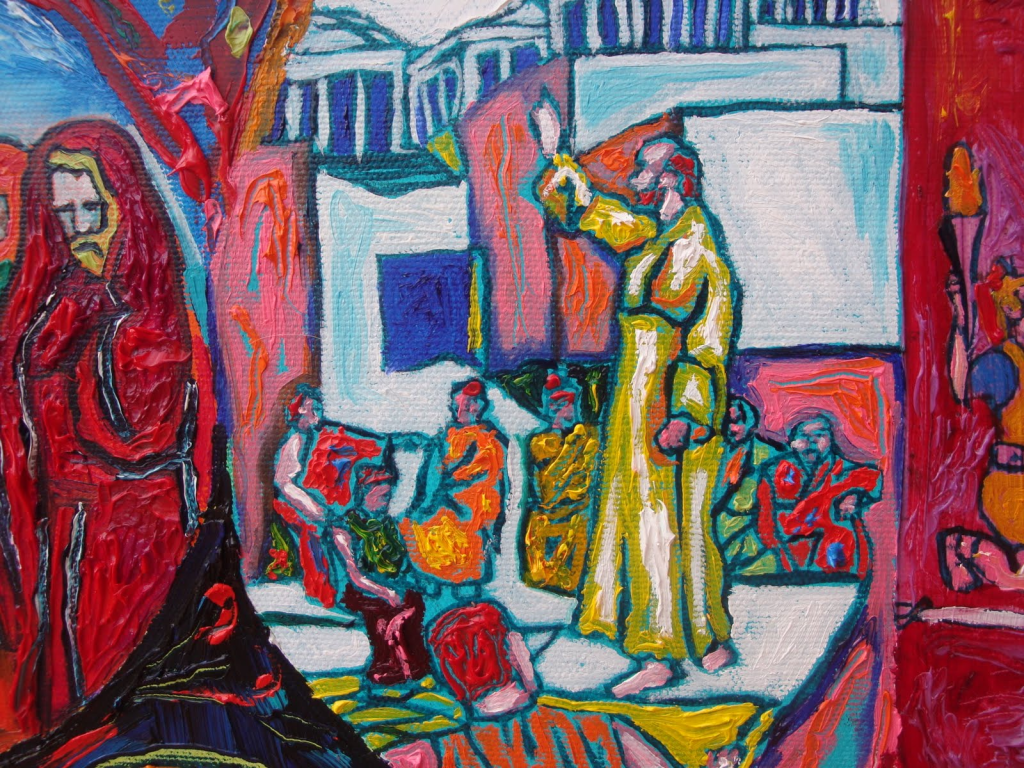
Effective Communication (Acts 17:16-31)

St. Paul preaching at the Areopagus in Athens, by Kennedy A. Paizs

While Paul was waiting for them in Athens, he was deeply troubled by all the idols he saw everywhere in the city. He went to the synagogue to reason with the Jews and the God-fearing Gentiles, and he spoke daily in the public square to all who happened to be there.

He also had a debate with some of the Epicurean and Stoic philosophers. When he told them about Jesus and his resurrection, they said, “What’s this babbler trying to say with these strange ideas he’s picked up?” Others said, “He seems to be preaching about some foreign gods.”

Then they took him to the high council of the city. “Come and tell us about this new teaching,” they said. “You are saying some rather strange things, and we want to know what it’s all about.” (It should be explained that all the Athenians as well as the foreigners in Athens seemed to spend all their time discussing the latest ideas.)

So Paul, standing before the council, addressed them as follows: “Men of Athens, I notice that you are very religious in every way, for as I was walking along I saw your many shrines. And one of your altars had this inscription on it: ‘To an Unknown God.’ This God, whom you worship without knowing, is the one I’m telling you about.

“He is the God who made the world and everything in it. Since he is Lord of heaven and earth, he doesn’t live in man-made temples, and human hands can’t serve his needs—for he has no needs. He himself gives life and breath to everything, and he satisfies every need. From one man he created all the nations throughout the whole earth. He decided beforehand when they should rise and fall, and he determined their boundaries.

“His purpose was for the nations to seek after God and perhaps feel their way toward him and find him—though he is not far from any one of us. For in him we live and move and exist. As some of your own poets have said, ‘We are his offspring.’ And since this is true, we shouldn’t think of God as an idol designed by craftsmen from gold or silver or stone.

“God overlooked people’s ignorance about these things in earlier times, but now he commands everyone everywhere to repent of their sins and turn to him. For he has set a day for judging the world with justice by the man he has appointed, and he proved to everyone who this is by raising him from the dead.” (New Living Translation)

Ancient ruins of Athens, Greece

The city of Athens was a major intellectual center in the ancient world. Ideas, philosophy, reason, rhetoric, and debate were standard fare amongst the citizens. At the time of the Apostle Paul’s arrival in the city, Greece knew next to nothing about Christianity.

Paul’s response to what he saw and felt in the city dictated what he did and said. And those words were wise and impactful for the people of Athens. The Apostle’s interaction with the philosophers was like a seminar in how to communicate with folks who believe and live very differently than ourselves.

Observation

Paul entered the city and made a simple observation: Athens is full of idols. Out of all the observations Paul could have made, this one would not likely be made by most people visiting the city. Athens was a glorious place with its unparalleled architecture. The Acropolis and the Agora were resplendent with the arts and democracy.

For all its physical beauty and brilliance, the one thing Paul homed-in on was the idols. This would have struck many folks as odd – something like focusing on the dog collar instead of the dog. Yet, Paul was using more than his physical eyes – his spiritual sight was making a big observation – that Athens was very much a religious place.

Feeling

The Apostle felt troubled and distressed. Paul was disturbed down deep in his gut with the spiritual state of this renowned city-state. The sheer volume of idols and the practice of idolatry did not sit well with him. He experienced feelings of pity mixed with anger.

Paul handled his emotions well. By freely acknowledging them, he was then able to choose his response. Had he not done so, it’s likely Paul might have gone on some frustrating tirade, thereby never truly connecting relationally with the people. There’s nothing wrong with being irritated or exasperated; it’s what we do with those feelings that’s important.

Need

Emotions, not thoughts, move us to act. Paul knew why he was feeling disturbed, and decided not to stuff those feelings. Instead, he stepped out and addressed the great need he was observing.

Paul decided to meet the Athenians on their turf and on their level by reasoning with them every day in the great buildings and open spaces of the city.

While in Athens, it seems that Paul, understandably, utilized the Socratic method of dialogue – involving questions and answers. It’s impressive that throughout the Acts of the Apostles, Paul demonstrated a deft ability to communicate and connect with a broad range of people.

Appeal

Paul wasn’t interacting and dialoging just for the fun of it; he wanted to make an appeal, a request for people to seriously consider the Christian good news of Jesus Christ’s resurrection as a viable philosophy of life. He made a widespread appeal to Jews, Greeks, and passers-by, as well as philosophers.

Since the massive intellect of Paul could handle any reasoned debate, he was invited to the Areopagus, which was the place where the best-of-the-best carried-on their discussions.

Paul’s address to them was incredibly cogent and well-reasoned – finding common ground from which to debate. While doing so, he maintained outward grace amidst his inward disturbance.

Conclusion

The late British exegete, John R.W. Stott, reflected on today’s New Testament lesson and gave us words which are still relevant for us in these contemporary times:

“Why is it that, in spite of the great needs and opportunities of our day, the church slumbers peacefully on, and that so many Christians are deaf to Christ’s commission, and dumb with tongues-tied in testimony? The major reason is this: We do not speak as Paul spoke because we do not feel as Paul felt. We have never had his indignation. Divine jealousy has not stirred within us. We constantly pray, ‘Hallowed be Thy Name,’ yet we do not seem to mean it… Paul saw people created in the image and likeness of God giving to idols the homage which was due to God alone… and he was deeply pained by it.”

May the good news of Jesus Christ be so pressed into our minds, hearts, and guts that what comes out of us is deep compassion, wise dialogue, and an effective ministry of communication with others. Amen.

Trust vs. Anxiety (Isaiah 30:15-18)

The holy Lord God of Israel
    had told all of you,
“I will keep you safe
if you turn back to me
    and calm down.
I will make you strong
    if you quietly trust me.”

Then you stubbornly said,
“No! We will safely escape
    on speedy horses.”

But those who chase you
    will be even faster.
As few as five of them,
or even one, will be enough
    to chase a thousand of you.
Finally, all that will be left
    will be a few survivors
as lonely as a flag pole
    on a barren hill.

The Lord God is waiting
to show how kind he is
    and to have pity on you.
The Lord always does right;
he blesses those who trust him. (Contemporary English Version)

God’s plan for our lives calls for times of retreat and renewal, of quiet patience and perseverance, for restraint and waiting.

Ancient Judah was experiencing one of their many periods of rebellion toward God’s commands. One of the things that happens – whether in ancient times or today – is that whenever we go off the road of God’s ways, our lives become characterized by a grand self-help program.

Those in the Judean royal court could not wait on God. They had to do something about Assyria. The Assyrian Empire was waning, and Judah wanted to take advantage of it, seeing an opportunity for some relative autonomy.

So, many of the activists in the royal court rushed to Egypt for help – not at all considering to turn toward God and wait on the Lord. God blesses those who trust and wait on divine promises and initiative. But, in their anxiety, the people of Judah would not exercise faith and patience.

As a result, the enemy would overtake them. The people’s refusal to take the quiet course would not end well for them.

On many days, as I attend to the hospitals for which I work, I visit many hurting people, including patients, their families, and teammates. In my time there, I deal with a vast array of emotional problems, spiritual struggles, and mental disorders. One of things I have discovered through this work is that people’s internal issues absolutely need to be expressed, out loud, to someone who cares and knows what to do with those expressions.

And this is not only a modern problem; the need to deal with our internal stuff has been there throughout all of human history. Every culture and society who does not attend well to personal and communal spiritual health is literally killing their bodies – because body and soul are inextricably connected in a union as one.

It continually amazes me that people who think nothing of going to a medical doctor, an emergency room, or having a surgery, would never think of getting help when their minds are mixed up, emotions are frayed, and spirits are downcast.

Stubbornly holding onto self-help to handle a spiritual crisis, refusing help from others, and ignoring God, is just as sure to kill you as believing that chest pains, shortness of breath, and inability to walk across the room will simply get better on its own.

Conversely, isolating oneself and calling it “waiting on God” and remaining passive – when the Lord has clearly told us to be active – will accomplish the same ends as the committed self-help person. Faith and action are not mutually exclusive terms. It takes some wisdom to know when to retreat, pray, and be patient; and when to take initiatives of faith, and trust God to work through action.

Rebellion gets us nowhere. It’s what puts us in the awkwardness of making bad decisions and discernments. The Lord had told the people of Judah to stay put and not rely on Egypt to help them. There were clear instructions through the prophets about what to do. But the people were too anxious, too impatient, wondering too much about whether God would show up or not.

The Spirit God gave us does not make us afraid. His Spirit is a source of power and love and self-control.

2 Timothy 1:7, ERV

No matter where we have been or what we have done, the Lord is continually waiting on us – and will consistently respond with grace and mercy to our petitions and overtures to live for God. It’s never too late to flee to God in quiet trust.

Running to God is not escaping our problems. Rather, the Lord enables us to face both our outward situations, as well as our inward thinking and feeling. It’s easy to engage in busywork and keep active when we are anxious; yet it is very difficult to sit still before God and be alone. Silence and solitude put us face to face with ourselves. And doing that is what many people would rather avoid.

“I’ll do it myself!” is the cry of many a person who is mentally, emotionally, and spiritually overwhelmed. That approach, however, is a highway to the grave. And, in fact, it is a stubborn rebellion that puts a stiff arm to God.

I’m not saying that opening-up is easy; I am stating that it is necessary to our spiritual and emotional health. It might be helpful to begin communicating with some vulnerability and authenticity to God. The following are some appropriate ways that might help:

  1. Be congruent between the outer self and inner self. Make sure your outside affect and behavior is congruent with your inside feelings and thoughts. If you are discouraged on the inside, but wear a smile and pretend to be spiritually with it, you’re not fooling God. You cannot receive grace apart from humble authenticity.
  2. Focus on feelings. You won’t get struck by lightning if you express your anger, or other emotions, to God. Be aware of how you are feeling. In fact, ask the Lord to help you understand your feelings. Share them openly as much as you can.
  3. Change questions into statements. Sometimes, when we have an attitude or a feeling, we’re afraid to say it and be open. So instead, we ask a question. Try changing questions such as “Do you love me?” into “I love you.” And, “Do you want me to do this?” to “I want to do your will.”
  4. Speak in the first person. Begin sentences with “I” instead of “you,” For example, ” I am happy that you are with me,” instead of asking, “Are you there?”
  5. Say out loud what you really want and need. It’s okay to do that. This is when it is appropriate to ask questions. The Lord’s ear is ready to listen.

Patient and confident trust in God is always a better option than anxious and nervous striving by yourself.

O God, the source of all health: So fill my heart with faith in your love, that with calm expectancy I may make room for your power to possess me, and gracefully accept your healing; through Jesus Christ our Lord. Amen.

Facing Our Sadness (Psalm 42)

As a deer longs for a stream of cool water,
    so I long for you, O God.
I thirst for you, the living God.
    When can I go and worship in your presence?
Day and night I cry,
    and tears are my only food;
all the time my enemies ask me,
    “Where is your God?”

My heart breaks when I remember the past,
    when I went with the crowds to the house of God
    and led them as they walked along,
    a happy crowd, singing and shouting praise to God.
Why am I so sad?
    Why am I so troubled?
I will put my hope in God,
    and once again I will praise him,
    my savior and my God.

Here in exile my heart is breaking,
    and so I turn my thoughts to him.
He has sent waves of sorrow over my soul;
    chaos roars at me like a flood,
    like waterfalls thundering down to the Jordan
    from Mount Hermon and Mount Mizar.
May the Lord show his constant love during the day,
    so that I may have a song at night,
    a prayer to the God of my life.

To God, my defender, I say,
    “Why have you forgotten me?
Why must I go on suffering
    from the cruelty of my enemies?”
I am crushed by their insults,
    as they keep on asking me,
    “Where is your God?”

Why am I so sad?
    Why am I so troubled?
I will put my hope in God,
    and once again I will praise him,
    my savior and my God. (Good News Translation)

Sadness. Every human on planet earth knows the feeling. Since we are emotional creatures, profound sadness – even to the point of depression and/or despondency – will happen.

Despite the universal nature of discouragement and tears, many Christians buck the sadness. Far too many believers focus so exclusively on victory in Jesus through his resurrection, ascension, and glorification that they use religion as their denial when unwanted emotions like sadness come banging at the doorstep of their soul.

So, I most emphatically say: Depression is not sin. To be discouraged is not the Enemy. Experiencing sadness is neither wrong nor selfish. Quite the opposite, in fact.

It is necessary to sit with our emotions and feel the breadth and depth of them. Both our spiritual and emotional health come through an awareness and robust engagement with our feelings. To refuse to feel is to put the stiff arm to God.

The psalmist does anything but deny his feelings. He brings them before the Lord and spreads them out before the Divine. Why am I discouraged? Why am I restless? Why the sadness? Could it be that God has forgotten me? Where is the Lord? Is God angry with me? Are my troubles the result of divine wrath?

To blandly say we have never uttered or thought such questions is a telltale sign of denial. The bottom line for many folks is that they do not want to feel these emotions because it complicates their lives. Besides, discouragement and sadness hurt. “Why feel,” we reason, “when it only brings pain?”

Oh my, the avoidance of pain. And there is no pain quite like emotional and spiritual pain. Much like an open wound which needs a liberal application of painful peroxide, our spiritual wounds must sting with the salve of emotional feeling. Healing is neither cheap, easy, nor painless. It typically hurts like hell.

The psalmist’s own pain revolved around feelings of alienation from God, being cut off from fellow worshipers, and harassed by others around him. Understandably, he experienced despondency and loneliness. The psalmist wondered if anyone, including God, even cared what he was going through. In other words, he is desperate for God to show up.

Here’s a simple observation about this psalm: The psalmist did not get any answers to the several questions he posed. He even repeated them, to no avail. The only form of comfort the psalmist received was to remember what God had done in the past. Somehow, someway, this will help with the difficulties of the present.

There are times in life when we must recall what we know about God, ourselves, and others. If the Lord has delivered in the past, God can do it again. If others helped before, perhaps they will be present in the here and now. And just maybe, even likely, you and I will discover a resilient spirit within. We already possess everything we need to not only survive but to grow and thrive in life.

Hope arises from holding the big picture of the past, present, and future together at the same time. When present circumstances are difficult, and it appears we are about to be swallowed up into the now, we must hold the past and future along with it, in careful tension. Then, we shall find the enablement to keep going.

Trust in the future, and a confident expectation of hope is born from the trustworthiness of the past. A prayerful song in our heart will carry us through till our hope is realized.

Almighty and merciful God, you heal the broken-hearted, and turn the sadness of the sorrowful to joy. Let your fatherly goodness be upon all whom you have made. Remember in pity all those who are this day destitute, homeless, elderly, infirm, or forgotten. Bless the multitude of your poor. Lift up those who are cast down.

Mightily befriend innocent sufferers and sanctify to them the endurance of their wrongs. Cheer with hope all who are discouraged and downcast, and by your heavenly grace preserve from falling those whose poverty tempts them to sin. Though they are troubled on every side, suffer them not to be distressed; though they are perplexed, save them from despair. Grant this, O Lord, for the love of him who for our sakes became poor, your Son our Savior Jesus Christ.