
Beware of Your Fear (Mark 13:1-8)

As he came out of the temple, one of his disciples said to him, “Look, Teacher, what large stones and what large buildings!” Then Jesus asked him, “Do you see these great buildings? Not one stone will be left here upon another; all will be thrown down.”

When he was sitting on the Mount of Olives opposite the temple, Peter, James, John, and Andrew asked him privately, “Tell us, when will this be, and what will be the sign that all these things are about to be accomplished?” 

Then Jesus began to say to them, “Beware that no one leads you astray. Many will come in my name and say, ‘I am he!’ and they will lead many astray. When you hear of wars and rumors of wars, do not be alarmed; this must take place, but the end is still to come. For nation will rise against nation and kingdom against kingdom; there will be earthquakes in various places; there will be famines. This is but the beginning of the birth pangs. (New Revised Standard Version)

In my undergraduate college days, decades ago, springtime brought a regular staple of sidewalk preachers calling for people to repent, because the end of the world is imminent.

That was in the days of the Cold War; the specter of a nuclear holocaust was a real fear among many. The outdoor preachers got a serious hearing with some.

Although religious end times preaching gets little attention anymore, the idea of a cataclysmic apocalypse is still very much a part of the culture. Dystopian novels are widely read; and stockpiling for a zombie apocalypse is a real thing.

End of the world stuff is, at the least, interesting and/or fascinating to many; and, at the most, there are folks fully prepared for an apocalypse of the world to happen in their lifetime.

Christ’s disciples asked him a question. And Jesus went directly to talking apocalypse.

In the Gospel of Mark, Jesus takes on demons and all sorts of other-worldly opposition. Christ is certainly presented by Mark as one who discerns there is much more going on – and will go on – in this world than what it may seem on the surface of things.
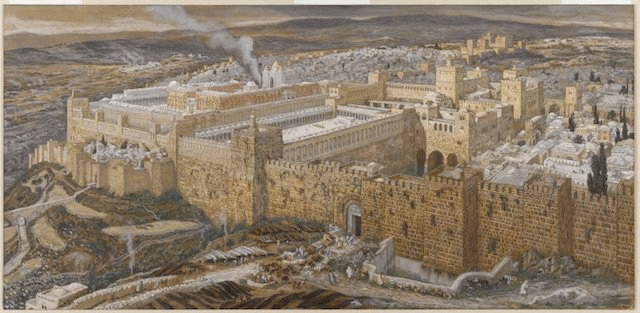
Jerusalem and Herod’s Temple, by James Tissot, c.1890

The disciples saw large and wonderful stones which were part of the temple. They marveled at what their physical eyes perceived. But Jesus saw further, into the future, and was not at all impressed; he saw a time of apocalypse. All of those stones in a heap. No one marveling over the temple.

Christ’s disciples wanted to know when such a time would happen. As was often the case with Jesus, he didn’t answer their question, at least not directly. He used it as an opportunity to teach about things to come.

The gist of Christ’s words to his disciples was to communicate that things are going to get worse than what they already are. The Roman occupation they were experiencing is nothing compared to what’s coming.

The apocalyptic language had been around in ancient Judea for a long time. There had been centuries of people talking about the world’s end.

Apocalyptic stuff is nothing new to contemporary folk, as well. Just mention the Book of Revelation and heads pop up, eyebrows raise, and imagination goes to seed.

We as biblical readers, however, need to observe that Jesus didn’t answer the question of his disciples. Which is perhaps something we must become more alert to.

Nobody knows when the end of the world will come. Not even Jesus. But that doesn’t seem to stop folks from asking anyway. Perhaps we need to ask a different question. Instead of asking “When will these things happen?” maybe we ought to ask, “What must I watch out for?”

The change of question orients us in a different way. Rather than end times speculation, we begin watching for things which are dangerous to humanity, things that bring upheaval to our world.

We start valuing awareness and observance, listening and contemplating. We learn to place our energies wisely into the things we believe truly matter in this life for the common good of all.

God is up to all sorts of kingdom business that is beyond our purview, and frankly, even beyond our ability to perceive or understand.

When we accept the exhortation of Jesus to “beware,” then we watch and look for things that are already here among us, and not get lost in a future we cannot predict. That type of future orientation only produces the kind of worry and anxiety that leads to fear.

And when fear takes root, it spawns the evils of hate and injustice. We become vulnerable to selfish incompetent leaders who make promises to take our fears away. We end up doing terrible acts against others, like imprisoning political opponents, denaturalizing and deporting citizens we don’t like, and creating fascist states that oppress others.
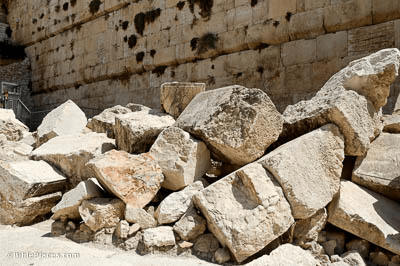
Fallen stones from the destruction of the Temple

But if we will wake up, hear the call of Jesus to beware, and awaken to our true commitment to the kingdom of God, we will then forsake fear-based tactics, and courageously help others in both body and soul.

It also means that, at times, we are off somewhere in centering and contemplative prayer, just like our Lord in the Garden of Gethsemane, knowing that the real source of power and authority is outside of us.

A true biblical view of the end times is about God working out divine purpose on behalf of all humanity. It isn’t about us and all of our fears and anxieties getting worked out in harmful ways.

The realization of a coming apocalypse must lead us toward faith and trust in the God who holds justice, righteousness, and mercy in good divine hands.

God has no limitations because of our questions. God will be God. God is who God is. Our task is to watch, remain faithful, and persevere until Christ returns to judge the living and the dead.

May it be so, to the glory of God.

Fear or Faith? (1 Samuel 13:23-14:23)

The pass at Micmash had meanwhile been secured by a contingent of the Philistine army.

One day Jonathan said to his armor bearer, “Come on, let’s go over to where the Philistines have their outpost.” But Jonathan did not tell his father what he was doing.

Meanwhile, Saul and his 600 men were camped on the outskirts of Gibeah, around the pomegranate tree at Migron. Among Saul’s men was Ahijah the priest, who was wearing the ephod, the priestly vest. Ahijah was the son of Ichabod’s brother Ahitub, son of Phinehas, son of Eli, the priest of the Lord who had served at Shiloh.

No one realized that Jonathan had left the Israelite camp. To reach the Philistine outpost, Jonathan had to go down between two rocky cliffs that were called Bozez and Seneh. The cliff on the north was in front of Micmash, and the one on the south was in front of Geba.“Let’s go across to the outpost of those pagans,” Jonathan said to his armor bearer. “Perhaps the Lord will help us, for nothing can hinder the Lord. He can win a battle whether he has many warriors or only a few!”

“Do what you think is best,” the armor bearer replied. “I’m with you completely, whatever you decide.”

“All right, then,” Jonathan told him. “We will cross over and let them see us. If they say to us, ‘Stay where you are or we’ll kill you,’ then we will stop and not go up to them. But if they say, ‘Come on up and fight,’ then we will go up. That will be the Lord’s sign that he will help us defeat them.”

When the Philistines saw them coming, they shouted, “Look! The Hebrews are crawling out of their holes!” Then the men from the outpost shouted to Jonathan, “Come on up here, and we’ll teach you a lesson!”

“Come on, climb right behind me,” Jonathan said to his armor bearer, “for the Lord will help us defeat them!”

So they climbed up using both hands and feet, and the Philistines fell before Jonathan, and his armor bearer killed those who came behind them. They killed some twenty men in all, and their bodies were scattered over about half an acre.

Suddenly, panic broke out in the Philistine army, both in the camp and in the field, including even the outposts and raiding parties. And just then an earthquake struck, and everyone was terrified.

Saul’s lookouts in Gibeah of Benjamin saw a strange sight—the vast army of Philistines began to melt away in every direction. “Call the roll and find out who’s missing,” Saul ordered. And when they checked, they found that Jonathan and his armor bearer were gone.

Then Saul shouted to Ahijah, “Bring the ephod here!” For at that time Ahijah was wearing the ephod in front of the Israelites. But while Saul was talking to the priest, the confusion in the Philistine camp grew louder and louder. So Saul said to the priest, “Never mind; let’s get going!”

Then Saul and all his men rushed out to the battle and found the Philistines killing each other. There was terrible confusion everywhere. Even the Hebrews who had previously gone over to the Philistine army revolted and joined in with Saul, Jonathan, and the rest of the Israelites. Likewise, the men of Israel who were hiding in the hill country of Ephraim joined the chase when they saw the Philistines running away. So the Lord saved Israel that day, and the battle continued to rage even beyond Beth-aven. (New Living Translation)

The vicinity of Micmash (modern Mukmas) in Israel

Israel had demanded a king. The people wanted to be like everyone else in the world. All the other nations had a king. The Israelites believed that they needed one, too. (1 Samuel 8)

Not unlike today, Israel got a king who looked the part. Saul was tall, dark, and handsome. The only problem was that he didn’t act much like a king at all.

On the day he was anointed king, Saul hid in the baggage, like some guy ducking into a dumpster to avoid people chasing him. If the kings of other nations acted boldly on behalf of their subjects, Saul was not that sort of king. He seemed bent toward cowardice, and more concerned about his reputation than actually accomplishing anything.

Saul could have distinguished his royal kingship through listening to God and obeying the Lord; instead, his rule and reign was often marked by a half obedience, if he obeyed at all.

Old Testament stories are filled with contrasting characters. And in the narrative for today, there is a clear difference between King Saul and his son Jonathan. Saul was supposed to be leading the charge against the Philistine threat to Israel, but he was hiding out.

But Jonathan was determined to deal with the arrogant Philistines, even though it meant going against an entire garrison of troops with only his armor-bearer alongside him.

In the story, we find Saul and the army cowering in secrecy. But we find Jonathan in the bright light of day for the entire Philistine army to see. The contrast couldn’t be any more obvious:

  • Saul is afraid, and Jonathan is brave
  • Saul is fearfully passive; Jonathan is faithfully aggressive
  • Saul could only see reasons not to face the Philistines; Jonathan saw no obstacles to facing them, even though he had to scale crags and thorns in order to get to the Philistines

The opposite of faith is not unbelief; it’s fear. All of the Israelite soldiers were afraid, except Jonathan and his armor-bearer. The two of them had remarkable faith.

Jonathan had full confidence in the power of God. It wasn’t stupidity that led him toward an entire army by himself; it was the firm conviction that nothing is too difficult for the Lord.

It was neither pride nor glory-seeking that caused Jonathan to go, against all odds, to fight the Philistine army. He simply reasoned by faith that perhaps God would work on their behalf and bring about a great deliverance for Israel.

What’s more, Jonathan trusted the Lord without making assumptions that God would act in a particular way. There wasn’t any ‘name-it-and-claim-it’ theology happening with him.

Indeed, God did intend to defeat the Philistines. Maybe the Philistines thought Jonathan was bluffing by coming up to them; and they were going to teach this guy a lesson! But false confidence is typically shown through talking smack, whereas real confidence is born of faith.

Trust fully expects God to show up and take on injustice, unrighteousness, and arrogant pride.

Jonathan did some damage; and God got into the thick of it by directly intervening. The Lord turned the tables by bringing great fear on the Philistines. This turning of the tables emboldened the Israelites. The result was a decisive victory for Israel, leaving Philistia slack-jawed and confused.

We may be uncertain about the future; but if we are pursuing a good thing, and are confident in God’s power, there’s no need to be afraid in pursuing it.

We are free to step out in faith and attempt great things for the sake of the Lord, knowing that God may indeed bless our trusting initiative.

Almighty and everlasting Father, you have given the Holy Spirit to abide with us forever: Bless us with divine grace and presence so that, being preserved in true faith and confident hope, we may fulfill all the good that is in our mind and heart to do; through Jesus Christ your Son, our Lord, who lives and reigns with you, in the unity of the Holy Spirit, one God, today and always. Amen.

Fear vs. Faith (Numbers 13:1-2, 17-33; 14:1-9)

The Spies Return with Discordant Views, by Yoram Raanan

The Lord said to Moses, “Send some men to explore the land of Canaan, which I am giving to the Israelites. From each ancestral tribe send one of its leaders”…

When Moses sent them to explore Canaan, he said, “Go up through the Negev and on into the hill country. See what the land is like and whether the people who live there are strong or weak, few or many. What kind of land do they live in? Is it good or bad? What kind of towns do they live in? Are they unwalled or fortified? How is the soil? Is it fertile or poor? Are there trees in it or not? Do your best to bring back some of the fruit of the land.” (It was the season for the first ripe grapes.)

So they went up and explored the land from the Desert of Zin as far as Rehob, toward Lebo Hamath. They went up through the Negev and came to Hebron, where Ahiman, Sheshai and Talmai, the descendants of Anak, lived. (Hebron had been built seven years before Zoan in Egypt.) 

When they reached the Valley of Eshkol, they cut off a branch bearing a single cluster of grapes. Two of them carried it on a pole between them, along with some pomegranates and figs. That place was called the Valley of Eshkol because of the cluster of grapes the Israelites cut off there. At the end of forty days they returned from exploring the land.

They came back to Moses and Aaron and the whole Israelite community at Kadesh in the Desert of Paran. There they reported to them and to the whole assembly and showed them the fruit of the land. They gave Moses this account:

“We went into the land to which you sent us, and it does flow with milk and honey! Here is its fruit. But the people who live there are powerful, and the cities are fortified and very large. We even saw descendants of Anak there. The Amalekites live in the Negev; the Hittites, Jebusites and Amorites live in the hill country; and the Canaanites live near the sea and along the Jordan.”

Then Caleb silenced the people before Moses and said, “We should go up and take possession of the land, for we can certainly do it.”

But the men who had gone up with him said, “We can’t attack those people; they are stronger than we are.” And they spread among the Israelites a bad report about the land they had explored. They said, “The land we explored devours those living in it. All the people we saw there are of great size. We saw the Nephilim there (the descendants of Anak come from the Nephilim). We seemed like grasshoppers in our own eyes, and we looked the same to them.”

That night all the members of the community raised their voices and wept aloud. All the Israelites grumbled against Moses and Aaron, and the whole assembly said to them:

“If only we had died in Egypt! Or in this wilderness! Why is the Lord bringing us to this land only to let us fall by the sword? Our wives and children will be taken as plunder. Wouldn’t it be better for us to go back to Egypt?” And they said to each other, “We should choose a leader and go back to Egypt.”

Then Moses and Aaron fell face down in front of the whole Israelite assembly gathered there. Joshua son of Nun and Caleb son of Jephunneh, who were among those who had explored the land, tore their clothes and said to the entire Israelite assembly:

“The land we passed through and explored is exceedingly good. If the Lord is pleased with us, he will lead us into that land, a land flowing with milk and honey, and will give it to us. Only do not rebel against the Lord. And do not be afraid of the people of the land, because we will devour them. Their protection is gone, but the Lord is with us. Do not be afraid of them.” (New International Version)

“Pessimism has done infinitely more harm than atheism.”

Pierre Teilhard de Chardin

Fear can be debilitating. At its core, we fear either what we don’t know, or believe to be bad. For example, if I am convinced that my boss does not have my best interests at mind, then I will likely be afraid and hold back.

The majority of the ancient Israelites were paralyzed by fear because of the anxiety and fearfulness of those who came back from spying out the Promised Land. They had a low view of God. Yet Caleb, and only a few others, acknowledged that God is good for divine promises, and so, trusted the Lord completely in confidence, not fear.

If we view God as being angry all the time, then we will not use the incredible gifts given to us for fear of messing up and bringing divine wrath upon us. We will be plagued with uncertainty and only see giants in the land who we cannot begin to deal with.

Yet, if we commit ourselves to knowing God through seeking the divine will and trusting in divine promises, then we understand that God is gracious and generous, always having our backs. We live by faith, not by sight, and discern that giants in the land are really nothing more than gnats.

Fear is maybe the devil’s greatest tool to prevent God’s people from being productive and responsible in serving the church and the world. Beneath that fear are powerful feelings of inferiority, inadequacy, and a low view of self – which is really born of a low view of God. Being afraid wastes what impact a person could have for God, and waters-down life so that it’s ineffective.

Enjoy the Lord, and he will give what your heart asks.

Psalm 37:4, CEB

We are to enjoy the gracious and generous God; and in our enjoyment, the Lord places within us godly dreams that are a delight for God to fulfill. Our enjoyment of the Lord gives us the security and confidence to act upon those godly desires and wed them to divine promises from Holy Scripture.   

But put fear in the mix, and it dilutes and destroys everything. It makes you do nothing. And the fear is a result of not knowing the Lord, of not seeking God’s mind or will.

God had a grand vision and a big dream for the Israelites to enter the Promised Land. But ten of the twelve spies who came back after checking out the land were paralyzed by fear, feeling like grasshoppers next to the people in the land. 

Caleb and Joshua, however, had a different view of taking the land because they had a different view of God. They didn’t see giants – they saw a gracious and generous God who could easily take care of whoever might be in the land, and they wanted to act on the faith they had in a mighty and merciful God. 

The God of the other spies wasn’t big enough to handle the giants. Their low view of themselves as grasshoppers betrayed their low view of God.

“We wrap a lot of our fears in morbidly sanctified self-belittling.  We piously cover this self-despising and call it consecration and self-crucifixion.”

David Seamands

Too many people feel good about feeling bad – and then use those feelings to make spiritual excuses for not exploring what God promises, expects, commands, and dreams for them. 

It is high time for us to get into the world with our witness in a far greater way because we serve a God who sees giants as gnats; and we will, too, if we have a high view of God.

Yet, holding us back, is fear of criticism, of taking a risk, of going outside of the way we’ve always done it, and of what others may think or say. 

If you once dreamed something and you think your dream is dead because you destroyed it by your sins or bad habits, you are wrong. Dreams are destroyed by fear, by being tricked into thinking that we are nothing but grasshoppers and God doesn’t care, and so we do nothing.

Unfortunately, it appears the most common way of coping with feelings of fear, insecurity, and inferiority is by withdrawing from other people – because you cannot give yourself fully to your family, church, neighborhood, vocation, and the world without a healthy robust view of and relationship with God. 

Give God a chance to work in and through your life. May you step up and step out because you have a God behind you that is gracious and generous. Amen.

The Spirit of Faith, Not Fear (Romans 8:14-17)

Come Holy Spirit, by Ed de Guzman, 2014

For those who are led by the Spirit of God are the children of God. The Spirit you received does not make you slaves, so that you live in fear again; rather, the Spirit you received brought about your adoption to sonship. And by him we cry, “Abba, Father.” The Spirit himself testifies with our spirit that we are God’s children. Now if we are children, then we are heirs—heirs of God and co-heirs with Christ, if indeed we share in his sufferings in order that we may also share in his glory. (New International Version)

The distinguishing mark of the believer in Jesus Christ is the presence and power of the Holy Spirit. The Spirit is the sine qua non – the indispensable and most essential element – of the Christian life.

Christians are spiritual people, that is, people of the Spirit. Christianity is a religion dependent upon spiritual resources for life and godliness.

There is nothing more practical, beneficial, and enjoyable than the application of biblical truth to our lives each and every day.  

The Spirit’s work is to point us to Christ. The application of biblical truth is an experience of getting to know Jesus Christ better, and becoming ever more aware and involved with God. This involvement, characterized by faith, hope, and love, increasingly transforms every area of the Christian’s character and life. And it is the Spirit who helps us do it.

It is not God’s will that we fail in living the Christian life by succumbing to fear.  

Rather, it is God’s intention that believers have a robust faith which sings with gusto, connects meaningfully and vulnerably with other Christians, and a boldness to embody the good news of grace and forgiveness in Christ. To love God, and love the world, is to have a life of faith, not fear.

The successful Christian life is characterized by:

  • Experiencing inner transformation through suffering
  • Enjoying ministry and worship with others
  • Progressive deliverance from the power of sin
  • Continual enablement to live a holy life
  • Being an effective witness to the person and work of Jesus

Living this kind of life keeps believers from yielding to temptation. Life in the Spirit motivates us to read the Bible and pray; and to live above criticism and pretense.

The spiritual life helps others discern and understand what Christianity is all about. And, perhaps most importantly, life in the Spirit glorifies God, because we are then reflecting the joy and beauty of the Lord in all we do and say.

So, why don’t more Christians experience this kind of life-giving knowledge and joy? 

It is possible, even with the best of intentions in living a faithful and spiritually rich life, to be stonewalled or crippled with fear and anxiety. And in our fearful state, we almost always produce incorrect actions. These mistakes end up becoming barriers to living an enjoyable and productive Christian life. 

Here are just a few of the fearful and/or erroneous statements I have heard as a pastor over the years:

  1. It’s the pastor’s job to do all that stuff (as if parishioners can live vicariously through their pastor and not have to face their fears of failure)
  2. I don’t need to be a part of a church (as if it’s optional for Christians; and as if I can do it myself)
  3. I don’t like reading (as if this gets us off the hook to personally learn Holy Scripture)
  4. I think (or feel) _____ (as if my thoughts and opinions are the final authority concerning what I should do or not do).
  5. That’s nice advice (as if what is heard in a sermon or read in the Bible does not really need to be followed)
  6. God will lead people to Jesus (as if I have no responsibility for involvement with unbelievers)
  7. I sincerely believe ______ (as if sincerity makes something true)
  8. If I can’t do it 100% I won’t do it at all (as if service depends on my effort, and not on the Spirit’s power)
  9. I might screw it up; others can do it better than me (as if the word “grace” doesn’t exist in Christianity)
  10. That might work for you, but it doesn’t work for me (as if certain people are exceptions to the a spiritually successful life)

      What might you add to this list? 

      What are some of the hindrances which keep you from enjoying the Lord and living in faith?  

Fear disconnects us from the God of grace, that is, unless we acknowledge we are afraid and drink deeply from the fount of Scripture, letting the Holy Spirit be our divine mentor in leading us to Jesus, who is the way, the truth, and the life.

I sought the Lord, and he answered me
    and delivered me from all my fears.
Look to him, and be radiant,
    so your faces shall never be ashamed. (Psalm 34:4-5, NRSV)

Mighty and merciful God, I humble myself before you, trusting that you shall exalt me in due time. Therefore, I cast all my anxiety on you because you care for me. May the grace of the Lord Jesus be with all your people, along with the presence and power of the Holy Spirit. And may you conspire within yourself – Father, Son, and Spirit – to alleviate our fears and bolster our faith. Amen.