Expressing Grief (Lamentations 3:55-66)

An engraving of the prophet Jeremiah lamenting, 1937

I called on your name, Lord,
    from the depths of the pit.
You heard my plea: “Do not close your ears
    to my cry for relief.”
You came near when I called you,
    and you said, “Do not fear.”

You, Lord, took up my case;
    you redeemed my life.
Lord, you have seen the wrong done to me.
    Uphold my cause!
You have seen the depth of their vengeance,
    all their plots against me.

Lord, you have heard their insults,
    all their plots against me—
what my enemies whisper and mutter
    against me all day long.
Look at them! Sitting or standing,
    they mock me in their songs.

Pay them back what they deserve, Lord,
    for what their hands have done.
Put a veil over their hearts,
    and may your curse be on them!
Pursue them in anger and destroy them
    from under the heavens of the Lord. (New International Version)

Over the years of ministry, I’ve encountered a host of confessing Christians who did not know the book of Lamentations even existed in the Bible. Even more people, I have discovered, are unfamiliar with the word “lament.”

This anecdotal evidence is quite telling: It tells me that a large chunk of people in society don’t know what to do with themselves whenever they experience or encounter trauma, abuse, unwanted circumstances, death, or overwhelming situations.

It’s no wonder that so many of us are anxious, depressed, and emotionally struggling. To be overwhelmed means that we don’t have enough internal resources to match what’s going on with us externally. Being overwhelmed means being devastated or overpowered by several circumstances at once; and experiencing several emotions at once, including the feeling of estrangement from God and/or others.

The book of Lamentations is the prophet Jeremiah’s public expression of grief over the destruction of his home city of Jerusalem. King Nebuchadnezzar and the Babylonian army invaded the land, broke down the city walls, razed the temple, killed many people, and took most of the rest into captivity. The experience, along with the atrocities committed, were overwhelming.

On top of all that, Jeremiah had proclaimed a message of judgment, prophesying what would happen – and it did. And after the Babylonians took over, the remaining people put much of their misplaced anger and grief on Jeremiah, making his situation even worse.

Lamentations of Jeremiah, by Marc Chagall, 1956

What would you do if you were Jeremiah?

In whatever way you might respond, I believe Jeremiah did precisely what was most needed: He called on the name of the Lord, he expressed his lament, and it was all more than a private affair – because we are able to still read his lamentation all these many centuries later.

To lament is to express our feelings and story of grief to another. Without doing so, we are spiritually and emotionally stuck. And if we remain stuck for too long, our grief comes out sideways, either hurting others or ourselves.

The general populace of the people didn’t deal with their grief, and didn’t lament their loss. Instead, they mocked Jeremiah, plotted against him, and insulted him. That’s what happens when we don’t grieve and lament.

Jeremiah, however, left the people in God’s hands, and didn’t take matters into his own hands. He did what he was supposed to do instead of lashing out on others: Crafted this book of Lamentations, which we have access to, and can read.

So, why don’t we?

There’s lots of reasons we don’t examine the book of Lamentations (and explore our own lament). The primary reason is fear:

  • Fear of our own emotions – getting lost in them and afraid we’ll never get out of them – so we construct elaborate thoughts and words of positivity, believing that it will shoo the difficult feelings away. But the truth is, it won’t. It only makes it worse. We can choose to courageously tell our story, to whomever we want, in as much or as little detail as we want.
  • Fear of getting hurt. We’ve already experienced a level of hurt we never thought was possible. It’s only human to want to keep as far away from hurt as we can. So, we keep tight-lipped, tell others that we’re fine (when we’re not), all in the belief that if we can shut others out, we can keep any more hurt from touching us. The problem is that when we do that, we also keep the love out that could and would come to us.
  • Fear of connection. Examining myself and exploring relationships with others sounds too risky. It’s fraught with emotion. Besides, we might reason, I don’t want to put my burdens onto someone else. So, we don’t face our grief. The feelings get buried and, over time, become gangrene of the soul, poisoning us. Like a nasty boil, our grief needs to be lanced, and plenty of peroxide put on the wound. And the right medicine is doing what Jeremiah did: lament our loss.
  • Fear of losing control. I might cry in front of others. I may get really angry and yell. I could go absolutely ape and do weird stuff around people. If I open up, it will be a Pandora’s box of releasing myself. In reality, this is a fear of vulnerability, of letting others see the true self. And since we may not like our true self to begin with, this makes things quite complicated. However, there is not another way. Yet, if we go down the narrow path of lament, we will find many comforters who are able to empathize with us in our suffering.

“Sometimes you have to get your behind in the past before you can put your past behind you.”

Mit Tdrahrhe

The place to begin is in offering our feelings of grief, and our emotional words of lament, to the God who is always ready and available to hear it. And, from there, we reach out to a trusted friend, relative, or faith leader and tell them our story. Eventually, we discover enough healing that we can then comfort others with the comfort we ourselves have received. (2 Corinthians 1:3-11)

You can do this.

Almighty God, Father of mercies and giver of comfort: Deal graciously, we pray, with all who mourn; that, casting all their care on you, they may know the consolation of your love; through Jesus Christ our Lord. Amen.

Be Merciful (Jonah 4:1-11)

Jonah was really upset and angry. So he prayed:

Our Lord, I knew from the very beginning that you wouldn’t destroy Nineveh. That’s why I left my own country and headed for Spain. You are a kind and merciful God, and you are very patient. You always show love, and you don’t like to punish anyone.

Now let me die! I’d be better off dead.

The Lord replied, “What right do you have to be angry?”

Jonah then left through the east gate of the city and made a shelter to protect himself from the sun. He sat under the shelter, waiting to see what would happen to Nineveh.

The Lord made a vine grow up to shade Jonah’s head and protect him from the sun. Jonah was very happy to have the vine, but early the next morning the Lord sent a worm to chew on the vine, and the vine dried up. During the day the Lord sent a scorching wind, and the sun beat down on Jonah’s head, making him feel faint. Jonah was ready to die, and he shouted, “I wish I were dead!”

But the Lord asked, “Jonah, do you have the right to be angry about the vine?”

“Yes, I do,” he answered, “and I’m angry enough to die.”

But the Lord said:

You are concerned about a vine that you did not plant or take care of, a vine that grew up in one night and died the next. In that city of Nineveh there are more than 120,000 people who cannot tell right from wrong, and many cattle are also there. Don’t you think I should be concerned about that big city? (Contemporary English Version)

Fear and anger go hand in hand. The fear of what sort of evil might happen often leads a person toward angry vitriol, even violence.

I once dealt with a woman who was so upset with her husband that she was literally shaking with anger. There was a time when her husband had been abusive, but thankfully, he gave his life to God, changed, and became a loving person. 

The thing that was so upsetting for the wife is that God saved her husband without punishing him for all the abuse he had dished out. She wanted some divine payback! The woman was actually furious about God showing grace and compassion.

This is not a novel or new experience. In the ancient world, the Assyrians were notorious for their brutality toward conquered peoples. They thought up forms of torture as a creative past-time. It was a violent culture, full of inhumane practices, and soldiers who were the scourge of the Middle East.

The violent ways of the Assyrians caught the notice of God. Divine judgment was hanging over the capital of the Assyrian Empire, Nineveh. So, God told the prophet Jonah to go and give the powerful empire a message of impending doom. (Jonah 1:2)

Jonah did not immediately obey God. However, he eventually went to Nineveh (after the infamous being in the belly of a great fish for three days and nights). The result was a great repentance of sin from the Assyrian people. 

The entire city turned from their evil ways. God saw this mass repentance and relented from sending disaster. Instead of destroying the city, with all its inhabitants and animals, the Lord was merciful and spared them. After all, God delights in seeing humility and the courage to admit evil and turn from it.

But Jonah had a serious problem with God’s grace toward the Assyrians. He was so upset and angry about the whole affair, that he wanted to die. Jonah was actually annoyed and greatly displeased by God’s goodness. Jonah wanted justice; he was looking for judgment. The last thing he wanted was divine mercy toward the very people who were experts at killing Jews. 

Yet, we must come to grips with the reality that God’s grace is so massive that it even extends to some of the most evil people in history. And Jonah wanted no part of that sort of theology.

God asked Jonah twice, “Do you have a right to be angry?” Jonah wanted destruction and pay-back for all the sin of the Assyrians. But God searches our hearts and exposes our expectations. Often, when those expectations do not happen, we are disappointed and become angry, even livid over the lack of retribution from God.

God wanted Jonah to share the same heart of mercy. And God still desires God’s people to have a heart that has grace and compassion, even in the face of terrible evil. Sometimes, God calls us to do what we least want to do in order to reveal what is really in our own hearts.  

Hating people to the point of wanting nothing but destruction upon them does nothing to bring about the righteous life that God desires. In Christian understandings, the blood of Jesus Christ has the power to bring healing and hope, even to the worst of sinners.

Whenever our fears turn to anger and we believe that God should bomb evil people off the face of the earth… or if we think our neighbors might be harboring ill-intent just because they are of a different race, ethnicity, or religion… or if we harbor bitterness because of real evil present in this world and want at least a little payback; then, we are no better than Jonah.

We end up looking just as ridiculous as Jonah, sitting at the edge of the city, pouting like a little kid.

Let’s grow up and rise above the current rancor that exists in so many places. Be concerned for the billions of people on this earth who need a merciful divine intervention and the grace of repentance that leads to new life. 

Pray for your enemies. Do good works for those who oppose you. Gain a bigger for the nations of the world. Remember what is really important in life. 

Any fool can rant and rave with anger against another; but the wise and gracious follower of God patiently and carefully prays and acts in ways that brings mercy and grace to others.

Merciful God, your presence of love in this world is truly amazing. Despite the real existence of evil on this earth, your grace cuts through it all and has the last word. Work in my life in such a way that fear is done away with and sinful anger vanishes, to be replaced with the love of Jesus Christ. Amen.

Don’t Be Afraid (Matthew 17:1-9)

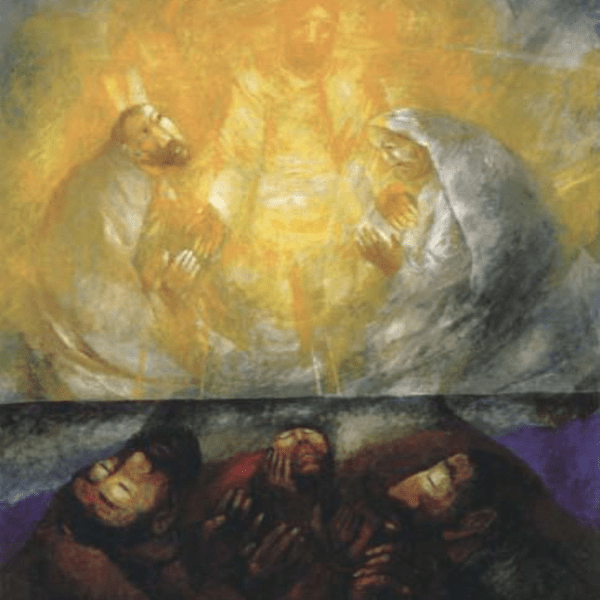
Transfiguration by Sieger Köder (1925-2015)

After six days Jesus took with him Peter, James and John the brother of James, and led them up a high mountain by themselves. There he was transfigured before them. His face shone like the sun, and his clothes became as white as the light. Just then there appeared before them Moses and Elijah, talking with Jesus.

Peter said to Jesus, “Lord, it is good for us to be here. If you wish, I will put up three shelters—one for you, one for Moses and one for Elijah.”

While he was still speaking, a bright cloud covered them, and a voice from the cloud said, “This is my Son, whom I love; with him I am well pleased. Listen to him!”

When the disciples heard this, they fell facedown to the ground, terrified. But Jesus came and touched them. “Get up,” he said. “Don’t be afraid.” When they looked up, they saw no one except Jesus.

As they were coming down the mountain, Jesus instructed them, “Don’t tell anyone what you have seen, until the Son of Man has been raised from the dead.” (New International Version)

Fear is a universal feeling and experience. None of us has to work at being afraid – but we all have to work at being brave and having the courage to face our fears.

Sometimes, we adults teach children not to fear because we assume they are afraid of the dark, high places, and monsters in the closet. But I tend to think a lot of our own adult fear is projected on kids. Why? Because some of the bravest folks I have ever known are children. 

Kids don’t understand near as much as we adults do, yet they conquer their fears every day by facing the world with courage. If you were to go to any children’s hospital today, I believe you would be amazed at the kind of courage you would find amongst kids. We adults have a whole lot to learn about being brave because we have become far too sophisticated in hiding our fears and avoiding courage.

This is why the most repeated exhortation is all of Holy Scripture is to not be afraid. We need courage to live the way God wants. Every day is a fresh opportunity to practice courage.

We need the courage to stand alone

Korah son of Izhar, the son of Kohath, the son of Levi, and certain Reubenites—Dathan and Abiram, sons of Eliab, and On son of Peleth—became insolent,and rose up against Moses. With them were 250 Israelite men, well-known community leaders who had been appointed members of the council. They came as a group to oppose Moses and Aaron and said to them, “You have gone too far! The whole community is holy, every one of them, and the Lord is with them. Why then do you set yourselves above the Lord’s assembly?” (Numbers 16:1-3, NIV)

When Moses heard this, he responded with prayer to God – because he clearly understood that this was all a big power play by Korah, who got others stirred up to take action against him. 

Moses stood alone. Out of the millions of Israelites, not one single person stood with Moses. To be sure, the majority of Israelites did not side with Korah; but neither did they come and stand with Moses. Why? They were too afraid to be involved and took the posture of bystanders. 

God did a miraculous thing, never done before or since, by opening up the ground and having the earth swallow Korah and his followers. The Lord wasn’t only upset with Korah; God was also angry with the people for fearfully standing in the safety of numbers and doing nothing. In fact, God was so mad that he was ready to wipe them all off the face of the earth. But, yet again, Moses, in humility, prayed and pleaded with God to spare them – and God did.

There will always be someone opposing you when you are just trying to obey God and do the right thing. And there will always be a crowd of people who do not want to be involved because they are afraid.

The church everywhere needs to be what Jesus wants it to be, and not what a particular person or group of people want it to be. Courageous people need to stand up to people who want positions of power in order to lead in self-serving ways.

We need the courage to love people

Now while he was in Jerusalem at the Passover Festival, many people saw the signs he was performing and believed in his name. But Jesus would not entrust himself to them, for he knew all people. He did not need any testimony about mankind, for he knew what was in each person. (John 2:23-25, NIV)

Jesus did not get carried away with his own press. Whether people responded to him by the hundreds, or whether they refused him altogether and tried to throw him off a cliff, Jesus was consistently the same. He did not need people’s responsive affirmation in order to do his mission on earth. Christ loved people just because he wanted to, and not because he was trying to get them to love him in return, like insecure and fearful people do.

We need the courage to love the unlovely. And we must understand that perfect love casts out fear.

“We should not only love our brothers and sisters, but also not consider ourselves better than them. Instead, we should show compassion and acceptance to others. We want to have others strictly reprimanded for their offenses, but we will not be reprimanded ourselves. We are inclined to think the other person has too much freedom, but we ourselves will not put up with any restraint to our freedom. There must be rules for everyone else, but we must be given free rein. It is seldom that we consider our neighbor equally with ourselves. If everyone was perfect, what would we have to endure for the love of God?… for we cannot live in this world without adversity. Those who can suffer well will enjoy the most peace, for such persons are brave, courageous, not afraid of pain, have Christ as their friend, and heaven as their reward.”

Thomas à Kempis, The Imitation of Christ, c.1425, C.E.

It is no test of virtue to be on good terms with easy-going people. And, of course, all of us want to live in peace and prefer those who agree with us. Yet, in this mortal life, our peace consists in the humble bearing of suffering and contradictions, not in being free of them.

We need the courage to please God

The devil took him to a very high mountain and showed him all the kingdoms of the world and their splendor. “All this I will give you,” he said, “if you will bow down and worship me.” Jesus said to him, “Away from me, Satan! For it is written: ‘Worship the Lord your God, and serve him only.’” (Matthew 4:8-10, NIV)

Jesus is our model of courage. He sought to please the Father, and not anyone else. Jesus bravely resisted becoming someone other than he was called to be. 

On the Mount of Transfiguration, Jesus courageously refused to remain on the mountain, instead choosing to go into the valley and undertake a new and risky ministry. 

Christ fearlessly came to this earth in the incarnation and resisted the comfort of security. He valiantly confronted sin, overturned the money-changers’ tables, and did his Father’s will, instead of shrinking in fear about what people would think. 

Jesus heroically faced crucifixion, even though he was terribly stressed about it, in order to offer forgiveness in the face of persecution. Jesus gallantly said “No!” to the power of sin by rising from death. And he boldly ascended to heaven and confidently passed the work of ministry to a motley group of people who did not show any promise to carry the mantle of his teaching.

The Son found his identity in relation to the Father. For us to please God, we need the courage to play to an audience of One. 

If we need other people’s acceptance and approval in order to do anything, then we will never have the courage to act for God. 

We must live by conviction, and not by sticking our finger to the wind to see which way popular opinion is blowing.

Conclusion

History is filled with men and women who said “no” to destructive fear and changed the world. But imagine if they had succumbed to the paralyzing effects of fear in their lives. Imagine if…

The Apostle Paul, fearing resistance or rejection, chose to stay home rather than embarking on the missionary journeys that took the message of Christ throughout the known world.

Martin Luther King Jr. gave speeches filled with gentle hints about the evils of segregation, because he feared pushing too hard.

Jackie Robinson refused to enter major league baseball so as to not rock the boat; or Branch Rickey, the owner of the Brooklyn Dodgers, just going with the way baseball had always operated. But neither of them went that way. In the film, “42,” Robinson asks Rickey:

“You want a player that doesn’t have the guts to fight back?” “No. No.” replies Rickey. “I want a player who has the guts not to fight back. People aren’t going to like this. They’re going to do anything to get you to react. Follow a curse with a curse and they’ll hear only yours. Follow a blow with a blow and they’ll say the Negro lost his temper; that the Negro does not belong. Your enemy will be out in force and you cannot meet him on his own low ground. We win with hitting, running, fielding—only that. We win only if the world is convinced of two things: That you are a fine gentleman, and a great ball player. Like our Savior, you’ve got to have the guts to turn the other cheek. Can you do it?”  Robinson replies, “You give me a uniform; you give me a number on my back; and I’ll give you the guts.”

42 (2013 film)

Now imagine yourself, fully aware of the mission and vision God has placed in your heart to advance his gracious and benevolent rule in this world – and yet there is also present all the phobias, irrational worries, and destructive fears of failure, harm, or rejection. So I ask:

If you don’t fulfill the mission God assigned to you, who will?

Make the Impossible Possible (Judges 7:12-22)

The camp was huge. The Midianites, Amalekites, and other eastern nations covered the valley like a swarm of locusts. And it would be easier to count the grains of sand on a beach than to count their camels. Gideon overheard one enemy guard telling another, “I had a dream about a flat loaf of barley bread that came tumbling into our camp. It hit the headquarters tent, and the tent flipped over and fell to the ground.”

The other soldier answered, “Your dream must have been about Gideon, the Israelite commander. It means God will let him and his army defeat the Midianite army and everyone else in our camp.”

As soon as Gideon heard about the dream and what it meant, he bowed down to praise God. Then he went back to the Israelite camp and shouted, “Let’s go! The Lord is going to let us defeat the Midianite army.”

Gideon divided his little army into three groups of 100 men, and he gave each soldier a trumpet and a large clay jar with a burning torch inside. Gideon said, “When we get to the enemy camp, spread out and surround it. Then wait for me to blow a signal on my trumpet. As soon as you hear it, blow your trumpets and shout, ‘Fight for the Lord! Fight for Gideon!’ ”

Gideon and his group reached the edge of the enemy camp a few hours after dark, just after the new guards had come on duty. Gideon and his soldiers blew their trumpets and smashed the clay jars that were hiding the torches. The rest of Gideon’s soldiers blew the trumpets they were holding in their right hands. Then they smashed the jars and held the burning torches in their left hands. Everyone shouted, “Fight with your swords for the Lord and for Gideon!”

The enemy soldiers started yelling and tried to run away. Gideon’s troops stayed in their positions surrounding the camp and blew their trumpets again. As they did, the Lord made the enemy soldiers pull out their swords and start fighting each other.

The enemy army tried to escape from the camp. They ran to Acacia Tree Town, toward Zeredah, and as far as the edge of the land that belonged to the town of Abel-Meholah near Tabbath. (Contemporary English Version)

It took some doing, but Gideon finally got around to taking on the massive army of people.

For years, marauders from the East came and raided Israel. They ate crops and livestock, then destroyed anything that was left. The Israelites, of course, were miserable. Yet, what could they do? There were so many of them!

So, they begged God for help. (Judges 6:6-7)

And the Lord responded. God chose Gideon to be the agent of change.

But Gideon failed to see it. He just couldn’t wrap his pea brain and small heart around the fact that God was choosing him to lead the charge against this humungous mean-spirited ornery bandits.

It was as if Gideon was Barney Fife, being made Sheriff in the Old West town to try and stop the powerful thieves from making off with all their cattle and drinking all of the saloon’s whiskey.

So, it took a while for Gideon to envision what the Lord was doing. And, on top of it all, God went and whittled the Israelite army down to 300 men. That’s it. A few hundred townsfolk against an army that was too big to count.

Yet, Gideon, bless his doubtful and fearful heart, was handed one last piece of gracious information. He caught a conversation between two of the enemy about a dream; it emboldened him to listen and act. And the result was a miraculous victory in which the big bullies were driven from the valley – not because of Gideon’s superior faith or ability – but because the Lord made it possible through him.

And that is precisely how it still works today.

I’m a guy who likes his research; and I can study something to death before pulling the trigger. For me, knowledge is power; and I’ll gobble up every morsel of information I can get my hands on in order to feel a semblance of confidence and courage. But the real issue is trusting God and sensing the Lord’s presence. God is with me. And if God is with me, who can be against me? (Romans 8:31-39)

And I’m not the only one. We all have our ways of trying to feel better and make some sense of the nonsensical situations we get put into, such as:

  • Creating a detailed plan of everything that’s going to happen, accounting for every contingency possible. But God already has a plan. The real issue is: Will you accept it?
  • Making everyone around you happy. Giving, helping, serving. If you could just bake enough cookies for all those men, then everything will be okay, right!?… Wrong. God already loves you and has your back. If some people don’t like you, that’s not the end of the world.
  • Working harder than everyone else. Putting your nose to the grindstone and determining you’ll outwork the enemy. That might get some short term results, but it will only result in burnout. The victory isn’t up to you; it’s up to God.
  • Giving in and giving up. Meh. Why even try? They’re just going to beat up everyone and steal everything anyway. I’ll just tap into my spirit animal, Eeyore, and watch a bunch of British dark comedy on TV. Yet, that approach helped get you into the mess you’re in now. Pay attention to the Lord’s voice, not somebody else’s.
  • Retreating to the high ground. We just need to get away. Stay safe. Keep everyone protected by getting them out of harm’s way. However, anyone outside of God’s will is never safe. If the Lord says to take on something, that’s the safest place you can be.
  • Throwing a party. Hey, let’s try and make the best of it. Let’s eat and drink today, for tomorrow we die. It’s better to go out having fun than wasting away worrying about everything. Pass the chip dip, please. *Sigh* You’re the dip! Trying to put a positive spin on a terrible situation is a terrible solution that will have negative results.
  • Taking charge. If everyone will just listen to me and do what I tell them, we’ll get out of this mess. Reality check, my friend: Who put you in charge? The Lord is God; you are not him. Stop it! Start taking orders from God and follow the Lord.
  • Failing to take a side. Why all the conflict? Can’t we all just get along? Maybe if I take a nap it will all go away. I’m not even going to touch that one. Did you hear yourself?

Most of life is about calming ourselves long enough to hear the voice of the Lord speaking to us. And if we will just take a few deep breaths and follow through with what God tells us, it’s going to go a lot better than any of our contrived ways of coping.

God is with you. God loves you. God makes the impossible possible. Faith over fear. Calm over chaos. Armed with that understanding, you’ve already won.