Fear vs. Faith (Numbers 13:1-2, 17-33; 14:1-9)

The Spies Return with Discordant Views, by Yoram Raanan

The Lord said to Moses, “Send some men to explore the land of Canaan, which I am giving to the Israelites. From each ancestral tribe send one of its leaders”…

When Moses sent them to explore Canaan, he said, “Go up through the Negev and on into the hill country. See what the land is like and whether the people who live there are strong or weak, few or many. What kind of land do they live in? Is it good or bad? What kind of towns do they live in? Are they unwalled or fortified? How is the soil? Is it fertile or poor? Are there trees in it or not? Do your best to bring back some of the fruit of the land.” (It was the season for the first ripe grapes.)

So they went up and explored the land from the Desert of Zin as far as Rehob, toward Lebo Hamath. They went up through the Negev and came to Hebron, where Ahiman, Sheshai and Talmai, the descendants of Anak, lived. (Hebron had been built seven years before Zoan in Egypt.) 

When they reached the Valley of Eshkol, they cut off a branch bearing a single cluster of grapes. Two of them carried it on a pole between them, along with some pomegranates and figs. That place was called the Valley of Eshkol because of the cluster of grapes the Israelites cut off there. At the end of forty days they returned from exploring the land.

They came back to Moses and Aaron and the whole Israelite community at Kadesh in the Desert of Paran. There they reported to them and to the whole assembly and showed them the fruit of the land. They gave Moses this account:

“We went into the land to which you sent us, and it does flow with milk and honey! Here is its fruit. But the people who live there are powerful, and the cities are fortified and very large. We even saw descendants of Anak there. The Amalekites live in the Negev; the Hittites, Jebusites and Amorites live in the hill country; and the Canaanites live near the sea and along the Jordan.”

Then Caleb silenced the people before Moses and said, “We should go up and take possession of the land, for we can certainly do it.”

But the men who had gone up with him said, “We can’t attack those people; they are stronger than we are.” And they spread among the Israelites a bad report about the land they had explored. They said, “The land we explored devours those living in it. All the people we saw there are of great size. We saw the Nephilim there (the descendants of Anak come from the Nephilim). We seemed like grasshoppers in our own eyes, and we looked the same to them.”

That night all the members of the community raised their voices and wept aloud. All the Israelites grumbled against Moses and Aaron, and the whole assembly said to them:

“If only we had died in Egypt! Or in this wilderness! Why is the Lord bringing us to this land only to let us fall by the sword? Our wives and children will be taken as plunder. Wouldn’t it be better for us to go back to Egypt?” And they said to each other, “We should choose a leader and go back to Egypt.”

Then Moses and Aaron fell face down in front of the whole Israelite assembly gathered there. Joshua son of Nun and Caleb son of Jephunneh, who were among those who had explored the land, tore their clothes and said to the entire Israelite assembly:

“The land we passed through and explored is exceedingly good. If the Lord is pleased with us, he will lead us into that land, a land flowing with milk and honey, and will give it to us. Only do not rebel against the Lord. And do not be afraid of the people of the land, because we will devour them. Their protection is gone, but the Lord is with us. Do not be afraid of them.” (New International Version)

“Pessimism has done infinitely more harm than atheism.”

Pierre Teilhard de Chardin

Fear can be debilitating. At its core, we fear either what we don’t know, or believe to be bad. For example, if I am convinced that my boss does not have my best interests at mind, then I will likely be afraid and hold back.

The majority of the ancient Israelites were paralyzed by fear because of the anxiety and fearfulness of those who came back from spying out the Promised Land. They had a low view of God. Yet Caleb, and only a few others, acknowledged that God is good for divine promises, and so, trusted the Lord completely in confidence, not fear.

If we view God as being angry all the time, then we will not use the incredible gifts given to us for fear of messing up and bringing divine wrath upon us. We will be plagued with uncertainty and only see giants in the land who we cannot begin to deal with.

Yet, if we commit ourselves to knowing God through seeking the divine will and trusting in divine promises, then we understand that God is gracious and generous, always having our backs. We live by faith, not by sight, and discern that giants in the land are really nothing more than gnats.

Fear is maybe the devil’s greatest tool to prevent God’s people from being productive and responsible in serving the church and the world. Beneath that fear are powerful feelings of inferiority, inadequacy, and a low view of self – which is really born of a low view of God. Being afraid wastes what impact a person could have for God, and waters-down life so that it’s ineffective.

Enjoy the Lord, and he will give what your heart asks.

Psalm 37:4, CEB

We are to enjoy the gracious and generous God; and in our enjoyment, the Lord places within us godly dreams that are a delight for God to fulfill. Our enjoyment of the Lord gives us the security and confidence to act upon those godly desires and wed them to divine promises from Holy Scripture.   

But put fear in the mix, and it dilutes and destroys everything. It makes you do nothing. And the fear is a result of not knowing the Lord, of not seeking God’s mind or will.

God had a grand vision and a big dream for the Israelites to enter the Promised Land. But ten of the twelve spies who came back after checking out the land were paralyzed by fear, feeling like grasshoppers next to the people in the land. 

Caleb and Joshua, however, had a different view of taking the land because they had a different view of God. They didn’t see giants – they saw a gracious and generous God who could easily take care of whoever might be in the land, and they wanted to act on the faith they had in a mighty and merciful God. 

The God of the other spies wasn’t big enough to handle the giants. Their low view of themselves as grasshoppers betrayed their low view of God.

“We wrap a lot of our fears in morbidly sanctified self-belittling.  We piously cover this self-despising and call it consecration and self-crucifixion.”

David Seamands

Too many people feel good about feeling bad – and then use those feelings to make spiritual excuses for not exploring what God promises, expects, commands, and dreams for them. 

It is high time for us to get into the world with our witness in a far greater way because we serve a God who sees giants as gnats; and we will, too, if we have a high view of God.

Yet, holding us back, is fear of criticism, of taking a risk, of going outside of the way we’ve always done it, and of what others may think or say. 

If you once dreamed something and you think your dream is dead because you destroyed it by your sins or bad habits, you are wrong. Dreams are destroyed by fear, by being tricked into thinking that we are nothing but grasshoppers and God doesn’t care, and so we do nothing.

Unfortunately, it appears the most common way of coping with feelings of fear, insecurity, and inferiority is by withdrawing from other people – because you cannot give yourself fully to your family, church, neighborhood, vocation, and the world without a healthy robust view of and relationship with God. 

Give God a chance to work in and through your life. May you step up and step out because you have a God behind you that is gracious and generous. Amen.

Who Is Jesus? (John 7:40-52)

The Light of the World, by William Holman Hunt, c.1853

On hearing his words, some of the people said, “Surely this man is the Prophet.”

Others said, “He is the Messiah.”

Still others asked, “How can the Messiah come from Galilee? Does not Scripture say that the Messiah will come from David’s descendants and from Bethlehem, the town where David lived?” Thus the people were divided because of Jesus. Some wanted to seize him, but no one laid a hand on him.

Finally the temple guards went back to the chief priests and the Pharisees, who asked them, “Why didn’t you bring him in?”

“No one ever spoke the way this man does,” the guards replied.

“You mean he has deceived you also?” the Pharisees retorted. “Have any of the rulers or of the Pharisees believed in him? No! But this mob that knows nothing of the law—there is a curse on them.”

Nicodemus, who had gone to Jesus earlier and who was one of their own number, asked, “Does our law condemn a man without first hearing him to find out what he has been doing?”

They replied, “Are you from Galilee, too? Look into it, and you will find that a prophet does not come out of Galilee.” (New International Version)

Orthodox Christian icon of Jesus Christ

There was a lot of buzz in Christ’s day of who Jesus really was. Prophet? Messiah? And, if Jesus really is a big deal, would he really come from Hicksville Nazareth? What about his credentials? His class? His pedigree?

Opinions on Jesus haven’t really changed all that much from the ancient world. They are still just as diverse now as when he was on this earth.

Unlike today, ancient people could not simply “Google” Jesus and find out where he was born and grew up. And they had no access to doing background checks in a matter of minutes to find out all kinds of things about him. Had the religious authorities bothered to do their homework and investigated Jesus, they would have found that, indeed, he was born of the Davidic line and in Bethlehem.

The short of it is that a chunk of the people simply assumed they knew Jesus wasn’t of proper Messiah credentials. They assumed and did not investigate because they did not want to know. No one can be faulted for ignorance. However, purposeful ignorance is perhaps the greatest of all sins, betraying a deep egoism of pride and prejudice.

In their hubris, the religious leaders sent the temple guards to bring Jesus in. Yet, in a clear demonstration of heavenly authority, the guards actually listened to Jesus and saw for themselves who he really is. Their simple confession testifies to Christ’s credibility. If one would but just see and listen for themselves, and engage in a genuine investigation, they could walk away finding truth.

6th-Century Byzantine mosaic of Jesus

Opponents of Jesus for the past two thousand years assume that Christians have been duped into taking the opiate of the people. Many think that followers of Christ were manipulated by religious hacks trying to gain power over others. But that’s a curious opinion, considering Jesus continually did just the opposite of that and was a champion for the poor, the powerless, and the marginalized persons of society.

When professional people with recognized degrees and competence do not believe you, nor take your own experience and learning seriously, what do you do?

Well, you could listen to them, or you could listen to your own gut telling you that you’re being gaslighted by a bunch of highly intelligent simpletons who are unfamiliar – are ignorant – of the faith you are familiar with.

What’s more, there are always smart and experienced people in the room who know better. Nicodemus was such a person. He was a serious scholar, and chose to speak up about these things. Authorities and credentials matter, yet of first importance is to know how to go about any sort of inquiry – rather than just passing over an objective investigation and assuming you know better.

Ethiopian artist depiction of Jesus teaching

For decades, I have (graciously) challenged others who do not believe in Jesus to actually read the Gospel accounts and at least engage in some minimal investigation – rather than giving opinions based on limited knowledge and secondary sources.

After all, as Nicodemus pointed out so long ago, shouldn’t we first give Jesus a fair hearing before we start dismissing him as nothing more than a religious figure that a bunch of people follow?

And I must also point out that this applies to us Christians, as well. Rather than waving aside Buddha or Muhammad or any other religious figure as false, don’t you owe their followers the basic respect of hearing them out before you dismiss them as fake, or in some cases, worse than that?

If you accuse another point of view, which is different than your own, as wrong or not real, without first hearing the accused and gathering objective evidence, then we really have no business getting uppity when another person accuses or dismisses our own faith.

Sadly, the colleagues of Nicodemus chose not to answer him but to instead engage in the age old practice of ad hominem argumentation by attacking the person, thereby deflecting having to give an answer.

People attack other people out of fear. And, in this case, it seems to me the religious leaders were downright afraid of investigating Jesus and giving him an honest hearing. Because if they did, they just might have their world turned upside-down; and they wanted the status quo to be maintained, at all costs, even if it meant ignoring the truth.

Jesus Washing the Feet of His Disciple, by Japanese artist Sadao Watanabe (1913-1996)

You don’t have to take my word on any of these things about Christ or Christianity. Read the Gospel of John for yourself – in one sitting if possible. Ingest the words. Drink in the experiences. Then, come and have a conversation with me.

Jesus, Lamb of God, have mercy on us.

Jesus, Bearer of our sins, have mercy on us.

Jesus, Redeemer of the world, give us your peace.

Jesus, Light of the world, shine in our hearts.

Jesus, Hope of all, be our companion on our way.

Jesus, Great Physician, heal our broken lives.

Jesus, Beloved Son of God, kindle within us the fire of your love. Amen.

Good News Is for Everyone (Isaiah 56:1, 6-8)

This is what the Lord says:

“Maintain justice
    and do what is right,
for my salvation is close at hand
    and my righteousness will soon be revealed….

And foreigners who bind themselves to the Lord
    to minister to him,
to love the name of the Lord,
    and to be his servants,
all who keep the Sabbath without desecrating it
    and who hold fast to my covenant—
these I will bring to my holy mountain
    and give them joy in my house of prayer.
Their burnt offerings and sacrifices
    will be accepted on my altar;
for my house will be called
    a house of prayer for all nations.”
The Sovereign Lord declares—
    he who gathers the exiles of Israel:
“I will gather still others to them
    besides those already gathered.” (New International Version)

Issues of identity

Ever since the Jewish people existed – for the past 4,000 years – there have been other people and other nations who have conquered them, displaced them, and have even tried to annihilate them altogether, several times throughout history.

A seminal experience for ancient Israel was when God’s temple was destroyed and the people taken into exile in Babylon. Generations later, many faithful Jews returned to Jerusalem to rebuild and reform under Nehemiah and Ezra.

Undergoing defeat, occupation, and oppression can and will do a great deal of psychological, emotional, and spiritual harm. And when it happens repeatedly, it’s easy to understand how any group of people might wonder: “Are we still God’s people? Have so many years of being in other places made us different? Who are we right now?”

These are questions of identity. For many Jews, since God allowed them to be conquered, because they did not obey the covenant, then now is the time to double-down on following the rules and proving they are truly God’s chosen people. So much so, that some (not all) insisted that their identity can only be maintained by radically separating themselves from everyone and everything foreign that is not Jewish. 

We can understand how a vulnerable people who have been attacked and conquered would be suspicious about welcoming outsiders. In fact, any sort of hospitality could be seen as a betrayal of their own struggle, and a deviation from their sense of community, identity, and integrity. 

Diversity and inclusion isn’t warm and fuzzy

So, when God comes along and shares a plan of bringing foreigners to the holy mountain, it’s scandalous. The people don’t see this as a wonderful moment of everybody getting to together, singing kumbaya, and letting bygones be bygones. Nobody in Israel is saying, “Lord, please let us gather together with a bunch of foreigners, strangers, aliens, and gentiles!”

Quite the opposite. Instead, they start circling the wagons to survive and maintain and preserve their Jewish identity. Isaiah’s message challenged the people to their core. It was not a popular idea – even coming from God – of including the other. Such change was a threat.

Welcoming strangers can be upsetting

Whenever I walk through neighborhoods in major cities and see banners in yards that say, “All Are Welcome!” and churches that emblazon that message on their signage, I wonder if they really understand what they’re saying. There are many folks who expect welcoming the stranger to feel good, to be rewarding and connect us to one another. There may be romantic notions of connecting with others with idyllic visions of new people folding seamlessly into who we already are.

The reality is typically much different than that. We are surprised and disheartened when others don’t think or act like we do, and having them around feels awkward. They’re upsetting the status quo and making the group into something I don’t like. It might be something like your crazy uncle who shows up on holidays and makes everything weird. 

The thing we must face and contend with is this: Strangers, foreigners, immigrants, and anyone different from ourselves, often bring God’s own message to us, coming in amongst us to disrupt and transform. Strangers bring strange practices; foreigners bring foreign worldviews; and different people bring different practices and ideas we aren’t familiar with. But why in the world would we ever be surprised that strangers are strange!? 

What in God’s name is going on?

On God’s holy mountain, people are gathered around values, ethics, and obedience. Community and being together with the Lord is defined by faith, and not by simply signing off on a list of approved beliefs and doctrinal statements. God makes it clear that faithfulness, even of foreigners, will determine who is brought into the house of prayer for all people. Deliverance is offered to those who walk the walk and don’t just talk the talk.

What’s more, deliverance does not involve revenge, nor assurances that bad things will never happen again. Instead, salvation means freedom to pray and be connected to God. This is what God wants. And so, the Lord will bring and gather faithful people from all over – both Jew and Gentile. They will all dwell together in God’s house with much joy.

An invitation for belonging

We find words in today’s text having to do with a sense of belonging: house, accepting, prayer, gather. Isaiah puts forth a compelling vision of life with God, where we belong and have community. At the heart of God is a hospitality which invites all kinds of people to come and enjoy the divine presence and being with one another.

At the time of Christ’s incarnation, the angels showed up and announced good news of great joy to all people. And yet, far too many persons, perhaps out of sense to guard against outsiders hurting them, turn this gracious message on it’s head by announcing bad news of great judgment to all people that aren’t like me and don’t think like me.

Christ’s Church has struggled through its history to invite and include the other, and to uphold this basic message of gracious good news for everyone.

From the Council of Jerusalem that met to decide whether one ought to become a Jew first in order to be a Christian (Acts 15), to withholding membership to African Americans in certain churches in the 20th century, to the just plain ignoring of the poor and marginalized in many places, we must be intentional and deliberate about reaching and ministering to all people.

The joy of salvation is that I do not need to jump through certain spiritual hoops to enter into Christianity, nor be a certain kind of person. The church is not an exclusive club of one particular sort of people based in race, gender, ethnicity, class, spiritual pedigree, or even certain preferences on issues. Through repentance and faith in Jesus, all may come to God.

All people have intrinsic worth as individuals created in the image of God, and therefore need the attention of Christians in bringing the gospel to them. It is much too easy to ignore people we do not understand and who are different from us, or to look down on those who do not agree with me on disputable matters.

When it comes to the good news of Jesus, having people out of sight does not mean we keep them out of mind. Too many people are often off the radar of many churches for a variety of reasons, not the least of which is because the poor and needy have to compete with the wealthy and powerful for attention. To intentionally reach and minister to a different class or generation or race requires much love and many resources.

How big is your inner space?

Jesus had a big enough inner space to accommodate prostitutes, drunks, tax collectors, and a whole variety of sinners. Do you and I have a big enough space to allow people in our lives who are not like us, without feeling threatened or insecure? The Pharisees feared being contaminated if having table fellowship with such people; the Sadducees were afraid of losing their religious power if the status quo was changed to focus on others; and the Zealots feared continued Roman domination if Jesus kept up spending his time in graciousness to all kinds of sinners. So, all the religious people killed him.

The gospel of Jesus is good news of great joy for everyone. We are to work together to propagate this message by having the shared purpose of evangelism to everyone without discrimination. When we engage in this critical endeavor together, there is tremendous joy. We are meant to gather on God’s holy mountain and share with all sorts of people.

Blessed Lord God, through your Son you commanded us to go into all the world and proclaim good news to every creature. Increase our faith and zeal, that we may more earnestly desire the salvation of all people.

We confess that our hearts are often indifferent and dull to your cry of mission. Forgive our callousness and judgmentalism toward others, and by your Holy Spirit fill us with a burning zeal to bring light into darkness. Give us loving hearts, sincerity of speech, and holiness of life.

Knowing that this world, as it is now, will not last forever, drawing to a close, may we by your Spirit’s prompting, support the mission of this church with our personal witness, our earnest prayers, and our sacrificial gifts. Grant that through us many may be included on your holy mountain, through Jesus Christ, your Son, our Lord, who with you and the Holy Spirit reign as one God, now and forever. Amen.

Walk on Water? Why? (Matthew 14:22-33)

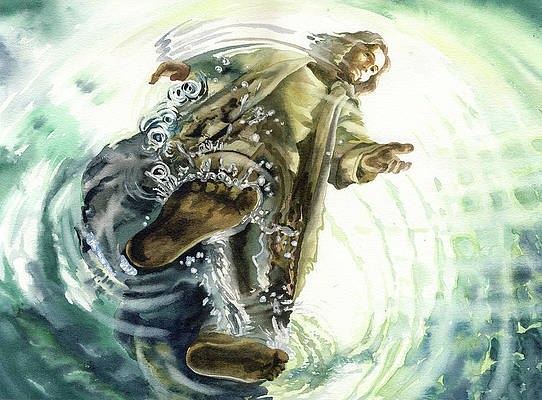
Jesus Walks on Water, by Konstantin Alexejewitsch Korowin, 1890 

Immediately Jesus made the disciples get into the boat and go on ahead of him to the other side, while he dismissed the crowd. After he had dismissed them, he went up on a mountainside by himself to pray. Later that night, he was there alone,and the boat was already a considerable distance from land, buffeted by the waves because the wind was against it.

Shortly before dawn Jesus went out to them, walking on the lake. When the disciples saw him walking on the lake, they were terrified. “It’s a ghost,” they said, and cried out in fear.

But Jesus immediately said to them: “Take courage! It is I. Don’t be afraid.”

“Lord, if it’s you,” Peter replied, “tell me to come to you on the water.”

“Come,” he said.

Then Peter got down out of the boat, walked on the water and came toward Jesus. But when he saw the wind, he was afraid and, beginning to sink, cried out, “Lord, save me!”

Immediately Jesus reached out his hand and caught him. “You of little faith,” he said, “why did you doubt?”

And when they climbed into the boat, the wind died down. Then those who were in the boat worshiped him, saying, “Truly you are the Son of God.” (New International Version)

In the New Testament Gospels, we see Jesus for who he is – Son of God and true Sovereign of the universe – seeking to reconcile people to God through his life, miracles, and teaching. In the Gospels we also see Christ’s disciples for who they are – a rag-tag bunch who express both belief and doubt, and experience both faith and failure.

The reality of the Christian life is that it is a sort of three-steps-forward and two-steps-backward kind of experience. The expectation that we will “succeed” and have everything go hunky-dory each time we step out in faith, is far from how things actually work in both the world and in God’s kingdom. Doubt and failure are important experiences for the believer in Jesus.

Without failure, there is no Christian life. Why? Because it means we are still in the boat.

It’s evidence that we never left the safety of established routines and responded to God’s command to step out of our comfort zone, and boldly go where we’ve never gone before.

Our failures may, like Peter, be colossal bellyflops. Yet, Jesus is there – extending grace to Peter and helping him, even in his failure of faith. Failure does not define us; it isn’t our identity. Jesus is Lord over everything, including storms, hardship, and trouble. 

Yes, there are a lot of scary things in life. Learning to ride a bike was scary. Driving for the first time on an icy road was scary. Getting married and having kids was scary. Admitting a fault, mistake, or weakness is scary. Being vulnerable with another person is scary.

It can even be scary to be at church. Why? Because we might fail, and it may crush us.

The fear of failure, however, need not control our lives. Why? Because grace overcomes everything.

We all find ourselves, at times, caught midway between faith and doubt. But to know this situation is to experience grace. If the worst scenario you worry about in your head would actually come to pass, it will still never change the reality that God loves you! And it will not stop Jesus from extending his hand to you in a life-saving grip of grace. 

Fear melts away when we keep our eyes on Jesus. So, we must focus on Christ, instead of fixating on the waves around us. The truth sets us free. Therefore, let’s notice five truths about Jesus that help us overcome the fear of failure and embrace a life of faith.

1. Jesus is a person of prayer

Jesus was deeply dependent on his heavenly Father. His life exhibited the necessities of simple prayer and obedience. If Jesus found the need for solitude and prayer for his life and ministry, how much more to we need it!? 

The Lord had his disciples get into the boat and go out on the lake. Jesus knew they were about to face a storm. The boat ended up getting thrown around by the waves. Even though the disciples were doing God’s will by going out on the lake, they were not spared from adversity.  

Jesus wanted his disciples to experience the storm. Why? Because it is through the storm that we learn faith.  

Faith is developed through experience and adversity. Faith that never endures distress, never grows and matures. Faith must be exercised – and if it isn’t, it atrophies and becomes useless. 

Show me a person with great faith, and I’ll show you a person that has gone through a boatload of adversity and hurt, having allowed Jesus to grace them with healing.

2. Jesus is present with us, and this presence brings an end to fear

Being in the middle of a lake during a storm did not prevent Jesus from being present with the disciples – he just walked on the water to be with them. Even though the disciples had just participated in the miracle of Jesus feeding the five thousand, another miracle was not on their radar – which is why they did not recognize Jesus and were afraid when they saw him.

While afraid, we don’t see Jesus, even when he’s right in front of our faces. Why? Because we don’t expect him to be there and mistake him for a ghost.  

When the disciples cried out in fear, Jesus responded. I used to have a factory job, training workers. When the training was completed, I had the trainees evaluate our time together. The top response I received is that my presence helped them to learn their job – the freedom to fail time and time again without judgment. Having me there to rescue them, when things got too much, built confidence that they could do it on their own.

3. Jesus desires those who follow him to imitate him

Jesus walked on water. Jesus invited Peter to walk on water. Peter was not chided by Jesus for getting out of the boat, but for doubting that he could continue in the miracle that was happening. 

Jesus isn’t merely interested in disciples being able to regurgitate his teaching. Why? Because he wants us to exercise our learning through actual deeds of faith.  

Once the command of Jesus was given to Peter, “Come”, then walking on water became only a matter of trust.

“Christianity has not been tried and found wanting. It has been found difficult and left untried.”

G.K. Chesterton

We understandably get nervous when a crazy Jesus and an unpredictable Holy Spirit call us to change by getting out of the friendly confines of the boat. Why? After all, we might fail. 

However, it is at those times that we bank on God’s Word and promises. The Apostle James said that if we find ourselves lacking wisdom to deal with the unpredictable and unknowable, we are to ask God who gives generously to all without finding fault and will be given to us. (James 1:5)

Christ Walking on the Sea, by Natali Fedorova

Peter responded to his predicament by crying out to Jesus, “Lord, save me!” Jesus immediately reached out and saved Peter from his own doubt and lack of faith. Jesus called Peter a “little-faith.”

Many people have lived too long with the notion that God is some stern angry deity who is constantly displeased with sinful people, and that only through perfection will God ever be happy with us. The truth is that Jesus wants us to imitate him; and, when we fail, he is there to pick us up. 

4. Jesus has the authority to settle the storm when he is ready to do it

Jesus is King. Christ is Sovereign of the world. He will bring the crisis to an end according to his own good pleasure and good timing. Rather than spending all our emotional capital by worrying or conniving to get out of a situation, we can trust God and keep our eyes on Jesus.  Our job is to believe; God’s job is everything else.

5. Jesus’ power led the disciples to acknowledge who he is

Worship happens when we see Jesus as he really is, the Son of God. Flat, dull, boring worship comes from flat, dull, boring Christians who are unable to see the power of Jesus in their lives. We discover the power of God when we are in a situation which requires God’s strength to deliver us. Grasping Jesus as the Son of God is more than a verbal confession of faith; it is being able to trust him, like getting out of a boat in the middle of a lake.

We are to live by faith in the Son of God who loved us and gave himself for us (Galatians 2:20). It doesn’t require much faith to pray that Aunt Mable’s bunions will feel better. It only requires a little faith to give a dollar when you have ten dollars. It takes no faith to discuss the weather and steer clear of hard conversations.

But it does require faith:

  • to pray for a miraculous healing every day without giving up for a little boy who is racked by epilepsy, and trust God to spare his life
  • to write a check for $100 to someone in need when you have exactly $100 in your checking account, and trust God to provide for you own necessities. 
  • to go off the grid of the routine schedule to have a difficult discussion about social justice, and trust God to act on Christ’s teachings. 
  • to live as though the mission of God in this world is the most important thing we could ever do, and trust God to step out and do it.

It would be great if we could pray and act without ever doubting or failing, yet the only way to do that is to never step out of the boat. Instead, live life. Trust God. And see what happens.

Holy God, help us, your people, to embrace the life that is truly life by stepping out of the boat.  May Jesus define our lives instead of letting failure define us. May we accept the grace that is ours in Jesus Christ our Lord, in whose name we are bold to pray. Amen.