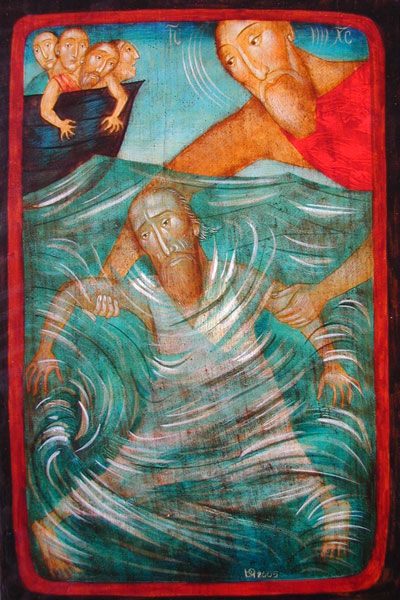
The Sinking of the Apostle Peter by Julia Stankova, 2006
The New Testament Gospels of Matthew, Mark, Luke, and John allow us to see Jesus for who he really is: The Son of God, the true King of the universe who seeks to reconcile people to God through his life, miracles, and teaching. The Gospels also allow us to see the disciples of Jesus for who they really are: A rag-tag bunch who express both belief and doubt, and experience both faith and failure.
The reality of the Christian life is that it is often a herky-jerky three-steps-forward and two-steps-backward kind of experience. An expectation that we will “succeed” and have everything go well every time we try something by stepping out in faith is way out of step with how things work in both this world and in the kingdom of God. It would be a bit like a basketball player expecting to make every free throw attempt – and if they cannot do it, they refuse to even try.
Doubt and failure are important experiences for the believer in Jesus Christ. Without failure, there is no Christian life. Never failing means we have not tried – we are still in the boat, having never left the safety of established routines and responded to God’s command to come, leave your comfort zone, and enter the scary world of kingdom living.
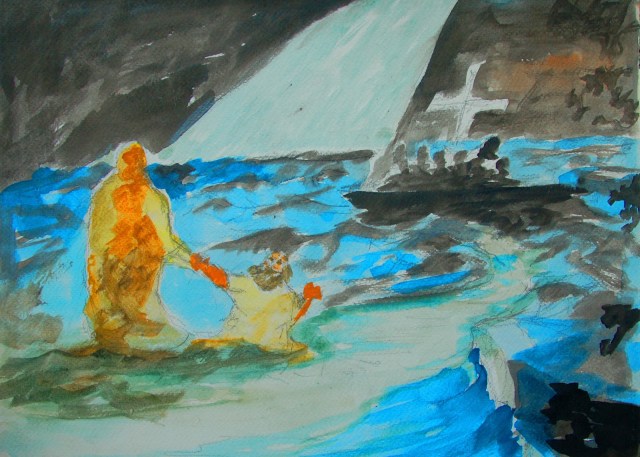
Our failures may sometimes, like the disciple Peter, be colossal belly-flops. Yet, the story of Peter getting out of the boat and walking on the water and becoming overcome with the waves is just as much or more about Jesus (Matthew 14:22-33). Christ extended grace to Peter and helped him, even in his failure of faith. Therefore, our failures do not need to define us. Jesus is Lord over the water, the storms, and of everything – including our own hardship and trouble.
Yes, there are a lot of scary things in life. Learning to ride a bike is scary. Driving for the first time on an icy road is scary. Getting married and having kids is scary. Admitting an addiction or unethical behavior is scary. Sharing the innermost thoughts with a friend is scary. It is scary just to be in this world. It can even be scary to be at church! It is all scary because we might fail, and the failure, we reason and worry about, might crush us.
However, the fear of failure need not control our lives because grace overcomes everything. We all find ourselves, at times, caught midway between faith and doubt. Yet, to know this situation is to experience grace. If the worst scenario you worry about in your head would actually come to pass, it will still never change the reality that God loves you! And it will not stop Jesus from extending his hand to you in a life-saving grip of grace.
Jesus Saving Peter by Bertram Poole, 2012
Fear only melts away when we keep our eyes on Jesus. Christ is the polestar whom we must center our lives, instead of focusing on the waves around us. The truth sets us free, so, take note of the following truths about Jesus that will help us overcome the fear of failure and embrace a life of faith.
Jesus is a person of prayer (Matthew 14:22-24).
Jesus, the Son of God, was deeply dependent on his heavenly Father. His life exhibited the necessities of simple prayer and obedience. If Jesus found the need for solitude and prayer in his life and ministry, how much more to we need it!?
Jesus made the disciples get into the boat and go out on the lake. As Lord of the elements, he knew very well they were about to face a storm. Sure enough, the storm clouds gathered, and the boat got thrown around by the waves. Even though the disciples were doing God’s will by going out on the lake, they were not spared from the adversity. In fact, Jesus wanted them to experience the storm because it is through the storm that we really learn faith.
Faith is a muscle which requires continual use. Through stressful and vigorous exercise, there is a breaking down of muscle tissue and tearing of muscle fibers which leaves the body in need of rest and recuperation. It is through this process of healing that the muscles grow and are strengthened. Muscles which do not experience this type of stress become useless and eventually atrophy. Show me a person of great faith, and I’ll show you a person who has gone through a boat load of adversity and hurt, having allowed Jesus to grace them with healing.
There is no shame in either being hurt and/or admitting failure. Where there is shame, our instinct is to run away much like our ancestors Adam and Eve. We can try and hide from the shame, but we will end up hiding ourselves from the grace that could be ours through the Body of Christ. Grace is free, not cheap – it is accessed by the humility of confession.
Jesus is present with us, bringing an end to fear (Matthew 14:25-27).
Although on the middle of a lake during a storm, Jesus was still present with the disciples. Adverse weather was no problem for Jesus – he just walked on the water to be with them. Even though the disciples had just seen and participated in the miracle of Jesus feeding the five thousand, they were not looking for another miracle. Maybe that is why they did not recognize Jesus and were afraid when they saw him.
The disciples’ expectations of Jesus were far too low! Sometimes when we are afraid, we fail to see Jesus, even when he is right in front of our faces. We just do not expect him to be there. When the disciples cried out in fear, Jesus responded. I used to work at a factory where I trained people in their jobs. When the training was finished, I had the trainees evaluate our time together. The top response I received from most of them is that it was my presence that helped them to learn their job – the ability to fail time and time again. And having me there to rescue them when things got overwhelming eventually built faith that they could do it on their own.
Jesus wants those who follow him to imitate him (Matthew 14:28-31).
Jesus walked on water. Jesus invited Peter to walk on water. We are to do what Jesus did. Notice that Peter is not chided by Jesus for getting out of the boat but for doubting that he could continue in the miracle that was happening. Jesus wants more than a regurgitation or parroting of his teaching; he wants us to exercise that learning through actual deeds of faith. Once the command of Jesus was given to “come” then walking on water became nothing more than a matter of trust. Christianity is more than a set of doctrines to believe; it is a powerful reality to be live into.
“Christianity has not been tried and found wanting. It has been found difficult and left untried.” –G.K. Chesterton
We understandably get nervous when a crazy Jesus and an unpredictable Holy Spirit call us to get out of the friendly confines of the boat. After all, we might fail. However, it is in such times we bank on the Word of God and the promises of God.
The Apostle James said that if we find ourselves lacking wisdom to deal with the unpredictable and unknowable that we are to ask God who gives generously to all without finding fault and will be given to them (James 1:5).
Peter responded to his sinking situation by crying out to Jesus, “Lord, save me!” Jesus immediately reached out and saved Peter from his own doubt and lack of faith. Jesus called Peter a “little-faith.” Many people have lived too long with the notion that God is some stern angry deity who is constantly displeased with his sinful people, and that only through perfection will he ever be happy with us. The truth is that Jesus wants us to imitate him; and, when we fail, he is there to pick us up.
Jesus has the authority to settle the storm when he is good and ready to do it (Matthew 14:32).
Jesus is the King of the universe and the Sovereign of the world. He will bring the crisis to an end according to his own good pleasure and in his own good timing. Rather than spending all our emotional capital by worrying or conniving to get out of a situation, we need to trust God and keep our eyes on Jesus. Our job is trust; God’s job is everything else.
Jesus’ power led the disciples to acknowledge who he is (Matthew 14:33).
Worship happens when we see Jesus as he really is, the Son of God. Flat, dull, boring worship comes from flat, dull, boring Christians who are unable to see the power of Jesus in their lives. And the way we know the power of God is when we are in a situation which requires God’s strength to deliver us. Grasping Jesus as the Son of God is more than a verbal confession of faith; it is being able to trust him, like getting out of a boat in the middle of a lake.
We are to live by faith in the Son of God who loved us and gave himself for us (Galatians 2:20). It does not require much faith to pray that Aunt Mable’s bunions will feel better. It only requires a little faith to give a dollar when you have ten dollars. It takes no faith to discuss the weather and steer clear of hard conversations.
However, it does require faith to pray for a miraculous healing every day without giving up for a little boy who is racked by epilepsy, and trust God to spare his life. It does require faith to write a check for $100 to someone in need when you have exactly $100 in your checking account, and you must trust God to provide for you own necessities. It does require faith to deviate from the routine schedule to have a difficult discussion about race. It does require faith to act on Christ’s teachings. It does require faith to live as though the mission of God in this world is the most important thing we could ever do.
It would be nice for me say that if you live by faith in the Son of God that you will never fail, but that would be lying. The only way of not failing is not living life, and not exercising faith. It would be great if we could pray and act without ever doubting, yet the only way to avoid doubt is to not believe.
So, may we embrace the life that is truly life by stepping out of the boat. May Jesus define our lives instead of letting failure define us. May we accept the grace that is ours in Jesus Christ our Lord.
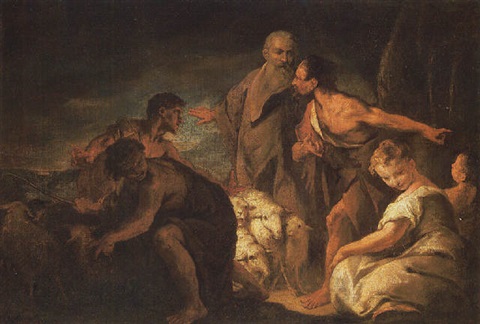
Jacob and Laban by Italian painter Nicola Grassi (1682-1748)
On the third day Laban was told that Jacob had fled. Taking his relatives with him, he pursued Jacob for seven days and caught up with him in the hill country of Gilead. Then God came to Laban the Aramean in a dream at night and said to him, “Be careful not to say anything to Jacob, either good or bad.”
Jacob had pitched his tent in the hill country of Gilead when Laban overtook him, and Laban and his relatives camped there too. Then Laban said to Jacob, “What have you done? You’ve deceived me, and you’ve carried off my daughters like captives in war. Why did you run off secretly and deceive me? Why didn’t you tell me, so I could send you away with joy and singing to the music of timbrel and harp? You didn’t even let me kiss my grandchildren and daughters goodbye. You have done a foolish thing.I have the power to harm you; but last night the God of your father said to me, ‘Be careful not to say anything to Jacob, either good or bad.’ Now you have gone off because you longed to return to your father’s household. But why did you steal my gods?”
Jacob answered Laban, “I was afraid, because I thought you would take your daughters away from me by force. But if you find anyone who has your gods, that person shall not live. In the presence of our relatives, see for yourself whether there is anything of yours here with me; and if so, take it.” Now Jacob did not know that Rachel had stolen the gods.
So, Laban went into Jacob’s tent and into Leah’s tent and into the tent of the two female servants, but he found nothing. After he came out of Leah’s tent, he entered Rachel’s tent. Now Rachel had taken the household gods and put them inside her camel’s saddle and was sitting on them. Laban searched through everything in the tent but found nothing.
Rachel said to her father, “Don’t be angry, my lord, that I cannot stand up in your presence; I’m having my period.” So, he searched but could not find the household gods.
Jacob was angry and took Laban to task. “What is my crime?” he asked Laban. “How have I wronged you that you hunt me down? Now that you have searched through all my goods, what have you found that belongs to your household? Put it here in front of your relatives and mine and let them judge between the two of us.
“I have been with you for twenty years now. Your sheep and goats have not miscarried, nor have I eaten rams from your flocks. I did not bring you animals torn by wild beasts; I bore the loss myself. And you demanded payment from me for whatever was stolen by day or night. This was my situation: The heat consumed me in the daytime and the cold at night, and sleep fled from my eyes. It was like this for the twenty years I was in your household. I worked for you fourteen years for your two daughters and six years for your flocks, and you changed my wages ten times. If the God of my father, the God of Abraham, and the Fear of Isaac, had not been with me, you would surely have sent me away empty-handed. But God has seen my hardship and the toil of my hands, and last night he rebuked you.” (NIV)
Jacob’s in-law issues did not magically disappear when he sneaked out of town with his entire family. I am glad God is faithful and acts on our behalf even when we are fearful with little faith. Far too often we do the right thing in the wrong way. It is far too easy to run away from people we don’t like. Yet, it is rarely so simple. Sometimes we plain need divine intervention to deal with people in our lives.
To Jacob’s credit, he obeyed God and headed back to the land of Canaan. However, he did it in a deceitful way which avoided confrontation. Out of fear of facing his father-in-law Laban and the worry of what might happen, Jacob got out of Dodge. It seems Jacob’s wife Rachel also acted out of fear by taking her father’s idols. Fear can cause us to have some skewed ideas and do some stupid things which get us in trouble.
“According to most studies, people’s number one fear is public speaking. Number two is death. Death is number two. Does that sound right? This means to the average person, if you go to a funeral, you’re better off in the casket than doing the eulogy.” –Jerry Seinfeld
Laban found out what was going on with Jacob and was anything but a happy camper. He went after the upstart Jacob with gusto and finally caught up to him. Despite having the power and ability to deal severely with Jacob, Laban backs off because Jacob finally found his voice and took his father-in-law to task. Embedded in Jacob’s rehearsal of their relationship is the God who intervened and took care of Jacob when Laban didn’t.
Jacob Confronts Laban by Dutch painter Jan Steen, 1669
The lengthy dialogue between Jacob and Laban was a power struggle: Laban wanted to keep the status quo authority as family head over Jacob’s family; but Jacob asserted himself as having his own distinct household. In the end, they ended-up on equal footing because of God’s intervention. Whereas Laban had his own intentions for Jacob and his family, God had other plans. It was God who enriched Jacob with a wealth of flocks and herds, even as he was being oppressed and intimidated by Laban.
The same God, who was with Jacob, is with you and me:
God is with us through difficulty, oppression, and injustice.
Now, it is commendable if, because of one’s understanding of God, someone should endure pain through suffering unjustly. But what praise comes from enduring patiently when you have sinned and are beaten for it? But if you endure steadfastly when you’ve done good and suffer for it, this is commendable before God. (1 Peter 2:19-20, CEB)
God does not give up on his people. We Christians are often living contradictions, like Jacob, who acknowledge God and give him glory but at the same time act out of fear and insecurity. Out of the compost of human sin, the sovereign God accomplishes his will.
Christ died for us when we were unable to help ourselves. We were living against God, but at just the right time Christ died for us… while we were still sinners, and by this God showed how much he loves us. (Romans 5:6, 8, ERV)
God cares both about what we do, and about why and how we do it. Ethics is the difference between morality and legality; and, between what I ought to do, and what is required of me. Jacob did what was demanded of him by God; yet, he did it out of fear along with unwise methods.
Anything that is not done in faith is sin. (Romans 14:23b, GW)
God’s intervention is needed. Without divine help, we are hopelessly lost. Furthermore, we continue to need God so we can deal with the unpredictable attempts of others to control us and push us into a mold outside of trusting in God.
Give all your worries to God because he cares about you. (1 Peter 5:7, NCV)
God instills confidence in us. After twenty hard years of service, Jacob returned to the land of Canaan prosperous and more confident in God than ever. Jacob’s trials with Laban gave him a growing sense of dependence on God. Jacob struggled, suffered, and endured – and came out the stronger for it.
You know that when your faith is tested, your endurance has a chance to grow. So, let it grow, for when your endurance is fully developed, you will be perfect and complete, needing nothing. (James 1:3-4, NRSV)
God loves us enough to not always give us an easy out because he is concerned for our walk of faith and our education in grace. So, may you discover the intervening God and exercise trust through those times when others give you a hard time.
God, grant me the serenity to accept the things I cannot change, the courage to change the things I can, and the wisdom to know the difference. Living one day at a time, enjoying one moment at a time; accepting hardship as a pathway to peace; taking, as Jesus did, this sinful world as it is, not as I would have it; trusting that You will make all things right if I surrender to Your will; so that I may be reasonably happy in this life and supremely happy with You forever in the next.Amen. –The Serenity Prayer by Reinhold Niebuhr, 1951
After the Sabbath, at dawn on the first day of the week, Mary Magdalene and the other Mary came to look at the tomb. Look, there was a great earthquake, for an angel from the Lord came down from heaven. Coming to the stone, he rolled it away and sat on it. Now his face was like lightning and his clothes as white as snow. The guards were so terrified of him that they shook with fear and became like dead men. But the angel said to the women, “Don’t be afraid. I know that you are looking for Jesus who was crucified. He isn’t here, because he’s been raised from the dead, just as he said. Come, see the place where they laid him. Now hurry, go and tell his disciples, ‘He’s been raised from the dead. He’s going on ahead of you to Galilee. You will see him there.’ I’ve given the message to you.”
With great fear and excitement, they hurried away from the tomb and ran to tell his disciples. But Jesus met them and greeted them. They came and grabbed his feet and worshipped him. Then Jesus said to them, “Don’t be afraid. Go and tell my brothers that I am going into Galilee. They will see me there.” (CEB)
The Resurrection of Christ from death has changed everything – especially when it comes to fear. In this season of Eastertide, we discover and explore the vast implications of what it means to possess a new life. Because Christians serve a risen Savior, this newfound awareness brings courage and confidence. Fear isn’t something we can simply exercise willpower over. Rather, fear begins to give way to the presence of God among us. Consider just a few of the many references to this in Holy Scripture:
“Be strong and courageous. Do not be afraid; do not be discouraged, for the Lord your God will be with you wherever you go.” (Joshua 1:9, NIV)
“Be strong and courageous. Do not be afraid or terrified because of them, for the Lord your God goes with you; he will never leave you nor forsake you.” (Deuteronomy 31:6, NIV)
“So do not fear, for I am with you;
do not be dismayed, for I am your God.
I will strengthen you and help you;
I will uphold you with my righteous right hand.” (Isaiah 41:10, NIV)
“God has said, ‘Never will I leave you;
never will I forsake you.” So, we say with confidence, ‘The Lord is my helper; I will not be afraid.
What can mere mortals do to me?’” (Hebrews 13:5-6, NIV)
Believe it, or not, the Bible tells us 365 times to not be afraid. Maybe that’s not a coincidence that we can quote a verse every day of the year about our own fearfulness in the face of so much of the world’s cruel circumstances.
When it comes to fear and bravery, God does not so much command us to be courageous, as he wants us to draw from the great reservoir of bravery within. That is, God has already created us strong, as creatures in his image. We just need to get in touch with what is already there. And the reality of Easter awakens and calls forth that life.
We can act with boldness and overcome fear because Jesus is the pioneer of our salvation. He is the One which enables us to draw from the deep well of courage….
“So then, since we have a great High Priest who has entered heaven, Jesus the Son of God, let us hold firmly to what we believe. This High Priest of ours understands our weaknesses, for he faced all the same testing we do, yet he did not sin. So, let us come boldly to the throne of our gracious God. There we will receive his mercy, and we will find grace to help us when we need it most.” (Hebrews 4:14-16, NLT).
You and I really can face the fears in front of us. You can surmount the adversity you are in the middle of – not because of some words I say, but because Christ has risen from death. He’s alive, and his presence makes all the difference.
“Let all therefore enter into the joy of our Lord. Let rich and poor dance with one another.” –St John Chrysostom
The following is an Easter homily from the fourth-century preacher St. John Chrysostom to the Church of Constantinople:
“Let no one grieve at his poverty,
for the universal kingdom has been revealed.
Let no one mourn that he has fallen again and again;
for forgiveness has risen from the grave.
Let no one fear death, for the Death of our Savior has set us free.
He has destroyed it by enduring it.
He destroyed Hades when He descended into it.
He put it into an uproar even as it tasted of His flesh.
Isaiah foretold this when he said,
“You, O Hell, have been troubled by encountering Him below.”
Hell was in an uproar because it was done away with.
It was in an uproar because it is mocked.
It was in an uproar, for it is destroyed.
It is in an uproar, for it is annihilated.
It is in an uproar, for it is now made captive.
Hell took a body, and discovered God.
It took earth, and encountered Heaven.
It took what it saw, and was overcome by what it did not see.
O death, where is thy sting?
O Hades, where is thy victory?
Christ is Risen, and you, o death, are annihilated!
Christ is Risen, and the evil ones are cast down!
Christ is Risen, and the angels rejoice!
Christ is Risen, and life is liberated!
Christ is Risen, and the tomb is emptied of its dead;
for Christ having risen from the dead,
is become the first-fruits of those who have fallen asleep.
To Him be Glory and Power forever and ever. Amen!”
Click Because He Lives sung by Guy Penrod as we are reminded that the living Christ makes all the difference today.







 Rev. Tim Ehrhardt