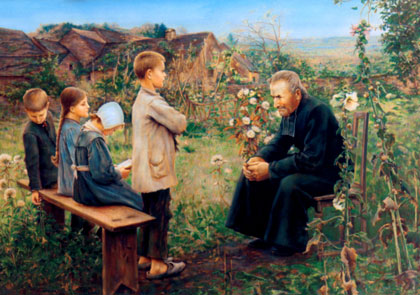
Luke 15:1-3, 11b-32 – Parable of the Lost Son

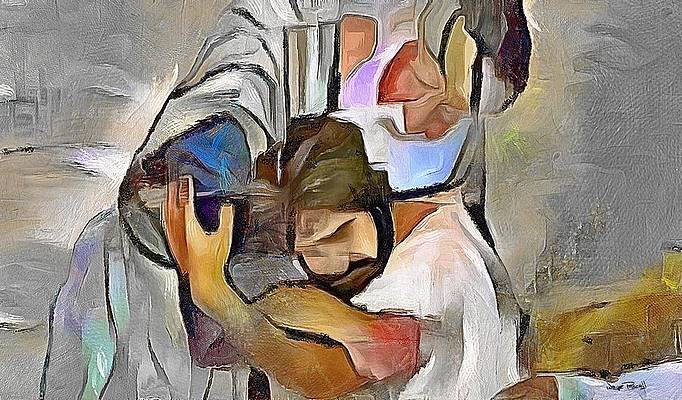
Prodigal Son by Wayne Pascall

Now all the tax collectors and sinners were coming to hear him. But the Pharisees and the experts in the law were complaining, “This man welcomes sinners and eats with them.”

So, Jesustold them this parable….

“A man had two sons. The younger of them said to his father, ‘Father, give me the share of the estate that will belong to me.’ So, he divided his assets between them. After a few days, the younger son gathered together all he had and left on a journey to a distant country, and there he squandered his wealth with a wild lifestyle. Then after he had spent everything, a severe famine took place in that country, and he began to be in need. So, he went and worked for one of the citizens of that country, who sent him to his fields to feed pigs. He was longing to eat the carob pods the pigs were eating, but no one gave him anything. But when he came to his senses he said, ‘How many of my father’s hired workers have food enough to spare, but here I am dying from hunger! I will get up and go to my father and say to him, “Father, I have sinned against heaven and against you.I am no longer worthy to be called your son; treat me like one of your hired workers.”’ So, he got up and went to his father. But while he was still a long way from home his father saw him, and his heart went out to him; he ran and hugged his son and kissed him. Then his son said to him, ‘Father, I have sinned against heaven and against you; I am no longer worthy to be called your son. ’But the father said to his slaves, ‘Hurry! Bring the best robe and put it on him! Put a ring on his finger and sandals on his feet! Bring the fattened calf and kill it! Let us eat and celebrate,because this son of mine was dead, and is alive again—he was lost and is found!’ So, they began to celebrate.

“Now his older son was in the field. As he came and approached the house, he heard music and dancing. So, he called one of the slaves and asked what was happening. The slave replied, ‘Your brother has returned, and your father has killed the fattened calf because he got his son back safe and sound.’ But the older son became angry and refused to go in. His father came out and appealed to him, but he answered his father, ‘Look! These many years I have worked like a slave for you, and I never disobeyed your commands. Yet you never gave me even a goat so that I could celebrate with my friends! But when this son of yours came back, who has devoured your assets with prostitutes, you killed the fattened calf for him!’ Then the father said to him, ‘Son, you are always with me, and everything that belongs to me is yours. It was appropriate to celebrate and be glad, for your brother was dead, and is alive; he was lost and is found.’” (New English Translation)

Lost people matter to God.

In the story of the lost prodigal son, that son hit rock bottom and rehearsed a speech he would give to his father when he came back. He never got to finish it, because the father interrupted his confession of sin and got the celebration going! 

We celebrate the things that are important to us. Lost people matter to God so much that it is a cause for a great celebration. God’s grace steps in and takes over, erasing past guilt and bringing radical forgiveness and reconciliation.

The Prodigal Son by Kaye Redman

Today there are literally tens of thousands of children who have walked away from their upbringing in faith, and even many times, literally walked away from their family of origin. Their parents know the feeling of standing at the window, wondering how their prodigal daughter really is, and longing for their prodigal son to come home. 

So, what do you do when you are the parent of a prodigal? How do you deal with the pain and the estrangement of a wayward son or daughter? 

  • Don’t expect a prodigal to be Christ-like. If the son or daughter is not a Christian, they aren’t going to act like one. Exhortations to stop drinking cheap wine, cease partying, not get a tattoo, or even go to church is not only useless, but it can also be harmful. Behind all the speech or behavior of a prodigal that might make a parent cringe, there is a world of hurt. The heart is sick or broken. Prodigals need to be treated as fellow humans and equals.

He was pierced because of our rebellions
    and crushed because of our crimes.
    He bore the punishment that made us whole;
    by his wounds we are healed.
Like sheep we had all wandered away,
    each going its own way,
    but the Lord let fall on him all our crimes. (Isaiah 53:5-6, CEB)

  • Welcome a prodigal home. It is possible (and necessary!) to remain connected in relationship, even if there are differing values or practices between parents and prodigals. In other words, don’t make it hard for a son or daughter to come home. Yes, there are instances when parents need to clarify and maintain boundaries, but those instances are actually rare.

In most cases, if a daughter smells like weed or an ashtray, just spray her jacket with Febreze and change the sheets when she leaves – but let her come home. If you find out she’s pregnant, then be with her and take her to her twenty-week ultrasound.

If a son is broke because he spent all the money you lent him on women and liquor, then forgive his debt as you’ve been forgiven; don’t give him any more money—and let him come home. If in doubt, always go with grace.

For God has revealed his grace for the salvation of all people. That grace instructs us to give up ungodly living and worldly passions, and to live self-controlled, upright, and godly lives in this world. (Titus 2:11-12, GNT)

  • Point a prodigal to Christ. A prodigal’s real problem is not sex or addiction, laziness or crime, cussing or ill manners. It is very possible that they simply don’t see Jesus for who he really is. So much Christian dogma or traditional practice might be encrusted on them that they simply cannot experience Jesus Christ’s love. God’s grace is what draws us all to faith – not hellfire preaching or parental badgering.

At one time you were separated from God. You were his enemies in your minds, and the evil things you did were against God. But now God has made you his friends again. He did this through Christ’s death in the body so that he might bring you into God’s presence as people who are holy, with no wrong, and with nothing of which God can judge you guilty. (Colossians 1:21-22, NCV)

We are to all share the same heart of the father in the parable of the lost son – a heart of hospitable love, abundant grace, and open celebration.

Loving heavenly Father, thank you that Jesus showed us your heart of love for the children of this world. Help us to do everything we can so that they will know how much you love them and want them to know your blessing. Thank you for your compassion for those who have strayed from you. Thank you that you are always ready to welcome us back with mercy and acceptance. Amen.


Psalm 127 – How to View Our Work

Psalm 127:1 by Stushie Art

Unless the Lord builds the house,
    those who build it labor in vain.
Unless the Lord guards the city,
    the guard keeps watch in vain.
It is in vain that you rise up early
    and go late to rest,
eating the bread of anxious toil;
    for he gives sleep to his beloved.

Sons are indeed a heritage from the Lord,
    the fruit of the womb a reward.
Like arrows in the hand of a warrior
    are the sons of one’s youth.
Happy is the man who has
    his quiver full of them.
He shall not be put to shame
    when he speaks with his enemies in the gate. (New Revised Standard Version)

When my wife was growing up, her family had a prominent portrait of John Wayne in the living room above the television. That picture spoke volumes about the family ethos. They had horses and loved to ride and enjoy the outdoors. Hard work was a daily reality of life, as well as a rugged individualism that often suppressed all else in order to engage in work. 

Doing your best, striving for excellence, and learning responsibility are good things that mature people do every day. Yet, there is a fine line between hard work that provides and enriches, and lonely work that is frenetic and fueled by anxiety about the future.

Today’s psalm gives us a wake-up call. All our work is useless, in vain, unless it is connected to the G-d who gives strength and sweet sleep.

The motives that lie behind why we burn the candle at both ends are just as important to the Lord as the work itself. 

If we independently believe that our life is in our own hands, and we work with worry animating our every job, then we have lost touch with the understanding that it is G-d who ultimately provides us with every good thing in life. 

However, if we begin to relax and let go of our stubborn independent streak, then we work hard with the strength G-d gives and let the Lord watch over us.

Trusting G-d in our work is connected to children being a heritage from the Lord. Children worked with their parents in the ancient world. Fathers and mothers did not go it alone – it was a family affair, as well a community endeavor. 

Whenever we slip into a groove of worshiping individualism rather than simply taking personal responsibility, then we must come back to the inter-dependence that we were designed for as people. 

The ethos the psalmist is looking for is trust in God, reliance on others, and working together for the common good of all. 

Here are a few ways of working together and not carrying the load of work on our own:

Ask for what you want and need to accomplish the task. Whenever we don’t ask, we inevitably go the route of hustling for help through manipulation, guilt, and shaming others.

If someone says, “no,” simply ask another person or persons. Asking once just won’t do. And neither is commanding others to get things done. We have the ability to ask calmly, confidently, and compassionately. Accept the “no” which you might get without retreating back to manipulation. This is especially necessary when it comes to asking family members.

Ask God to help you in your work. Each day as I enter the hospital for which I am a Chaplain, I say a prayer, “God almighty, blessed Father, Son, and Spirit, please go before me, with me, and after me to each patient, their family members, and every team member I encounter today, with the love and compassion of Jesus Christ.”

Delegate, if possible. This is not the same thing as barking orders. It is a realization that we are finite creatures with limitations of time, energy, and resources. It’s okay to share the load with others. In fact, most people are more than willing to help, if you and I will just ask. It enables them to feel needed and important.

Be vulnerable and gracious. We all mess up our work, at times. And it’s important that we are own our mistakes without heaping unnecessary criticism on ourselves, or others. Offering an apology, recognizing that you’ve bit off more than you can chew, and admitting your lack of energy are healthy, not sinful. Also, whenever others fall short of their responsibilities, it’s our job to handle it with grace – seeking to understand and help rather than criticize and judge.

Working together, consulting, collaborating, and engaging in fellowship enable us to speak with those who may oppose, misunderstand, or misinterpret us. It’s also a more joyful way to live.

Sovereign God, you created all things and in you everything holds together. Preserve me with your mighty power that I may not fall into disconnection with you and others, nor be overcome by anxiety. In all I do direct me to the fulfilling of your purposes, through Jesus Christ my Lord. Amen.

Malachi 3:16-4:6 – Turning Hearts

Then those revering the Lord,
    each and every one, spoke among themselves.
        The Lord paid attention and listened to them.
Then a scroll of remembrance was written before the Lord
        about those revering the Lord,
            the ones meditating on his name.
On the day that I am preparing,
says the Lord of heavenly forces,
        they will be my special possession.
        I will spare them just as parents spare a child who serves them.
You will again distinguish between the righteous and the wicked,
        between those serving God and those not serving him.

Look, the day is coming,
        burning like an oven.
All the arrogant ones and all those doing evil will become straw.
    The coming day will burn them,
says the Lord of heavenly forces,
        leaving them neither root nor branch.
But the sun of righteousness will rise on those revering my name;
        healing will be in its wings
            so that you will go forth and jump about like calves in the stall.
You will crush the wicked;
        they will be like dust beneath the soles of your feet
            on the day that I am preparing,
says the Lord of heavenly forces.
Remember the Instruction from Moses, my servant,
        to whom I gave Instruction and rules for all Israel at Horeb.
Look, I am sending Elijah the prophet to you,
        before the great and terrifying day of the Lord arrives.
Turn the hearts of the parents to the children
    and the hearts of the children to their parents.
            Otherwise, I will come and strike the land with a curse. (CEB)

According to the U.S. Census Bureau, twenty-five million children in America — one out of every three — live in biological father-absent homes. The National Fatherhood Initiative reports that nine in ten American parents agree this is a “crisis.”  Consequently, there is a “father factor” in many social issues today. Children with involved fathers do better across every measure of child well-being than their peers in father-absent homes.

From a biblical perspective, the relationship between fathers and children is hugely important not only for the well-being of family and society, but for God’s people.  Fathers in ancient Israel were the primary instructors of God’s covenant to their children.  This responsibility was critical to ensuring success in Israel and obeying their God. 

The fact of the matter in the prophet Malachi’s day was this: The fathers blew it.  The last verse of the Old Testament ends on a note of coming judgment. However, that is not the end of the story because the prophet Elijah will come to turn the hearts of the fathers to their children and vice versa.

John the Baptist, Jesus said, was the Elijah to come:

From the days of John the Baptist until now, the kingdom of heaven has been subjected to violence, and violent people have been raiding it. For all the Prophets and the Law prophesied until John. And if you are willing to accept it, he is the Elijah who was to come. Whoever has ears, let them hear. (Matthew 11:12-15, NIV)

In the Christian tradition, Jesus is the fulfillment of God’s covenant promises to the people. Therefore, fathers who follow Jesus have a sacred responsibility to gently guide their kids to Christ. It is important for Christian dads to take up the mantle of teaching children the ways of God especially as expressed by Jesus.  

God is on a mission of restoration, and a good place to begin is with restoring relationships between fathers and children. In fact, it behooves all fathers to step back and slow down enough to consider what the nature of their family relationships are really like – taking action to instruct kids in both word and deed.

The word catechism derives from the Greek language and means “instruction.” Ever since the start of the Protestant Reformation, learning about God has often taken the form of catechetical teaching. Catechisms vary in length with a pedagogical question and answer format. Typically included are explanations on the Apostle’s Creed, the Ten Commandments, and the Lord’s Prayer.

Question and answer 104 of the Reformed Confession, the Heidelberg Catechism, says this:

Q. What is God’s will for you in the fifth commandment?

A. That I honor, love, and be loyal to my father and mother and all those in authority over me; that I submit myself with proper obedience to all their good teaching and discipline; and also that I be patient with their failings – for through them God chooses to rule us.

Here is a simple observation: Children cannot obey what they have not been taught. Underpinning all submission and obedience of both divine and human authority is the basic assumption that parents will instruct their children in the way of sound theology, biblical ethics, and religious piety.

What is more, we are all spiritual fathers and mothers to a host of children in our sphere of influence. This is a foundational way of relating to one another, and so, deliberate intention and effort needs to be placed here. Otherwise, there is religious decline with neither social nor familial cohesion.

So, let us love one another through careful training, effective teaching, and gracious tutoring so that righteousness will shine like a cloudless dawn and rise to warm the world with the love of God.

Gracious God, thank you for the gift of children.  Teach me your ways of grace so that I might pass them on to children in the merciful name of Jesus Christ through the power of the Holy Spirit.  Amen.