Turning the Hearts of Parents and Children (Malachi 3:16-4:6)

Then those who honored the Lord spoke with each other, and the Lord listened and heard them. The names of those who honored the Lord and respected him were written in his presence in a book to be remembered.

The Lord All-Powerful says, “They belong to me; on that day they will be my very own. As a parent shows mercy to his child who serves him, I will show mercy to my people. You will again see the difference between good and evil people, between those who serve God and those who don’t.

“There is a day coming that will burn like a hot furnace, and all the proud and evil people will be like straw. On that day they will be completely burned up so that not a root or branch will be left,” says the Lord All-Powerful. “But for you who honor me, goodness will shine on you like the sun, with healing in its rays. You will jump around, like well-fed calves. Then you will crush the wicked like ashes under your feet on the day I will do this,” says the Lord All-Powerful.

“Remember the teaching of Moses my servant, those laws and rules I gave to him on Mount Sinai for all the Israelites.

“But I will send you Elijah the prophet before that great and terrifying day of the Lord’s judging. Elijah will help parents love their children and children love their parents. Otherwise, I will come and put a curse on the land.” (New Century Version)

According to the U.S. Census Bureau, twenty-five million children in America — one out of every three — live in biological father-absent homes. The National Fatherhood Initiative reports that nine in ten American parents agree this is a “crisis.”  Consequently, there is a “father factor” in many social issues today. Children with involved fathers do better across every measure of child well-being than their peers in father-absent homes.

From a biblical perspective, the relationship between fathers and children is hugely important not only for the well-being of family and society, but for God’s people. Fathers in ancient Israel were the primary instructors of God’s covenant to their children. This responsibility was critical to ensuring success in Israel and in obeying their God. 

The fact of the matter in the prophet Malachi’s day was that, for the most part, the fathers blew it. The last verse of the Old Testament ends on a note of coming judgment. However, that’s not the end of the story because the prophet Elijah will come to turn the hearts of the fathers to their children and vice versa.

John the Baptist, Jesus said, was the Elijah to come:

From the days of John the Baptist until now, the kingdom of heaven has been subjected to violence, and violent people have been raiding it. For all the Prophets and the Law prophesied until John. And if you are willing to accept it, he is the Elijah who was to come. Whoever has ears, let them hear. (Matthew 11:12-15, NIV)

In the Christian tradition, Jesus is the fulfillment of God’s covenant promises to the people. Therefore, fathers who follow Jesus have a sacred responsibility to gently guide their kids to Christ. It’s important for Christian dads to take up the mantle of teaching children the ways of God, especially as expressed by Jesus.  

God is on a mission of restoration; and a good place to begin is with restoring relationships between fathers and children. In fact, it behooves all fathers to step back and slow down enough to consider what the nature of their family relationships are really like – taking action to instruct kids in both word and deed.

The word catechism derives from the Greek language and means “instruction.” Ever since the start of the Protestant Reformation, learning about God has often taken the form of catechetical teaching. Catechisms vary in length with a pedagogical question-and-answer format. Typically included are explanations on the Apostle’s Creed, the Ten Commandments, and the Lord’s Prayer.

Question and answer 104 of the Reformed Confession, the Heidelberg Catechism, says this:

Q. What is God’s will for you in the fifth commandment?

A. That I honor, love, and be loyal to my father and mother and all those in authority over me; that I submit myself with proper obedience to all their good teaching and discipline; and also that I be patient with their failings – for through them God chooses to rule us.

A simple observation: Children cannot obey what they have not been taught. Underpinning all submission and obedience of both divine and human authority is the basic assumption that parents will instruct their children in the way of sound theology, biblical ethics, and religious piety.

What’s more, we are all spiritual fathers and mothers to a host of children in our sphere of influence. This is a foundational way of relating to one another, and so, deliberate intention and effort needs to be placed here. Otherwise, there is religious decline with neither social nor familial cohesion.

This planet has quite enough curses upon it; we need not add to it by having constant friction and estrangement between parents and children. So, let us love one another through careful training, effective teaching, and gracious tutoring so that righteousness will shine like a cloudless dawn and rise to warm the world with the love of God.

Gracious God, thank you for the gift of children. Teach me your ways of grace so that I might pass them on to children, in the merciful name of Jesus Christ through the power of the Holy Spirit. Amen.

Family Dynamics (Matthew 12:46-50)

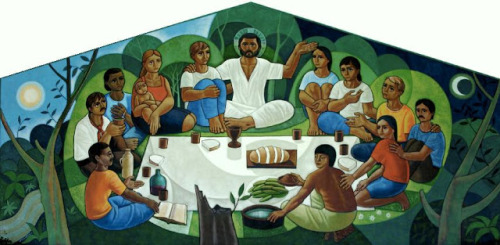
En la Cena ecológica del Reino (At the Ecological Kingdom Dinner) by Spanish artist Cerezo Barredo

While Jesus was speaking to the crowds, his mother and brothers stood outside trying to speak with him.Someone said to him, “Look, your mother and brothers are outside wanting to speak with you.”

Jesus replied, “Who is my mother? Who are my brothers?” He stretched out his hand toward his disciples and said, “Look, here are my mother and my brothers. Whoever does the will of my Father who is in heaven is my brother, sister, and mother.” (Common English Bible)

Jesus obviously did not get the cultural memo that blood is thicker than water.

When his own blood family were waiting outside for him, Jesus used the occasion to speak of what makes up a true follower of God. Christ boldly asserted that his true family is made up of people who do God’s will. By saying this, Jesus brought the point home that the kingdom of God turns on obedience.

Rather than merely confessing a belief, or appealing to a family heritage of faith, Jesus said that a genuine believer in God is one who listens to God’s words and then promptly obeys them. Therefore:

A Christian is defined by allegiance to Jesus, and not by having a certain bloodline. 

Identity determines activity. For example, if I identify myself primarily as…

  • a worker at my job, my activity will show it – I will spend long hours at my labor, and will do whatever it takes to please my boss and gain promotions.
  • an athlete, I will spend long hours honing my skills, and do whatever it takes to please the coach and to win.
  • a spouse and a parent, I will focus most of my attention on my family and seek to please them in all things. 

But if my identity is first and foremost as a Christian, I will seek to please Jesus. With my identity in Christ:

  • I will view my job as an opportunity to express the ethics of God’s kingdom, as a calling from God, and as a means for God to transform me for his glory.
  • I will view athletics as means to glorify God, and not as an end in and of itself but as a special gift for God to teach me about the importance of community and working together. 
  • I will view my kids as belonging to God and I will steward the trust of children given me by doing whatever it takes to teach and train them in the way of Jesus. I will thank God for my family and not confuse them with being God by idolizing them.

Jesus was inside a house, with his family on the outside. So, why were the family members of Jesus not inside the house sitting at his feet, taking the posture of a disciple?

The disciple Matthew wanted to communicate more than physical distance between Jesus and his physical family – being “outside” was meant to convey the posture of Christ’s family as spiritually distant, skeptical of him, and indecisive about who he was and what he was up to. The disciple Mark made this spiritual and emotional distance clear:

Jesus entered a house. A crowd gathered again so that it was impossible for him and his followers even to eat. When his family heard what was happening, they came to take control of him. They were saying, “He’s out of his mind!” (Mark 3:20-21, CEB)

Christ’s earthly family were not looking for Jesus to give them warm-fuzzies and have a big family hug. They were there to essentially say to him, “Cut it out, Jesus, because you’re acting like a nut-cake and embarrassing us all!”

Jesus was saying that identifying only with a biological family leads to only pleasing that family. However, identifying with Jesus leads to a radical form of following God that seeks to please him instead of submitting to family practices, mores, and beliefs which are inconsistent with the kingdom of God. 

Ethiopian Orthodox Church depiction of Christ and his disciples

For the Christian, the church is the family of God, and we are to act consistent with being in such a family.  We are to pursue God’s will, serve one another, and adopt outsiders into our family. The church is a family, not a restaurant. When we go to a restaurant, we either like the food and the service, or not. If the experience was unpleasant, we might complain to the waitress and may or may not come back. Try doing that with your mother and see where it gets you! 

As a biological family, we are committed to each other. There is no complaining about mom because of dad’s wrath. Instead, we are expected to clear our plates and put them in the dishwasher, to sweep the floor and clean the table, and to work together for the benefit of the entire family. In the same way, following Jesus means being committed to his family, the church.

Priority is to be given in doing God’s will, regardless of blood, because obedience to Christ identifies us as being in the family of God. Our actions and the way we live points to what we honestly believe and where our commitments truly lie. 

The first step of God’s desire for us is quality focused time in sitting at Christ’s feet and listening to him, because this is at the heart of all Christian discipleship. We can only do God’s will if we have clearly heard it; and we can only hear God’s will by taking the time to be at the feet of Jesus. 

Both listening and doing are necessary. Listening without engaging the world is a failure of mission; and doing without first listening leads to misguided acts and eventual burn-out. Allow Jesus to call the shots and let him instruct us so that we can live wisely and obediently. 

Jesus did not devalue blood relatives as irrelevant. Rather, the kingdom of God seeks to restore and redeem all things, including family. Both church and family are important. The relationships within each are to be nurtured.

The family of Jesus, the church, is important because Christ suffered and died for her. So, we are to be committed to the church, love the church, and serve the church because we are family. If we have a good grasp of this, we will make decisions based in what we believe God’s will is, instead of whether a relative will get upset, or not. 

We need to persistently pray for spiritually lost family members, and those whom we are estranged from. Most families have at least a few toxic persons in their orbit. Here is how we might pray for them:

  • That God will arrange divine appointments between them and others who love Jesus.
  • That God will draw them to the mercy of Christ.
  • That God will hinder the devil’s schemes against them.
  • That they will understand and respond to the good news of God’s grace.

O God, you made us in your own image and redeemed us through Jesus your Son: Look with compassion on the whole human family; take away the arrogance and hatred which infect our hearts; break down the walls that separate us; unite us in bonds of love; and work through our struggle and confusion to accomplish your purposes on earth; that, in your good time, all nations and races may serve you in harmony around your heavenly throne; through Jesus Christ our Lord. Amen.

Family Drama (Genesis 29:15-28)

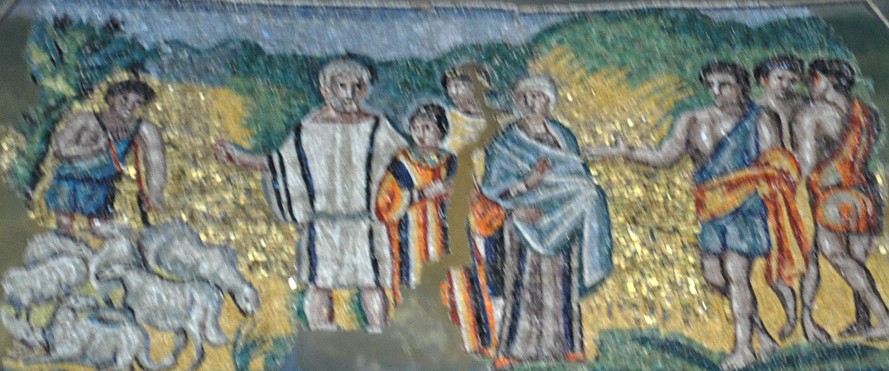
Jacob works to gain Rachel’s hand, 5th century mosaic, Basilica of Santa Maria Maggiore, Rome

Laban said to him [Jacob] “Just because you are a relative of mine, should you work for me for nothing? Tell me what your wages should be.”

Now Laban had two daughters; the name of the older was Leah, and the name of the younger was Rachel. Leah had weak eyes, but Rachel had a lovely figure and was beautiful. Jacob was in love with Rachel and said, “I’ll work for you seven years in return for your younger daughter Rachel.”

Laban said, “It’s better that I give her to you than to some other man. Stay here with me.” So Jacob served seven years to get Rachel, but they seemed like only a few days to him because of his love for her.

Then Jacob said to Laban, “Give me my wife. My time is completed, and I want to make love to her.”

So Laban brought together all the people of the place and gave a feast. But when evening came, he took his daughter Leah and brought her to Jacob, and Jacob made love to her. And Laban gave his servant Zilpah to his daughter as her attendant.

When morning came, there was Leah! So Jacob said to Laban, “What is this you have done to me? I served you for Rachel, didn’t I? Why have you deceived me?”

Laban replied, “It is not our custom here to give the younger daughter in marriage before the older one. Finish this daughter’s bridal week; then we will give you the younger one also, in return for another seven years of work.”

And Jacob did so. He finished the week with Leah, and then Laban gave him his daughter Rachel to be his wife. (New International Version)

There’s no drama quite like family drama. Love and hate, unity and inequality, privileged and powerless, gender and patriarchy, altruism and selfishness, all combine for a strange brew we call “family.” It seems you can’t live with them, or without them.

In a love story for the ages, the lonely Jacob meets the lovely Rachel. It was a divine appointment, and quite literally, a match made in heaven. (Genesis 29:1-14)

Although the romance appears to lead to a happy and better days, it is anything but. The family dynamics are at play, and it leads to plenty of dysfunctional stuff. Just as Jacob the deceiver successfully wrangled a blessing away from his brother for himself, Rachel’s father Laban did his own bit of deception.

Having promised Rachel to Jacob, the elder daughter Leah replaces her sister and is found in the marriage bed in the morning after the wedding. Oy! It was Laban’s doing. He had Jacob over a barrel.

The whole situation ended up creating an unhealthy competition between the two sisters for the affection of their husband. So much for living happily ever after.

A lot of this story exposes the gap between the ancient biblical world and our own contemporary cultural context. The patriarchal and tribal society within the book of Genesis assumes that marriage is first and foremost an alliance between men involving the exchange of women. This is anything but a commitment between individuals intending to share their lives together. Laban and Jacob work out the marriage price of seven years of labor without any consultation of the bride(s)-to-be.

What’s more, polygamy seems a given. We get no objections to multiple women being married to one man. And this is typically how Old Testament narratives work – they give us the story, without moral comment, and let that story speak for itself about the ethics involved. The consequences to the decisions and actions are meant to demonstrate the morality or immorality of it all.

There remains, however, a tender love story inside all the drama. Despite all the deceit and masculine posturing for position, Jacob was madly in love with Rachel and would do anything for her – including working fourteen years in unjust conditions.

As in most family affairs, all of this is terribly complicated. Jacob’s singular love for Rachel, and Laban’s finagling, strands the older sister Leah in a loveless marriage. Even with God’s enablement of giving Leah many children, the tragedy of the family drama continued. Rachel envied her elder sister’s fertility, as she herself desperately tried to conceive. It’s all a quite convoluted way to realizing the blessing of God to Abraham’s descendants.

The casual introduction of servant women in this narrative raises all sorts of issues concerning social class, slave and domestic labor, and reproductive rights – not to mention such realities as sexual trafficking and abuse with which we still wrestle in the twenty-first century.

Despite the distance between the ancient world and our own, we have a lot in common with people of the past. We are far from perfect. Families are messy and often broken. We hurt each other intentionally and unintentionally. We act in our own best interest and against the greater good of others. We forget to ask those with less power about decisions that impact their lives.

To look in on this family reality show in Genesis is to look straight into human brokenness. And yet, through all of Jacob’s family drama, God’s purposes were advanced. Jacob had been promised he would have a multitude of descendants, and it was through the unloved Leah and her servant Zilpah that eight of the twelve tribes of Israel trace their descent.

Even the deceitfulness of Laban and Jacob cannot stand in the way of God’s purposes. Human sin may delay the realization of God’s promises, but our human foibles shall never overrule the sovereignty and providence of God’s good plans for humanity.

God of compassion, whose Son Jesus Christ, the child of Mary, shared the life of a home in Nazareth, and on the cross drew the whole human family to himself: Have mercy on us all, especially on our families of origin and all the various family situations we find ourselves within.

Strengthen us in our daily living, so that in joy and in sorrow we may know the power of your presence to bind together and to heal, through Jesus Christ our Lord, the power of the Holy Spirit. Amen.

Tussling with Trouble (Matthew 10:24-39)

“The student is not above the teacher, nor a servant above his master. It is enough for students to be like their teachers, and servants like their masters. If the head of the house has been called Beelzebul, how much more the members of his household!

“So do not be afraid of them, for there is nothing concealed that will not be disclosed, or hidden that will not be made known. What I tell you in the dark, speak in the daylight; what is whispered in your ear, proclaim from the roofs. Do not be afraid of those who kill the body but cannot kill the soul. Rather, be afraid of the One who can destroy both soul and body in hell. Are not two sparrows sold for a penny? Yet not one of them will fall to the ground outside your Father’s care. And even the very hairs of your head are all numbered. So don’t be afraid; you are worth more than many sparrows.

“Whoever acknowledges me before others, I will also acknowledge before my Father in heaven. But whoever disowns me before others, I will disown before my Father in heaven.

“Do not suppose that I have come to bring peace to the earth. I did not come to bring peace, but a sword. For I have come to turn

“‘a man against his father,
    a daughter against her mother,
a daughter-in-law against her mother-in-law—
    a man’s enemies will be the members of his own household.’

“Anyone who loves their father or mother more than me is not worthy of me; anyone who loves their son or daughter more than me is not worthy of me. Whoever does not take up their cross and follow me is not worthy of me. Whoever finds their life will lose it, and whoever loses their life for my sake will find it. (New International Version)

We can expect opposition and trouble from the world

Those who follow the words and ways of Jesus will experience hardship at the hands of others, because Christ’s values are often different than how the world’s systems typically operate. 

Being called the Devil (Beelzebul) isn’t exactly a term of endearment. There were those so upset with Jesus that they equated him with Satan. So, since Christ got this kind of verbal treatment, how much more will we be the brunt of false accusations, slander, and gossip? 

We are not above our Lord – we will be treated as he was. We cannot expect that we are above getting into trouble. Believers are promised deliverance from sin, death, and hell – and not from the meanness and ignorance of people in this present life.

Because of this reality, we need to be savvy to our situation of trouble and practice common sense, as well as have a mental disposition that thinks the best of people, and does not immediately judge and condemn others.

All of this requires us to avoid the two extremes of either simple assimilation into the culture, or rejection of the culture as evil. Both the blending into culture, and the separating from it, each share the same preferred outcome of trying to avoid opposition and trouble. 

Instead, there is a third way of being faithful to following the way of Jesus: Interact with and engage the culture as salt and light. (Matthew 5:13-16)

Assimilation causes us to lose our saltiness; and isolation hides our light. So, let’s find wise ways to understand truth and apply it in the concrete situations of life in this world. 

For example, we can discuss life issues about our jobs and school from a Christian perspective, so that we might speak into others’ lives, instead of just standing against something and complaining about it: How might we show both grace and truth in a particular situation? Are there ways we can give support without condoning something we oppose, and how?

We can expect that we are going to disrupt and upset our families and experience opposition from them

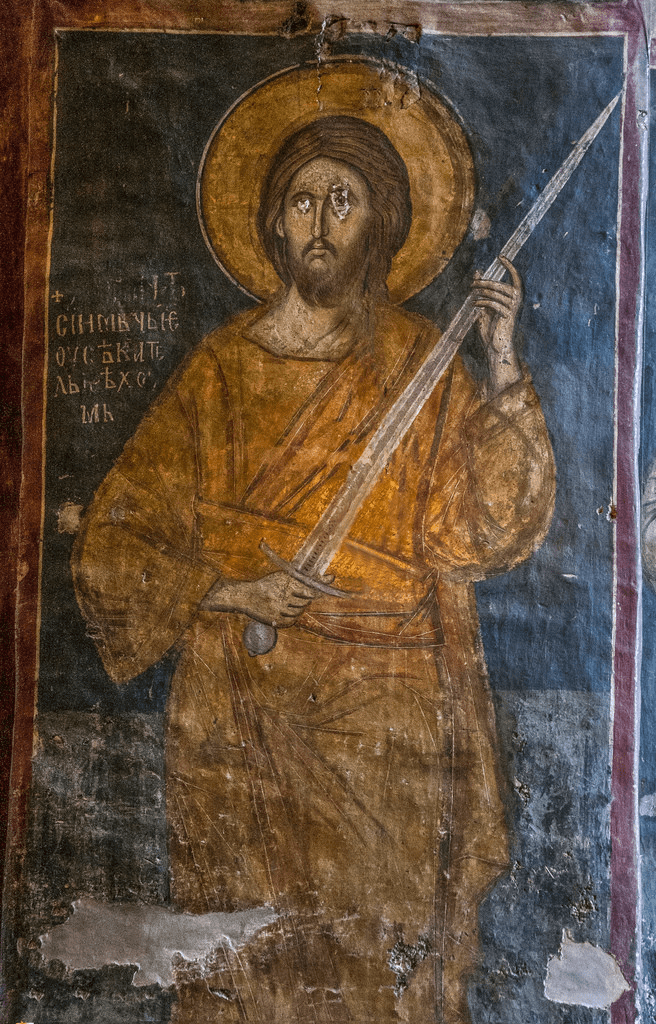
14th century fresco of Christ with a sword, in the Sacred Monastery of the Ascension of Christ Church, Kosovo

Unfortunately, opposition does not just come from the world, but within the very families and communities we love and rub shoulders with every day. Most persecution, hardship, and trouble for believers in Jesus come from family and those closet to us. 

Although I grew up in a church-going family, we never really discussed faith or Christianity. When I became serious about walking with Jesus, I faced a lack of support. I was often the brunt of teasing and verbal jabbing. My commitment to Christ had butted up against the family value of never rocking the boat. 

There was once a woman who experienced new life in Christ. When God grabbed ahold of her life, she had been on track to becoming the next Barbara Walters. But her newfound values of embracing the Beatitudes of Jesus rubbed the television broadcast world too much. 

So, she went into radio. Instead of looking toward a lucrative life on screen, she settled for less money and no fame behind the microphone of a Christian radio station. Her family didn’t understand this. And marrying a preacher didn’t help the situation any for her. To this day she still faces hardship and resentment for making decisions that did not get her the American dream.

Jesus said that anyone who wants to take the path of least resistance by not rocking the family boat with Christian love is not worthy of him. Anyone who does not take up their cross and follow Jesus in the way of trouble is not worthy of following him. 

We must die to self – which often means dying to avoidance of conflict – and become alive to the wonder of God’s mercy and love in the world.

We don’t need to be afraid of getting into trouble

Why? Because…

  1. Fear has to do with the unknown. So since we know opposition and trouble is expected, we will not live in dread of what might happen. The early Christians actually rejoiced in their suffering because they considered it a privilege to be walking in the way of Jesus. (Acts 5:27-42)
  2. You will receive special help. In times of persecution, we have a Helper, the Holy Spirit, given to us for such times as these. (John 3:34; 16:1-15)
  3. God isn’t surprised by your hardship. The Lord will eventually deal with all that is wrong in this world.
  4. The wrath of God is to be more feared than the wrath of people.
  5. God is watching over all the details of my life. If God cares for all the small details, how much more will the Lord take care of the big issues in my life?

Conclusion

It is a privilege to follow Jesus into trouble. This is what is called “upside-down” theology: 

  • In giving my life away to Jesus, I find it. 
  • In getting into trouble, I find peace. 
  • In serving and taking up our cross, there is happiness, not depression. 

Sometimes, things in the kingdom of God seem upside-down; and that is as it should be. Facing trouble is really not the worst thing to be experienced – being separated from God is. 

We are to expect opposition from the world, and from family. Yet, we need not be afraid, because tussling with trouble is part of what it means to follow Jesus – it is the way of the cross.

So, count the cost. Give your life away. In doing so, you will certainly not lose your reward from God.