Dealing with Hate (Genesis 37:5-11)

One night Joseph had a dream, and when he told his brothers about it, they hated him more than ever. “Listen to this dream,” he said. “We were out in the field, tying up bundles of grain. Suddenly my bundle stood up, and your bundles all gathered around and bowed low before mine!”

His brothers responded, “So you think you will be our king, do you? Do you actually think you will reign over us?” And they hated him all the more because of his dreams and the way he talked about them.

Soon Joseph had another dream, and again he told his brothers about it. “Listen, I have had another dream,” he said. “The sun, moon, and eleven stars bowed low before me!”

This time he told the dream to his father as well as to his brothers, but his father scolded him. “What kind of dream is that?” he asked. “Will your mother and I and your brothers actually come and bow to the ground before you?” But while his brothers were jealous of Joseph, his father wondered what the dreams meant. (New Living Translation)

We need to talk about hate, and it’s wicked stepsisters jealousy and disrespect.

In the ancient world, the oldest son was usually the one favored by parents. The eldest child would typically grow up to lead the family and inherit the largest share of the family resources. Joseph and Benjamin were two sons born to Jacob and Jacob’s favored wife, Rachel (Genesis 30:22-24). They were the youngest of Jacob’s twelve sons.

Jacob loved Joseph more than any other of his children (Genesis 37:3). To make things even more complicated, Jacob made his affection for the seventeen-year-old Joseph very public by giving Joseph a special long multi-colored robe. Not surprisingly, the other brothers hated him. 

“Joseph’s Dreams” by Susan Govatos

From the brothers’ perspective, Joseph added insult to injury by sharing a dream of his, implying that all of them would one day bow down to him. Dreams were significant in the ancient world; they were understood to be one way the divine realm could communicate with humans. But all this only made Joseph’s brothers hate him more than they already did.

Unfortunately, as the story unfolds further into Genesis, Joseph’s brothers take their sibling rivalry to a diabolical level. And it’s all fueled by their hatred and jealousy.

We all can relate to feelings of hatred and jealousy toward another. They can overwhelm us. So, what do we do when these big emotions come upon us?

  1. Consider your thoughts. If you find that you’ve been engaging in an all-or-nothing thought or a generalization, consider what a more balanced thought might be. Instead of saying, “He’s a total jerk,” consider instead, “I don’t like what he did to me” as an alternative. This approach typically makes the difference between health and sickness. A peaceful heart leads to a healthy body; jealousy is like cancer in the bones. (Proverbs 14:30, NLT)
  2. Pause for a moment and be curious about whether what you’re telling yourself about the other person or group is accurate. Crowds came from the villages around Jerusalem, bringing their sick and those possessed by evil spirits, and they were all healed. The high priest and his officials, who were Sadducees, were filled with jealousy. They arrested the apostles and put them in the public jail. (Acts 5:15-18, NLT)
  3. Lead with empathy and compassion if you feel hatred toward a person or group. Empathy is the ability to understand and share the feelings of another. Compassion is engaging in an act of kindness. If you come upon your enemy’s ox or donkey that has strayed away, take it back to its owner. If you see that the donkey of someone who hates you has collapsed under its load, do not walk by. Instead, stop and help. (Exodus 23:4-5, NLT) “But to you who are willing to listen, I say, love your enemies! Do good to those who hate you. Bless those who curse you. Pray for those who hurt you.” (Luke 6:27-28, NLT)
  4. Talk to God instead of bottling up your feelings. Many people believe that ignoring their emotions will make them disappear, but in reality, it’s quite the opposite. Rather than going away, unaddressed emotions build up and intensify over time. Praying to the Lord and crying out to God are therapeutic. Rescue me from the mud; don’t let me sink any deeper! Save me from those who hate me, and pull me from these deep waters. (Psalm 69:14, NLT)
  5. Receive God’s love and kindness. We cannot give that which we have not first received. Once we, too, were foolish and disobedient. We were misled and became slaves to many lusts and pleasures. Our lives were full of evil and envy, and we hated each other. But when God our Savior revealed his kindness and love, he saved us, not because of the righteous things we had done, but because of his mercy. He washed away our sins, giving us a new birth and new life through the Holy Spirit. (Titus 3:3-5, NLT)

If we spend a disproportionate amount of time hating someone in our heart, have difficulty focusing on other things because of jealousy, or consider disrespecting another to the point of violence, then we need help; we cannot handle this alone.

Seeking help to resolve hatred doesn’t mean that there’s mental illness going on. Everyone experiences hatred at some point in their lives. Allowing God and others to help is a rational, responsible, and courageous act.

Almighty God, from whom all thoughts of truth and peace proceed: kindle, we pray, in the hearts of all, the true love of peace and guide us with your pure and peaceable wisdom, so that your kingdom may go forward on this earth, filled with the knowledge of your love; through Jesus Christ your Son our Lord, who is alive and reigns with you, in the unity of the Holy Spirit, one God, now and forever. Amen.

Trust vs. Trickery (Genesis 30:25-36)

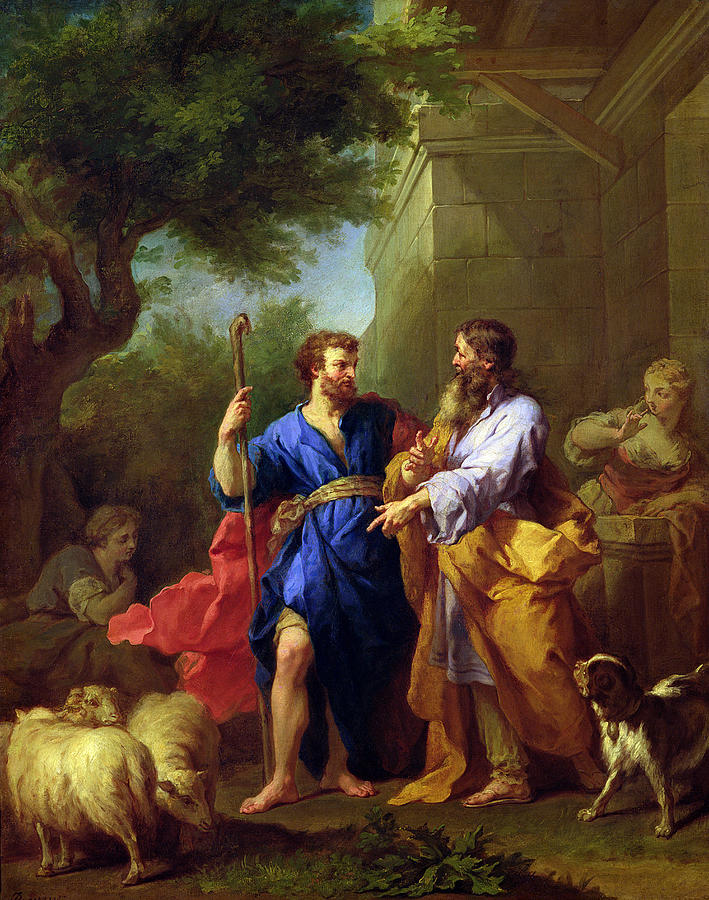
Jacob and Laban, by Pietro da Cortona (1596-1669)

After Joseph was born, Jacob said to Laban, “Release me from our agreement and let me return to my own country. You know how hard I’ve worked for you, so let me take my wives and children and leave.”

But Laban told him, “If you really are my friend, stay on, and I’ll pay whatever you ask. I’m sure the Lord has blessed me because of you.”

Jacob answered:

You’ve seen how hard I’ve worked for you, and you know how your flocks and herds have grown under my care. You didn’t have much before I came, but the Lord has blessed everything I have ever done for you. Now it’s time for me to start looking out for my own family.

“How much do you want me to pay you?” Laban asked.

Then Jacob told him:

I don’t want you to pay me anything. Just do one thing, and I’ll take care of your sheep and goats. Let me go through your flocks and herds and take the sheep and goats that are either spotted or speckled and the black lambs. That’s all you need to give me. In the future you can easily find out if I’ve been honest. Just look and see if my animals are either spotted or speckled, or if the lambs are black. If they aren’t, they’ve been stolen from you.

“I agree to that,” was Laban’s response. Before the end of the day, Laban had separated his spotted and speckled animals and the black lambs from the others and had put his sons in charge of them. Then Laban made Jacob keep the rest of the sheep and goats at a distance of three days’ journey. (Contemporary English Version)

Jacob left home by himself and went to his mother’s family. After twenty years away, he had two wives and twelve sons by four different women. He had worked for his father-in-law Laban for all that time – all to Laban’s advantage. During those twenty years, there was plenty of complicated and awkward family drama.

Now Jacob was ready to be done with all that. He wanted to move on and go back to the place of his family origin. But, of course, Laban had a good thing going and did not want Jacob to leave. So, he did his best to convince him to stay. Jacob was able to set his own terms. And there was some space put between his burgeoning family and his in-law’s.

But returning is a lot more difficult than leaving. When I left home as a young man I had all my worldly possessions in a ’74 Chevy Vega. And when I returned to the land of my origins, it was in a large rental truck with a wife a three kids. There was a lot of logistics involved, not to mention all the relationships we left.

For twenty years, Jacob and Laban did a weird relational dance. They were both tricky dudes, and were continually attempting to maneuver and outmaneuver the other. Yet, Jacob mostly got the brunt of unfairness.

In reality, Jacob owed Laban nothing. He had agreed to work for him fourteen years in total. But he could take nothing with him except his family – which would leave him with no means of support. And Laban was not about to give his son-in-law any support outside of his fatherly-in-law control.

Jacob came up with a strange set of terms concerning the flocks of sheep. Laban logically calculates that Jacob is unlikely to gain much profit from the plan, and can still keep the status quo going. So it becomes a done deal.

In a typical relational dynamic which they have become accustomed to, Laban himself sorts the flock, removes all the spotted and speckled sheep to a safe distance, and leaves Jacob with the rest.

So, if Jacob is to acquire any flock of his own, he needs to discover a way of breeding multicolored sheep from monochrome ones – a task which seems to be improbable if not impossible. But that’s exactly what Jacob does in the end, and that is yet the subject of another Old Testament lesson….

So, exactly what is today’s lesson? Life is anything but a nice, neat trajectory upwards toward achieving goals. Rather, life is a series of twists and turns, leading us to often take three steps forward and two steps backward in a herky-jerky sort of journey. Yet, behind it all, the Lord’s promises are still there, still in effect, still being worked out, in order to be fully realized. Nothing and no one is going to derail the plans and purposes of God.

Sometimes we need to be reminded that God is the giver of prosperity, and not anyone or anything else.

When you become successful, don’t say, “I’m rich, and I’ve earned it all myself.” Instead, remember that the Lord your God gives you the strength to make a living. That’s how he keeps the promise he made to your ancestors. (Deuteronomy 8:17-18, CEV)

To the person who pleases him, God gives wisdom, knowledge and happiness, but to the sinner he gives the task of gathering and storing up wealth to hand it over to the one who pleases God. (Ecclesiastes 2:26, NIV)

If any of you lacks wisdom, you should ask God, who gives generously to all without finding fault, and it will be given to you. (James 1:5, NIV)

We may, at times, feel the need to acquire what we want through trickery or manipulation. However, there is a God in heaven who sees and who cares. The Lord delights is being generous and giving to us, that is, if we are aware and attentive enough to ask. We might not get what we want immediately, and it likely won’t be easy, but we shall nonetheless receive it. We only need to trust.

Heavenly Father, source of all life, we thank you for the many ways in which you have blessed and enriched our lives: Keep us from possessiveness and greed, and lead us into the greater joy of sharing your gifts with others, through Jesus Christ, in whom is perfect peace. Amen.

Family Drama (Genesis 29:15-28)

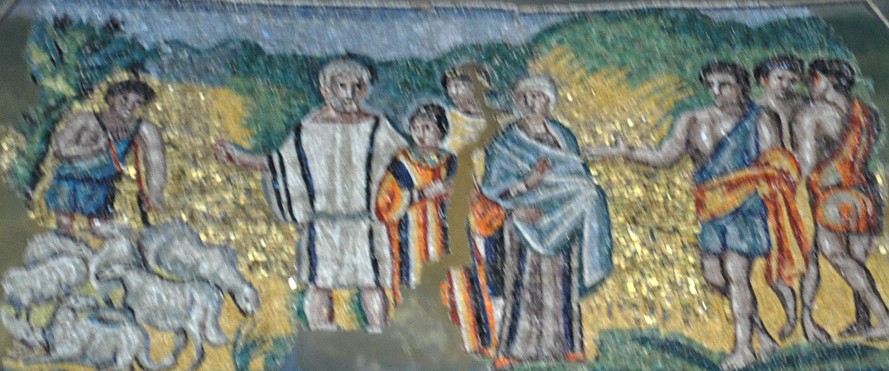
Jacob works to gain Rachel’s hand, 5th century mosaic, Basilica of Santa Maria Maggiore, Rome

Laban said to him [Jacob] “Just because you are a relative of mine, should you work for me for nothing? Tell me what your wages should be.”

Now Laban had two daughters; the name of the older was Leah, and the name of the younger was Rachel. Leah had weak eyes, but Rachel had a lovely figure and was beautiful. Jacob was in love with Rachel and said, “I’ll work for you seven years in return for your younger daughter Rachel.”

Laban said, “It’s better that I give her to you than to some other man. Stay here with me.” So Jacob served seven years to get Rachel, but they seemed like only a few days to him because of his love for her.

Then Jacob said to Laban, “Give me my wife. My time is completed, and I want to make love to her.”

So Laban brought together all the people of the place and gave a feast. But when evening came, he took his daughter Leah and brought her to Jacob, and Jacob made love to her. And Laban gave his servant Zilpah to his daughter as her attendant.

When morning came, there was Leah! So Jacob said to Laban, “What is this you have done to me? I served you for Rachel, didn’t I? Why have you deceived me?”

Laban replied, “It is not our custom here to give the younger daughter in marriage before the older one. Finish this daughter’s bridal week; then we will give you the younger one also, in return for another seven years of work.”

And Jacob did so. He finished the week with Leah, and then Laban gave him his daughter Rachel to be his wife. (New International Version)

There’s no drama quite like family drama. Love and hate, unity and inequality, privileged and powerless, gender and patriarchy, altruism and selfishness, all combine for a strange brew we call “family.” It seems you can’t live with them, or without them.

In a love story for the ages, the lonely Jacob meets the lovely Rachel. It was a divine appointment, and quite literally, a match made in heaven. (Genesis 29:1-14)

Although the romance appears to lead to a happy and better days, it is anything but. The family dynamics are at play, and it leads to plenty of dysfunctional stuff. Just as Jacob the deceiver successfully wrangled a blessing away from his brother for himself, Rachel’s father Laban did his own bit of deception.

Having promised Rachel to Jacob, the elder daughter Leah replaces her sister and is found in the marriage bed in the morning after the wedding. Oy! It was Laban’s doing. He had Jacob over a barrel.

The whole situation ended up creating an unhealthy competition between the two sisters for the affection of their husband. So much for living happily ever after.

A lot of this story exposes the gap between the ancient biblical world and our own contemporary cultural context. The patriarchal and tribal society within the book of Genesis assumes that marriage is first and foremost an alliance between men involving the exchange of women. This is anything but a commitment between individuals intending to share their lives together. Laban and Jacob work out the marriage price of seven years of labor without any consultation of the bride(s)-to-be.

What’s more, polygamy seems a given. We get no objections to multiple women being married to one man. And this is typically how Old Testament narratives work – they give us the story, without moral comment, and let that story speak for itself about the ethics involved. The consequences to the decisions and actions are meant to demonstrate the morality or immorality of it all.

There remains, however, a tender love story inside all the drama. Despite all the deceit and masculine posturing for position, Jacob was madly in love with Rachel and would do anything for her – including working fourteen years in unjust conditions.

As in most family affairs, all of this is terribly complicated. Jacob’s singular love for Rachel, and Laban’s finagling, strands the older sister Leah in a loveless marriage. Even with God’s enablement of giving Leah many children, the tragedy of the family drama continued. Rachel envied her elder sister’s fertility, as she herself desperately tried to conceive. It’s all a quite convoluted way to realizing the blessing of God to Abraham’s descendants.

The casual introduction of servant women in this narrative raises all sorts of issues concerning social class, slave and domestic labor, and reproductive rights – not to mention such realities as sexual trafficking and abuse with which we still wrestle in the twenty-first century.

Despite the distance between the ancient world and our own, we have a lot in common with people of the past. We are far from perfect. Families are messy and often broken. We hurt each other intentionally and unintentionally. We act in our own best interest and against the greater good of others. We forget to ask those with less power about decisions that impact their lives.

To look in on this family reality show in Genesis is to look straight into human brokenness. And yet, through all of Jacob’s family drama, God’s purposes were advanced. Jacob had been promised he would have a multitude of descendants, and it was through the unloved Leah and her servant Zilpah that eight of the twelve tribes of Israel trace their descent.

Even the deceitfulness of Laban and Jacob cannot stand in the way of God’s purposes. Human sin may delay the realization of God’s promises, but our human foibles shall never overrule the sovereignty and providence of God’s good plans for humanity.

God of compassion, whose Son Jesus Christ, the child of Mary, shared the life of a home in Nazareth, and on the cross drew the whole human family to himself: Have mercy on us all, especially on our families of origin and all the various family situations we find ourselves within.

Strengthen us in our daily living, so that in joy and in sorrow we may know the power of your presence to bind together and to heal, through Jesus Christ our Lord, the power of the Holy Spirit. Amen.