Luke 15:1-3, 11b-32 – Parable of the Lost Son

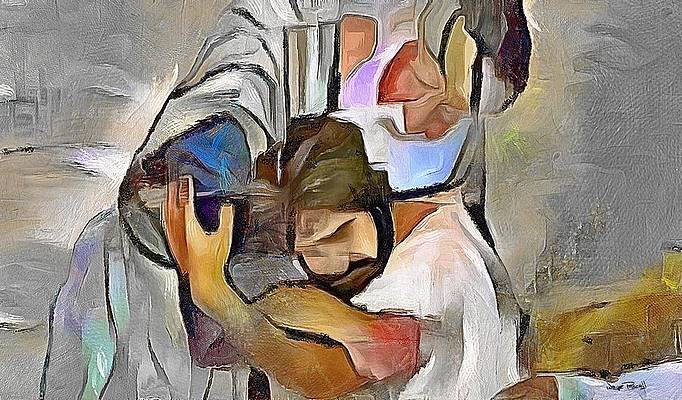
Prodigal Son by Wayne Pascall

Now all the tax collectors and sinners were coming to hear him. But the Pharisees and the experts in the law were complaining, “This man welcomes sinners and eats with them.”

So, Jesustold them this parable….

“A man had two sons. The younger of them said to his father, ‘Father, give me the share of the estate that will belong to me.’ So, he divided his assets between them. After a few days, the younger son gathered together all he had and left on a journey to a distant country, and there he squandered his wealth with a wild lifestyle. Then after he had spent everything, a severe famine took place in that country, and he began to be in need. So, he went and worked for one of the citizens of that country, who sent him to his fields to feed pigs. He was longing to eat the carob pods the pigs were eating, but no one gave him anything. But when he came to his senses he said, ‘How many of my father’s hired workers have food enough to spare, but here I am dying from hunger! I will get up and go to my father and say to him, “Father, I have sinned against heaven and against you.I am no longer worthy to be called your son; treat me like one of your hired workers.”’ So, he got up and went to his father. But while he was still a long way from home his father saw him, and his heart went out to him; he ran and hugged his son and kissed him. Then his son said to him, ‘Father, I have sinned against heaven and against you; I am no longer worthy to be called your son. ’But the father said to his slaves, ‘Hurry! Bring the best robe and put it on him! Put a ring on his finger and sandals on his feet! Bring the fattened calf and kill it! Let us eat and celebrate,because this son of mine was dead, and is alive again—he was lost and is found!’ So, they began to celebrate.

“Now his older son was in the field. As he came and approached the house, he heard music and dancing. So, he called one of the slaves and asked what was happening. The slave replied, ‘Your brother has returned, and your father has killed the fattened calf because he got his son back safe and sound.’ But the older son became angry and refused to go in. His father came out and appealed to him, but he answered his father, ‘Look! These many years I have worked like a slave for you, and I never disobeyed your commands. Yet you never gave me even a goat so that I could celebrate with my friends! But when this son of yours came back, who has devoured your assets with prostitutes, you killed the fattened calf for him!’ Then the father said to him, ‘Son, you are always with me, and everything that belongs to me is yours. It was appropriate to celebrate and be glad, for your brother was dead, and is alive; he was lost and is found.’” (New English Translation)

Lost people matter to God.

In the story of the lost prodigal son, that son hit rock bottom and rehearsed a speech he would give to his father when he came back. He never got to finish it, because the father interrupted his confession of sin and got the celebration going! 

We celebrate the things that are important to us. Lost people matter to God so much that it is a cause for a great celebration. God’s grace steps in and takes over, erasing past guilt and bringing radical forgiveness and reconciliation.

The Prodigal Son by Kaye Redman

Today there are literally tens of thousands of children who have walked away from their upbringing in faith, and even many times, literally walked away from their family of origin. Their parents know the feeling of standing at the window, wondering how their prodigal daughter really is, and longing for their prodigal son to come home. 

So, what do you do when you are the parent of a prodigal? How do you deal with the pain and the estrangement of a wayward son or daughter? 

  • Don’t expect a prodigal to be Christ-like. If the son or daughter is not a Christian, they aren’t going to act like one. Exhortations to stop drinking cheap wine, cease partying, not get a tattoo, or even go to church is not only useless, but it can also be harmful. Behind all the speech or behavior of a prodigal that might make a parent cringe, there is a world of hurt. The heart is sick or broken. Prodigals need to be treated as fellow humans and equals.

He was pierced because of our rebellions
    and crushed because of our crimes.
    He bore the punishment that made us whole;
    by his wounds we are healed.
Like sheep we had all wandered away,
    each going its own way,
    but the Lord let fall on him all our crimes. (Isaiah 53:5-6, CEB)

  • Welcome a prodigal home. It is possible (and necessary!) to remain connected in relationship, even if there are differing values or practices between parents and prodigals. In other words, don’t make it hard for a son or daughter to come home. Yes, there are instances when parents need to clarify and maintain boundaries, but those instances are actually rare.

In most cases, if a daughter smells like weed or an ashtray, just spray her jacket with Febreze and change the sheets when she leaves – but let her come home. If you find out she’s pregnant, then be with her and take her to her twenty-week ultrasound.

If a son is broke because he spent all the money you lent him on women and liquor, then forgive his debt as you’ve been forgiven; don’t give him any more money—and let him come home. If in doubt, always go with grace.

For God has revealed his grace for the salvation of all people. That grace instructs us to give up ungodly living and worldly passions, and to live self-controlled, upright, and godly lives in this world. (Titus 2:11-12, GNT)

  • Point a prodigal to Christ. A prodigal’s real problem is not sex or addiction, laziness or crime, cussing or ill manners. It is very possible that they simply don’t see Jesus for who he really is. So much Christian dogma or traditional practice might be encrusted on them that they simply cannot experience Jesus Christ’s love. God’s grace is what draws us all to faith – not hellfire preaching or parental badgering.

At one time you were separated from God. You were his enemies in your minds, and the evil things you did were against God. But now God has made you his friends again. He did this through Christ’s death in the body so that he might bring you into God’s presence as people who are holy, with no wrong, and with nothing of which God can judge you guilty. (Colossians 1:21-22, NCV)

We are to all share the same heart of the father in the parable of the lost son – a heart of hospitable love, abundant grace, and open celebration.

Loving heavenly Father, thank you that Jesus showed us your heart of love for the children of this world. Help us to do everything we can so that they will know how much you love them and want them to know your blessing. Thank you for your compassion for those who have strayed from you. Thank you that you are always ready to welcome us back with mercy and acceptance. Amen.

Proverbs 22:1-21 – Teach and Train the Children

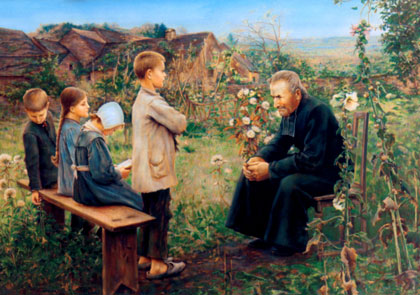
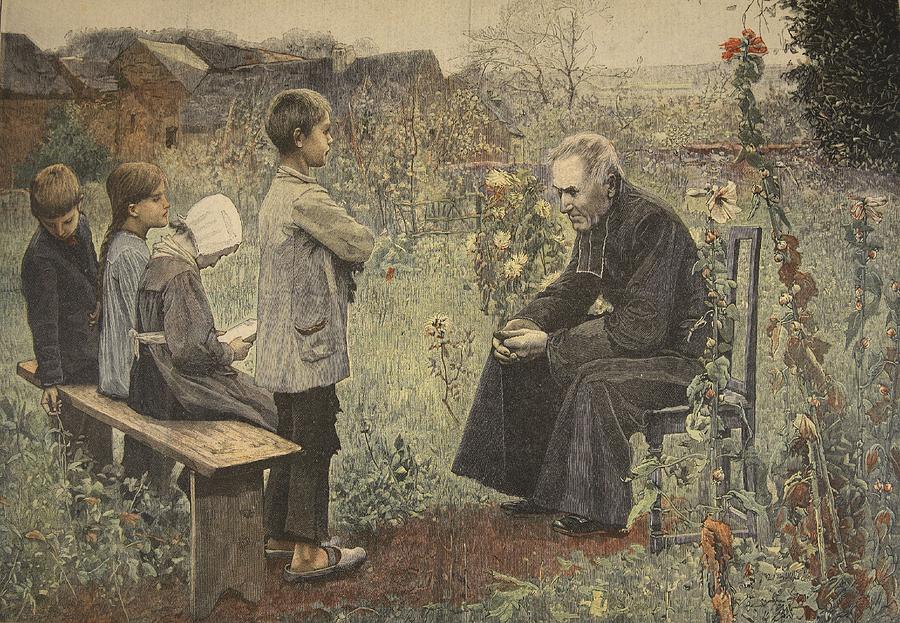
Priest teaching children the catechism by Jules-Alexis Meunier, 1898

Choose a good reputation over great riches;
    being held in high esteem is better than silver or gold.

The rich and poor have this in common:
    The Lord made them both.

A prudent person foresees danger and takes precautions.
    The simpleton goes blindly on and suffers the consequences.

True humility and fear of the Lord
    lead to riches, honor, and long life.

Corrupt people walk a thorny, treacherous road;
    whoever values life will avoid it.

Direct your children onto the right path,
    and when they are older, they will not leave it.

Just as the rich rule the poor,
    so the borrower is servant to the lender.

Those who plant injustice will harvest disaster,
    and their reign of terror will come to an end.

Blessed are those who are generous,
    because they feed the poor.

Throw out the mocker, and fighting goes, too.
    Quarrels and insults will disappear.

Whoever loves a pure heart and gracious speech
    will have the king as a friend.

The Lord preserves those with knowledge,
    but he ruins the plans of the treacherous.

The lazy person claims, “There’s a lion out there!
    If I go outside, I might be killed!”

The mouth of an immoral woman is a dangerous trap;
    those who make the Lord angry will fall into it.

A youngster’s heart is filled with foolishness,
    but physical discipline will drive it far away.

A person who gets ahead by oppressing the poor
    or by showering gifts on the rich will end in poverty.

Listen to the words of the wise;
    apply your heart to my instruction.
For it is good to keep these sayings in your heart
    and always ready on your lips.
I am teaching you today—yes, you—
    so you will trust in the Lord.
I have written thirty sayings for you,
    filled with advice and knowledge.
In this way, you may know the truth
    and take an accurate report to those who sent you. (New Living Translation)

As a pastor, I have seen my share of parents broken over their particular son’s or daughter’s lifestyle and/or behavior. In some cases, the parents have a great deal of work to do with their own shortcomings. In many other scenarios, there are godly mothers and fathers experiencing the heartache of a wayward child through no real fault of their own. 

Yet, some of them feel tremendously guilty because of a famous (or infamous) verse tucked away in our Old Testament lesson for today, to train children in the way they should go, and when they are old, they won’t depart from it.

Keep in mind, there are many different literary genres in Holy Scripture. Narratives, parables, gospel, epistles, poetry, and even apocalyptic literature all occur in the Bible. The book of Proverbs is a collection of wisdom sayings. 

A proverb is a short pity statement of experiential truth. 

In other words, a proverb expresses a general truth in which, all things considered, a particular outcome will likely occur. Proverbs were never designed to be ironclad promises of how things always are or will be. Rather, they are meant to teach wisdom, to give guidance in how to apply reality to a range of life circumstances.

So, when it comes to directing, guiding, and training children, it cannot be claimed that if a parent does a certain set of practices or disciplines that the child will always come out living a certain way. Neither people, nor Scripture, operates in that manner. 

Biblical proverbs on parenting are designed to place emphasis on the necessity of intentional training and instructing children in the ways of God. And, more than likely, all things being equal, that training in the law of God will kick-in when the child is an adult, living on their own, needing wisdom to navigate a difficult world. Yet, remember, it is not a guarantee.

Even God, as the perfect parent, had rebellious children. 

Adam and Eve disobeyed and went their own way. The ancient Israelites, God’s people, were often fickle about their commitment and obedience to the God who consistently showed them steadfast love.

Proverbs encourage us to put significant effort into developing children to be responsible people who live into their full humanity. We teach, train, exhort, live by example, and discipline our kids. We do it all because we love them and seek to be faithful in our own faith commitments.

And we live with the hope that our maternal and paternal efforts are not in vain. So, it is good for parents, teachers, and all who work with kids to have a gracious, wise, well-thought-out plan for training those children. 

As we do so, we trust God, the One who ultimately does the needed renovations of the heart, and transformation of the mind.

Lord of life, you shape us in your image, and by your gracious gift the human family is increased. Grant to all parents everywhere the blessing of teaching and training children. Fill them with wisdom and love as they care for their family, so that they and their children may know and love you. Give us all, whether parents or not, wisdom so that we might always pray intelligently, live circumspectly, and speak lovingly to all the children in our lives, through Jesus Christ our Lord. Amen.

Malachi 3:16-4:6 – Turning Hearts

Then those revering the Lord,
    each and every one, spoke among themselves.
        The Lord paid attention and listened to them.
Then a scroll of remembrance was written before the Lord
        about those revering the Lord,
            the ones meditating on his name.
On the day that I am preparing,
says the Lord of heavenly forces,
        they will be my special possession.
        I will spare them just as parents spare a child who serves them.
You will again distinguish between the righteous and the wicked,
        between those serving God and those not serving him.

Look, the day is coming,
        burning like an oven.
All the arrogant ones and all those doing evil will become straw.
    The coming day will burn them,
says the Lord of heavenly forces,
        leaving them neither root nor branch.
But the sun of righteousness will rise on those revering my name;
        healing will be in its wings
            so that you will go forth and jump about like calves in the stall.
You will crush the wicked;
        they will be like dust beneath the soles of your feet
            on the day that I am preparing,
says the Lord of heavenly forces.
Remember the Instruction from Moses, my servant,
        to whom I gave Instruction and rules for all Israel at Horeb.
Look, I am sending Elijah the prophet to you,
        before the great and terrifying day of the Lord arrives.
Turn the hearts of the parents to the children
    and the hearts of the children to their parents.
            Otherwise, I will come and strike the land with a curse. (CEB)

According to the U.S. Census Bureau, twenty-five million children in America — one out of every three — live in biological father-absent homes. The National Fatherhood Initiative reports that nine in ten American parents agree this is a “crisis.”  Consequently, there is a “father factor” in many social issues today. Children with involved fathers do better across every measure of child well-being than their peers in father-absent homes.

From a biblical perspective, the relationship between fathers and children is hugely important not only for the well-being of family and society, but for God’s people.  Fathers in ancient Israel were the primary instructors of God’s covenant to their children.  This responsibility was critical to ensuring success in Israel and obeying their God. 

The fact of the matter in the prophet Malachi’s day was this: The fathers blew it.  The last verse of the Old Testament ends on a note of coming judgment. However, that is not the end of the story because the prophet Elijah will come to turn the hearts of the fathers to their children and vice versa.

John the Baptist, Jesus said, was the Elijah to come:

From the days of John the Baptist until now, the kingdom of heaven has been subjected to violence, and violent people have been raiding it. For all the Prophets and the Law prophesied until John. And if you are willing to accept it, he is the Elijah who was to come. Whoever has ears, let them hear. (Matthew 11:12-15, NIV)

In the Christian tradition, Jesus is the fulfillment of God’s covenant promises to the people. Therefore, fathers who follow Jesus have a sacred responsibility to gently guide their kids to Christ. It is important for Christian dads to take up the mantle of teaching children the ways of God especially as expressed by Jesus.  

God is on a mission of restoration, and a good place to begin is with restoring relationships between fathers and children. In fact, it behooves all fathers to step back and slow down enough to consider what the nature of their family relationships are really like – taking action to instruct kids in both word and deed.

The word catechism derives from the Greek language and means “instruction.” Ever since the start of the Protestant Reformation, learning about God has often taken the form of catechetical teaching. Catechisms vary in length with a pedagogical question and answer format. Typically included are explanations on the Apostle’s Creed, the Ten Commandments, and the Lord’s Prayer.

Question and answer 104 of the Reformed Confession, the Heidelberg Catechism, says this:

Q. What is God’s will for you in the fifth commandment?

A. That I honor, love, and be loyal to my father and mother and all those in authority over me; that I submit myself with proper obedience to all their good teaching and discipline; and also that I be patient with their failings – for through them God chooses to rule us.

Here is a simple observation: Children cannot obey what they have not been taught. Underpinning all submission and obedience of both divine and human authority is the basic assumption that parents will instruct their children in the way of sound theology, biblical ethics, and religious piety.

What is more, we are all spiritual fathers and mothers to a host of children in our sphere of influence. This is a foundational way of relating to one another, and so, deliberate intention and effort needs to be placed here. Otherwise, there is religious decline with neither social nor familial cohesion.

So, let us love one another through careful training, effective teaching, and gracious tutoring so that righteousness will shine like a cloudless dawn and rise to warm the world with the love of God.

Gracious God, thank you for the gift of children.  Teach me your ways of grace so that I might pass them on to children in the merciful name of Jesus Christ through the power of the Holy Spirit.  Amen.

Family Faith Formation


            The default setting for most people is that they continue being in the present what they have been in the past.  For many persons, the only way they really know how to live their lives is by drawing upon how they have been raised.  Rarely do people’s thoughts and behavior change dramatically without some big-time exposure to new relationships or to completely different experiences.  As a generalization, only when people face insurmountable challenges and unsatisfying solutions do they consider a different path from the one that they have always known.  In other words, people don’t usually change unless they have to.
 
            This is why faith formation within a family is so very important.  If a family’s modus operandi is mostly doing their own thing, like watching their own TV shows in separate rooms or pursuing only personal goals, then faith formation will likely be negligible.  But if a family makes it priority and intentionally pursues eating meals together, discussing shared experiences, and reading Scripture and other works of literature as a family, then the likelihood of a significant faith formation will occur. 
 
            Families may place importance on church attendance.  Yet, if that attendance is not followed through with family discussions and by looking for ways to put the sermon or worship event into practice, then church may have little impact upon any given family member.  Sociologist Christian Smith has discovered in his research that in order to sustain high levels of religious commitment through the adolescent and emerging adult years, several factors are present, including:  a strong faith commitment among parents that provides significant modeling; shared faith experiences in families; personal and family practice of prayer; other supportive faith-minded adults; close relationships between family members; and, frequent Scripture reading, along with the openness to ask questions.  Smith furthermore found that within such families kids had few religious doubts and tended to place a much higher importance on religious faith.
 
            This combination of a teenager’s parental spiritual practice, the importance placed on faith, prayer, and Bible-reading within a family makes an enormous difference in what will happen to that teen when he/she enters the twenty-something years – a time when many young adults dropout of church.  Perhaps one of the most significant reasons why a twenty-something moves away from a sustained faith commitment is that he/she never really had a firm foundation of faith as demonstrated and lived-out within the home.  If our past family situations hold such a prominent place in how we shape our lives, then it behooves us to ensure that as parents, grandparents, and significant others that we make the default setting one of confident faith and serious engagement with Holy Scripture.


            “Train a child in the way he should go, and when he is old he will not turn from it” (Proverbs 22:6) is not a promise of the Bible, but a short pithy statement of experiential truth for most people.  A significant way of helping kids to grow a strong faith is by helping families grow strong in their own faith formation.  Churches and Christian organizations would do well to put their energies in such directions.  In so doing, they can be a default setting for a generation of emerging adults.