Love Never Fails

“When we ask whether someone is a good man, we are not asking what he believes, or hopes, but what he loves.” St. Augustine

I believe there are few things in life which have sustainability and permanence, things which make the world go ‘round. Love is one of them; maybe even the greatest of them.

Love Language

And yet, in the English language, we really only have one word for “love.” That strikes me as curious and interesting.

I enjoy language and languages, as well as the use and smithing of words. One observation I’ve made about language is that any particular society, culture, or nation has several words for whatever is important or valuable to them.

For example, Indonesia has seven different words for the one English word “rice.” Since rice is so vital to the life of the people, it makes sense that they have several words to bring out all of the various nuances of “rice.”

By contrast, the West simply places adjectives in front of “rice” when needed (i.e. white or brown or jasmine). So, what does it say about us, about me and my fellow Americans, when we have only one word for “love?”

We certainly have plenty of words for “money.” It does little good to even use the word “money” unless one is speaking in very general terms. Americans make liberal use of words like “stocks and bonds,” “cash,” “checking and savings accounts,” etc. We even have several words for institutions which handle money: banks, savings and loans, credit unions, and mutual organizations.

Indeed, what does it say about us that we have a plethora of words for money? What’s more, in contrast to our one word for “love,” what does this tell us about Western society in general?

No wonder that American society has a love problem. Even when we borrow words for love from other languages, we seem to transform it into something else.

The Greek word “phileo” is engrafted into many of our English words such as philosophy (love of wisdom); philanthropy (love of humanity); or Philadelphia (brotherly love).

Often the last thing on our minds about the city of Philadelphia is an association with love; philanthropy is widely understood as being generous with one’s money (there it is again!); and few people think of love when describing philosophy.

Please know that it’s not my purpose to rant about American culture. I just want us to think about how we tend to use the word, and the implications of that use.

Oftentimes, I find that my own understanding of the word tends to be in contrast with so many other uses of “love.”

St. Augustine and Love

I admit to being influenced most heavily by St. Augustine and Holy Scripture. Augustine was enamored with love. That’s likely because he knew what it felt like to be on the outside of God’s redeeming love in Christ. For Augustine, love explains everything. Love is to be our true nature, and the proper direction of everything we say and do in this world, insisted Augustine.

Augustine, of course, derived his understanding from Jesus – especially from the New Testament Gospels:

“Love the Lord your God with all your heart and with all your soul and with all your mind.’ This is the first and greatest commandment. And the second is like it: ‘Love your neighbor as yourself.”

Matthew 22:37-39, NIV

Unless there is love, we go nowhere – which is precisely what seems to be happening in our world today. Apart from love, there are no social problems which can be alleviated; no wars which will stop; and no rights and respect extended to particular people. Without love, peace and happiness are nothing but a pipe dream.

It is imperative that we have a robust understanding and practice of love. If we don’t, I believe that we are ruined, no matter how savvy or powerful we are.

Designed For Love

People are designed for love; it is our very purpose. And if we go against our basic inherent design, it will be like disrespecting gravity itself by walking off the roof of the house in the wrongheaded belief that I won’t get hurt.

Fullness of life (and fullness of any religious practice) comes only through love. In Christianity, it is clearly understood that God is Love with a capital “L.” Thus, we were created in love, stamped with the image of God’s love, and expected to love one another.

Love is so ubiquitous throughout the Bible that listening to a biblical sermon on love every day for the rest of your life would not exhaust love’s height, depth, breadth, and width within Scripture.

It is an understatement to say that love is the goal of religion, the purpose for being, and the best expression of human community.

For in Christ Jesus neither circumcision nor uncircumcision has any value. The only thing that counts is faith expressing itself through love. (Galatians 5:6, NIV)

For the entire law is fulfilled in keeping this one command: “Love your neighbor as yourself.” (Galatians 5:14, NIV)

Love does no harm to a neighbor. Therefore love is the fulfillment of the law. (Romans 13:10)

Love never fails. (1 Corinthians 13:8, NIV)

And this is my prayer: that your love may abound more and more in knowledge and depth of insight… (Philippians 1:9, NIV)

The thing about love is that it can either get choked-out, or it can flourish. Love gets suppressed by attaching ourselves to things rather than people. This is a gross misuse of our capacity for love. A radical detachment from stuff may be necessary in order to gain relational connection.

On the other hand, by learning to direct our love toward God and neighbor (and, by the way, our neighbor is everyone we encounter) we begin to discover the peace of being in sync with the way the universe is wired.

We need salvation from our own worldly self. For it is this false self which the devil can so easily deceive and woo us from attachments to God and neighbor. In other words, we must be saved from ourselves, because left to ourselves, there is no hope for us.

To be lost is to be fooled by my own ego that the false self is the true self. To live and love in God is the essence of the true self.

That means humility, gentleness, peaceful relations, mercy, and purity characterize us. If it doesn’t, we’ve been fooling ourselves by believing that peace can only be achieved through unconditional winning; and that I am not responsible for my neighbor’s welfare and well-being.

Here’s a little test of where you might be in your false self/true self, and in your actual ability to love: The more importance you attach to your own ideas, your own abilities, and your own work, the more you will find yourself building up the very idea of you. This inevitably comes out by condemning other people and becoming judgmental of most things they do. If we are continually critical of others, we have lost sight of love.

The true self, however, recognizes and remembers that I am made in the image and likeness of God; that God is my very reason for existence; and that, therefore, love is my true identity because God is Love.

That’s right. Love is your genuine true character, deep down. The late Trappist monk, Thomas Merton, got it right when he said:

“If I do anything or think anything or say anything or know anything that is not purely for the love of God, it cannot give me peace, or rest, or fulfillment, or joy.” Thomas Merton, Seeds of Contemplation

This is one reason why it’s so important to love my neighbor. Since God’s love is truly within me, hardwired into my very existence, this love can come to you and me from any person, any direction, any time.

Love comes not only directly from God, but also indirectly by means of the jewel of love placed within the other person I am encountering.

For it is only in love that we at last can become real. If we feel unworthy of love, we will probably feel that other persons are not worthy of it either. This is where hate is born, and why it manifests itself so hideously in a politics of hate where large groups of people are simply labeled as “monsters” or “evil.”

But that’s really only a projection of how the person feels about themselves. And the only way out of it for the hateful person is to know that they are loved – irrespective of one’s worth.

If and when we become out of sorts, it is best to come back to love. Which means returning to my first and original love, God; and to the love that I actually have for the people in my family and my life.

Maybe it’s high time we start inventing all sorts of new words for love in the English language. Because, after all is said and done, Love never fails.

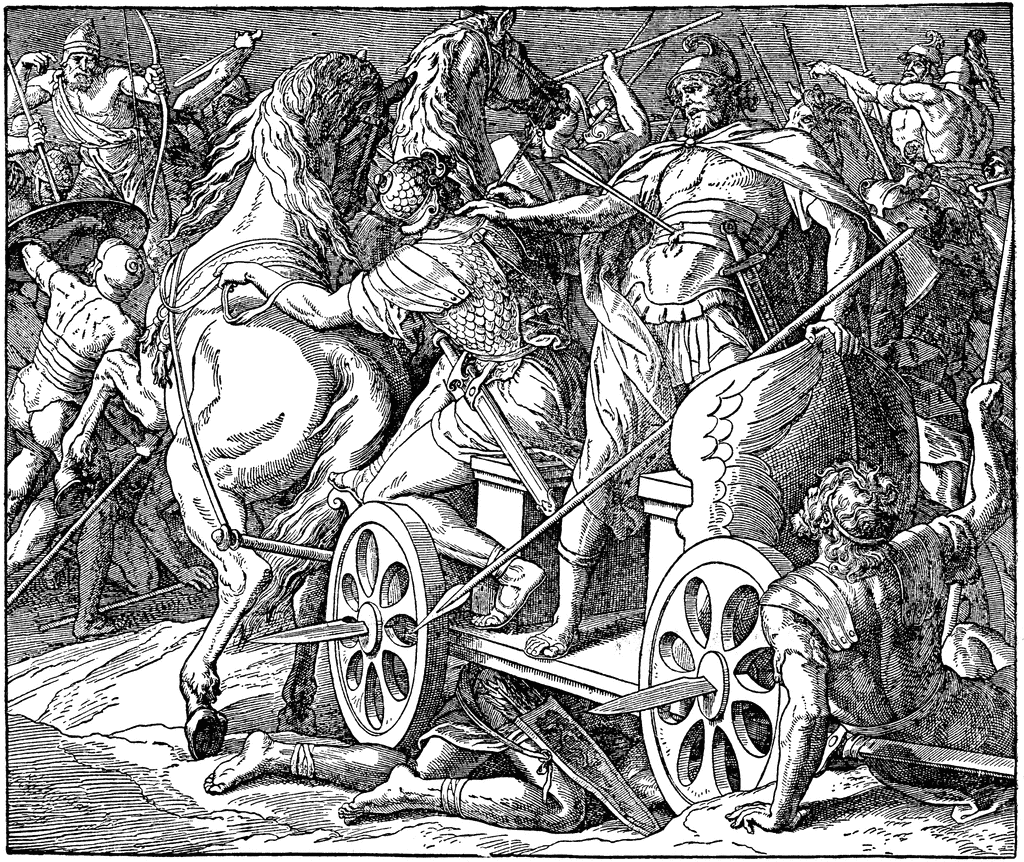
Real vs. Delusional (2 Kings 22:29-40, 51-53)

So the king of Israel and Jehoshaphat king of Judah went up to Ramoth Gilead. The king of Israel said to Jehoshaphat, “I will enter the battle in disguise, but you wear your royal robes.” So the king of Israel disguised himself and went into battle.

Now the king of Aram had ordered his thirty-two chariot commanders, “Do not fight with anyone, small or great, except the king of Israel.” When the chariot commanders saw Jehoshaphat, they thought, “Surely this is the king of Israel.” So they turned to attack him, but when Jehoshaphat cried out, the chariot commanders saw that he was not the king of Israel and stopped pursuing him.

But someone drew his bow at random and hit the king of Israel between the sections of his armor. The king told his chariot driver, “Wheel around and get me out of the fighting. I’ve been wounded.” All day long the battle raged, and the king was propped up in his chariot facing the Arameans. The blood from his wound ran onto the floor of the chariot, and that evening he died. As the sun was setting, a cry spread through the army: “Every man to his town. Every man to his land!”

So the king died and was brought to Samaria, and they buried him there. They washed the chariot at a pool in Samaria (where the prostitutes bathed), and the dogs licked up his blood, as the word of the Lord had declared.

As for the other events of Ahab’s reign, including all he did, the palace he built and adorned with ivory, and the cities he fortified, are they not written in the book of the annals of the kings of Israel? Ahab rested with his ancestors. And Ahaziah his son succeeded him as king….

Ahaziah son of Ahab became king of Israel in Samaria in the seventeenth year of Jehoshaphat king of Judah, and he reigned over Israel two years. He did evil in the eyes of the Lord, because he followed the ways of his father and mother and of Jeroboam son of Nebat, who caused Israel to sin. He served and worshiped Baal and aroused the anger of the Lord, the God of Israel, just as his father had done. (New International Version)

The Death of Ahab, by Julius Schnoor von Carolsfeld (1794-1872)

Whenever someone ignores or tries to get around reality, we call such a person “delusional.” It seems that the more power and authority a person possesses, the easier it is to delude themselves into thinking they can manipulate events in their favor. They then tend to listen only to what they want to hear.

King Ahab of Israel was delusional. He, like so many kings before and after him, was focused on the externals of personal power, accumulating more wealth, and exploring alternative religions. It all led to a twisted view of reality, as well as a prophetic demise.

Identifying so much with externalities, to the detriment of the internalities, is the ultimate bogus approach to life. It never ends well. Instead of exploring the image of God within himself and others, ensuring justice for all his subjects, and using his power to provide for the common good of all Israel, King Ahab went the spiritually and emotionally insecure route of listening to the wrong people.

Insecure and delusional people only listen to what is positive; and they eschew any negatives in their life. This is why the biblical prophets throughout Old Testament history typically found themselves at loggerheads, in prison, or at the end of a spear from those in power.

Ahab feigned wanting to hear what is true, but when hearing any negative aspects, he wrongly believed he could get around reality through his earthly authority and personal ingenuity. But he couldn’t. No one can outdo the stronger unseen forces in this world. (1 Kings 22:1-28)

So, Ahab laid a delusional plan to disguise himself as an ordinary soldier in battle. But although he chose to go against prophetic truth, there was no way to ignore the reality of it.

The providence and purposes of God prevail in any and all circumstances – no matter what they are. Today’s story highlights a seemingly random arrow from an enemy solider, hitting Ahab in the precise spot which could penetrate his armor.

The king was wounded and had to leave the battle. Yet, Ahab stuck to his delusional world, having his men prop him up in his chariot so that he could watch events unfolding in front of him.

Even in his powerlessness, King Ahab could not bring himself to believe that things could be different than he planned. He died at the end of the day, still stuck in his delusional and insecure world.

The editor of the Book of Kings summarized Ahab’s reign by mentioning impressive external improvements to his palace and fortified cities. Yet, these are mere incidentals. The real – and not delusional – assessment of the king’s life is that he was a religious apostate and a moral reprobate.

In the end, Ahab was nothing more than a weak and insecure individual who compromised God’s ethical law and sought to control events for his own misguided purposes. He followed Yahweh only if it aligned with his own plans.

Furthermore, it’s sad that Ahab’s approach to life, and his behavior toward others, was reflective of the Israelite nation as a whole (2 Kings 17:7-17). His own death eerily foreshadowed the death of Israel.

In our own era of incompetent leadership, morally inferior leaders, and delusional administrations, it behooves every concerned and pious believer to pray for all those in authority.

This side of heaven, there will always be cultural and societal pressures to conform to external pride, wealth, and success. But this is not the believer’s call, to take it’s cues from worldly power. Our focus is on consistently and patiently doing what is good, right, and just – accepting the unseen real over the seen delusion.

Rather than trying to continually manipulate events for our own shortsighted purposes, we must persevere in spurring-on one another to love and good deeds (Hebrews 10:24). For only together, as the one people of God, can we resist and subvert the machinations of delusional leaders.

O Lord God, Ruler of all, and whose glory exists in all the world: We commend nations and their leaders to Your divine providence, so that we may dwell secure in Your peace.

Grant to everyone in authority everywhere the wisdom and strength to know and do Your will. Fill them with the love of truth and justice; and make them mindful of their calling to serve all people with respect and reverence; through Jesus Christ our Lord, who lives and reigns with You and the Holy Spirit, one God, world without end. Amen.

Day of Pentecost (John 14:8-17, 25-27)

Philip said to him, “Lord, show us the Father, and we will be satisfied.” Jesus said to him, “Have I been with you all this time, Philip, and you still do not know me? Whoever has seen me has seen the Father. How can you say, ‘Show us the Father’? Do you not believe that I am in the Father and the Father is in me? The words that I say to you I do not speak on my own, but the Father who dwells in me does his works. 

“Believe me that I am in the Father and the Father is in me, but if you do not, then believe because of the works themselves. Very truly, I tell you, the one who believes in me will also do the works that I do and, in fact, will do greater works than these, because I am going to the Father. I will do whatever you ask in my name, so that the Father may be glorified in the Son. If in my name you ask me for anything, I will do it.

“If you love me, you will keep my commandments. And I will ask the Father, and he will give you another Advocate, to be with you forever. This is the Spirit of truth, whom the world cannot receive because it neither sees him nor knows him. You know him because he abides with you, and he will be in you….

“I have said these things to you while I am still with you. But the Advocate, the Holy Spirit, whom the Father will send in my name, will teach you everything and remind you of all that I have said to you. Peace I leave with you; my peace I give to you. I do not give to you as the world gives. Do not let your hearts be troubled, and do not let them be afraid.” (New Revised Standard Version)

The Christian observance of Pentecost is much more than a date on the calendar or a cognitive belief about the Holy Spirit. Pentecost is a powerful reality for believers to be aware of and to live into.

The symbols used to communicate this reality are the elements of wind and fire. They each have incredible potential for both help and harm, life and death. Tornadoes and wildfires bring awful destruction, whereas flame and wind power are necessary elements for life.

There is power in the Spirit. The Spirit of God dismantles and rearranges our lives to make something different or new altogether.

When the Spirit gets involved, nothing is the same again.

The Spirit upsets the status quo, brings energy and ability, heals broken lives, and establishes a truly egalitarian society. The New Testament knows the Christian as one given wholly to the Spirit in order to accomplish the will of God on this earth.

Therefore, this time of the year is hugely significant. Christians attune themselves to Holy Time because it is the age of the Spirit, the blessed opportunity of Pentecostal life and power. 

Jesus promised us an Advocate, the Spirit, and the era of the Spirit is here. We enjoy the very same Holy Spirit as our spiritual ancestors in the faith. This gives us great confidence and security knowing that the Spirit’s enablement, guidance, and power is available to us.

Pentecost flings every single believer into a congregational whole, the church, and lets us know that we are not to be rugged individualists acting alone, but are part of the Body of Christ.   

The Spirit uses us to forge spiritual bonds of kinship, fellowship, and solidarity.  Pentecost throws disparate people together in a unified whole, made up of every kind of language, nationality, ethnicity, gender, and race. We all use the gifts of the Spirit given to us for the benefit of building up one another.

Pentecost and the presence of the Spirit opens up the greatest of possibility in seeing our true selves emerge, and experiencing what is false melt away.

For most of us, we eventually discover that our egos are much thicker and predominant than we realized. And that ego gets in the way of bringing our authentic selves to the world. The Spirit comes along with fire to purify us, and then blows a mighty wind to drive the false self away.

Such true spiritual power helps us discern that issues of power in this world are difficult to deal with because things are not as they appear to be. Operating in the ego, far too many of us puff up ourselves to try and merely appear strong. People who present themselves as large and in charge end up hiding their vulnerabilities and insecurities in favor of keeping up appearances.

Jesus openly talked of real spiritual power, and promised to give the Spirit for our benefit. And Christ laid bear himself, stretching his arms out on a cross in a display of humiliation and degradation – all for us and our deliverance from false power and pesky egos.

If we go looking for earthly power and rely upon worldly power structures, we will likely be as confused as Philip and the other disciples of Jesus. But if we adopt the inner spiritual power provided for us, we find real effective strength which brings us the peace of Christ in any and all circumstances.

Life in the Spirit – spiritual life – happens within the depths of the soul. And it happens when we give up all pretense to alternative power sources, and participate with the Holy Spirit in allowing God to melt all that is false with spiritual fire and blow it all away with spiritual wind.

Pentecost was and is a watershed event. It’s effects are lasting, right up to the present time. Rather than settling for power-substitutes, we can imbibe ourselves of real spiritual power.

Living God, you have created all that is. Send forth your Spirit to renew and restore us, so that we may proclaim your good news in ways and words that everyone will understand and believe. Amen.

The Illness of Our Era: What Is It?

Anxiety, by James Callaghan

Our contemporary society focuses primarily on a functional existence. In our pragmatism, we care a great deal about production, the things we can do and produce; and we are attentive of how we appear to others. Western culture is enamored with all things of the outer person that others can see, touch, hear, smell, and taste with physical senses.

The outer person is important. The way in which we present ourselves to the world does have meaning and significance. Yet, so does the inner person.

The Inner Person

I believe the inner person, the true self, the soul, is just as vital, if not more, than the outward displays we give to others. On the inside is where our motives and intents come from. The core of self is of utmost importance; it is the place where our inherent worth is found.

Being aware of this inner person (which I use interchangeably with “soul” and “true self”) gives us a guide for ordering our outer self – our activities, work, and relationships.

If we are unaware of what’s happening deep within us, or pay little to no attention to the soul, our outer person becomes a false self. A gross disconnect then occurs between how we think and feel within, and what we choose to display for everyone.

In paying attention to the inner person, we will likely find that there is a lot of anxiety within us. Anxiety may even transform itself into a despair of self and/or the world.

The Anxiety Within

This anxiety, however, is not all bad. It certainly can lead us to a struggle with life, an experience of strained relationships, and a crippling fear of what will happen. Yet it can also help us become in touch with the soul, and enable us to gain an awareness of what is happening within and what to do about it.

It is my firm understanding and unshakable conviction that if we are to learn anything at all about healthy functioning in this world, it must begin with learning about one’s self – the true self, the inner person, the soul.

Knowing Ourselves

“Without knowledge of self, there is no knowledge of God.”

John Calvin, Institutes of the Christian Religion, Vol.1

As we commit ourselves to the journey within, we come to discover our place in the cosmos, and the image of God that is inherent in us. We come to know ourselves as integral to creation.

If we never gain this sense of humanity and of the divine, then we lose our special perspective on reality, and of the vital interconnectedness we have with God and others. Separateness then replaces the unity and oneness which exists. As a result, the person lives without a sense of their true place or function in this world.

Feelings of isolation and estrangement take over. This profound experience of disconnection with God, people, and even self creates a powerful sense of anxiety. Fear becomes a dominant theme. Unconscious emotions and desires drive the anxious person. A belief that my conscious self is all there is to me is a path of denial that leads to abject misery.

Knowing ourselves – before we know anything else – must be our pursuit. Failure to do this is perhaps why we live in such an era of worry, pessimism, and fear.

Addressing Our Fears

Have you ever felt that there is no one to whom you could turn to in your time of loneliness and despair?

Is there a time when you felt as if you were in a deep dark hole of quiet anxiety?

Did you ever brood over your situation in life so much that all of your courage melted like ice cream on a 100 degree day?

Was there a season in your life where you felt the world could not understand your grief?

Has God ever felt aloof to you, with your prayers seeming as if they were bouncing off the ceiling?

Depending upon who we are, the self believes that if I am right enough, help enough, achieve enough, unique enough, know enough, plan enough, party enough, lead enough, or withdraw enough, then I will relieve this bothersome anxiety and fear within me and can get on with life.

Others may seek solace in the finite things of this world. But that approach only exacerbates the existing problem. Believing that freedom from an ethereal illness can come by having more of something you can see only increases the despairing feelings.

Any sickness of the soul must be addressed by means of infinite resources.

The Need For Integration

If we lose ourselves, we are fragmented and in need of integration. The work needed is to bring our spiritual internal parts into a unified whole. This then puts us in a position to experience the grace and peace of God. Indeed, the process itself becomes the divine mercy and settled rest.

We tend to hold onto what we are afraid of experiencing. This very problem often becomes the solution. Our anxiety has the potential to lead us toward the grace of God, or away from it by self-conjured solutions and/or coping mechanisms.

Rather than holding our anxieties and fears close so that we can keep an eye on them, we need to let go of them. This is accomplished by actually feeling our feelings. By holding our emotions loosely, they can express themselves and then fly away.

If we never experience anxiety, worry, discouragement, fear, depression, or despair, then we internally see no reason whatsoever to pursue transformation of life – to go after that which is immortal and invisible.

The Apostle Paul’s Struggle

At the end of a frustrating litany of anxiety over his inability to control the trajectory of his inner self, the Apostle Paul concluded:

So I find it to be a law that, when I want to do what is good, evil lies close at hand. For I delight in the law of God in my inmost self, but I see in my members another law at war with the law of my mind, making me captive to the law of sin that dwells in my members. Wretched person that I am! Who will rescue me from this body of death? Thanks be to God through Jesus Christ our Lord! (Romans 7:21-25, NRSV)

Sin presupposes itself through anxiety. And anxiety awakens the awareness of needing freedom and deliverance. Worry is not our master. Anxiety has no authority over us. Fear merely exists for us to pay attention to something.

In Christianity, that something is a someone: Jesus. Christ is the Deliverer from sin, death, and hell. The oblivious and lonely darkness we find ourselves trapped within has a way out, or rather, up. A divine hand reaches from above to snatch us from our inky hole.

If humanity never had a need of God, people would not know themselves. They would fail to realize that there is immortality in their very souls.

Taking the Journey Within

It takes bravery to engage in a journey within, down into the core of one’s being. It’s neither a vacation nor a weekend adventure. The path unfolds slowly over time; it is circuitous, and often frustrating. Yet, when we find the incredibly bright blue diamond at the center, we immediately know every part of the journey was worth it.

The illness of our era is that we are soul-sick with anxiety, even despair, and most of us don’t know it. But why?

Like a cancer lurking unaware within the body, the years of ego construction has smothered the image and likeness of God within.

Anxiety becomes the initial symptom that something is askew with us. We’d better get checked out and find what the root problem is.

Are you up for the discovery of yourself, and thus, of God?