
Return to the Lord (1 Samuel 7:3-15)

Samuel prays to the Lord on behalf of the people, by Bible Art

So Samuel said to all the Israelites, “If you are returning to the Lord with all your hearts, then rid yourselves of the foreign gods and the Ashtoreths and commit yourselves to the Lord and serve him only, and he will deliver you out of the hand of the Philistines.” So the Israelites put away their Baals and Ashtoreths, and served the Lord only.

Then Samuel said, “Assemble all Israel at Mizpah, and I will intercede with the Lord for you.” When they had assembled at Mizpah, they drew water and poured it out before the Lord. On that day they fasted and there they confessed, “We have sinned against the Lord.” Now Samuel was serving as leader of Israel at Mizpah.

When the Philistines heard that Israel had assembled at Mizpah, the rulers of the Philistines came up to attack them. When the Israelites heard of it, they were afraid, because of the Philistines. They said to Samuel, “Do not stop crying out to the Lord our God for us, that he may rescue us from the hand of the Philistines.” Then Samuel took a suckling lamb and sacrificed it as a whole burnt offering to the Lord. He cried out to the Lord on Israel’s behalf, and the Lord answered him.

While Samuel was sacrificing the burnt offering, the Philistines drew near to engage Israel in battle. But that day the Lord thundered with loud thunder against the Philistines and threw them into such a panic that they were routed before the Israelites. The men of Israel rushed out of Mizpah and pursued the Philistines, slaughtering them along the way to a point below Beth Kar.

Then Samuel took a stone and set it up between Mizpah and Shen. He named it Ebenezer, saying, “Thus far the Lord has helped us.”

So the Philistines were subdued and they stopped invading Israel’s territory. Throughout Samuel’s lifetime, the hand of the Lord was against the Philistines. The towns from Ekron to Gath that the Philistines had captured from Israel were restored to Israel, and Israel delivered the neighboring territory from the hands of the Philistines. And there was peace between Israel and the Amorites.

Samuel continued as Israel’s leader all the days of his life. (New International Version)

Faithfulness to God matters. One cannot worship the Lord by day, then have a moonlighting job with other gods.

The priest and prophet Samuel helped lead Israel to repentance, and thus, a restoration of right relationship with their God. His leadership made all the difference. Samuel was not like the previous priests of Eli and his sons; nor was he like anyone else who didn’t really know what they were doing.

Samuel performed the appropriate sacrifices correctly; interceded with God on behalf of the people; enabled them to achieve victory; and continually and carefully watched over everything. Samuel was a needed stabilizing force in Israel. He identified sin in the nation and dealt with it wisely. Samuel led them to do right.

I confess my iniquity; I am troubled by my sin.

Psalm 38:18, NIV

Godly sorrow brings repentance that leads to salvation and leaves no regret, but worldly sorrow brings death. (2 Corinthians 7:10, NIV)

Come near to God and he will come near to you. Wash your hands, you sinners, and purify your hearts, you double-minded. Grieve, mourn and wail. Change your laughter to mourning and your joy to gloom. Humble yourselves before the Lord, and he will lift you up. (James 4:8-10, NIV)

Today’s Old Testament lesson brings up important questions of acknowledging disobedience, ignorance, and guilt; and how we are to respond to it.

Whenever we say or do something that we ought not to, it’s like squeezing a big tube of toothpaste out; there’s no way you can get it back in.

I actually did that once when I was a little kid. I saw new tube of toothpaste in the bathroom and wondered what it would be like to squeeze out a big amount. So, I did. It was fun. I did it again, then again and again, until it was all gone.

Knowing that perhaps this toothpaste thing might be a problem, I made an artwork out of it. After I was done, I turned off the light, shut the door, and in my little four-year-old brain, hoped nobody would see it. But oh my, they did!

As we get older, and into adulthood, we discover that we have a capacity to do a lot worse than toothpaste escapades. When we sin, there’s no way to put everything back the way it was before. Everything has changed because of our actions (or inactions). And we cannot make it look better, or put a positive spin on it.

There needs to be repentance – a confession of sin, a coming to God, and letting grace and forgiveness have its way. This is the path to restoration in returning to God, in bringing relational connections together again.

Repentance means that we tell God what we did; and that we’re sad about it. Instead of running away, we run to God and admit our guilt. This, by no means, is easy; but it’s the only way to take care of the problem and to feel better about it. And the Lord won’t make us feel worse, but will help us, no matter what.

Everybody is sad when they are caught doing something bad. But there is a good kind of sad, and a bad kind of sad. The bad kind of sad thinks to self, “I’m so stupid; I can’t do anything right,” and punishes myself for the wrong. On the other hand, the good kind of sad helps us realize that we never want to do that thing ever again; and we look to Jesus to forgive us and be our example of what to do right.

Good leaders, like Samuel, assist us in this process with grace, sensitivity, humility, respect, and a forthright spirit.

Most merciful God, we confess that we have sinned against you in thought, word, and deed, by what we have done, and by what we have left undone. We have not loved you with our whole heart; we have not loved our neighbors as ourselves. We are truly sorry and we humbly repent. For the sake of your Son Jesus Christ, have mercy on us and forgive us; that we may delight in your will, and walk in your ways, to the glory of your Name. Amen.

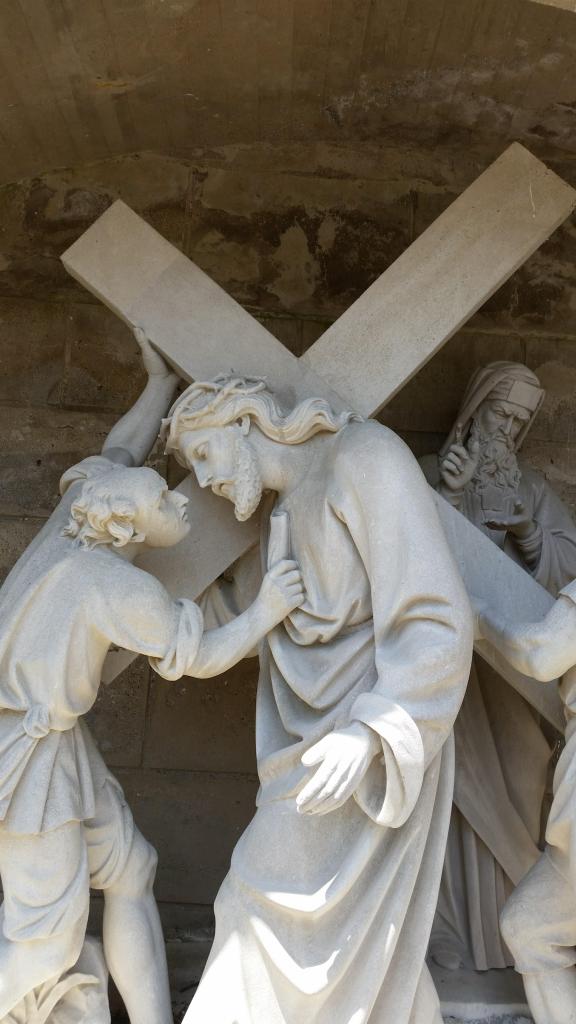
Hebrews 9:11-14 – A Clear Conscience

Stations of the Cross at Holy Hill, Hubertus, Wisconsin

When the Messiah arrived, high priest of the superior things of this new covenant, he bypassed the old tent and its trappings in this created world and went straight into heaven’s “tent”—the true Holy Place—once and for all. He also bypassed the sacrifices consisting of goat and calf blood, instead using his own blood as the price to set us free once and for all. If that animal blood and the other rituals of purification were effective in cleaning up certain matters of our religion and behavior, think how much more the blood of Christ cleans up our whole lives, inside and out. Through the Spirit, Christ offered himself as an unblemished sacrifice, freeing us from all those dead-end efforts to make ourselves respectable, so that we can live all out for God. (The Message)

We all have times when we feel guilty. Guilt, in and of itself, is a good thing. Guilt is the response of our conscience telling us we have done something wrong or have not done the good we know we ought to have done. It’s what we do with the guilt that determines the trajectory of our Christian lives. There are several ways we can respond to guilt.

  1. Denial. We can deny and rationalize our guilt by not accepting the truth about what we have done. Using phrases such as, “It’s not my fault,” “It’s only wrong if I get caught,” “I didn’t hurt anybody,” “They deserved it,” and “It’s not that bad,” has the effect of searing our conscience like a hot iron so that we eventually do not feel guilty. The inevitable result of this is hardness of heart.
  2. Shame. Another inappropriate way of dealing with guilt is the opposite of denying guilt; it is to hyper-focus on the guilt by feeling ashamed. Guilt feels bad for actions done or not done. Shame, however, feels bad for who I am, as if I am incapable of being good. Shame believes I do bad things because I am bad and deserve the consequences. In other words, shame is really false guilt.
  3. Inaction. Shame and false guilt may result in despair. We become inactive because of feeling discouraged or defeated. We might reason to ourselves, “What’s the point? I screw up everything I do.” So, we do nothing.
  4. Hyperactive. Some folks become a flurry of activity, working like crazy to feel better in the hope that guilt and shame disappear. It is to impose a penance upon yourself to try and cope with the icky feeling of guilt.

            The good news is that we can experience freedom from guilt and a clear conscience because of Jesus Christ.

  • If we have been victimized in the past, we no longer have to feel ashamed as though we caused or deserved the violence done to us.
  • If we have said or done some truly egregious things that displease God and damage others, we no longer have to live with the regret and the guilt on our consciences. 
  • If we have failed others and God by not living up to who we ought to be, we no longer have to live day after day with our consciences bound with guilt and shame.

            There are three reasons from Hebrews which tell us why we can have freedom from guilt and live with a clear conscience. They all focus on the person and work of Jesus Christ.

Christ has obtained eternal redemption for us by his blood.

Under the old sacrificial system, year after year, the priest offered the same sacrifices which never took away sin. The animal sacrifice was an act of worship in which the worshiper acknowledged guilt before God. The continuous ritual was designed to point forward to a better sacrifice.

The worshiper was purposely led to think, “Wouldn’t it be great if we didn’t have to do this all the time?” The blood of bulls and goats were an annual reminder of sins – such sacrifices never cleansed the conscience of the worshiper. Jesus Christ, however, is the sacrifice to end all sacrifices. Jesus has secured, once and for all, our eternal redemption through his own blood.

The death of Christ, Holy Hill, Hubertus, Wisconsin

Dr. Samuel Weinstein is the chief pediatric cardiac surgeon for a children’s hospital in the New York City. He once traveled to El Salvador to provide life-saving operations for less-fortunate children. Dr. Weinstein and his team operated on an eight year old boy. Twelve hours into the surgery, the procedure took a deadly turn.  

Dr. Weinstein said, “The surgery had been going well, but he was bleeding a lot and there were not many medicines we would use to stop the bleeding. After a while, they said they couldn’t give him blood because they were running out and he had a rare type.” The boy’s blood type was B-negative, which is present in only two percent of the population.

The only other person in the room with a blood type of B-negative was Dr. Weinstein. Immediately knowing what he had to do, he stepped down from the operating table. As his colleagues continued their work, Dr. Weinstein set aside his scalpel, took off his gloves, and began washing his hands and forearm. Then, in the corner of an unfamiliar operating room, the prestigious doctor from one of the most advanced hospitals in the world sat down to give away his own blood. 

When he had given his pint, Dr. Weinstein drank some bottled water and ate a Pop-Tart. Then—twenty minutes after stepping away from the table—he rejoined his colleagues. After watching his own blood circulating into the boy’s small veins, Dr. Weinstein completed the operation that saved the boy’s heart—and his life.

It is the blood of Jesus Christ which saves us from sin, death, and hell. Our condition is so dire that we can do nothing other than let Jesus deliver us. By faith, we trust Jesus to secure a new life for us free from guilt and shame.

Christ cleanses our consciences.

For some, the greatest prison is not tangible or physical – it is the prison of conscience bound and wracked by guilt and shame. Yet, Jesus has taken care of the problem of a guilty conscience once for all through his blood. Forgiveness comes through Jesus. Christ cleanses us from the inside-out and frees us from being slaves to our guilt.

In 1811, the U.S. government began collecting and storing letters like the following note dated from February 6, 1974: “I am sending ten dollars for blankets I stole while in World War II. My mind could not rest. Sorry I’m late.” It was signed by an ex-GI. And there was this postscript: “I want to be ready to meet with God.”  The U.S. government not only collects and stores these letters, but the Treasury Department established a fund and labeled it the “Conscience Fund.” Since its inception, the fund has grown to almost seven million dollars.

A clear conscience is worth a lot. If we try and impose penance upon ourselves, how do we know when it’s enough? In Christ, we are not just outwardly clean, but inwardly clean because of his finished work on the cross. 

Accepting this reality, through God’s eternal Spirit, helps us experience forgiveness and cleansing. The Holy Spirit takes the redemptive events of Jesus and applies them to our consciences so that we are assured of forgiveness.

Christ sanctifies our service.

In the Old Testament sacrificial system, the high priest entered the temple/tabernacle to offer animal sacrifices. Once a year, on the Day of Atonement (Yom Kippur) the priest entered the Most Holy Place. He slaughtered a heifer, took some blood, and sprinkled it on the altar. 

The priest had bells on his ankles when performing this ritual, along with a rope tied to one ankle. In case the judgment of God broke out on the priest and he was killed, then the other priests could reel him out of the Most Holy Place without entering themselves and being killed, as well.

There were several rituals to perform to access God. And, even then, the sprinkling of blood only outwardly took care of cleansing the people. But when Jesus offered himself once for all, the curtain separating the Most Holy Place from the people was torn from top to bottom. The way has been opened for complete purification, inside and out, a cleansing of the guilty conscience so that we might now serve the living God with freedom and confidence.

Since Christ has obtained redemption for us by his blood, cleansed our consciences, and sanctified our service, here’s how we can live into his finished work:

  • Confess and forsake known sin.

Those who hide their sins won’t succeed [shame] but those who confess and give them up will receive mercy. (Proverbs 28:13, CEB)

If we confess our sins, God will forgive us. We can trust God to do this. He always does what is right. He will make us clean from all the wrong things we have done. (1 John 1:9, ERV)

  • Ask forgiveness and be reconciled to anyone you have wronged. 

Jesus said, “So if you are offering your gift at the altar and remember there that another believer has something against you, leave your gift at the altar. First go away and make peace with that person. Then come back and offer your gift. (Matthew 5:23-24, GW)

  • Make restitution to those you have wronged. 

If any of you commit a crime against someone, you have sinned against me [God]. You must confess your guilt and pay the victim in full for whatever damage has been done, plus a fine of twenty percent. (Numbers 5:6-7, CEV)

  • Don’t procrastinate in clearing your wounded conscience.

Paul said he did his best to keep his conscience clear before God and others (Acts 24:16). Some people put off dealing with their guilt, believing their conscience will clear itself in time – but it will not. Procrastination only allows the guilt feelings to fester. Unchecked guilt eventually turns to shame. Today is the day to deal with guilt.

God forgives, not because of the quality of our prayers, but on the basis of Christ’s blood. We can now take advantage of our wonderful situation of freedom to serve the church and the world because God is bigger than a guilty conscience.

Genesis 42:1-28 – Guilt and Grace

Jacob grieving Joseph

When Jacob learned that there was grain in Egypt, he said to his sons, “Why do you just keep looking at each other?” He continued, “I have heard that there is grain in Egypt. Go down there and buy some for us, so that we may live and not die.”

Then ten of Joseph’s brothers went down to buy grain from Egypt. But Jacob did not send Benjamin, Joseph’s brother, with the others, because he was afraid that harm might come to him. So, Israel’s sons were among those who went to buy grain, for there was famine in the land of Canaan also.

Now Joseph was the governor of the land, the person who sold grain to all its people. So, when Joseph’s brothers arrived, they bowed down to him with their faces to the ground. As soon as Joseph saw his brothers, he recognized them, but he pretended to be a stranger and spoke harshly to them. “Where do you come from?” he asked.

“From the land of Canaan,” they replied, “to buy food.”

Although Joseph recognized his brothers, they did not recognize him. Then he remembered his dreams about them and said to them, “You are spies! You have come to see where our land is unprotected.”

“No, my lord,” they answered. “Your servants have come to buy food. We are all the sons of one man. Your servants are honest men, not spies.”

“No!” he said to them. “You have come to see where our land is unprotected.”

But they replied, “Your servants were twelve brothers, the sons of one man, who lives in the land of Canaan. The youngest is now with our father, and one is no more.”

Joseph said to them, “It is just as I told you: You are spies! And this is how you will be tested: As surely as Pharaoh lives, you will not leave this place unless your youngest brother comes here. Send one of your number to get your brother; the rest of you will be kept in prison, so that your words may be tested to see if you are telling the truth. If you are not, then as surely as Pharaoh lives, you are spies!” And he put them all in custody for three days.

On the third day, Joseph said to them, “Do this and you will live, for I fear God: If you are honest men, let one of your brothers stay here in prison, while the rest of you go and take grain back for your starving households. But you must bring your youngest brother to me, so that your words may be verified and that you may not die.” This they proceeded to do.

They said to one another, “Surely we are being punished because of our brother. We saw how distressed he was when he pleaded with us for his life, but we would not listen; that’s why this distress has come on us.”

Reuben replied, “Didn’t I tell you not to sin against the boy? But you wouldn’t listen! Now we must give an accounting for his blood.” They did not realize that Joseph could understand them, since he was using an interpreter.

He turned away from them and began to weep, but then came back and spoke to them again. He had Simeon taken from them and bound before their eyes.

Joseph gave orders to fill their bags with grain, to put each man’s silver back in his sack, and to give them provisions for their journey. After this was done for them, they loaded their grain on their donkeys and left.

At the place where they stopped for the night one of them opened his sack to get feed for his donkey, and he saw his silver in the mouth of his sack. “My silver has been returned,” he said to his brothers. “Here it is in my sack.”

Their hearts sank and they turned to each other trembling and said, “What is this that God has done to us?” (NIV)

So far, the story of Joseph has been told in three acts:

  1. Joseph was sold into Egypt and rose to the head of Potiphar’s household.
  2. Joseph was sent to prison and rose to oversee the prisoners.
  3. Joseph was released from prison and rose to be the administrator of all Egypt, second only to Pharaoh himself.

Today’s Old Testament narrative hinges on the treatment of Joseph toward his brothers, who don’t know who he is, and on the response of guilt the brothers have concerning their encounter with Joseph. It is a story of guilt and grace; and, there must be one before the other.

Joseph’s brothers have a history; they aren’t very nice guys. Thus far in the book of Genesis, we have these events from them:

  • Simeon and Levi committed premeditated genocide against the town of Shechem.
  • Reuben committed incest.
  • They all, except for Benjamin, sold their own brother Joseph into Egypt.
  • Judah impregnated his daughter-in-law, Tamar.

These guys seem like disappointing recipients of Abraham’s covenant.  Yet, this only heightens how gracious God is (who is always the principal actor in all these stories). God’s covenant loyalty is the operative force and is not dependent on the actions of less than stellar brotherly spirit.

So, Joseph, knowing his brothers’ character, put them to the test. He did not trust them any more than he could lift a pyramid, and so, set up a ruse to find out about his brother, Benjamin, and his father, Jacob. Joseph appeared to carefully craft a plan to see Benjamin (his only full brother) and be with him – whereas he doesn’t seem to have any desire, understandably, to be with his other half-brothers.

Joseph’s plan awakened (likely unintentionally) guilt in the brothers for what they had done to Joseph.  There are two kinds of guilt: true guilt and false guilt.  False guilt takes responsibility for something which we have not done or assumes guilt for some nebulous action. On the other hand, true guilt arises from a specific act which spurs the person to seek forgiveness, repentance, and reconciliation. This is a grace from God.

Sometimes we need to get our behind in the past before we can get our past behind us.

Moving forward in life, while ignoring actions which have hurt or damaged others, will eventually come back to bite us in that same behind – not to mention the unattended guilt which, over time, turns into gangrene of the soul.

Today is the day to deal with unresolved stuff lingering within your spirit, for tomorrow may be too late. Let us confess our sins:

Holy and merciful God, I confess my sinfulness – the shortcomings and offenses against you and your people. You alone know how often I have sinned in wandering from your ways, wasting your gifts, and forgetting your love. Have mercy on me, O Lord, for I am ashamed and sorry for all I have done to displease you and harm your image-bearers. Forgive my sins and help me to live in your light and walk in your ways, for the sake of Jesus Christ, my Savior. Amen.

Free to Serve


I am not into arm-twisting when it comes to recruiting volunteers for service in the church.  And whenever someone thinks I am being “soft” on people by not making them feel guilty, I respond with conviction:  “That kind of approach is not consistent with the gospel of grace.”
 
Yet, that does not mean we ignore guilt because only true guilt can lead us to grace.  We all have times when we feel guilty.  Guilt in and of itself is not a bad thing.  Guilt is the response of the conscience to things we have done or left undone.  Guilt is the conscience telling us that we have done something wrong or have not done the good we know we ought to have done.  It is what we do with the guilt that determines the trajectory of our Christian lives. 
 
There are several ways we can respond to guilt.  We can rationalize our guilt and not accept the truth about what we have done.  When we use phrases like “it’s not my fault,” “it’s only wrong if I get caught,” “I didn’t hurt anybody,” “they deserved it,” and “it’s not that bad,” then our conscience can be seared like a hot iron so that we eventually do not feel guilty.  The result is of this is always hardness of heart.
 
            Another inappropriate way of dealing with guilt is the opposite of denying guilt; it is to hyper-focus on the guilt by feeling ashamed.  There is a difference between guilt and shame.  Guilt feels bad for actions done or not done.  Shame feels bad for who I am, as if I am incapable of being good.  Shame believes I do bad things because I am bad and deserve the consequences.  In other words, shame is really false guilt.
 
            The result of shame and false guilt is always one of two responses:  either we become inactive through feelings of discouragement and defeat; or, we become hyperactive by working like crazy to feel better and hope that the guilt and shame go away.  It is to impose a certain penance upon yourself in order to cope with the dirty feelings of guilt.
 
            But the good news is that every one of us can have freedom from guilt and a clear conscience because of Jesus Christ.  If we have been victimized in the past, we no longer have to feel ashamed as though we caused or deserved the violence done to us.  If we have said or done some truly egregious things that displease God and damage others, we no longer have to live with the regret and guilt on our consciences.  If we have failed others and God by not living up to who we ought to be, we no longer have to live day after day with our consciences bound with guilt.
 
            Here’s why we experience freedom and a clear conscience:  Christ has obtained eternal redemption for us by his blood (Hebrews 9:11-14).  Back in the Old Testament sacrificial system, the high priest would enter the temple/tabernacle to offer animal sacrifice.  Once a year, on the Day of Atonement (Yom Kippur) he would enter the Most Holy Place.  The Ark of the Covenant was there.  The priest would slaughter the heifer and take some blood and sprinkle it on the altar. 
 
There were all kinds of rituals to perform in order to access God, and even then the sprinkling of blood only outwardly took care of cleansing the people.  But when Jesus offered himself once for all, the curtain that separated the Most Holy Place from the people was torn from top to bottom.  The way has been opened for not only an outward purification, but an inward cleansing of a guilty conscience so that we might now serve the living God with freedom and confidence.
 
All are now welcome at Christ’s Table.  There are no hoops to jump through.  There is only a radical hospitality that accepts everyone who comes to God by faith in Jesus.  We are holy because of the blood of Jesus Christ.  We can now serve God with joy and not serve him in order to gain spiritual brownie points and assuage our guilt. 


Service in the church needs to be motivated not by feelings of guilt but by a deep awareness of grace.  When we are overwhelmed with grace, to serve is to love God, which is the very thing we become eager to do.  So, when recruiting volunteers, take the route of inspiring grace in others, not guilt, for we are gloriously free in order to serve.