Remember and Listen to History (Deuteronomy 32:1-10)

Listen, heaven, and I will speak.

Earth, hear the words from my mouth.

Let my teachings come down like raindrops.
Let my words drip like dew,
like gentle rain on grass,
like showers on green plants.
I will proclaim the name of the Lord.
Give our God the greatness he deserves!
He is a rock.
What he does is perfect.
All his ways are fair.
He is a faithful God, who does no wrong.
He is honorable and reliable.

He recognizes that his people are corrupt.
To their shame they are no longer his children.
They are devious and scheming.
Is this how you repay the Lord,
you foolish and silly people?
Isn’t he your Father and Owner,
who made you and formed you?

Remember a time long ago.
Think about all the past generations.
Ask your fathers to remind you,
and your leaders to tell you.
When the Most High gave nations their land,
when he divided the descendants of Adam,
he set up borders for the tribes
corresponding to the number of the sons of Israel.

But the Lord’s people were his property.
Jacob was his own possession.
He found his people in a desert land,
in a barren place where animals howl.
He guarded them, took care of them,
and protected them because they were helpless. (God’s Word Translation)

In addition to being a church pastor and a hospital chaplain, I hold two academic history degrees. I firmly believe the past is important. Having an historical perspective on just about everything is helpful in order to negotiate present circumstances.

Another way of saying this is that it’s imperative that we remember times from long ago, and think about all the past generations – what they faced, why they faced it, and how they dealt with it – because it all influences us right now, whether we are aware of it, or not.

Listening to others is important. Hearing and responding to the voice of God is necessary. And listening to voices of the past is just as crucial. After all, Holy Scripture is ancient, containing the voices of hundreds of people, as well as the voice of the Lord. The faithful throughout the ages have encountered all sorts of situations related to their religious tradition; and they remain as a great cloud of witnesses testifying to us and encouraging us in the way we ought to go.

In today’s Old Testament lesson, the Lord exhorted the people to remember, simply because they had forgotten. And whenever a people forget where they have come from, they forget who they are; and if they forget who they are, their very identity is in jeopardy of being hijacked by corruption, guilt, and shame.

Israel needed to recall their own history, because they were in danger of failing to tell their stories to the next generation, who in turn, would not then have anything to remember.

The great redemptive events of God in calling their father, Abraham, out of Chaldea, promising divine presence and property to the descendants of Abraham, Isaac, and Jacob; the miraculous deliverance from Egyptian slavery; and the wandering in the wilderness had to be lifted up and recognized, not forgotten.

In fact, every generation of believers needs to not only affirm their faith, but also restate that faith for the next generation.

And that is precisely what Moses did for the people. He restated Israel’s history and the giving of God’s Law for a new generation about to enter the Promised Land. Only with this collective memory of divine help and revelation would the people be able to make it in in the place they were going.

There is, I believe, a great collective ignorance of history. Many Westerners know very little of their own genealogy beyond a generation or two. Folks have little to no recollection of seminal events which have shaped the places where they live and work. It’s as if there is no foundation under their feet from which to stand firm.

For example, this is one reason why so many people of color get treated as if they do not belong – because the white folk in the room don’t even know their own history, let alone the background and challenges of those who look different than them.

“Every true history must force us to remember that the past was once as real as the present and as uncertain as the future.”

George Macaulay Trevelyan, Professor of History, Cambridge University, 1898-1943

History is about people, and not so much about dates and facts. And so, to be indifferent about history is to be disinterested, even calloused, toward other people. Conversely, to engage history and learn from it is to be transformed by it.

Historians are people tasked with describing and interpreting the past. They take the many historical facts and responsibly interpret those facts and events in a coherent narrative for the benefit of those in the present. That’s exactly what Moses did. He told Israel’s story.

Moses recalled the past, then retold it and revised it for his contemporary generation. All history is revisionist – and that’s a good thing. It just means that we faithfully tell the story of our past by clearly understanding that history within the historical actors own time and terms, as well as possessing an equally discerning grasp of the people who hear it.

An attention to history can guide us, and help heal us of our narcissistic ways. It can help dethrone us from the misguided belief that we are the center of the universe. History provides us with the tools necessary to hear and understand the other, enabling us to reconcile with one another. 

As we learn from reading and listening to historical narratives, we find resources that can bring transformation of our own lives and the communities in which we live. So, what are you waiting for? Read the Bible. Read history. Read the contemporary culture. Perhaps you will have a compelling, challenging, and coherent voice that will rise above all the other competing contemporary voices of contempt and corruption.

Great God of all history, thank you for the many faithful people who, through the centuries, have made a positive impact in this world.

Thank you for the godly men and women who, by your grace, have rewritten history books by their actions; who have heard your call to go into the world. We praise you for the good example they have shown and the difference they have made.

May you enable each of us to leave an imprint and legacy of your love and mercy in our spheres of influence, so that those who come after us will look back one day and say, “They made a difference.” Amen.

What Is Your View of God? (Psalm 86:1-10)

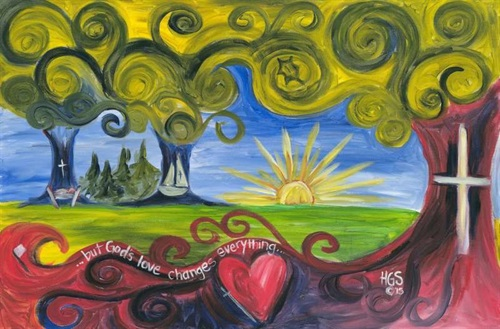
God’s Love… by Hope G. Smith

Incline your ear, O Lord, and answer me,
    for I am poor and needy.
Preserve my life, for I am devoted to you;
    save your servant who trusts in you.
You are my God; be gracious to me, O Lord,
    for to you do I cry all day long.
Gladden the soul of your servant,
    for to you, O Lord, I lift up my soul.
For you, O Lord, are good and forgiving,
    abounding in steadfast love to all who call on you.
Give ear, O Lord, to my prayer;
    listen to my cry of supplication.
In the day of my trouble I call on you,
    for you will answer me.

There is none like you among the gods, O Lord,
    nor are there any works like yours.
All the nations you have made shall come
    and bow down before you, O Lord,
    and shall glorify your name.
For you are great and do wondrous things;
    you alone are God. (New Revised Standard Version)

What is your view of God? 

For some, God is up there, somewhere, like some white-bearded old guy who is aloof to what is going on down here – there is neither anything personal nor personable about him, at all. If he gets involved, at all, it’s just to get out his divine BB gun and shoot a few sinners in the backside.

For others, God is a force which binds all things together; God is there, but you’re never quite sure how to get in touch with him – it’s like a crap shoot trying to connect with God. So, you might do all sorts of things to get God’s attention, like be especially good – and if that doesn’t work, maybe you’ll go the other way and be especially bad, just to get any sort of attention.

For yet others, God is perpetually perturbed about something; he’s got a bee in his divine bonnet and it’s our job to figure out what he’s sullen and upset about all the time, that we might appease God in some way. So, you might double-down on being self-sacrificial, try not to swear in front of the Pastor, and help others so that God will, in turn, help you.

The psalmist David, however, sees God in a very different way than all the aforementioned. God is not aloof and distant, nor angry. Instead, David understands and views God as personal, knowable, and reachable.

What characterizes God?

Reading today’s psalm tells us a great deal of how David thought and felt about God. Notice what we learn about God from David’s description: good and forgiving; abounding in steadfast love; listens and answers; and, does great and wondrous things.

Now this is a God you can sink your teeth into. This God is attentive, engaged, and is anything but upset all the time – which is why David has no problem asking God to listen and answer his prayer.

David put his trust in God to save him and make his heart glad. With this kind of God, David can willingly affirm his devotion. With a God of steadfast love and support, the worshiping and praying person’s heart forever belongs to the Lord.

If your view of God cannot support and bear the weight of your life’s hardest circumstances, then you need a different view of God!

Rather than God being the problem, it could be that your understanding of God is off. And if your understanding of God is off, then it’s likely that your own understanding of yourself is skewed – which is why many persons who have darker views of God are down on themselves and possess little self-worth.

I invite you to see the God of David. This God has both the ability and the willingness to satisfy your life’s greatest needs.

What will you do with your view of God?

In humility and brokenness, we call out in our misery. God responds in steadfast love and abundant mercy. With God, we can move from trouble to confidence.

And sometimes, we discover that our troubles and our circumstances change very little. But we ourselves have changed a great deal. Our compulsions for solid answers to our questions give way to a settled confidence in divine mystery. And our obsessions with a pain-free and problem-free life are replaced with a curiosity for what the hard situations in our lives will teach us.

The poor and needy cry out to God, knowing that grace and mercy characterizes the Lord. Life on this earth may not treat us well, but God gives us much more than we deserve.

The faithful trust in the Lord, fully confident that their preservation and protection are in God’s hands – and not in political leaders or padded bank accounts.

The miserable pray, constantly persevering in prayer, because their hope is in the name of the Lord who made heaven and earth. They have learned to pray expectantly, understanding that sometimes the greatest miracle of all is being delivered from the need to have a miracle.

Those who lift their faces to heaven, looking for the bright sunshine of grace, will know joy, down deep in their soul – and not simply a fleeting happiness from temporary reprieve of trouble.

The ones calling on the name of the Lord, banking their lives on God’s love, discover forgiveness and a good peaceful life of peace – rather than the anxiety of constantly worrying about tomorrow.

The spiritually devoted are confident that God will answer in their day of trouble – and they are patient, knowing full well that God’s sense of timing is much better than their own. So, they learn to hold all things loosely, knowing that God gives and God takes away. Blessed be the name of the Lord.

All those taking the time and effort to find the God who is truly characterized by kindness and compassion know in their gut, without a shadow of a doubt, that there is no one like the Lord – a God who does wondrous things and is attentive to justice and righteousness.

What is your view of God? Listen closely to the psalmist, and he will tell you what the Lord has done for him because of God’s basic nature of love and goodness.

Great God of David, you are above all things and beside all things and with all things. You are uniquely positioned and powerful to walk with me through all the situations of my life. Thank you for sending the Son of David to make your promises real to me. Amen.

Speak Up In Faith (Acts 7:1-16)

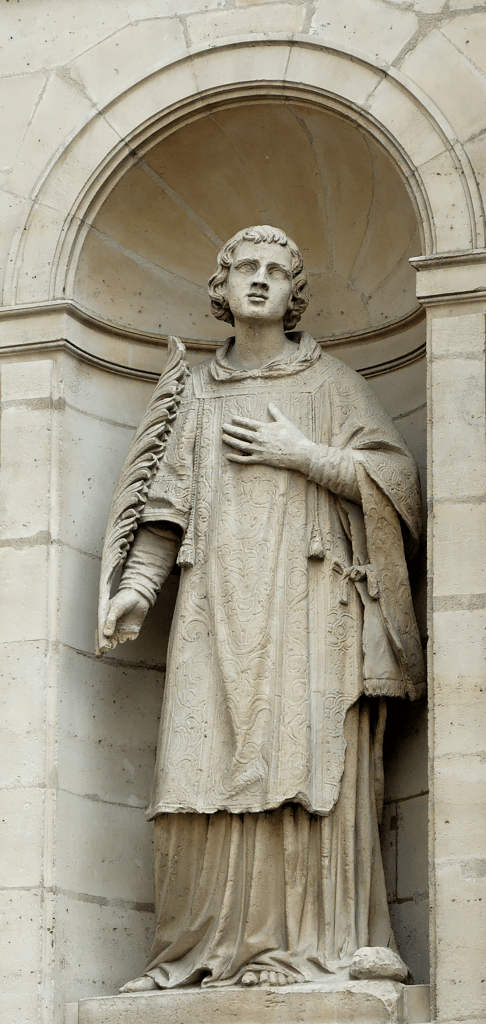
Statue of St. Stephen, by Joseph Marius Ramus (1805–1888) at the Saint-Étienne-du-Mont Church in Paris

Then the Chief Priest said, “What do you have to say for yourself?”

Stephen replied, “Friends, fathers, and brothers, the God of glory appeared to our father Abraham when he was still in Mesopotamia, before the move to Haran, and told him, ‘Leave your country and family and go to the land I’ll show you.’

“So he left the country of the Chaldees and moved to Haran. After the death of his father, he immigrated to this country where you now live, but God gave him nothing, not so much as a foothold. He did promise to give the country to him and his son later on, even though Abraham had no son at the time. God let him know that his offspring would move to an alien country where they would be enslaved and brutalized for four hundred years. ‘But,’ God said, ‘I will step in and take care of those slaveholders and bring my people out so they can worship me in this place.’

“Then he made a covenant with him and signed it in Abraham’s flesh by circumcision. When Abraham had his son Isaac, within eight days he reproduced the sign of circumcision in him. Isaac became father of Jacob, and Jacob father of twelve ‘fathers,’ each faithfully passing on the covenant sign.

“But then those ‘fathers,’ burning up with jealousy, sent Joseph off to Egypt as a slave. God was right there with him, though—he not only rescued him from all his troubles but brought him to the attention of Pharaoh, king of Egypt. He was so impressed with Joseph that he put him in charge of the whole country, including his own personal affairs.

“Later a famine descended on that entire region, stretching from Egypt to Canaan, bringing terrific hardship. Our hungry fathers looked high and low for food, but the cupboard was bare. Jacob heard there was food in Egypt and sent our fathers to scout it out. Having confirmed the report, they went back to Egypt a second time to get food. On that visit, Joseph revealed his true identity to his brothers and introduced the Jacob family to Pharaoh. Then Joseph sent for his father, Jacob, and everyone else in the family, seventy-five in all. That’s how the Jacob family got to Egypt.

“Jacob died, and our fathers after him. They were taken to Shechem and buried in the tomb for which Abraham paid a good price to the sons of Hamor. (The Message)

“What do you have to say for yourself?” conjures up for me women in a church basement with hands on hips, fingers pointing, staring at my 4-year-old self, after I ran through a bunch of old clothes at their annual rummage sale. And it wouldn’t be the last time I’d be asked that question throughout my life.

It’s a question that wants an accounting of something we’ve said or done. It’s not a polite question – more rhetorical than anything else.

Stephen was asked the question – and displayed a non-plussed presence that used the opportunity to turn it around back on his accusers and, indeed, of all humanity and human history.

Throughout Jewish history (and everyone else’s history, too!) there are human movements of good, inspired by divine initiatives; and alongside the good, there also are streams of resistant humanity who seek to thwart the good.

St. Stephen delivered a speech to the religious leaders, highlighting these two developments of human activity in the lives of two major figures in Jewish history.

Abraham

The patriarch of the Jewish people, Abraham, demonstrated faith by listening to the call of God to go to a country he knew nothing about. The Lord’s promises included both blessing and hardship. Although Abraham would be faithful to God’s covenant, his descendants would still find themselves as slaves in Egypt for four-hundred years.

Opposition to faith is always hanging in the shadows, ready to spring when there is an opportunity. Even though Abraham was a devoted follower of God, there were faithless people around him who had a different agenda than the Lord’s. His name continued into the New Testament with the faithless using it.

But invoking the ancient name of Abraham isn’t a protective amulet that makes everything okay. Doing the will of God is what really matters; and exhibiting faith like Abraham is the real issue.

“Produce fruit in keeping with repentance. And do not begin to say to yourselves, ‘We have Abraham as our father.’ For I tell you that out of these stones God can raise up children for Abraham. The ax is already at the root of the trees, and every tree that does not produce good fruit will be cut down and thrown into the fire.” (John the Baptist, Luke 3:8-9, NIV)

A good and right life comes through faith, and not by willpower nor in lifting up oneself by the bootstraps.

If, in fact, Abraham was justified by works, he had something to boast about—but not before God. What does Scripture say? “Abraham believed God, and it was credited to him as righteousness.” (Romans 4:2-3, NIV)

Joseph

Abraham, Isaac, and Jacob are the original pillars of Judaism. Jacob had twelve sons, known as the twelve patriarchs, from whom all Jews come from. The history of the brothers, like many families, is complicated. Joseph, next to the youngest of the brothers, was intensely disliked by several of the others.

Joseph found himself in Egypt because his brothers sold him into slavery. Like Abraham, Joseph had a robust faith, yet this did not inoculate him from trouble. Eventually, however, through a round-about turn of events, Joseph became in charge of the very empirical power that originally received him as a slave.

Through the eyes of faith, Joseph was not bitter, but understood why he needed to go through such terrible adversity. As administrator over all of Egypt, Joseph was able to handle severe years of drought with wisdom and confidence, thus saving many lives from hunger and starvation. And so, he was able to say to his brothers, many years later:

“You intended to harm me, but God intended it for good to accomplish what is now being done, the saving of many lives. “

(Genesis 50:20, NIV)

So, what do you have to say for yourself? Let you and I have the ability to say that we have been people of faith and patience. Let us be those who tenaciously hold to God, and steadfastly do good, speaking up in faith, no matter the situation, and regardless of faithless people who oppose us.

Because, in the end, the words of Jesus are true:

“So do not be afraid of them, for there is nothing concealed that will not be disclosed, or hidden that will not be made known. What I tell you in the dark, speak in the daylight; what is whispered in your ear, proclaim from the roofs. Do not be afraid of those who kill the body but cannot kill the soul. Rather, be afraid of the One who can destroy both soul and body in hell. Are not two sparrows sold for a penny? Yet not one of them will fall to the ground outside your Father’s care. And even the very hairs of your head are all numbered. So don’t be afraid; you are worth more than many sparrows.” (Matthew 10:26-31, NIV)

Just and right God, when we are faithless, you are faithful, because your very character is faithfulness. Help us to be faithful – not fearful – to the end, exhibiting the same commitment as your martyr Stephen, who fully entrusted himself to the Lord Jesus Christ, in whose name we are bold to pray. Amen.

Making Everything New (Isaiah 65:17-25)

Creator: CharlieAJA | Copyright: CharlieAJA

“Look! I am creating new heavens and a new earth,
    and no one will even think about the old ones anymore.
Be glad; rejoice forever in my creation!
    And look! I will create Jerusalem as a place of happiness.
    Her people will be a source of joy.
I will rejoice over Jerusalem
    and delight in my people.
And the sound of weeping and crying
    will be heard in it no more.

“No longer will babies die when only a few days old.
    No longer will adults die before they have lived a full life.
No longer will people be considered old at one hundred!
    Only the cursed will die that young!
In those days people will live in the houses they build
    and eat the fruit of their own vineyards.
Unlike the past, invaders will not take their houses
    and confiscate their vineyards.
For my people will live as long as trees,
    and my chosen ones will have time to enjoy their hard-won gains.
They will not work in vain,
    and their children will not be doomed to misfortune.
For they are people blessed by the Lord,
    and their children, too, will be blessed.
I will answer them before they even call to me.
    While they are still talking about their needs,
    I will go ahead and answer their prayers!
The wolf and the lamb will feed together.
    The lion will eat hay like a cow.
    But the snakes will eat dust.
In those days no one will be hurt or destroyed on my holy mountain.
    I, the Lord, have spoken!” (New Living Translation)

I long for better days. Perhaps you do, as well. Day after day I see the physical and emotional suffering of others. I hear of the many needs of people in my community and around the world. And I face my own personal experiences of loss, grief, disease, death, limitations, etc. We all do. We inhabit a planet full of people in want, families in crisis, communities in pain, institutions in decline, and nations in conflict.

Yet, thank God, it won’t be like this forever. There are days coming which many people could never even dream or conceive of – days of unimaginable blessing, peace, and rest. This is anticipatory joy.

The coming newness will be as large and capacious as God is. Although the old heavens have had controversy and rebellion, and the old earth is burned over with violence, the new realm of God shall be free of sin, death, and evil. It will be governed with unending peace, justice, righteousness, and faithfulness.

Stability and order will oversee long life. No more will there be waking up to mass shootings, overnight murders, theft, brutality, coups, wars, and unrest. Life itself shall thrive, and will not be continually at risk. Quality of life will be the rule, not the exception.

Economic security will be ensconced with no fear of losing jobs or being taken advantage of – no phishing emails, no scam artists, no religious manipulators – a person shall reap the full harvest of their labor. The land and its people will experience continual blessing, and no longer live under a curse. The threat of disaster won’t hang over everyone’s head.

Children will be protected and free from harm. Whereas they are vulnerable to a host of the world’s evils, in God’s new heaven and earth, every year is the year of the child. They will neither be exploited nor expected to be adults before their time.

In short, the coming newness will be a true egalitarian society in which everyone possesses what they need and contributes fully to the community and common good of all. It’s more than individual blessing; its public practices and policies of blessing for the entire community.

Civil peace and protection, economic viability and development, and social stability and security need more than human ingenuity and attention – they need God’s providential care and pure holiness to be realized on a real and practical level.

Accessibility to God is a must. Otherwise, we’re just building structures that will fall and programs which shall fizzle and be forgotten. According to the New Testament, such access has been granted.

For he [Christ] is our peace; in his flesh he has made both into one and has broken down the dividing wall, that is, the hostility between us, abolishing the law with its commandments and ordinances, that he might create in himself one new humanity in place of the two, thus making peace, and might reconcile both to God in one body through the cross, thus putting to death that hostility through it. So he came and proclaimed peace to you who were far off and peace to those who were near, for through him both of us have access in one Spirit to the Father. (Ephesians 2:14-18, NRSV)

And so,

Let us therefore approach the throne of grace with boldness, so that we may receive mercy and find grace to help in time of need. (Hebrews 4:16, NRSV)

Present circumstances may be difficult; current situations might be hard; a sense of being overwhelmed could be our experience, right now – yet our present difficulties and current realities cannot overwhelm God’s new and upcoming heaven and earth. Our daring faith sees beyond the now to what will be.

For our slight, momentary affliction is producing for us an eternal weight of glory beyond all measure.

2 Corinthians 4:17, NRSV

Then I saw a new heaven and a new earth, for the first heaven and the first earth had passed away, and the sea was no more. And I saw the holy city, the new Jerusalem, coming down out of heaven from God, prepared as a bride adorned for her husband. And I heard a loud voice from the throne saying,

“See, the home of God is among mortals.
He will dwell with them;
they will be his peoples,
and God himself will be with them and be their God;
he will wipe every tear from their eyes.
Death will be no more;
mourning and crying and pain will be no more,
for the first things have passed away.”

And the one who was seated on the throne said, “See, I am making all things new.” Also he said, “Write this, for these words are trustworthy and true.” (Revelation 21:1-5, NRSV)

Amen.