Remember and Listen to History (Deuteronomy 32:1-10)

Listen, heaven, and I will speak.

Earth, hear the words from my mouth.

Let my teachings come down like raindrops.
Let my words drip like dew,
like gentle rain on grass,
like showers on green plants.
I will proclaim the name of the Lord.
Give our God the greatness he deserves!
He is a rock.
What he does is perfect.
All his ways are fair.
He is a faithful God, who does no wrong.
He is honorable and reliable.

He recognizes that his people are corrupt.
To their shame they are no longer his children.
They are devious and scheming.
Is this how you repay the Lord,
you foolish and silly people?
Isn’t he your Father and Owner,
who made you and formed you?

Remember a time long ago.
Think about all the past generations.
Ask your fathers to remind you,
and your leaders to tell you.
When the Most High gave nations their land,
when he divided the descendants of Adam,
he set up borders for the tribes
corresponding to the number of the sons of Israel.

But the Lord’s people were his property.
Jacob was his own possession.
He found his people in a desert land,
in a barren place where animals howl.
He guarded them, took care of them,
and protected them because they were helpless. (God’s Word Translation)

In addition to being a church pastor and a hospital chaplain, I hold two academic history degrees. I firmly believe the past is important. Having an historical perspective on just about everything is helpful in order to negotiate present circumstances.

Another way of saying this is that it’s imperative that we remember times from long ago, and think about all the past generations – what they faced, why they faced it, and how they dealt with it – because it all influences us right now, whether we are aware of it, or not.

Listening to others is important. Hearing and responding to the voice of God is necessary. And listening to voices of the past is just as crucial. After all, Holy Scripture is ancient, containing the voices of hundreds of people, as well as the voice of the Lord. The faithful throughout the ages have encountered all sorts of situations related to their religious tradition; and they remain as a great cloud of witnesses testifying to us and encouraging us in the way we ought to go.

In today’s Old Testament lesson, the Lord exhorted the people to remember, simply because they had forgotten. And whenever a people forget where they have come from, they forget who they are; and if they forget who they are, their very identity is in jeopardy of being hijacked by corruption, guilt, and shame.

Israel needed to recall their own history, because they were in danger of failing to tell their stories to the next generation, who in turn, would not then have anything to remember.

The great redemptive events of God in calling their father, Abraham, out of Chaldea, promising divine presence and property to the descendants of Abraham, Isaac, and Jacob; the miraculous deliverance from Egyptian slavery; and the wandering in the wilderness had to be lifted up and recognized, not forgotten.

In fact, every generation of believers needs to not only affirm their faith, but also restate that faith for the next generation.

And that is precisely what Moses did for the people. He restated Israel’s history and the giving of God’s Law for a new generation about to enter the Promised Land. Only with this collective memory of divine help and revelation would the people be able to make it in in the place they were going.

There is, I believe, a great collective ignorance of history. Many Westerners know very little of their own genealogy beyond a generation or two. Folks have little to no recollection of seminal events which have shaped the places where they live and work. It’s as if there is no foundation under their feet from which to stand firm.

For example, this is one reason why so many people of color get treated as if they do not belong – because the white folk in the room don’t even know their own history, let alone the background and challenges of those who look different than them.

“Every true history must force us to remember that the past was once as real as the present and as uncertain as the future.”

George Macaulay Trevelyan, Professor of History, Cambridge University, 1898-1943

History is about people, and not so much about dates and facts. And so, to be indifferent about history is to be disinterested, even calloused, toward other people. Conversely, to engage history and learn from it is to be transformed by it.

Historians are people tasked with describing and interpreting the past. They take the many historical facts and responsibly interpret those facts and events in a coherent narrative for the benefit of those in the present. That’s exactly what Moses did. He told Israel’s story.

Moses recalled the past, then retold it and revised it for his contemporary generation. All history is revisionist – and that’s a good thing. It just means that we faithfully tell the story of our past by clearly understanding that history within the historical actors own time and terms, as well as possessing an equally discerning grasp of the people who hear it.

An attention to history can guide us, and help heal us of our narcissistic ways. It can help dethrone us from the misguided belief that we are the center of the universe. History provides us with the tools necessary to hear and understand the other, enabling us to reconcile with one another. 

As we learn from reading and listening to historical narratives, we find resources that can bring transformation of our own lives and the communities in which we live. So, what are you waiting for? Read the Bible. Read history. Read the contemporary culture. Perhaps you will have a compelling, challenging, and coherent voice that will rise above all the other competing contemporary voices of contempt and corruption.

Great God of all history, thank you for the many faithful people who, through the centuries, have made a positive impact in this world.

Thank you for the godly men and women who, by your grace, have rewritten history books by their actions; who have heard your call to go into the world. We praise you for the good example they have shown and the difference they have made.

May you enable each of us to leave an imprint and legacy of your love and mercy in our spheres of influence, so that those who come after us will look back one day and say, “They made a difference.” Amen.

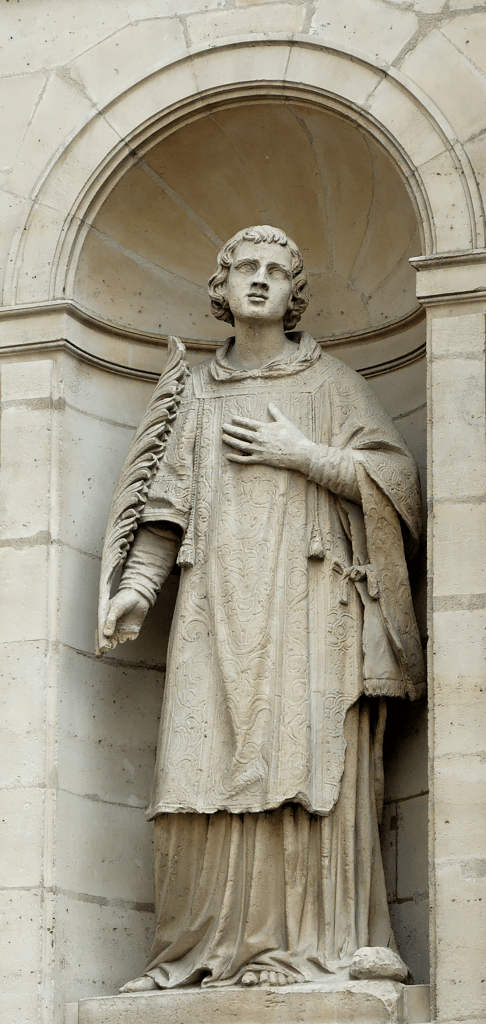
Speak Up In Faith (Acts 7:1-16)

Statue of St. Stephen, by Joseph Marius Ramus (1805–1888) at the Saint-Étienne-du-Mont Church in Paris

Then the Chief Priest said, “What do you have to say for yourself?”

Stephen replied, “Friends, fathers, and brothers, the God of glory appeared to our father Abraham when he was still in Mesopotamia, before the move to Haran, and told him, ‘Leave your country and family and go to the land I’ll show you.’

“So he left the country of the Chaldees and moved to Haran. After the death of his father, he immigrated to this country where you now live, but God gave him nothing, not so much as a foothold. He did promise to give the country to him and his son later on, even though Abraham had no son at the time. God let him know that his offspring would move to an alien country where they would be enslaved and brutalized for four hundred years. ‘But,’ God said, ‘I will step in and take care of those slaveholders and bring my people out so they can worship me in this place.’

“Then he made a covenant with him and signed it in Abraham’s flesh by circumcision. When Abraham had his son Isaac, within eight days he reproduced the sign of circumcision in him. Isaac became father of Jacob, and Jacob father of twelve ‘fathers,’ each faithfully passing on the covenant sign.

“But then those ‘fathers,’ burning up with jealousy, sent Joseph off to Egypt as a slave. God was right there with him, though—he not only rescued him from all his troubles but brought him to the attention of Pharaoh, king of Egypt. He was so impressed with Joseph that he put him in charge of the whole country, including his own personal affairs.

“Later a famine descended on that entire region, stretching from Egypt to Canaan, bringing terrific hardship. Our hungry fathers looked high and low for food, but the cupboard was bare. Jacob heard there was food in Egypt and sent our fathers to scout it out. Having confirmed the report, they went back to Egypt a second time to get food. On that visit, Joseph revealed his true identity to his brothers and introduced the Jacob family to Pharaoh. Then Joseph sent for his father, Jacob, and everyone else in the family, seventy-five in all. That’s how the Jacob family got to Egypt.

“Jacob died, and our fathers after him. They were taken to Shechem and buried in the tomb for which Abraham paid a good price to the sons of Hamor. (The Message)

“What do you have to say for yourself?” conjures up for me women in a church basement with hands on hips, fingers pointing, staring at my 4-year-old self, after I ran through a bunch of old clothes at their annual rummage sale. And it wouldn’t be the last time I’d be asked that question throughout my life.

It’s a question that wants an accounting of something we’ve said or done. It’s not a polite question – more rhetorical than anything else.

Stephen was asked the question – and displayed a non-plussed presence that used the opportunity to turn it around back on his accusers and, indeed, of all humanity and human history.

Throughout Jewish history (and everyone else’s history, too!) there are human movements of good, inspired by divine initiatives; and alongside the good, there also are streams of resistant humanity who seek to thwart the good.

St. Stephen delivered a speech to the religious leaders, highlighting these two developments of human activity in the lives of two major figures in Jewish history.

Abraham

The patriarch of the Jewish people, Abraham, demonstrated faith by listening to the call of God to go to a country he knew nothing about. The Lord’s promises included both blessing and hardship. Although Abraham would be faithful to God’s covenant, his descendants would still find themselves as slaves in Egypt for four-hundred years.

Opposition to faith is always hanging in the shadows, ready to spring when there is an opportunity. Even though Abraham was a devoted follower of God, there were faithless people around him who had a different agenda than the Lord’s. His name continued into the New Testament with the faithless using it.

But invoking the ancient name of Abraham isn’t a protective amulet that makes everything okay. Doing the will of God is what really matters; and exhibiting faith like Abraham is the real issue.

“Produce fruit in keeping with repentance. And do not begin to say to yourselves, ‘We have Abraham as our father.’ For I tell you that out of these stones God can raise up children for Abraham. The ax is already at the root of the trees, and every tree that does not produce good fruit will be cut down and thrown into the fire.” (John the Baptist, Luke 3:8-9, NIV)

A good and right life comes through faith, and not by willpower nor in lifting up oneself by the bootstraps.

If, in fact, Abraham was justified by works, he had something to boast about—but not before God. What does Scripture say? “Abraham believed God, and it was credited to him as righteousness.” (Romans 4:2-3, NIV)

Joseph

Abraham, Isaac, and Jacob are the original pillars of Judaism. Jacob had twelve sons, known as the twelve patriarchs, from whom all Jews come from. The history of the brothers, like many families, is complicated. Joseph, next to the youngest of the brothers, was intensely disliked by several of the others.

Joseph found himself in Egypt because his brothers sold him into slavery. Like Abraham, Joseph had a robust faith, yet this did not inoculate him from trouble. Eventually, however, through a round-about turn of events, Joseph became in charge of the very empirical power that originally received him as a slave.

Through the eyes of faith, Joseph was not bitter, but understood why he needed to go through such terrible adversity. As administrator over all of Egypt, Joseph was able to handle severe years of drought with wisdom and confidence, thus saving many lives from hunger and starvation. And so, he was able to say to his brothers, many years later:

“You intended to harm me, but God intended it for good to accomplish what is now being done, the saving of many lives. “

(Genesis 50:20, NIV)

So, what do you have to say for yourself? Let you and I have the ability to say that we have been people of faith and patience. Let us be those who tenaciously hold to God, and steadfastly do good, speaking up in faith, no matter the situation, and regardless of faithless people who oppose us.

Because, in the end, the words of Jesus are true:

“So do not be afraid of them, for there is nothing concealed that will not be disclosed, or hidden that will not be made known. What I tell you in the dark, speak in the daylight; what is whispered in your ear, proclaim from the roofs. Do not be afraid of those who kill the body but cannot kill the soul. Rather, be afraid of the One who can destroy both soul and body in hell. Are not two sparrows sold for a penny? Yet not one of them will fall to the ground outside your Father’s care. And even the very hairs of your head are all numbered. So don’t be afraid; you are worth more than many sparrows.” (Matthew 10:26-31, NIV)

Just and right God, when we are faithless, you are faithful, because your very character is faithfulness. Help us to be faithful – not fearful – to the end, exhibiting the same commitment as your martyr Stephen, who fully entrusted himself to the Lord Jesus Christ, in whose name we are bold to pray. Amen.

I Am the Gate (John 10:1-10)

“Very truly I tell you Pharisees, anyone who does not enter the sheep pen by the gate, but climbs in by some other way, is a thief and a robber. The one who enters by the gate is the shepherd of the sheep. The gatekeeper opens the gate for him, and the sheep listen to his voice. He calls his own sheep by name and leads them out. When he has brought out all his own, he goes on ahead of them, and his sheep follow him because they know his voice. But they will never follow a stranger; in fact, they will run away from him because they do not recognize a stranger’s voice.” Jesus used this figure of speech, but the Pharisees did not understand what he was telling them.

Therefore Jesus said again, “Very truly I tell you, I am the gate for the sheep. All who have come before me are thieves and robbers, but the sheep have not listened to them.I am the gate; whoever enters through me will be saved. They will come in and go out, and find pasture. The thief comes only to steal and kill and destroy; I have come that they may have life, and have it to the full. (New International Version)

In an idyllic world, we would never have to contend with thieves and interlopers within the flock of God. But, as you well know, we live in a less than perfect world. The spiritual robber-baron is the one who poses as a religious figure, yet is really around to fleece the sheep.

Obviously, anyone who has to jump the fence, instead of entering through the gate, has something nefarious up their dastardly sleeve. In fact, these interlopers feel they have a right to get in, by any means, because of their inflated sense of self-importance.

Jesus, of course, is using metaphor and figure of speech to communicate something important: The thieves are robbing God’s honor for themselves and bringing harm to God’s people. By trying to take away the way, the truth, and the life, the religious leaders were spiritual burglars attempting to be both gate and gatekeeper.

In short, the religious leaders believed they were more important than Jesus; and they tried to keep Christ and the people from connecting with each other.

And that is the insidious form of all religious quackery – to keep people separated from what can help them the most so that the charlatan can soak up all the attention, authority, and accolades.

But a faithful and true shepherd enters through the gate with confidence and care. Such a person has no other agenda and no other concern than Jesus and what Christ has said, has done, and will do.

The pastoral ministers amongst us help lead the flock through the gate so that they might enjoy safety, security, and succulence. The shepherd calls people by name, and doesn’t generically yell at nameless folk, to bring them alongside the Good Shepherd.

Thus, we are to have a faithful concentration and commitment to Christ; a voice which is discernibly oriented toward pointing people’s attention to Christ; and a teaching and leadership which moves into the world in order to bring Christian speech and action that blesses the world.

One of the problems many persons experience is that they listen to strange voices, instead of the familiar voice of their trusted pastor and the voice of Scripture, reason, and history. They follow a pet preacher’s or person’s interpretation of everything without reservation, rather than seeking to hear the voice of God in everything which is said.

Big churches, large ministries, and eloquent people are not necessarily the vocal chords of God. We must be discerning and wise. Not everyone who says, “Lord, Lord,” will enter the kingdom of heaven. It’s only the person and the faith community which does the will of God that’s able to get in.

Wolves in sheep’s clothing exist. So, we must beware.

Idioms, figures of speech, and metaphors get lost on some folk. That’s what happened for Christ’s original hearers. A lot of head-scratching was happening because they couldn’t figure out what in the world Jesus was talking about. “They” are the people who interpret all of life through personal agendas and selfish means. Their self-absorption prevented them from seeing the person right in front of them, who he really was, and what he was actually saying to them.

I Am the Gate of the Sheepfold, by Kathrin Burleson

So, Jesus plainly told them that he himself is the gate of the sheep. “I am” the gate. Deliverance, reconciliation, freedom, and protection all come together in Christ to provide a good life, a life of abundance that is worth living. We have peace with God through the Lord Jesus.

In today’s Gospel lesson, we learn from Jesus the following:

  • The key to being a good shepherd is being faithful to Jesus Christ
  • The concerns of a good shepherd are to attract, bring in, protect, free, feed, and lead God’s people into a good life through Jesus Christ
  • The way for a good shepherd is to love the sheep, care for them, and be with them through thick and thin, as Christ does
  • The preoccupations of those who ignore entering through the gate, which is Jesus, are to gain for themselves what rightly belongs to God: glory, honor, praise, power, authority, accolades, and devotion.

Everything hinges on Jesus as the gate of life. In centering ourselves completely around Christ, and by giving up the false self of keeping up appearances to others, we find our true self, connected to God in which all our needs are fully met and satisfied.

Merciful Father, you gave your Son Jesus Christ to be the Good Shepherd. In his love for us, he laid down his life and rose again. Keep us always under his protection, and give us grace to follow in his steps, in the strength and enablement of the Holy Spirit. Amen.

Encouragement to Be Faithful (2 Timothy 1:3-7)

Orthodox icon of St. Timothy
Orthodox icon of St. Paul the Apostle

Timothy, I thank God for you—the God I serve with a clear conscience, just as my ancestors did. Night and day I constantly remember you in my prayers. I long to see you again, for I remember your tears as we parted. And I will be filled with joy when we are together again.

I remember your genuine faith, for you share the faith that first filled your grandmother Lois and your mother, Eunice. And I know that same faith continues strong in you. This is why I remind you to fan into flames the spiritual gift God gave you when I laid my hands on you. For God has not given us a spirit of fear and timidity, but of power, love, and self-discipline. (New Living Translation)

Every individual person I meet is interesting. Everyone has a story. Each person has values which are important to them.  

The Apostle Paul had quite the story of conversion to Christianity. And so, he understandably had a high value of passing on the faith to reliable and competent persons who would then do the same. Timothy was one of those persons, a protégé of his mentor Paul.

Paul reminded Timothy of his identity, rooted in a faithful family, and encouraged him to tap into that robust spirit which resides within him. The Apostle encouraged him to fully express that spirit without fear or timidity.

For example, I care about kids. Children are a high value to both me and my wife. When meeting and engaging a family for the first time, we will inevitably talk to the child before addressing the parents. We care about any issue in the world which has to do with children – and we have a strong sense of morality concerning children because we love kids.

Be faithful to your calling, and to the values and ethics which undergird it. Whatever is important to us is where our sense of morality and ministry lie.

“Wherever your treasure is, there the desires of your heart will also be.”

Jesus (Matthew 6:21, NLT)

Everyone is moralistic because everyone cares about something. And we will live and die by our code of ethics, grounded in the values we most cherish.

In Holy Scripture, although there are hundreds of laws in the Bible, the highest standard of ethics and morality is contained in just a few chapters: The Ten Words (Commandments) found in the Old Testament chapter of Exodus 20; and Christ’s Sermon on the Mount found in the New Testament chapters of Matthew 5-7. 

These few chapters can be distilled into a few short ethical phrases:

“Love God with all your heart, soul, mind, and strength.” And “Love your neighbor as yourself.” (Matthew 22:37-39)

This means that every teaching found in the Bible comes down to love. (Mark 12:30-31)

Throughout the history of the church, the highest ethical values have always had to do with knowing and loving the Creator, Sovereign, and triune God – Father, Son, and Spirit – and the majesty of people who are created in the divine image and likeness.

The movement and trajectory of Holy Scripture is that a good and benevolent God makes and keeps promises to people. Even when they fall and try to create small petty worlds of their own, a gracious God is active, wooing lost people to return to the spirit which resides within them.

Therefore, the Bible is an unfolding drama of redemption in which a loving God goes out of the way to bring back straying, hurting, helpless people. (Luke 15)

Which is why, for me, attending to the inner soul, teaching people the words and ways of Jesus, and providing spiritual care to others is a very high value. I love God, and I love people. It’s easy to understand, then, why I treasure the following:

  1. Practicing solitude, silence, and other spiritual disciplines.
  2. Connecting with God daily in contemplative prayer and meditative Bible reading.
  3. Paying attention to hurting people and bringing them grace, mercy, faith, hope, love, and gentleness.
  4. Seeking to act with civility and respect toward others I disagree with, or just don’t like very well.
  5. Engaging others who don’t share my values of faith in God.
  6. Praying and hoping for people to be healed and whole.
  7. Pursuing the common good of all people, no matter who they are.

My deep conviction is that the care of the soul is just as important as the care of the body; that attention to exercising the mind with Holy Scripture is just as important to overall health and well-being as cardio workouts and sensible eating; and that the hope of the world resides with knowing Jesus Christ (and not with a lesser hope that wishes things will work out in the end if I’m sincere to my personal ethical beliefs).

Paul wanted Christians to engage in the care of souls, to fan into flame the spiritual gifts which already lie within us, even if they may seem dormant or non-existent.

So, be faithful to who you are, to what you have been called to, and especially to the good news:

For there is one God and one Mediator who can reconcile God and humanity—the man Christ Jesus. He gave his life to purchase freedom for everyone. This is the message God gave to the world at just the right time. (1 Timothy 2:5-6, NLT)

Great God and Father of all, remember the multitudes who have been created in your image but have not known the redeeming work of our Savior Jesus Christ; and grant that, by the prayers and labors of your Church, they may be brought to know and worship you as you have been revealed in your Son, who lives and reigns with you and the Holy Spirit, one God, now and forever. Amen.