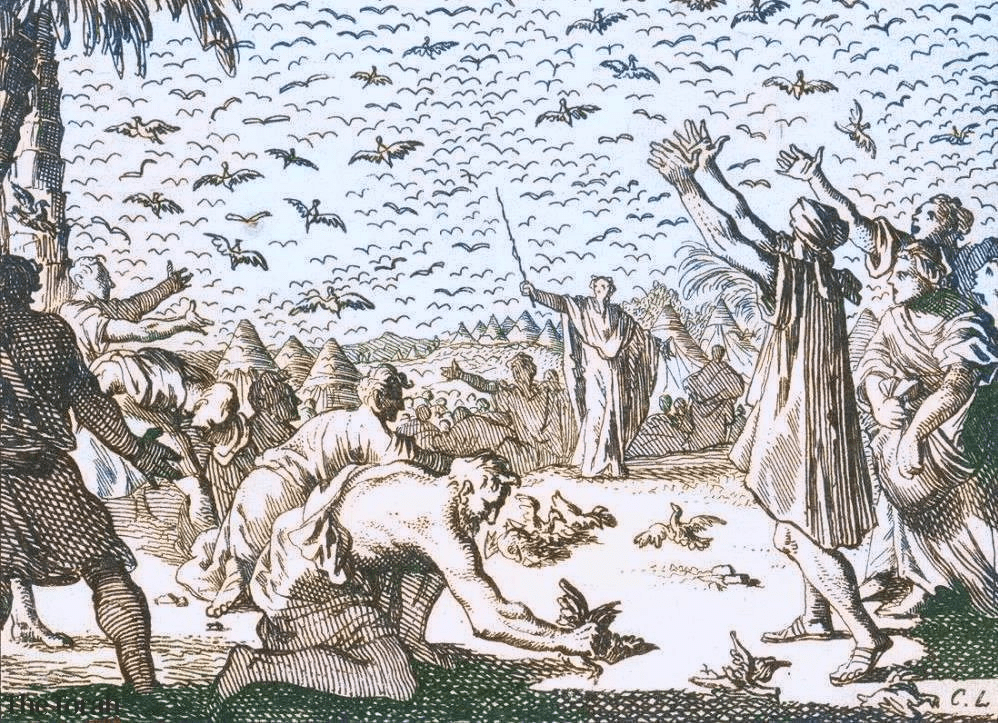
Divine Goodness, Despite Human Ingratitude (Psalm 78:23-29)

Quail in the Wilderness, by Caspar Luyken, 1698

Yet he commanded the skies above
    and opened the doors of heaven;
he rained down on them manna to eat
    and gave them the grain of heaven.
Mortals ate of the bread of angels;
    he sent them food in abundance.
He caused the east wind to blow in the heavens,
    and by his power he led out the south wind;
he rained flesh upon them like dust,
    winged birds like the sand of the seas;
he let them fall within their camp,
    all around their dwellings.
And they ate and were well filled,
    for he gave them what they craved. (New Revised Standard Version)

Today’s psalm is the second longest in the psalter (72 verses, with Psalm 119 the longest at a hefty 176 verses). Along with Psalms 105-106, Psalm 78 remembers and rehearses the history of Israel. This is a psalm which is meant for teaching and passing on important lessons.

The upshot of this psalm’s historical recollection is that the people’s ancestors were faithless; therefore, those reading the psalm now should live differently in a positive life of goodness, having observed how the past actors serve as a negative example of ingrates.

The psalmist, Asaph, viewed past events as highly informative for present circumstances. His purpose for crafting the psalm was explicit. He wanted the people:

 to put their hope in God—
        never forgetting God’s deeds,
        but keeping God’s commandments—
    and so that they won’t become like their ancestors:
    a rebellious, stubborn generation,
        a generation whose heart wasn’t set firm
        and whose spirit wasn’t faithful to God. (Psalm 78:7-8, CEB)

The verses for today’s lectionary reading have a unique place within the psalmist’s rehearsal of the past. They connect to the previous section (verses 9-22) which recounts the Lord’s angry response concerning Israel’s unbelief and rebellion.

In many ways, Psalm 78 has a consistent theme of human stubbornness, lack of faith, and wanting to do their own thing apart from God. Bucking God’s covenant code and moral law was ever-present in Israel’s history. And yet…

The Lord remained the same: Faithful and true. Furthermore, God stubbornly showed steadfast divine love and covenant loyalty to the people, despite their herky-jerky commitment and fickle faith.

Manna from heaven

Although the theme of human failure runs throughout the psalm, the dominant idea points to God’s gracious mercy, eternal faithfulness, and steadfast love. Most of all, the psalmist wanted his readers to remember the goodness and grace of God.

The people’s unbelief in no way stymied the promises of God. That’s because salvation and deliverance, faith and hope, do not originate and are not sustained by humans, but by the Lord God almighty who created heaven and earth.

Even though the people were faithless, and thus, had no trust in God’s power; nevertheless, the Lord opened the doors of heaven in order to meet the needs of people who did not deserve divine help.

The verses for today remember the story of God’s provision of manna and quail in the desert (Exodus 16). The Lord was gracious, merciful, and kind to the Israelites, despite their incessant grumbling. God responded to them because of their sheer need, and not because of any righteousness coming from them.

God not only provided food, but gave the manna in abundance, and the quail in superabundance. The contrast could not be any more glaring: Israel murmured, grumbled, complained, and demonstrated a lack of faith; God granted the Israelites a ridiculous amount of food, and evidenced steadfast faithfulness to the covenant.

The supreme goodness of God brings out, in stark relief, the incredible foolishness of Israel’s attitude. In the Exodus account, while the meat was still in their mouths, God’s anger flared because of the people’s recalcitrance.

On the surface, the divine response of judgment may appear out of sorts to the divine grace shown to Israel. Yet, the Lord cares about the holistic needs of people, and not only in giving sustenance.

God wants faithful and obedient people. The Lord desires goodness, righteousness, and justice to be the hallmark of the community.

To have your belly full and your spirit empty is an affront to God – because the Lord is good, right, and just, and does not tolerate impertinence, impudence, and impetuousness. Vice and ingratitude only makes a person an imbecile who is worthless to their fellow humanity.

Divine punishment – anywhere you find it in Holy Scripture – is meant to draw people back into relationship with God. Another way of phrasing this, is that God delivers people and grants them freedom, so that they will have no obstacles toward living a good, right, and just life.

No matter the response of God – whether it is by miraculous provision or by divine punishment – it’s always a response of grace; the Lord consistently acts from a place of compassion and commitment to doing what is best for the community.

Whereas the Israelites repeatedly cycled themselves through spirals of faith and unbelief, gratitude and grumbling, obedience and disobedience; God, however, constantly demonstrated the presence of grace and mercy, righteousness and justice, holiness and love.

The only reason the Israelites (and the entire human race, for that matter) are not wiped out is because God forgave their iniquity and did not destroy them. What’s more, the Lord didn’t even let them destroy themselves, unwittingly by their own unawareness and foolishness. (Psalm 78:36-39)

I am profoundly glad that God is the bigger person in the relationship with humanity. The Lord is continually mindful of who we are, as well as God’s own divine essence and power.

Yet he, being compassionate,
    forgave their iniquity
    and did not destroy them;
often he restrained his anger
    and did not stir up all his wrath.
He remembered that they were but flesh,
    a wind that passes and does not come again. (Psalm 78:38-39, NRSV)

As people created in the image and likeness of God, we find our highest joy and greatest fulfillment in receiving the good things from God with gratitude; and of giving goodness to others in a spirit of love – no matter what.

Gracious and almighty God: Open wide the eyes of my soul that I may see the good in all things. Grant me today a new vision of your truth. Inspire me with the spirit of joy and gladness. Make me a cup of strength to suffering souls. Amen.

Showing God’s Kindness (2 Samuel 9:1-13)

King David reaching out and receiving Mephibosheth, 13th century Bible illustration

David asked, “Is there anyone from Saul’s family still alive that I could show faithful love for Jonathan’s sake?” There was a servant from Saul’s household named Ziba, and he was summoned before David.

“Are you Ziba?” the king asked him.

“At your service!” he answered.

The king asked, “Is there anyone left from Saul’s family that I could show God’s kindness to?”

“Yes,” Ziba said to the king, “one of Jonathan’s sons, whose feet are crippled.”

“Where is he?” the king asked.

“He is at the house of Ammiel’s son Machir at Lo-debar,” Ziba told the king.

So King David had him brought from the house of Ammiel’s son Machir at Lo-debar. Mephibosheth, Jonathan’s son and Saul’s grandson, came to David, and he fell to the ground, bowing low out of respect.

“Mephibosheth?” David said.

“Yes,” he replied. “I am at your service!”

“Don’t be afraid,” David told him, “because I will certainly show you faithful love for the sake of your father Jonathan. I will restore to you all the fields of your grandfather Saul, and you will eat at my table always.”

Mephibosheth bowed low out of respect and said, “Who am I, your servant, that you should care about a dead dog like me?”

Then David summoned Saul’s servant Ziba and said to him, “I have given your master’s grandson everything belonging to Saul and his family. You will work the land for him—you, your sons, and your servants—and you will bring food into your master’s house for them to eat. But Mephibosheth, your master’s grandson, will always be at my table.” (Now Ziba had fifteen sons and twenty servants.)

Then Ziba said to the king, “Your servant will do whatever my master the king commands.”

So Mephibosheth ate at David’s table, like one of the king’s own sons. Mephibosheth had a young son named Mica. All who lived in Ziba’s household became Mephibosheth’s servants. Mephibosheth lived in Jerusalem, because he always ate at the king’s table. He was crippled in both feet. (Common English Bible)

This is actually one of my favorite stories in all of Holy Scripture. It clearly demonstrates why David is a king and a person who reflects God’s own heart. I believe that King David is at his best here, ruling and living exactly as the Lord wanted him to.

In much of the ancient world, whenever a king came to power and replaced the previous king of whom he was not related, it was a common practice to either exile or outright kill the sons and grandsons who would have become heirs to the throne. It was a literal cutthroat way of securing the new throne, by wiping out any potential rivals.

It’s quite possible that no one would have faulted David or batted an eye if he had made sure there was nobody around related to King Saul – who died in a battle with the Philistines. Not only did David avoid that practice, but he did just the opposite of it.

Finally on the throne of both Israel and Judah, one of the first acts of King David was to wield his power and authority by finding out if there were any relatives of Saul that he could show faithful love toward.

I can just imagine the servant of Saul, Ziba, being brought into David’s presence, thinking for sure that this is the end. Instead, David wanted to know if there’s anyone in Saul’s family to which he could show kindness.

The word King David used to communicate his benevolent intentions was “chesed” (חסד – pronounced “KES-ed”). This is rich Hebrew word which refers to God’s steadfast covenant loyalty and love toward Israel.

Because of its richness, chesed is translated various ways in the English translations, including: “mercy,” “kindness,” “loving-kindness,” “steadfast love,” “compassion,” and even “goodness.”

The big idea in today’s story is that David had the power to destroy, but instead used his authority in order to extend loving loyalty and mercy to Mephibosheth, son of Jonathan, and grandson of Saul – David’s old enemy and nemesis.

What’s more, David could have found out about Mephibosheth, learned that the man was crippled, in no position to ever do anything for or against him, and simply left him alone. And again, nobody likely would have thought anything about ignoring the man.

But not David. He was determined to embody chesed in the life of Mephibosheth. So, he brought him to Jerusalem and provided for him by having him sit at the king’s table for the rest of his life.

David didn’t have to do that. Yet, God’s steadfast love compelled him. You know grace has a hold of someone’s life, whenever they go out of their way to extend human kindness to another person who has absolutely no means of paying them back or reciprocating at all.

Jesus, the Son of David, clearly understood the idea of chesed and lifted it, taught it, and embodied it for his own followers:

“If you love those who love you, why should you be commended? Even sinners love those who love them. If you do good to those who do good to you, why should you be commended? Even sinners do that. If you lend to those from whom you expect repayment, why should you be commended? Even sinners lend to sinners expecting to be paid back in full. 

“Instead, love your enemies, do good, and lend expecting nothing in return. If you do, you will have a great reward. You will be acting the way children of the Most High act, for he is kind to ungrateful and wicked people. Be compassionate just as your Father is compassionate. (Luke 6:32-36, CEB)

I wonder who it is that God wants you to show grace, mercy, and love toward?

Lord Jesus, as you commanded us to love one another, just as you love us, help us to demonstrate that love toward others. We acknowledge that it is impossible on our own, so we ask for the enabling of your Holy Spirit to produce that love in us.

We believe that you love and care for those who are suffering from illness, violence and persecution. We pray for protection, comfort and healing for those in need or who are forgotten.

Enliven us with your Holy Spirit, so that we may be instruments of your peace and love in a troubled world. Use us and all believers as your ambassadors to our families, colleagues and neighbors.

Holy God, you demonstrated your love for us through the Resurrection of your Son and our Savior Jesus Christ. We commit to making decisions as who trust in your ever-present love and grace. Guide us in becoming a people who welcomes all, and values mutuality and partnerships.

Provide us courage and insight as we seek to be a community who provides respite, and a place to sooth souls. Grant us all the things necessary for our common life, and bring us to be of one heart and mind within your Church; through Jesus Christ our Lord. Amen.

Recall the Faithfulness of God (Psalm 105:1-11, 37-45)

The Delivery of Israel out of Egypt, by Francis Danby, 1825

O give thanks to the Lord; call on his name;
    make known his deeds among the peoples.
Sing to him, sing praises to him;
    tell of all his wonderful works.
Glory in his holy name;
    let the hearts of those who seek the Lord rejoice.
Seek the Lord and his strength;
    seek his presence continually.
Remember the wonderful works he has done,
    his miracles and the judgments he has uttered,
O offspring of his servant Abraham,
    children of Jacob, his chosen ones.

He is the Lord our God;
    his judgments are in all the earth.
He is mindful of his covenant forever,
    of the word that he commanded for a thousand generations,
the covenant that he made with Abraham,
    his sworn promise to Isaac,
which he confirmed to Jacob as a statute,
    to Israel as an everlasting covenant,
saying, “To you I will give the land of Canaan
    as your portion for an inheritance….

Then he brought Israel out with silver and gold,
    and there was no one among their tribes who stumbled.
Egypt was glad when they departed,
    for dread of them had fallen upon it.
He spread a cloud for a covering
    and fire to give light by night.
They asked, and he brought quails
    and gave them food from heaven in abundance.
He opened the rock, and water gushed out;
    it flowed through the desert like a river.
For he remembered his holy promise
    and Abraham, his servant.

So he brought his people out with joy,
    his chosen ones with singing.
He gave them the lands of the nations,
    and they took possession of the wealth of the peoples,
that they might keep his statutes
    and observe his laws.
Praise the Lord! (New Revised Standard Version)

Some stories are worth repeating over and over again. For example, on the birthday of each of my children (and now grandchildren) I recount and remember their birth story; on Christmas, I read the first chapter of Luke’s Gospel to the family in order to recall and remember the birth of Jesus.

Psalm 105 is a remembering and retelling of the ancient Israelites’ exodus event, their deliverance from Egyptian slavery. That event permeates much of the Old Testament, and rightly so. God’s faithfulness, grace, and steadfast love dominates the psalm, namely because the Lord’s majesty, power, and sovereignty was overwhelmingly evident through the deliverance from Egypt.

And so, it is appropriate for the psalmist to express gratitude and praise to God in remembering that deliverance. It only makes sense, in such a retelling, that we are encouraged to continually seek the Lord. Seeking the Lord is a common biblical admonition, and is linked to memories of what God has done in the past.

Glory in his holy name;
    let the hearts of those who seek the Lord rejoice.
Seek the Lord and his strength;
    seek his presence continually.
Remember the wonderful works he has done,
    his miracles and the judgments he uttered. (1 Chronicles 16:10-12, NRSV)

God graciously works in history by choosing a people and making a covenant with them. The Lord is faithful to that arrangement by giving them everything they need to maintain obedience on their end of the covenant. For God doesn’t merely call persons who are already equipped and ready for high level spiritual service. Rather, the Lord equips those who are called.

Abraham was called by God, not because he had some sort of superior spirituality or inclination toward the divine, but only because God chose him, period. And once he was called, Abraham doggedly and faithfully sought the Lord.

God brought the Israelites out of Egypt because of the covenant made to Abraham. The Lord promised him and his descendants a people and a land. It may have seemed that becoming enslaved in Egypt would negate the promise. But not so. The exodus happened.

Being freed from slavery, the people could seek the Lord and pursue knowing God without any hindrance or obstacle. From that point on, the people were expected to utilize their memory of God’s saving actions to seek God with all their heart, soul, and mind.

The entire aim of recounting God’s covenant and the exodus event is to remind the people to observe God’s commands. Since a powerfully good God has acted in history, then we are to keep the faith by embracing the powerfully good words of God and following them with the utmost commitment.

Remembering that we belong to God, enables us to keep on seeking the Lord throughout all of life, for the rest of our lives. The consistent retelling of deliverance stories can strengthen our faith and equip us for what is ahead.

When times are tough, it is good and helpful to recall the divine deliverance that has already happened. Our memory can then serve us well, by renewing our minds and energizing us to persevere in the spiritual life.

O Lord our God, we pray that your Spirit would guide and inspire our life and worship, our contemplation and our action. Open our mouths to sing and speak your praise, our ears to hear your Word, our eyes to see to you at work among us, and our hearts to receive your divine love. Help us to remember your goodness, seek your face continually, and serve you always. Amen.

The Hound of Heaven (2 Timothy 2:8-13)

Remember Jesus Christ, who was raised from the dead and descended from David. This is my good news. This is the reason I’m suffering to the point that I’m in prison like a common criminal. But God’s word cannot be imprisoned. This is why I endure everything for the sake of those who are chosen by God so that they too may experience salvation in Christ Jesus with eternal glory. This saying is reliable:

“If we have died together, we will also live together.
        If we endure, we will also rule together.
        If we deny him, he will also deny us.
If we are disloyal, he stays faithful”
    because he can’t be anything else than what he is. (Common English Bible)

C.S. Lewis once described God as the Hound of Heaven. By that phrase he meant that God doggedly pursued him and would not let go. Lewis came into Christian faith, in his own words, “kicking and screaming” as God’s faithful pursuit won out in his life. 

The Apostle Paul reminded his young protégé Timothy of some basic theology to keep him on track and encouraged in a tough ministry. Paul gave Timothy a trustworthy saying that he could easily remember and say to himself day after day, especially when the going got tough: 

If we died with Christ,
    we will live with him.
If we don’t give up,
    we will rule with him.
If we deny
    that we know him,
he will deny
    that he knows us.
If we are not faithful,
    he will still be faithful.
Christ cannot deny
    who he is. (CEV)

The beauty, wonder, and distinction of God is his amazing grace. There is no ambiguity with God. The Lord is not fickle but loves and holds tight even when we are unlovely and practice avoidance. When God pursues, God finds; when God holds on, there is no letting go.

This trustworthy saying of Scripture is a good, short, solid expression of theological truth to memorize, meditate upon, and say to ourselves repeatedly. We belong to Jesus Christ. God is with us. The Hound of Heaven will always sniff us out and bring us to himself.

Lewis likely got his phrase “Hound of Heaven” from an English poem of the same name by Francis Thompson (1859-1907). Thompson was a tortured soul who flirted in and out of depression, opium addiction, and suicidal thoughts for much of his adult life. Yet, he understood, perhaps better than most, that a loving God never stops pursuing a wayward heart. The poem’s beginning and end says this:

I fled Him, down the nights and down the days;
I fled Him, down the arches of the years;
I fled Him, down the labyrinthine ways
Of my own mind; and in the mist of tears
I hid from Him, and under running laughter….

How hast thou merited—
Of all man’s clotted clay the dingiest clot?
Alack, thou knowest not
How little worthy of any love thou art!
Whom wilt thou find to love ignoble thee,
Save Me, save only Me?
All which I took from thee I did but take,
Not for thy harms,
But just that thou might’st seek it in My arms.
All which thy child’s mistake
Fancies as lost, I have stored for thee at home:
Rise, clasp My hand, and come.”
Halts by me that footfall:
Is my gloom, after all,
Shade of His hand, outstretched caressingly?
“Ah, fondest, blindest, weakest,
I am He Whom thou seekest!
Thou dravest love from thee, who dravest Me.

Theology is not an impersonal affair. Personal religion still exists. The individual’s wax and wane between faith and faithlessness shall never negate divine grace.

The Lord of the universe loves you. There is a deep Divine desire to shower grace on you, to shelter and protect you. There is no need to run. Yet, if you do, God remains steadfast in his dogged pursuit. The hunt will continue….

Thank you, O God, for your great faithfulness, even to me. I believe. Help me in my unbelief! I give unceasing praise and undying devotion to you for your grace of being the One who never lets up, through Jesus Christ my Lord. Amen.