The Day Is Coming (Malachi 4:1-6)

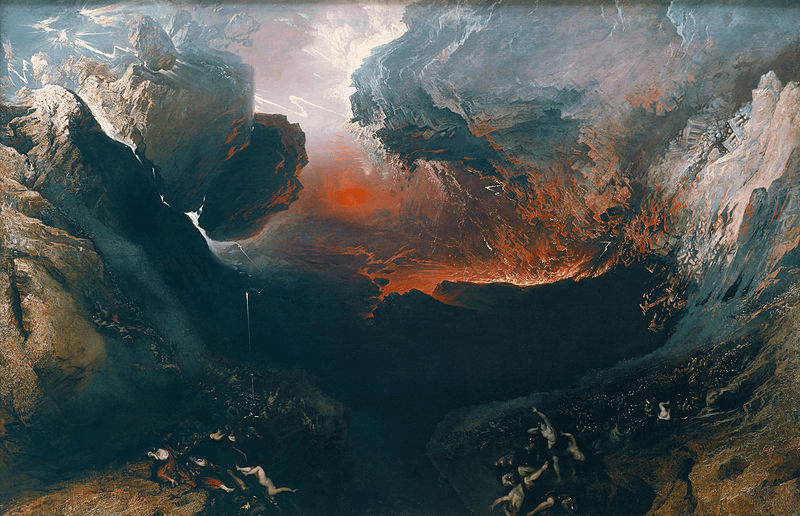
The Great Day of His Wrath, by John Martin, c.1851

“Surely the day is coming; it will burn like a furnace. All the arrogant and every evildoer will be stubble, and the day that is coming will set them on fire,” says the Lord Almighty. “Not a root or a branch will be left to them. But for you who revere my name, the sun of righteousness will rise with healing in its rays. And you will go out and frolic like well-fed calves. Then you will trample on the wicked; they will be ashes under the soles of your feet on the day when I act,” says the Lord Almighty.

“Remember the law of my servant Moses, the decrees and laws I gave him at Horeb for all Israel.

“See, I will send the prophet Elijah to you before that great and dreadful day of the Lord comes. He will turn the hearts of the parents to their children, and the hearts of the children to their parents; or else I will come and strike the land with total destruction.” (New International Version)

These are the final words of the Old Testament, the concluding message of the prophet Malachi.

Malachi’s vision of God’s future action describes a Day of Judgment, a time of utter destruction for all those who devoted themselves to wickedness. The faithful, however, will receive healing by means of bright righteousness. God will restore a good, right, and just order of things.

The divine restoration will cause joy and celebration. In their freedom, the faithful will ensure that the wicked shall not have power and authority ever again.

Therefore, the conclusion to the Book of Malachi – and of all the Old Testament – is a call to obedience, to observe the law. Finally, it is communicated that Elijah – one of the greatest prophets in Jewish history – will return in order to turn the hearts of family members toward one another. And without this change of heart and behavior within the family, there isn’t anything good to look forward to.

In other words, justice and righteousness, humility and gentleness, mercy and peace, all begin within the home. If we are to get things right out in the world, it will be because we have learned how to develop and maintain right relationships and provide for one another in our families.

So, how is that project going? (said in a sarcastic tongue-in-cheek sort of way).

And, how is the religious and spiritual progress going? (said in that same obnoxious sort of tone)

Furthermore, what are you and I doing to help the situation, and not to bring harm to it? (said in an actual serious tone)

It will not do for any of us to simply blame others – even though those others likely have a lot to answer for themselves. You and I cannot control others, especially family members (although some folks do their darndest to try and do it!).

Therefore, we must practice self-control, and do what is within our own power to do in order to help bring blessing – not judgment – to the earth.

All of us need to allow accountability into our lives, so that we may continue in living good and responsible lives.

Yet, that does not always happen. Graciously, the world is not presently spinning on its axis because of me or you. Our mistakes, foibles, screw-ups, and sins are not good, but they are also not going to stop the sun from coming up tomorrow.

It is terribly sad that there is so much war, death, destruction, harm, malevolence, disease, and disaster in this old world. It’s as if the earth is under a curse, which it is. But the world is also loved by God.

The faithful ultimately trust in the grace and mercy of God. The Christian, specifically, looks to Jesus to provide the righteousness and justice that we ourselves have not been able to accomplish.

The judgment of God exists, so that the justice and mercy of God can be fulfilled.

He himself bore our sins in his body on the cross, so that we might die to sins and live for righteousness; by his wounds you have been healed.

1 Peter 2:24, NIV

In union with Christ, the faithful know what a change of heart truly means. And they know what to do in order to affect that change in their lives today:

For we know that our old self was crucified with him so that the body ruled by sin might be done away with, that we should no longer be slaves to sin—because anyone who has died has been set free from sin.

Now if we died with Christ, we believe that we will also live with him. For we know that since Christ was raised from the dead, he cannot die again; death no longer has mastery over him. The death he died, he died to sin once for all; but the life he lives, he lives to God.

In the same way, count yourselves dead to sin but alive to God in Christ Jesus. Therefore do not let sin reign in your mortal body so that you obey its evil desires. Do not offer any part of yourself to sin as an instrument of wickedness, but rather offer yourselves to God as those who have been brought from death to life; and offer every part of yourself to him as an instrument of righteousness. (Romans 6:6-13, NIV)

So then, let us restore right relationships with others, and especially with family. Let us live as people who have been lifted from a curse, and are free from divine judgment.

Let’s get up each day and live into the freedom we possess from the power of guilt, shame, and plain old-fashioned sin.

Let’s be people who choose to look both backward and forward:

  • We look back at the redemptive events of Jesus, to his coming to this earth in a miraculous incarnation, and to his death, resurrection, and ascension.
  • We look forward to the return of Christ, a second advent, when he will save his people, judge all people, and restore all things.

We can do this, my friends. We can live as we ought to live, love as we ought to love, and give as we ought to give – because of the One who has gone before us, is with us, and is coming again.

The Day is coming. Make sure that when it does, we are found faithful.

“For even the Son of Man did not come to be served, but to serve, and to give his life as a ransom for many.”

Mark 10:45, NIV

To him who loves us and has freed us from our sins by his blood, and has made us to be a kingdom and priests to serve his God and Father—to him be glory and power for ever and ever! Amen. (Revelation 1:5b-6, NIV)

The Righteous and the Wicked (Malachi 3:13-18)

“You have spoken arrogantly against me,” says the Lord.

“Yet you ask, ‘What have we said against you?’

“You have said, ‘It is futile to serve God. What do we gain by carrying out his requirements and going about like mourners before the Lord Almighty? But now we call the arrogant blessed. Certainly evildoers prosper, and even when they put God to the test, they get away with it.’”

Then those who feared the Lord talked with each other, and the Lord listened and heard. A scroll of remembrance was written in his presence concerning those who feared the Lord and honored his name.

“On the day when I act,” says the Lord Almighty, “they will be my treasured possession. I will spare them, just as a father has compassion and spares his son who serves him. And you will again see the distinction between the righteous and the wicked, between those who serve God and those who do not. (New International Version)

The righteous and the wicked. Depending upon what sort of faith tradition you grew up in as a child; or by what belief system you currently adhere to, this may likely determine your understanding of those two words.

The terms “righteous” and “wicked” vary amongst differing groups of people. But however you understand those words, I want us to notice how the prophet Malachi understands them.

To be “righteous” means to have a right relationship with both God and others. It is to be close enough to knowing God to carry out what is important to God.

Righteous folk actually listen and talk to one another. They consult and collaborate with each other. They enjoy good relations because the righteous understand that relationships are a high value. They discern that people are important.

And so, God’s justice is very important to the righteous, because God wants everyone’s basic needs met. The Lord desires people to be treated well, with respect and dignity, in order to make a living and enjoy life.

To be “wicked” means to be arrogant, proud, and boastful. It is to have a string of messed up relationships with both God and others because they insist on their own way.

The wicked are far from God, and do whatever they want to do, regardless of how it may affect others. They view justice and righteousness as dispensable, and unnecessary, unless it can be used as leverage for selfish desires. Even though the wicked might be rich and powerful in this life, they will not be spared from God’s judgment.

Wicked persons – those who carry out injustice and seek to care only for themselves – are called to repent, to change, to amend their evil ways. Their negative statements about God, and their mistreatment of others, has not gone unnoticed.

A typical tactic of wicked persons is to blame others. In Malachi’s day, they were blaming God, and ironically, accusing the Lord of injustice. That’s because the wicked person’s understanding of God is that the Lord exists for their personal benefit.

So, if the wicked person is not receiving some benefit from God, then God isn’t being God, and then is accused and blamed as being the problem to any sort of adverse situation.

But in reality, the righteous are God’s treasured possession, because they consistently serve the Lord, no matter the circumstances. The righteous are faithful, and so, they will be spared on the day of God’s judgment.

So far, I have made this all seem quite black and white. But that was only to make clear the contrast between righteousness and wickedness. The truth is that all of us are a bit of both. We are not always completely right, nor are we always wrong.

We are in the middle of things. Most folks have not rejected God through a lack of belief. Yet, they also have not fully accepted God’s intentions for this world and are not fully living into them.

The prophet Malachi calls such persons (which is perhaps all of us?) to a day when trying circumstances will make the distinction between the wicked and the righteous much more clear.

Then, we will be able to change, fully convinced and knowing the difference between right and wrong, truth and error, faith and fear.

Charlatans will eventually be found out and known. And the consistently faithful people will eventually be noticed and held up by God for others to see and know.

If everything presently appears murky, shadowy, and unclear, please know that it will not always be this way for you.

I am assuming that there very few “wicked” persons actually reading or listening to this. Simply because they see no value in doing so. It doesn’t get them anywhere they want to go.

The wicked may seem to know what they’re doing, but they don’t. Life for them is very nebulous and unclear. They’re only spit-balling through life, trying to look out for number one, that is, themselves.

But you who are reading or listening to this likely want nothing to do with wickedness. You want to stay away from evil.

You are looking to make a difference on this earth, and to improve your little corner of the world. You desire good things for yourself and others. You seek to live as justly and rightly as you can.

Good for you! The Lord is noticing your faith and patience.

So do not throw away your confidence; it will be richly rewarded.

You need to persevere so that when you have done the will of God, you will receive what he has promised. For,

“In just a little while,
    he who is coming will come
    and will not delay.”

And,

“But my righteous one will live by faith.
    And I take no pleasure
    in the one who shrinks back.”

But we do not belong to those who shrink back and are destroyed, but to those who have faith and are saved. (Hebrews 10:35-39, NIV)

Eternal God, in whose perfect kingdom no sword is drawn but the sword of righteousness, no strength known but the strength of love: So mightily spread abroad your Spirit, that all peoples may be gathered under the banner of the Prince of Peace, as children of one Father; to whom be dominion and glory, now and forever. Amen.

The Coming Judgment (Revelation 11:1-14)

Then I was given a measuring stick, and I was told, “Go and measure the Temple of God and the altar, and count the number of worshipers. But do not measure the outer courtyard, for it has been turned over to the nations. They will trample the holy city for 42 months. And I will give power to my two witnesses, and they will be clothed in burlap and will prophesy during those 1,260 days.”

These two prophets are the two olive trees and the two lampstands that stand before the Lord of all the earth. If anyone tries to harm them, fire flashes from their mouths and consumes their enemies. This is how anyone who tries to harm them must die. They have power to shut the sky so that no rain will fall for as long as they prophesy. And they have the power to turn the rivers and oceans into blood, and to strike the earth with every kind of plague as often as they wish.

When they complete their testimony, the beast that comes up out of the bottomless pit will declare war against them, and he will conquer them and kill them. And their bodies will lie in the main street of Jerusalem, the city that is figuratively called “Sodom” and “Egypt,” the city where their Lord was crucified. And for three and a half days, all peoples, tribes, languages, and nations will stare at their bodies. No one will be allowed to bury them. All the people who belong to this world will gloat over them and give presents to each other to celebrate the death of the two prophets who had tormented them.

But after three and a half days, God breathed life into them, and they stood up! Terror struck all who were staring at them. Then a loud voice from heaven called to the two prophets, “Come up here!” And they rose to heaven in a cloud as their enemies watched.

At the same time there was a terrible earthquake that destroyed a tenth of the city. Seven thousand people died in that earthquake, and everyone else was terrified and gave glory to the God of heaven.

The second terror is past, but look, the third terror is coming quickly. (New Living Translation)

There are many people who look upon Christians as oppressors and persecutors in history. And they aren’t wrong. From calls to war for the Crusades, to the Spanish Inquisition, and much more, a great deal of blood has been spilled in the name of Christianity.

The Book of Revelation, however, knows nothing of that history, simply because it pre-dates all of it. Many people forget, in it’s first few hundred years, that Christianity was a persecuted religion by all sorts of people.

Christians were often the scapegoats to many a leader’s problems. From throwing Christians to the lions in the Roman Coliseum, to burning them at the stake because of their faith, many a martyr has faced a bloody death.

The Apostle John’s Apocalypse, which is known to us as the Book of Revelation, was a vision given to John in order to encourage the persecuted Christian Church that God knows their suffering; and that Jesus will return to judge the living and the dead.

John’s vision had a message of judgment on those who were persecuting Christians for their faithful witness of Jesus. The believers in Jesus who were suffering at the hands of oppressors, cried out for vindication and retribution against their persecutors.

Today’s portion of Revelation is situated between the sixth and seventh trumpets of God’s judgment (which are the second and third woes upon the earth). This interlude has to do with two godly witnesses. And the whole world is able to see them.

The space which the two witnesses occupy is in the outer courtyard of the Temple. The two of them symbolize all the faithful people of God in the world. They are attacked and killed, having carried out their witness for 1,260 days (42 months).

This is a time, related to the Old Testament prophecy of Daniel, appointed for the godless to overcome the city. But this time of suffering and woe will not last.

The two witnesses are not named or identified. The point is that whomever they are, these two maintain their prophetic witness to the Lord consistently to their martyrdom.

Like their Lord before them, the two witnesses lay dead for three days. Their bodies visible for all to see. The godless inhabitants of earth gloat over them, and celebrate their demise.

But again, like Jesus, the two are raised from death and ascend to heaven. This evokes a mass of fear throughout the world. The fact that the event causes fear and terror, instead of repentance  and penitence, speaks to how warped the people of earth have become.

Indeed, the Book of Revelation is highly symbolized reading, and John’s vision is not easy to understand. Yet, there are a few things we can reflect upon in light of this passage; and some questions we can ask of ourselves:

  1. It is important to be faithful and persevere to the very end of our lives. How will we respond to this present darkness in the world?
  2. The way in which we live our lives is the legacy we leave for others when we are gone. What will we be remembered for?
  3. Our lives speak to others about who the God of heaven is. Therefore, it is profoundly important how we go about living our current mundane daily existence. How, then, shall you and I live?
  4. Our short lives have eternal ramifications, not only for ourselves, but for future generations. In what ways will you build into the next generation and help them persevere in faith?
  5. Everything you and I see today will change. There is a Judgment Day coming, just as sure as summer will transition to autumn and then into winter. What will you do today that prepares for the final season of the earth as we know it?

Although much of John’s apocalyptic vision deals with wickedness reaching a ripeness which releases the wrath of God’s judgment; it is also simultaneously the church’s entrance into her eternal inheritance. Systemic sin, structural evil, and devilish deeds shall be no more.

Even so, come Lord Jesus. May peace soon come to this world, and within our hearts. Amen.

Pillow Thoughts (Psalm 132:1-12)

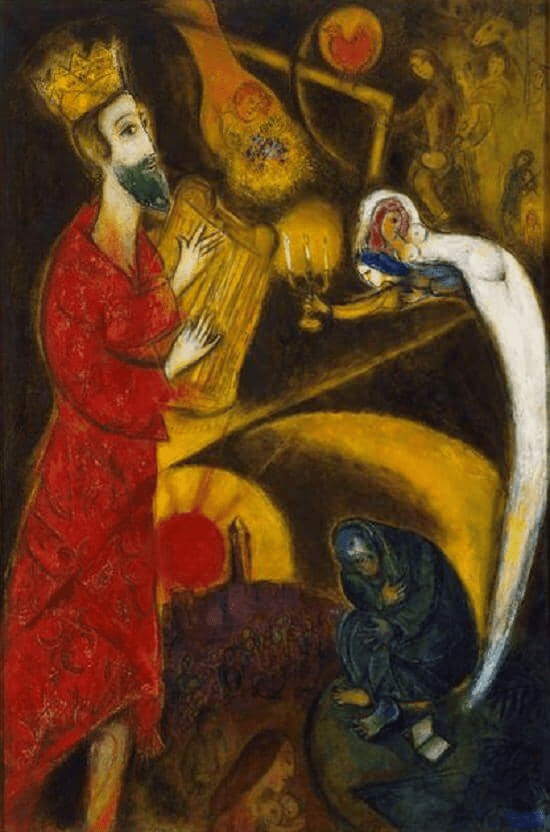
King David, by Marc Chagall, 1962

O Lord, remember in David’s favor
    all the hardships he endured;
how he swore to the Lord
    and vowed to the Mighty One of Jacob,
“I will not enter my house
    or get into my bed;
I will not give sleep to my eyes
    or slumber to my eyelids,
until I find a place for the Lord,
    a dwelling place for the Mighty One of Jacob.”

We heard of it in Ephrathah;
    we found it in the fields of Jaar.
“Let us go to his dwelling place;
    let us worship at his footstool.”

Rise up, O Lord, and go to your resting place,
    you and the ark of your might.
Let your priests be clothed with righteousness,
    and let your faithful shout for joy.
For your servant David’s sake
    do not turn away the face of your anointed one.

The Lord swore to David a sure oath
    from which he will not turn back:
“One of the sons of your body
    I will set on your throne.
If your sons keep my covenant
    and my decrees that I shall teach them,
their sons also, forevermore,
    shall sit on your throne.” (New Revised Standard Version)

King David took great pains in providing for the house of the Lord; and was very concerned about the worship of Yahweh. He went well out of his way to ensure that a temple would be built for his God.

David made as many preparations as he possibly could before his death, so that his son Solomon could follow through and build the temple. The editor of the Book of Chronicles commented on this:

David gave orders to gather together the aliens who were residing in the land of Israel, and he set stonecutters to prepare dressed stones for building the house of God. David also provided great stores of iron for nails for the doors of the gates and for clamps, as well as bronze in quantities beyond weighing, and cedar logs without number—for the Sidonians and Tyrians brought great quantities of cedar to David. 

For David said, “My son Solomon is young and inexperienced, and the house that is to be built for the Lord must be exceedingly magnificent, famous and glorified throughout all lands; I will therefore make preparation for it.” So David provided materials in great quantity before his death. (1 Chronicles 22:2-5, NRSV)

The king did all of this because God came to David and let him know that he would not be the one to build the temple; that job would fall to his son Solomon. (2 Samuel 7:4-13)

David’s final instruction to Solomon and the people had to do with the construction of a house for the Lord his God:

“Now set your mind and heart to seek the Lord your God. Go and build the sanctuary of the Lord God so that the ark of the covenant of the Lord and the holy vessels of God may be brought into the house built for the name of the Lord.” (1 Chronicles 22:19, NRSV)

The worship of God, for David, was to be the central feature of the Jewish people. All Israel and Judah were to encourage one another in worship at God’s house, the Lord’s Temple, in Jerusalem.

The priests of God wore special clothing, and handled the holy implements and the Ark of the Covenant of God. Yet, they were to be also clothed with righteousness, making sure that their outward ceremonial rituals reflected an inner moral purity and holiness before God.

David was bound and determined to not only worship the Lord himself, but to see that the entire nation of Israel had the opportunity to worship together in a central place.

Maybe a question arises for you about why David was so driven to construct a house for God. What is it that motivated King David to spend so much of his planning and energy on making sure that a temple would be constructed for the Lord?

Now when the king was settled in his house and the Lord had given him rest from all his enemies around him, the king said to the prophet Nathan, “See now, I am living in a house of cedar, but the ark of God stays in a tent.” Nathan said to the king, “Go, do all that you have in mind, for the Lord is with you.” (2 Samuel 7:1-3, NRSV)

A lot of events had transpired for David to be in the position of king, with peace all around him. The Lord had been with David, and brought him through the sort of adversities most of us will never know.

Once King David was at the pinnacle of peace and success, his thought were not about how to hold onto power, or to get more of it. He would lay his head on his pillow at night and wonder how he could give back to God for being so faithful.

And considering all that God had accomplished for him and for Israel, it seemed a travesty that he was luxuriating in a fine house, while the Ark of the Covenant – the objective presence of God among the people – was sitting in an old tent. So, David became determined to change that situation, because he could.

I wonder if when you and I are at a place in our lives where we feel safe and secure, prosperous and happy, our thoughts and dreams turn toward how we might give back to God in a worshipful way which will honor the Lord, as well as bless all the people of God.

I am curious what sort of things occupy your mind at night while your head is on your pillow, when you are feeling good about how your life is going.

Many, if not most, people will think about themselves, and what to do with what they have gained and/or accomplished. But what about you?

How will you respond to God’s grace, goodness, deliverance, and protection in your own life? What sort of ideas arise in your mind? What is in your heart to do for God and God’s people?

What are your pillow thoughts at night?

Presence itself is a great gift. The presence of God is incredibly gracious, good, and miraculous. And human presence, with each individual stamped with the image and likeness of God upon them, is also a wonderful gift from the Creator. And very much needed.

David enjoyed the presence of God, and longed for all the people to experience that divine presence. Although the Lord needed no temple to live in, David had in mind to provide one.

I imagine that King David understood that each person is a luminous icon of presence, reflecting God’s image, and needing the presence of God and others in order to have a nation who worships God as commanded in the Mosaic law.

Through communal worship at a designated site in Jerusalem, the Israelites could enjoy the beauty of God’s presence together, as well as the encouragement of one another.

Wherever there is presence and the acknowledgement of God and each other, there is freedom to offer affection, understanding, and respect.

It seems to me that these were the sort of thoughts that ran through King David’s mind, which made him determined to build a house for the Lord his God.

So, what will you do with your thoughts and your life?

Almighty God of all hope, of our thoughts and dreams: In humility, we give you thanks for all of creation; and for everything you give us. We praise you for forgiving us of our guilt and shame, even before we ask. You raise us from our broken state and make us whole. You give us the peace we yearn for.

Blessed God, fill us, your people, with your divine Spirit. Be our light in the darkness. Envelop us with your presence. Orient our hearts toward your justice; and help us always praise you. Let us ever be mindful of your power and grace in the world. Let us live as one with you in grace and in truth. Amen.