Psalm 68:24-35 – A Mighty God Who Rides the Skies

O God, your march of triumph is seen by all,
    the procession of God, my king, into his sanctuary.
The singers are in front, the musicians are behind,
    in between are the young women beating the tambourines.
“Praise God in the meeting of his people;
    praise the Lord, all you descendants of Jacob!”
First comes Benjamin, the smallest tribe,
    then the leaders of Judah with their group,
    followed by the leaders of Zebulun and Naphtali.

Show your power, O God,
    the power you have used on our behalf
    from your Temple in Jerusalem,
    where kings bring gifts to you.
Rebuke Egypt, that wild animal in the reeds;
    rebuke the nations, that herd of bulls with their calves,
    until they all bow down and offer you their silver.
Scatter those people who love to make war!
Ambassadors will come from Egypt;
    the Ethiopians will raise their hands in prayer to God.

Sing to God, kingdoms of the world,
    sing praise to the Lord,
    to him who rides in the sky,
    the ancient sky.
Listen to him shout with a mighty roar.
Proclaim God’s power;
    his majesty is over Israel,
    his might is in the skies.
How awesome is God as he comes from his sanctuary—
    the God of Israel!
He gives strength and power to his people.

Praise God! (Good News Translation)

The biblical psalms are uniform in praising God for God’s inherent character and for how that character acts in the world.

Since God is an infinitely immense Being, our human language cannot begin to adequately contain or describe such divinity. Yet, words are what we have for trying to communicate the attributes of such an incredible and awesome God.

This is why the use of metaphors is significant. Whenever we can picture something we are familiar with, then imaginatively place God alongside it, it helps give us at least a rudimentary idea and feeling of who this God is, what this God is all about.

To gain a glimpse of God’s majesty and sovereignty over the universe, we are invited to see with our spiritual eyes, God riding the sky; to hear with our spiritual ears the thunderous shout which roars and reverberates throughout the cosmos.

We are also invited to respond to what we see and hear by using our power of words and speech to proclaim God’s power. And that power is well beyond our ability to describe. With all of the powerful forces in this world, they are but a mere puff of breath to the God who reigns supreme over all powers, both in heaven and on earth. God’s power is a thunderous beauty. God’s splendor and strength rise larger than thunderheads.

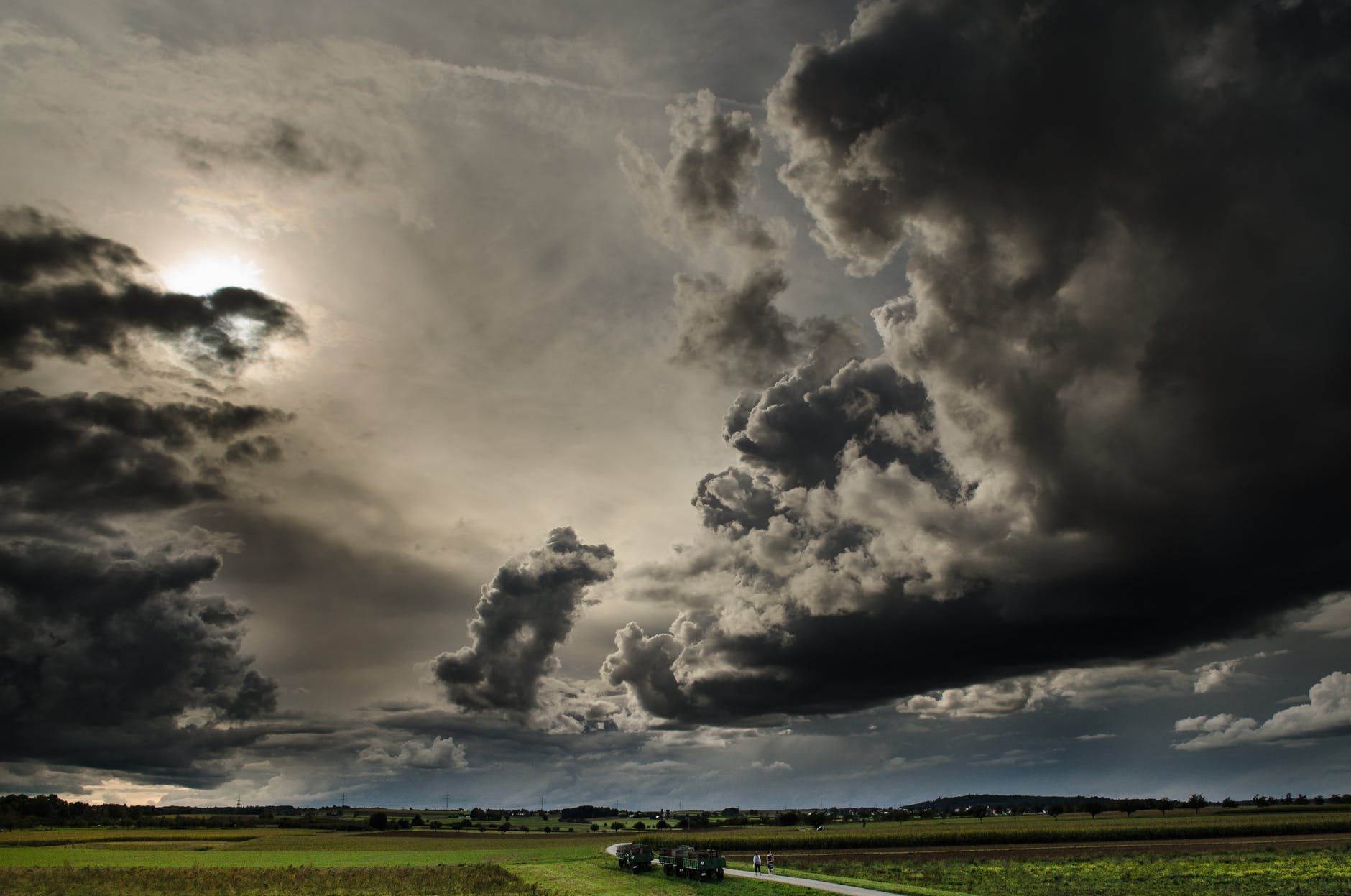
Having grown up in Midwest America, I’ve seen my share of large thunderheads (massive cumulus clouds which form just before a storm), thunderstorms replete with bright lightning and noise so awesome it shakes the farmhouse, and tornados with such force that they rip the roof off a barn as if it were a Lego building.

And God is bigger than that – stronger, louder, and brighter.

The appropriate response to such a God is to make music for the one who strides the ancient skies in a heavenly chariot yet stoops to listen and care about puny humans.

The reasonable response to such a God is to listen to the divine voice thundering in the world and submit to the sound which seems like it might split the heavens open.

To gain a mere glimpse of God’s strength and power will inevitably result in a response of giving up our all to the Lord of the universe, everything we have, and all that we are.

To know, even a tiny smidgeon, of such a God will bring our own loud shouts of proclaiming God’s goodness, grace, and generosity to anyone who will listen to us.

To glimpse what the psalmist sees will consume us with awe, as we intuitively connect with the glory which is constantly streaming from heaven.

God shares divine strength with people. God doesn’t have to do that. The Lord has no obligation to do so. Yet, it happens, despite our fickle praise and inconsistent devotion.

So, let’s give our highest praise to the God of the psalms. Let’s imbibe of God’s thunderous presence among us.

Then, we will likely be happier than a gopher in soft dirt; or a butcher’s dog; or a unicorn eating cake on a rainbow.

Eternal Trinity – blessed Father, Son, and Spirit – the awesome God whom I serve: The more I enter you, the more I discover, and the more I discover, the more I seek you. A massive thunderhead is but a small cloud next to you, the Godhead, the incredible Three-in-One.

Through you, almighty Lord, I shall come to know myself and my world. And that knowledge is a mighty love for humanity which spans longer and higher than the universe itself. May the love, unity, harmony, community, goodness, and power which is always present within yourself, mighty God, be present with me, your servant.

For just a molecule of You is enough to power me for eternity. Amen.

*Above photo by Moritz Bu00f6ing on Pexels.com

Colossians 4:2-18 – The Christian Life as Its Meant To Be Lived

Devote yourselves to prayer, being watchful and thankful. And pray for us, too, that God may open a door for our message, so that we may proclaim the mystery of Christ, for which I am in chains. Pray that I may proclaim it clearly, as I should. Be wise in the way you act toward outsiders; make the most of every opportunity. Let your conversation be always full of grace, seasoned with salt, so that you may know how to answer everyone.

Tychicus will tell you all the news about me. He is a dear brother, a faithful minister and fellow servant in the Lord. I am sending him to you for the express purpose that you may know about our circumstances and that he may encourage your hearts. He is coming with Onesimus, our faithful and dear brother, who is one of you. They will tell you everything that is happening here.

My fellow prisoner Aristarchus sends you his greetings, as does Mark, the cousin of Barnabas. (You have received instructions about him; if he comes to you, welcome him.) Jesus, who is called Justus, also sends greetings. These are the only Jews among my co-workers for the kingdom of God, and they have proved a comfort to me. Epaphras, who is one of you and a servant of Christ Jesus, sends greetings. He is always wrestling in prayer for you, that you may stand firm in all the will of God, mature and fully assured. I vouch for him that he is working hard for you and for those at Laodicea and Hierapolis. Our dear friend Luke, the doctor, and Demas send greetings. Give my greetings to the brothers and sisters at Laodicea, and to Nympha and the church in her house.

After this letter has been read to you, see that it is also read in the church of the Laodiceans and that you in turn read the letter from Laodicea.

Tell Archippus: “See to it that you complete the ministry you have received in the Lord.”

I, Paul, write this greeting in my own hand. Remember my chains. Grace be with you. (New International Version)

Every church has its problems. Much like individual believers, each faith community has its own character and personality – which makes their particular issues unique to them.

The Apostle Paul wrote his letter to the church in the ancient city of Colossae to address an issue which was weighing on his heart.

Broadly speaking, the problem of the church was legalism. That is, boiling down and condensing the Christian life into spiritual rules to live by. Although, on the surface, that may not sound so terrible, for Paul it was damaging to Christianity.

Whenever anyone or any group of people systematize Christianity into a list, it is a fool’s errand. Let’s face it: the worship of God, and thus the Christian life, is, for the most part, ethereal and mysterious. Throughout church history there have been legions of folks who have attempted to nail down Christianity into laws we can clearly see and hold people accountable to.

Whether it is making human contrived lists of sins to avoid and codifying them as something like the Terrible Ten or the Nasty Nine; or whether it is trying to humanly comprehend salvation in a tidy Five Spiritual Laws or Basic Principles for Life – all this predilection for list-making does nothing but discourage the Christian heart and divide one another about things that just don’t matter.

Paul wanted all his churches to be encouraged and united in the love of God in Christ through the enablement of the Holy Spirit. This requires prayer – lots of it! Because we must live by faith, trusting God for each step to take in the Christian life, rather than relying on the list to tell me what to do.

So, that’s why Paul ended his letter to the church on a note exhorting the people to never give up praying.

“Prayer enlarges the heart until it is capable of Containing God’s gift of himself.”

Mother Teresa (1910-1997)

Devoting ourselves to prayer means that we will need to quit devoting ourselves to something else – namely, the nice, neat, packaged formula of do’s and don’ts on the list. Paul didn’t just want the people to adopt a different list; he wanted all the lists tossed into hell!

Instead of always trying to control outcomes, Paul wanted perseverance in prayer without knowing what the result and outcome would be. His deep desire was that believers would rely on God and the mystery of Christ. He longed for the church to pray with all their doubts and uncertainties – not believing they always needed sure answers for everything.

The Christian life cannot be made into some geeky algorithm so that we can avoid suffering, know all the right things to say in a conversation, and always keep God happy. God is not some algebra equation to figure out. He is not a gumball machine to put a quarter in and get what you want. He is not Santa God. 

Christianity requires living in the tension of not knowing everything and yet having cogent answers for others who inquire about our faith.  It is a dynamic relationship in which we must continually interact in prayer to God as we largely improvise our lives, spontaneously applying what understanding we have for each situation we face.

“The whole reason why we pray is to be united into the vision and contemplation of God to whom we pray.”

Julian of Norwich (1342-c.1416)

Christians need an ongoing dialogue with the God who answers in his own good time, according to his own good will. We are to make good use of the time God has given through choosing our words with others wisely as we simultaneously carry on a silent prayer conversation with God. This is a Christianity that’s far above rules and laws and checklists. It is Christianity as it’s meant to be lived, depending on Jesus, and relaxed in the Spirit.

This takes practice, practice, practice. Failure is both inevitable and expected. And that’s okay. We’re not living by lists and human contrived rules. We’re living a new life in the power of Christ’s resurrection.

God of Mystery, the One who conceals and reveals, forgive me for my attempts at reducing faith to a few spiritual rules to keep. Help me to speak in ways which are gracious, loving, and redemptive. May the person and work of Jesus come tumbling out of my mouth while I inhale the breath of your Holy Spirit. Amen.

*Above paintings of prayer by African artist Angu Walters

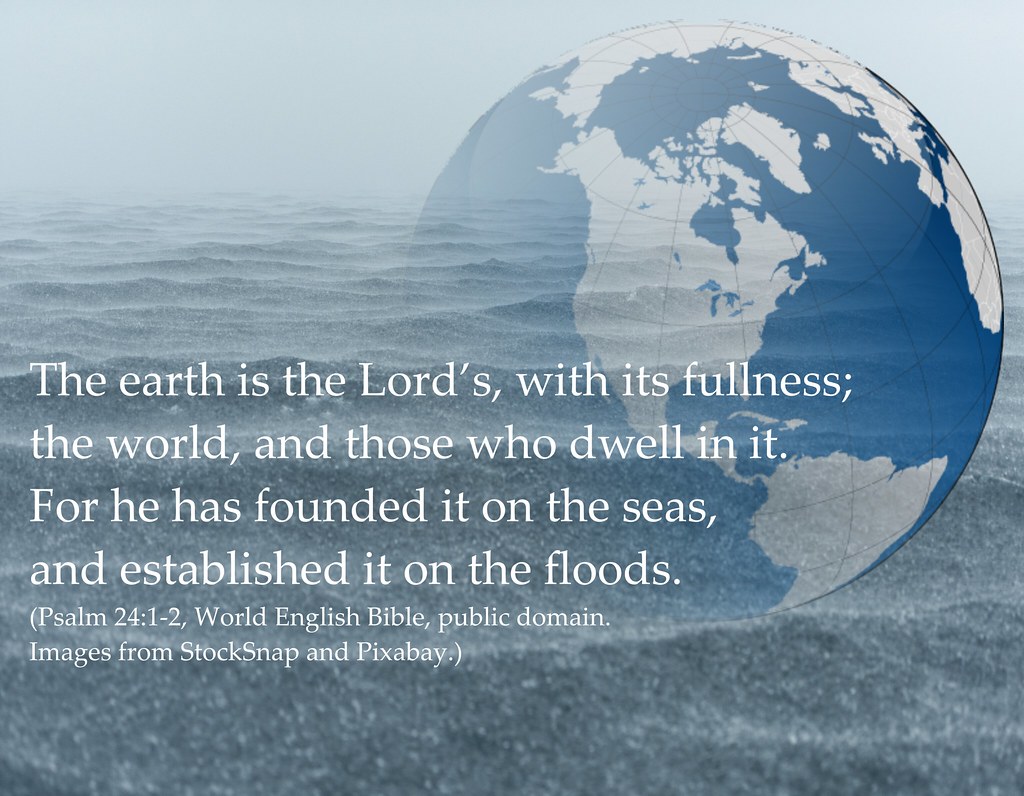
Psalm 24 – It All Belongs to God

The earth and everything on it
    belong to the Lord.
    The world and its people
    belong to him.
The Lord placed it all
    on the oceans and rivers.

Who may climb the Lord’s hill
    or stand in his holy temple?
Only those who do right
    for the right reasons,
    and don’t worship idols
    or tell lies under oath.
The Lord God, who saves them,
    will bless and reward them,
    because they worship and serve
    the God of Jacob.
Open the ancient gates,
    so that the glorious king
    may come in.

Who is this glorious king?
    He is our Lord, a strong
    and mighty warrior.

Open the ancient gates,
    so that the glorious king
    may come in.

Who is this glorious king?
    He is our Lord,
    the All-Powerful!
(Contemporary English Version)

Abraham Kuyper (1837-1920) was born in the Netherlands. He was a church minister, university professor, and politician – having established a Christian university, as well as served in the Dutch parliament and as Prime Minister of the Netherlands.

Kuyper labored throughout his life to flesh-out the theological implications of a sovereign God. He consistently insisted all we do as humans is to be integrated and brought under the lordship of Jesus Christ. He believed firmly that all things belong to God in Christ and all the fragments of our lives are to be oriented and integrated around our Creator’s great claim upon us as creatures. Whether a pastor, teacher, or politician, every vocation, each activity, and all thoughts and intents rightly belong to God.

In other words, religion and spirituality cannot be kept within superimposed limits. There is no separation of any one domain of human thought from the rest, no isolation of any one domain of human life from another or from Christ.

The spiritual life is not limited to merely the ethereal. It is both celestial and terrestrial – heavenly and earthly – concerned for the immaterial and the material. God cares about it all because it all belongs to God.

God owns the world. So, the implications of this for us is huge. It means we don’t really own anything. We are simply stewarding all that God has given us – including our very lives. The chaos of this world, from a biblical perspective, comes from creatures attempting to assert their own sovereignty and control things. Since we were not created to be little gods roaming about doing our own thing, the inevitable result is a topsy-turvy world.

God’s divine claim and ownership of the world means that absolute authority does not rest with nations, states, or leaders. Everything we see, as well as what we don’t see, belongs to the Lord. Part of the task of believers is to confess and bear witness to God’s rightful and benevolent rule in this world. In fact, Christians everywhere pray toward this end every week: Your kingdom come, your will be done, on earth, as it is in heaven.

The circle of life, within Holy Scripture, is the Creator God bestowing life and relationship to created humans, who then respond by practicing just and righteous living – thereby receiving renewal from the Lord and life anew. Theoretically, this movement can go unbroken. It is a regular celebration, for the believer, in consistent rhythms of worship and adoration of God.

When we are able to get in the intended divine groove of faith, life, and worship, we will discover our meaning and purpose in the world. By rightly ordering our lives, centering and grounding them in the gracious and loving relationship of Creator and creature, then we find true blessing because it enjoys an intuited stamp of approval by the God who makes life possible.

In the Christian tradition, Jesus is the Victor, the King of Glory. All the promises and hopes of people are found and focused, in Christ. We enter through Jesus, the door of life, to deliverance from death and all that separates us from God, others, and self.

Jesus comes to bring blessing, justice, righteousness, mercy, purity, and peace. For this is how the world was meant to operate from the beginning. We are to open the ancient door of faith, especially when the Lord comes knocking:

Listen! I am standing and knocking at your door. If you hear my voice and open the door, I will come in and we will eat together. Everyone who wins the victory will sit with me on my throne, just as I won the victory and sat with my Father on his throne. If you have ears, listen to what the Spirit says to the churches. (Revelation 3:20-22, CEV)

Old Abraham Kuyper might be long dead, yet he got it right, if we are able to hear him:

“Whatever people may do, to whatever they may apply their hands – in agriculture, in commerce, and in industry, or in mind, in the world of art, and science – they are, in whatsoever it may be, constantly standing before the face of God. They are employed in the service of God. They have strictly to obey God. And above all, they must aim at the glory of his God.”

Abraham Kuyper

Blessed Lord, Creator of heaven and earth, though I am quite capable of fretting, complaining, and lamenting about how out of control things seem, the truth is that nothing is outside your grip. I may not always see your hand, discern your heart, or like your ways, but you are God and there is no other. So, continue to renew my thinking, gentle my heart, and deepen my worship. I humbly and gladly affirm that you are God, and I am not, through Jesus Christ, my Lord, who with you and the Holy Spirit reign sovereign as one God, now and forever. Amen.

James 5:7-12 – Hang in There!

Be patient, then, brothers and sisters, until the Lord’s coming. See how the farmer waits for the land to yield its valuable crop, patiently waiting for the autumn and spring rains. You too, be patient and stand firm, because the Lord’s coming is near. Don’t grumble against one another, brothers and sisters, or you will be judged. The Judge is standing at the door!

Brothers and sisters, as an example of patience in the face of suffering, take the prophets who spoke in the name of the Lord. As you know, we count as blessed those who have persevered. You have heard of Job’s perseverance and have seen what the Lord finally brought about. The Lord is full of compassion and mercy.

Above all, my brothers and sisters, do not swear—not by heaven or by earth or by anything else. All you need to say is a simple “Yes” or “No.” Otherwise you will be condemned. (New International Version)

In 1952, a woman named Florence Chadwick attempted to become the first female to swim the twenty-one miles from Catalina Island to the California coast. Less than a half-mile from her destination she gave up. It wasn’t because of fatigue, but because of the thick fog. Florence simply could not see how close she was to her goal. Two months later she did it, also in the fog, but had learned her lesson and persevered even though she couldn’t see the coast in front of her.

Everyone who has faced adversity knows how hard it is to keep going without seeing the goal. It is important to be patient and to persevere knowing that the Lord’s coming is near. Like the farmer, we must expectantly wait till the harvest. There is nothing we can do to speed up the process and go straight from planting to harvest. It takes time and plenty of patience. Grumbling and complaining about how long it is taking will not make it go any faster.

Although the Christian’s salvation is free, the process of sanctification takes a great deal of blood, sweat, and tears. Perseverance in the face of hardship is a major pathway to realizing a holy life. To do that, the Apostle James encourages us to consider the ancient prophets and the Old Testament character Job:

  • The prophet Jeremiah was faithful to proclaim God’s message yet was thrown into a cistern and left for dead. (Jeremiah 38:1-28)
  • The prophet Micaiah was faithful to declare truth to King Zedekiah, who then promptly imprisoned him, even though the king asked for God’s message. (1 Kings 22:24-27)
  • The prophet Daniel was faithful to pray consistently to the one true God and was thrown into the lion’s den to be killed. (Daniel 6:1-28)

The prophets all suffered for doing the right thing and did not waver in their commitment to the Lord. Through their troubles they learned to trust and draw near to God. The adversity strengthened, not weakened, their faith.

As for Job, he had it all, along with constant faithfulness. And he lost it all… except his faith. Job tenaciously held onto righteousness, despite his grinding physical, mental, emotional, and spiritual pain. Although Job’s God was agonizingly silent for a long time, and Job’s friends were despairingly talkative for much too long, the flame of Job’s faith was never extinguished in his heart.

We are to keep going in our faith and not give up. There are forces and processes at work behind the scenes of our lives that we might never know, this side of heaven. Yet, God is moving a good and divine agenda to its climax.

The soul would have no rainbow if the eyes had no tears. We live in a time when we will either sink or swim – there is no in-between. God’s celestial shore is within sight; don’t miss it by getting discouraged by all the fog. Hang in there, my friend.

Patient God, you endure through all of my ignorance and impatience and just keep growing me by your grace. Thank you for working me as a farmer works the soil. May there be a great harvest of righteousness in my life as I allow your faithful work to be done in me. Amen.